
On this page
Start here
Quick answer
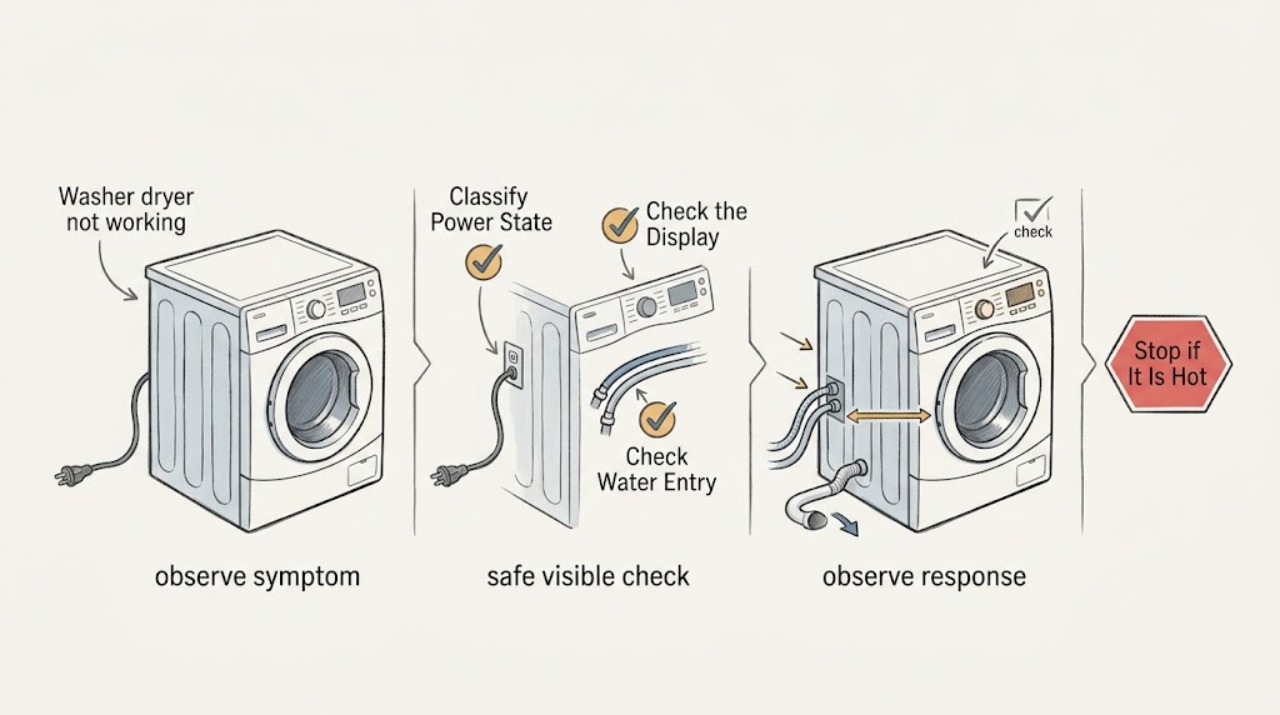
“Not working” can mean that a Beko washer dryer has no display, will not start, stops after starting, will not take in water, will not drain or spin, or will not dry. Start by identifying which stage fails: observe the display and power connection, confirm the door is fully closed, check that the water tap is on and the inlet hose is not crushed, and note whether water remains in the drum or an error is shown. Use only a normal wall socket, not an extension socket, and do not open the appliance, bypass the door lock, or repeatedly reset a fuse or breaker. If safe external checks do not restore operation, or there is a burning smell, water leak, damaged cord, repeated trip, or a locked drum with water inside, stop using it and arrange qualified Beko or appliance service.
Work through in order
Diagnostic checks
Use only checks that match the exact appliance or system and its official guide.
-
Check 1
Observe the Beko washer dryer without opening it: check whether the display or indicator lights come on, whether the mains supply is on, and whether the plug and cord look intact. Do not use an extension socket.
Expected result: The display is dead, the display works but the programme will not begin, or the power connection is damaged, loose, or uncertain.
Next step: If the socket is safely accessible, test it only with a known-working low-risk device as Beko describes. If the appliance still stays dead, or the cord or socket is damaged, stop and arrange qualified service.
Stop if: Stop for heat, burning odor, smoke, sparking, a damaged cord, water near the socket, or a repeated fuse or breaker trip.
Why this matters
Why: A dead display keeps the wall supply, plug fuse or protective device, cord, and appliance power section in scope. A live display points toward programme, door, water, drain, or control behavior rather than a total loss of supply.
-
Check 2
With the drum stopped, close the loading door normally and check that no garment is caught in the seal. Confirm a programme is selected, the machine is not paused, and the Start or Pause control is pressed once; do not force the door or bypass its lock.
Expected result: The door closes and locks, the door will not latch, the display shows a lock or child-lock state, or the programme still does not start.
Next step: Record the indicator and programme behavior and consult the exact Beko manual for control-specific lock or reset steps. If the door, latch, or control remains faulty, arrange service rather than forcing it.
Stop if: Stop if the door is stuck with water inside, the latch or glass is damaged, or the machine moves, leaks, or makes an abnormal electrical sound.
Why this matters
Why: A door that cannot close or lock can prevent a cycle from starting. A child lock, pause state, or unselected programme can look like a failure, while a correctly closed door with no start keeps the lock, control, or another interlock in scope.
-
Check 3
From behind the appliance only if it is safely accessible, observe whether the water tap is on and whether the inlet hose is kinked or crushed. Do not pull the machine forward or disconnect a pressurized hose.
Expected result: The tap is off, the inlet hose is bent or crushed, water enters normally, or no water enters after a programme starts.
Next step: Restore only an obviously closed tap or an accessible hose position without disturbing connections, then retry once. If water still does not enter, stop the cycle and arrange an engineer.
Stop if: Stop for a leaking connection, damaged hose, inaccessible rear area, water near electrics, or any need to remove an inlet filter or hose.
Why this matters
Why: Beko identifies a closed tap or restricted inlet hose as a cause of no water intake. Normal water entry shifts attention to the door, programme, drain, load, or an internal valve or control that needs service.
-
Check 4
Observe whether water remains in the drum after the failed cycle and whether the visible drain hose is kinked, crushed, or displaced. Do not open the pump filter or drain a hot, full drum without the exact model procedure.
Expected result: The drum is empty, water remains, the hose is restricted, or the hose appears normal but draining does not occur.
Next step: Stop using the machine if water remains and follow the exact model manual or request service. Do not force the door or loosen the filter while water may be hot or under pressure.
Stop if: Stop for hot water, a leak, a locked door, a loose hose, an unstable machine, or any need to reach under the appliance.
Why this matters
Why: Beko manuals associate retained water with a drain hose or pump-filter issue, and a machine may refuse to spin when water has not drained completely. A normal visible hose does not clear the internal pump or control.
-
Check 5
If the drum is empty of water and the door is safely open, note whether the load was unusually heavy, very small, or uneven and whether the drum moves normally only by the ordinary user control. Do not reach into a moving drum or dismantle the drive system.
Expected result: The load is heavily unbalanced, very small, overloaded, the drum does not spin during a selected cycle, or the drum behavior is abnormal.
Next step: For a plainly uneven load, stop the programme and redistribute it only when the drum is stopped and safe, then try one suitable cycle. If the symptom persists, leave the appliance unused and arrange service.
Stop if: Stop for grinding, scraping, burning odor, water in the drum, a seized drum, movement of the appliance, or any need to remove panels.
Why this matters
Why: Beko says an uneven load can prevent full spin and that a blocked filter or incomplete drain can also stop spinning. Abnormal drum resistance, grinding, or failure with a reasonable load needs professional diagnosis rather than a guessed belt or motor replacement.
-
Check 6
If washing works but drying does not, record the selected drying function, load size, filter or condenser warning, and whether the drum completed the wash and spin. Safely photograph the model and serial plate at the door edge if visible; do not remove a panel.
Expected result: Only drying fails, the drying load is large, a filter warning is present, the machine does not complete the wash or spin, or the model information is unavailable.
Next step: Follow the exact manual for the visible filter or programme check. If drying remains faulty, or if the machine also fails to wash, arrange Beko or qualified appliance service with the model details.
Stop if: Stop for overheating, burning odor, smoke, a blocked or damaged filter area, water leak, or any need to open the cabinet.
Why this matters
Why: Drying uses a different programme and capacity from washing, while poor spin or restricted airflow can leave clothes wet. The exact Beko model is needed before selecting a filter, sensor, heater, control, or other part; symptoms alone do not establish a failed component.
Use your observations
Decision map
Find the observation that best matches what you see, then follow the next safe action.
-
PATH 01Next step
What you see
The display is dead with a damaged cord or socket, there is smoke, burning odor, sparking, water near electrics, or a protective device trips repeatedly.
Do this next
Unplug or isolate only if it is safe without touching a hazard, keep the appliance unused, and arrange qualified appliance or electrical service.
-
PATH 02Next step
What you see
The display is dead but the wall supply and visible plug connection are normal.
Do this next
Do not open the washer dryer. Arrange service for the appliance power section, control, or internal wiring after recording the supply check.
-
PATH 03Next step
What you see
The display works but a programme will not start or the door will not lock.
Do this next
Check the door closure, programme selection, pause state, and visible lock or child-lock indication once. If it still will not start, request service.
-
PATH 04Next step
What you see
The programme begins but no water enters, and the tap is off or the inlet hose is visibly kinked.
Do this next
Correct only the obvious tap or hose position if safe and retry once. If water still does not enter, stop and arrange an engineer.
-
PATH 05Next step
What you see
Water remains in the drum, the drain hose is restricted, or the washer dryer will not spin.
Do this next
Keep the machine stopped, do not force the door or open a full filter, and follow the exact manual or request qualified service.
-
PATH 06Next step
What you see
Washing and spinning complete but drying does not, or clothes remain wet after drying.
Do this next
Check the selected drying function, load guidance, and visible filter or condenser indication using the exact model manual. Arrange service if the issue persists.
Helpful context
Understand the symptom
Classify what “not working” means
A dead display is a power or control-supply symptom. A lit display with no programme start keeps the door, programme selection, start control, child lock, or a protective state in scope. A cycle that fills but does not drain or spin points toward the drain path, filter, hose, load balance, or a related control decision. Drying-only trouble can have a different programme, load, or filter cause. Do not treat every symptom as a failed motor or control board.
Keep checks external
Do not remove covers, reach into a moving drum, defeat the door lock, work on live wiring, or pull a full machine forward. Do not open a pump filter while the drum may contain hot water or without following the exact manual procedure. Unplug before any movement that the model manual explicitly permits, and stop for smoke, burning smell, a damaged cord, water near electrics, repeated protective-device trips, or an unstable appliance.
What to record for service
Record whether the display is completely dead, the selected programme, door-lock behavior, water entering, remaining water, drum movement, drying behavior, any displayed code, and when the failure occurs. Note recent moves, installation, overloads, supply interruptions, or hose changes. Photograph the rating plate only if it is safely visible; Beko identifies the washer dryer model and serial information on the rating plate at the door edge for many models.
Safety boundary
Stop conditions
- Stop for smoke, burning odor, sparking, damaged cord, water near electrics, repeated fuse or breaker trips, overheating, unstable movement, or a leak that is spreading.
- Do not open the cabinet, defeat the door lock, work on live wiring, pull a full machine forward, force the door, or open a pump filter with hot or retained water unless the exact model procedure and safe isolation are established.
- Internal power, control, motor, door-lock, pump, valve, heater, sensor, and wiring repairs belong to qualified appliance service. Do not select a replacement part from “not working” alone.
Only after diagnosis
Potential parts
- door lock or door-latch assembly
Consider only if diagnosis confirms that the door is correctly aligned but the lock or latch fails to secure the programme.
Match the exact Beko model and door-lock design; do not bypass the interlock or infer fit from the symptom. - drain pump or pump filter component
Consider only after diagnosis confirms a drain fault and the hose, safe filter condition, and control behavior have been assessed.
Confirm the exact model, pump specification, filter housing, seals, and safe water-isolation procedure before replacement. - water inlet valve or inlet hose
Consider only if water supply is available, the hose is sound, and testing confirms an internal inlet component fault.
Match the exact model, connection arrangement, hose routing, and valve specification; a kinked hose does not prove the valve failed. - drying filter, sensor, or heater component
Consider only when washing and spinning complete and model-specific diagnosis confirms a drying-system component fault.
Confirm the exact model, drying system, safety controls, and component fit through the manual or qualified service.
When checks do not resolve it
Need a professional?
Use Beko or qualified appliance service when safe checks do not restore operation, the appliance will not power on, the door will not lock, water remains, the machine will not spin or dry, or a fault repeats. Seek urgent help for smoke, burning odor, sparking, overheating, a damaged cord, or water near electrics.
Common questions
FAQ
Why is my Beko washer dryer completely dead?
Check that the mains supply is on and the visible plug and cord are intact. Beko recommends checking the wall socket safely and not using an extension socket. If the appliance remains dead, arrange service rather than opening it.
Why does the Beko washer dryer turn on but not start?
Check that a programme is selected, the machine is not paused, and the door closes and locks without clothing caught in the seal. A lock, control, or other interlock fault needs service if the cycle still will not begin.
What should I check when no water enters?
Observe that the water tap is on and the inlet hose at the back is not twisted or crushed. If those are normal and the machine still does not fill, stop the cycle and arrange an engineer.
Why will my Beko washer dryer not spin?
An uneven load, blocked filter, or incomplete draining can prevent spinning. Check only the safe visible pattern and remaining water, follow the exact model manual, and do not open a full filter or remove panels as a first step.
Can I repair a Beko washer dryer myself?
Keep the first checks external. Do not open the cabinet, bypass the door lock, work on live wiring, or choose a motor, pump, heater, or control part from the symptom alone. Use qualified appliance service when the basic checks do not resolve it.
Read the exact guide
Official sources
- Washer-DryerBeko UK · Beko washer-dryer manual troubleshooting examples for door closure, supply problems, water intake, drain hose, pump filter, spinning, programme start, and drying.
- My Beko washer dryer is not taking in any water.Beko UK · Beko washer dryer no-water-intake guidance to check the rear inlet hose for twisting or crushing and confirm the water supply is on.
- My Beko washer dryer is not spinning.Beko UK · Beko washer dryer spin guidance about uneven loads, blocked filters, and the relationship between draining and spinning.
- My Beko washer dryer is not powering on, what should I do?Beko UK · Beko washer dryer no-power guidance, including checking mains supply and tripped or blown fuses before requesting support.
- How to check an electrical power fault on your washing machineBeko UK · Beko power-fault guidance to use a mains wall socket rather than an extension socket, safely test the socket, and seek service if power does not return.
- Washer Dryer RepairsBeko UK · Beko washer dryer repair support and model or serial plate identification guidance for service.
Community feedback
Share a repair observation
Share a plain-text repair observation. Accepted observations are published automatically; this page may take a moment to update.