
On this page
Start here
Quick answer
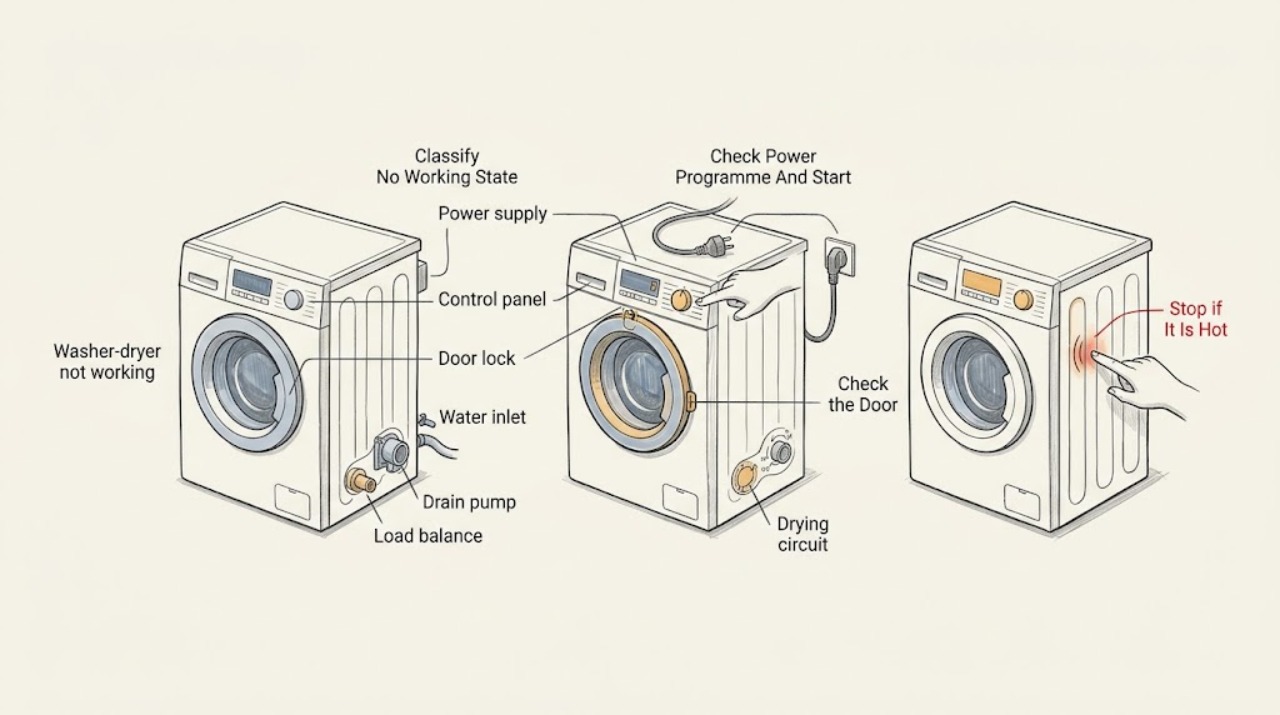
First identify whether the Bosch washer-dryer is completely dead, waiting at the door or water stage, stopped with water inside, or failing only during drying. Check the plug and household supply from a safe, dry position, make sure the programme is selected and the door is closed, and read any display symbol or code. Check that the water tap is open and visible hoses are not kinked, and inspect only the accessible drain path if water remains. An unbalanced load can abort or repeat spin attempts, while drying can require a smaller load and water supply for condensation. Follow the exact model manual for one external restart or reset. Stop using the appliance for a leak, water near electrical parts, smoke, burning smell, sparking, a damaged cord, repeated power trips, a door that will not release safely, or a code that returns; do not remove panels or attempt electrical, lock, pump, or heater repairs.
Work through in order
Diagnostic checks
Use only checks that match the exact appliance or system and its official guide.
-
Check 1
From a dry, safe position, record whether the Bosch washer-dryer has no display, displays a selected programme but does not start, stops during washing, stops before spin, leaves water, or fails only during drying; copy every visible symbol or code.
Expected result: The appliance is completely blank, waiting at start, locked with water or heat, showing a no-water or drain indication, repeating spin attempts, or reporting a drying condition.
Next step: Follow the matching power, door, water, drain, balance, drying, or error branch below and do not repeatedly press Start.
Stop if: Stop immediately for smoke, burning or electrical smell, sparking, a damaged cord, water near electrical parts, a leaking cabinet, or repeated breaker trips.
Why this matters
Why: Different phases point to different checks: supply and controls for a blank display, door or water for start, drain or balance for a wet load, and water, load, or temperature for drying. A code is evidence to preserve, not a diagnosis to invent.
-
Check 2
If the display is blank or the programme does not start, verify from a dry position that the plug is fully inserted, the household supply or dedicated breaker has not tripped, a programme is selected, and the door is closed; do not open an electrical panel.
Expected result: The display returns and the programme starts, the household supply is absent, the washer-dryer remains blank with a working supply, or the display shows a start, door, or childproof indication.
Next step: Correct only a clearly disconnected plug or selected-programme issue; arrange qualified electrical or Bosch appliance service for a dead supply, damaged cord, recurring trip, or persistent blank display.
Stop if: Do not use an extension workaround, touch wet electrical connections, replace internal fuses, or reset a breaker repeatedly.
Why this matters
Why: A supply problem is outside the appliance. A working supply with a blank appliance or a recurring start failure points to an appliance control or connection issue. A door or childproof indication directs the next check to the latch and model controls.
-
Check 3
If the programme is selected but the machine will not run or the door remains locked, make sure no clothing is trapped in the seal, close the door firmly, and check the exact model manual for any childproof-lock or Start/Reload control state.
Expected result: The door latches and the programme starts, a childproof or lock indicator remains, the door will not latch, or the door stays locked after the cycle and drain are complete.
Next step: Use only the model-specific external unlock or childproof-control instruction once; arrange service if the latch or lock remains abnormal.
Stop if: Do not force the door, use a tool on the latch, open it while water is visible, reach into a moving drum, or remove the lock cover.
Why this matters
Why: Bosch manuals require the door to be closed for operation and identify a locked door as a safety response when water level, temperature, or drum movement is unsafe. A failed latch or persistent lock is not permission to bypass it.
-
Check 4
If the display indicates no water, low water pressure, or the programme never progresses past filling, confirm the accessible water tap is open and inspect the visible supply hose for a kink or crushing; do not remove a pressurized hose.
Expected result: The tap is closed, the hose is visibly kinked, water begins flowing after a safe correction, or the warning returns with an apparently open tap and clear hose.
Next step: Open a clearly closed tap or restore a safe visible hose path, make one normal start attempt, and arrange service for a leak, recurring warning, or no-fill condition.
Stop if: Do not disconnect a pressurized supply hose, reach into internal filters, run with a leak, or continue if water reaches the power connection.
Why this matters
Why: Bosch identifies tap, inlet-filter, hose, and water-pressure conditions as causes of delayed or failed water entry. A persistent warning can involve an inlet valve, filter, sensor, or control that requires model-specific service.
-
Check 5
If water remains, the final spin is not reached, or the display indicates a drain problem, switch the programme off and disconnect power only when the area is dry and safe; inspect the visible drain hose and siphon connection for a kink or blockage without opening a wet service area.
Expected result: The hose has an accessible obstruction, water drains after a safe correction, E:18 or a similar drain indication remains, or water is still present with a clear external hose.
Next step: Correct only a clearly visible hose issue and follow the exact model's drain instruction once; arrange service if water remains or the drain indication returns.
Stop if: Do not open the door with water visible, drain hot water by hand, remove the pump cover without the model's safe procedure, tip the appliance, or run it with a leak.
Why this matters
Why: Bosch identifies a blocked drain pump or drainage hose as a cause of retained water and incomplete operation. If the external path is clear but water remains, an internal pump, filter, sensor, or control fault is possible.
-
Check 6
If the washer-dryer repeatedly tumbles, retries spin, or finishes with very wet clothes, stop normally and wait until the drum is stationary; then redistribute a tightly packed, single-heavy, or bunched load evenly and check that the appliance is stable without attempting to alter its leveling hardware.
Expected result: The load was visibly uneven, the machine was shaking, the cycle completes after redistribution, or the same spin interruption and E:32-style indication returns with a balanced load.
Next step: Run one appropriate wash or spin cycle with a balanced load; arrange service if the drum cannot spin, the machine moves violently, or the fault recurs.
Stop if: Do not reach into a moving drum, overload the appliance, continue violent banging, or open the cabinet to inspect the drive system.
Why this matters
Why: Bosch describes an imbalance detection system that can repeat spin attempts or abort the spinning phase to protect the appliance. A balanced load that repeatedly fails points beyond ordinary loading.
-
Check 7
If washing completes but drying does not start, stops, or gives poor results, check the exact model's drying-load limit, avoid overloading, confirm the connected water tap is open for a water-condensing model, and note whether the laundry entered drying excessively wet or the display reports no water or high temperature.
Expected result: The drying load is larger than the model allows, the tap is closed, a no-water or hot indication appears, drying resumes after a safe correction, or the same failure returns with a suitable load and water supply.
Next step: Reduce the load only as specified by the model manual, keep the tap open when required, and make one normal drying attempt; arrange service for recurring failure or an overheating indication.
Stop if: Do not bypass a hot-door or temperature warning, handle hot laundry or water immediately after an interrupted dry, block ventilation, or open the heater or control area.
Why this matters
Why: Bosch explains that washer-dryers use moisture and temperature sensing, need space for wet laundry to expand, and may require water during condensation drying. A returning drying fault can involve sensing, heating, airflow, or control components.
-
Check 8
After the washer-dryer is stopped, cool enough, dry, and free of hazards, record the complete code or symbol and follow the exact model manual's external Off-and-restart or power-cycle instruction once; then observe whether the same fault returns.
Expected result: The appliance completes one programme, the same code or symptom returns, the display remains unresponsive, or the supply trips again.
Next step: Leave the appliance off when unsafe and arrange qualified Bosch appliance or electrical service with the model, code, programme phase, water state, and checks performed.
Stop if: Do not repeat resets, open panels, test live parts, bypass a lock, or restore power after smoke, smell, sparking, water intrusion, or a breaker trip.
Why this matters
Why: Bosch manuals allow a limited external restart for some display conditions, but a returning code or symptom indicates an unresolved fault. A power trip is an electrical event, not a reset prompt.
Use your observations
Decision map
Find the observation that best matches what you see, then follow the next safe action.
-
PATH 01Safety boundary
What you see
The display is blank or the appliance loses power before a programme can begin.
Do this next
Check the plug and household supply from a dry, safe position; arrange qualified electrical or Bosch service if the supply is present but the appliance remains blank.
Why this path and its safety boundary
Safety stop: Do not touch wet connections, alter wiring, or repeatedly reset a tripped circuit.
-
PATH 02Safety boundary
What you see
A programme is selected but the door does not latch, a childproof indicator is active, or the door remains locked.
Do this next
Check only the visible seal and closure, use the exact model's documented control, and arrange service if the latch or lock does not respond.
Why this path and its safety boundary
Safety stop: Do not force or bypass the door lock, open it against visible water, or reach into a moving drum.
-
PATH 03Safety boundary
What you see
The washer-dryer shows a no-water or low-pressure indication or does not progress through filling.
Do this next
Confirm the tap is open and the visible hose is not kinked, then make one normal start attempt; arrange service if the warning returns.
Why this path and its safety boundary
Safety stop: Do not disconnect a pressurized hose or operate with a leak.
-
PATH 04Safety boundary
What you see
Water remains, the final spin is skipped, or a drain indication such as E:18 appears.
Do this next
Inspect only the visible drain path with power safely isolated and follow the model's drain guidance once; arrange service if water remains or the indication returns.
Why this path and its safety boundary
Safety stop: Do not open a door with visible water, drain hot water by hand, or access an internal pump without model-specific safe instructions.
-
PATH 05Safety boundary
What you see
The drum retries spin, the machine shakes, clothes remain wet, or an imbalance indication appears.
Do this next
Wait for the drum to stop, redistribute or reduce the load, and run one appropriate cycle; service is needed if a balanced load still fails.
Why this path and its safety boundary
Safety stop: Do not reach into motion, tolerate violent movement, or open the drive area.
-
PATH 06Safety boundary
What you see
Wash completes but drying does not start, stops, remains poor, or shows no-water or hot-door information.
Do this next
Use the model's drying-load limit, keep the water tap open when the model requires condensation water, and allow a hot programme to cool before access.
Why this path and its safety boundary
Safety stop: Arrange service for recurring drying failure, overheating, or a warning that does not clear; do not bypass temperature protection.
-
PATH 07Safety boundary
What you see
The same code, stopping phase, unresponsive control, or power trip returns after one safe external restart.
Do this next
Leave the washer-dryer off when unsafe and arrange qualified Bosch appliance or electrical service with the exact code and event history.
Why this path and its safety boundary
Safety stop: Do not keep resetting, remove panels, test live parts, or bypass a safety function.
-
PATH 08Safety boundary
What you see
The appliance has smoke, burning or electrical smell, sparking, a leak near electrical parts, a damaged cord, cracked glass or door, or repeated breaker trips.
Do this next
Stop using it and isolate power only if it can be done without contacting water or damaged equipment; arrange qualified appliance or electrical service.
Why this path and its safety boundary
Safety stop: Do not reconnect, open the cabinet, handle hot water, or attempt an emergency release without the exact model's safe procedure.
Helpful context
Understand the symptom
Not working can mean several different states
A washer-dryer that has no display needs a power and control check. One that displays a programme but does not begin may be waiting for the door, water, Start/Reload input, or a childproof setting. A wash that stops with water points toward draining; a wash that reaches spin repeatedly may be correcting an imbalance. A dry programme has its own load, temperature, and water-condensation conditions. Record the state and phase before changing settings.
Use the display as a decision clue
Bosch manuals describe symbols and codes for no water, low water pressure, blocked drain pump, unbalanced load, high door-lock temperature, and no water detected during drying. These indications are model-dependent, so copy the complete display and consult the exact manual rather than guessing from a partial code. A one-time external restart may clear a transient control state; a returning code is evidence for service, not a reason to keep resetting.
Keep water, heat, and moving parts behind a safety boundary
Do not open the door when water is visible, reach into a rotating drum, or handle hot wash water or laundry from an interrupted dry programme. External checks of the plug, tap, visible hoses, load, and controls are appropriate when the area is safe. Internal pump, heater, motor, lock, wiring, and control work requires a qualified technician.
Safety boundary
Stop conditions
- Stop immediately for smoke, burning or electrical smell, visible sparking, a damaged or hot cord, water near electrical parts, a leaking cabinet, or repeated breaker trips.
- Stop when the door cannot be released safely, water is visible behind the glass, the drum is still moving, a drying programme leaves the appliance or laundry dangerously hot, or a warning returns after the documented external action.
- Do not open the cabinet, remove the door lock or pump cover without model-specific safe instructions, bypass childproof or thermal protection, alter wiring, or test live components.
Only after diagnosis
Potential parts
- drain pump assembly
Only consider this part if a qualified diagnosis confirms that the visible drain path is clear but the appliance still retains water or cannot complete drain and spin.
Confirm the exact Bosch model or E-Nr. and manufacturer fit information before ordering; a drain symptom alone does not identify the pump. - door lock assembly
Only consider this part if a qualified diagnosis confirms that the door aligns and the seal is clear but the interlock does not report a safe closed state.
Confirm the exact Bosch model and lock design before ordering; never bypass or substitute an interlock based only on a locked door. - control module
Only consider this part after qualified testing links a recurring multi-phase failure or unresponsive display to the control module rather than supply, door, water, or drain conditions.
Confirm the exact Bosch model, E-Nr., and diagnosis before ordering; do not infer a control fault from a generic no-work symptom.
When checks do not resolve it
Need a professional?
Arrange qualified Bosch appliance or electrical service when the washer-dryer remains blank with a working supply, repeatedly stops at the same phase, cannot drain or spin a balanced load, shows a recurring error, will not latch or release safely, fails drying after the load and water checks, trips power, leaks, or produces smoke, smell, or sparking.
Common questions
FAQ
Why is my Bosch washer-dryer not starting?
Check the plug and household supply, select a programme, close the door, and read any childproof or water indication. A working supply with a persistent blank display or recurring start failure needs qualified diagnosis rather than repeated resets.
What should I check if my Bosch washer-dryer stops with water inside?
Keep the door closed, switch off safely, and inspect only the visible drain hose and connection for a kink or blockage. Bosch identifies a blocked drain pump or hose as a possible cause. If water remains after the model-specific drain step, arrange service instead of opening the wet cabinet.
Can an unbalanced load make a Bosch washer-dryer stop working?
Yes. Bosch describes repeated spin attempts or an aborted spin phase when imbalance is detected. Wait for the drum to stop, redistribute or reduce the load, and run one appropriate cycle. A balanced load that still fails needs service.
Why does my Bosch washer-dryer wash but not dry?
Check the model's drying-load limit, avoid overloading, and confirm the water tap is open when the model uses water condensation. Bosch says washer-dryers use moisture and temperature sensing. A recurring failure, hot warning, or poor result with a suitable load needs qualified diagnosis.
What does E:18 mean on a Bosch washer-dryer?
In the opened Bosch washer-dryer manual, E:18 indicates a blocked drain pump and directs attention to the drainage hose at the siphon. Check only the visible path with power and water handled safely; if the indication returns, arrange service.
Should I reset a Bosch washer-dryer that stopped working?
Only follow the exact model manual's external Off-and-restart or power-cycle instruction once, after the appliance is safe, cool enough, and free of water or electrical hazards. A returning code, stopping phase, or power trip is a reason to stop resetting and arrange service.
Read the exact guide
Official sources
- 9001053505_E.pdfBosch Home Appliances · The manual states electrical, scalding, rotating-drum, and water-damage cautions and describes door, water, drain, unbalance, drying, and recurring-display conditions.
- 9001474734_A.pdfBosch Home Appliances · The manual covers door, water, drain-pump, unbalance, drying-phase, and other display indications, along with safe handling and model-specific fault steps.
- Washer-dryer functionalityBosch Home Appliances · Bosch explains washer-dryer moisture and temperature sensing, the need not to overfill drying loads, use of the instruction manual for faults, and qualified support when the appliance remains out of action.
Community feedback
Share a repair observation
Share a plain-text repair observation. Accepted observations are published automatically; this page may take a moment to update.