
On this page
Start here
Quick answer
Start by deciding whether the Frigidaire washer-dryer has no power, refuses to start, pauses during a cycle, or only one section is affected. Frigidaire says a laundry center needs a tight power connection, a working house circuit, open water faucets, a level installation, and a closed washer lid or dryer door; the START or START/PAUSE control must also be engaged according to the model. A washer may spend the first two minutes sensing before water enters, and a pause between wash and spin can be normal. For a dryer, hold the start control as the model requires, confirm the selector is at a start position, and never use an extension cord. If the circuit trips again, the motor overheats, a thermal limiter is involved, water leaks, the door or lid will not lock, or the appliance still fails after these external checks, stop using the affected section and arrange qualified service.
Before you begin
Safety first
- This article covers external power and control checks, closure observation, visible water-supply checks, one model-permitted restart, and safe reporting. Cabinet removal, live electrical testing, lock or limiter bypass, motor, belt, heater, valve, wiring, and control repair require qualified service.
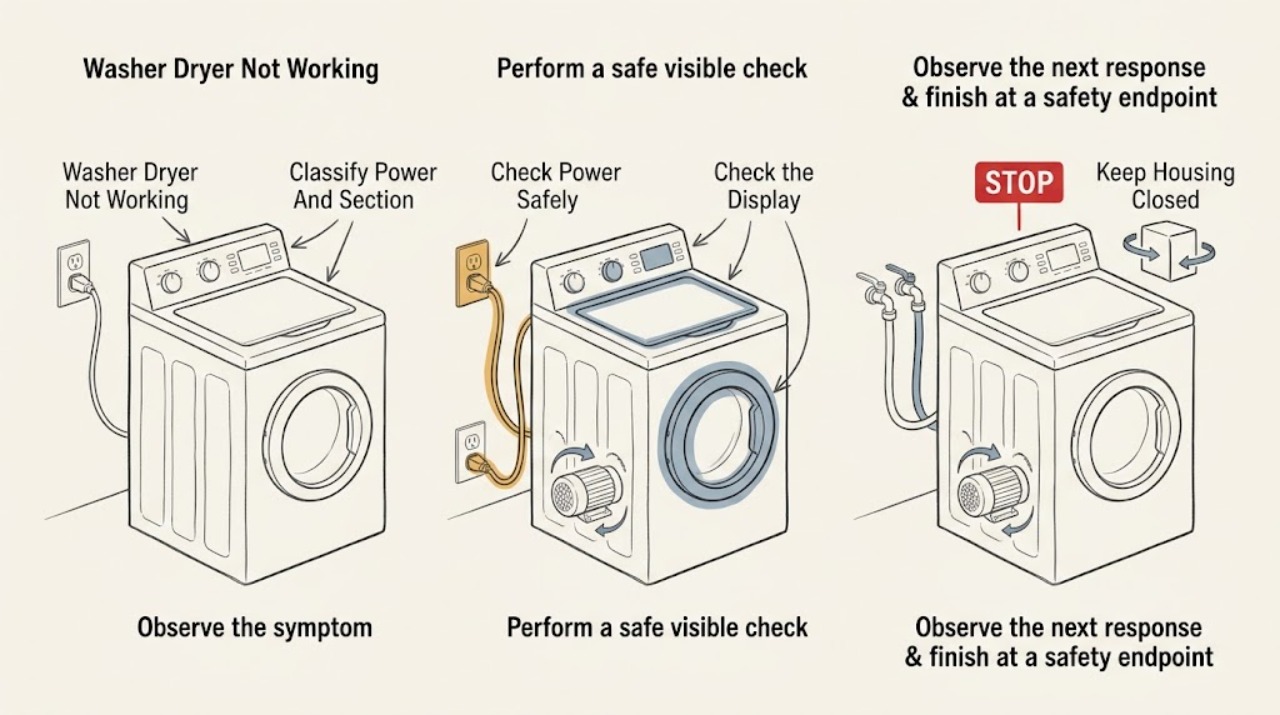
Work through in order
Diagnostic checks
Use only checks that match the exact appliance or system and its official guide.
-
Check 1
Check whether the washer-dryer display or indicator lights are present, whether the washer, dryer, or both sections are affected, and whether the failure began after a move, outage, or installation.
Expected result: The panel is blank, only the washer fails, only the dryer fails, the unit beeps, or a cycle began and then stopped.
Next step: Use the matching power, washer, dryer, water, or service branch. Record any displayed message exactly and do not run repeated cycles to force a response.
Stop if: Stop for smoke, burning smell, hot plug, exposed wiring, a leak, severe shaking, or a door or lid that cannot safely close.
Why this matters
Why: A blank panel points toward supply; one-section failure points toward that section's controls or safety path. A beep or mid-cycle stop may reflect a door, lid, pause, sensing period, or fault state rather than total power loss.
-
Check 2
Inspect the normal external power connection and household circuit without opening the appliance. Confirm the cord is firmly seated, the dedicated circuit has not tripped, and no extension cord is being used.
Expected result: The cord is loose, the breaker or fuse is open, the circuit is shared or overloaded, the connection looks normal, or the breaker trips again.
Next step: Correct only a clearly loose external connection and reset a breaker once if there is no hazard. If power does not return or the circuit trips again, leave the appliance off and contact a qualified electrician or appliance technician.
Stop if: Do not use an extension cord, replace a fuse with a larger capacity, open a junction area, or probe live wiring.
Why this matters
Why: Frigidaire lists a tight cord and house-circuit check for a laundry center or dryer that will not start and says a laundry center should use its own circuit. A repeat trip or overloaded circuit is an electrical fault, not a reason to keep resetting.
-
Check 3
Select the desired cycle, close the washer lid or dryer door completely, and press or hold START/PAUSE exactly as the model guide describes. Do not force the closure or defeat a lock.
Expected result: The cycle starts, the unit beeps with the lid or door closed, the display indicates pause, or the lid or door will not latch.
Next step: If the cycle starts, monitor it. If the unit still refuses to start or the latch does not engage, keep the affected section off and arrange service.
Stop if: Do not tape down a switch, bypass a lock, force a door, or reach into the tub or drum while it can move.
Why this matters
Why: Frigidaire says the laundry center will not start with an open lid or door and may require START/PAUSE after selection. A beeping or failed latch can indicate a closure or safety-interlock issue rather than a motor fault.
-
Check 4
For the washer section, confirm both water-supply faucets are open, visible fill hoses are not kinked, and the lid is closed. After pressing START, allow the model's sensing period to complete before deciding that no water is entering.
Expected result: Water enters after sensing, no water enters, a faucet is closed, a hose is kinked, the lid is open, or the cycle appears paused between stages.
Next step: Open the faucets or straighten a visible hose only if safe and permitted by the manual, close the lid, and make one supervised start attempt. If filling still fails or a pause never clears, arrange service.
Stop if: Do not disconnect pressurized hoses, clean an internal valve screen, or continue if water leaks, the lid lock fails, or the appliance fills unexpectedly.
Why this matters
Why: Frigidaire says many laundry centers sense load size before filling and may pause between wash and spin. Closed faucets, kinked hoses, or an open lid can prevent operation or filling.
-
Check 5
For a dryer that stops or will not resume, turn it off, allow the motor to cool, and reduce an obviously excessive load before one supervised restart. Check the lint filter and airflow only as directed by the model guide; do not open the cabinet.
Expected result: The dryer restarts after cooling and reducing the load, stops again, has a thermal-limiter indication, or has a burning smell or unusual heat.
Next step: If the dryer runs normally, monitor one cycle. If it stops again, a thermal-limiter condition is indicated, or heat or odor is abnormal, leave it off and arrange authorized service.
Stop if: Do not bypass a thermal limiter, operate with a burning smell, or keep restarting an overheated dryer.
Why this matters
Why: Frigidaire says overloading can overheat the motor and that a thermal limiter can turn off an electric dryer motor. Recurrence means the protective action did not resolve the cause and may require service.
-
Check 6
Record the exact model, affected section, power and breaker behavior, selected cycle, lid or door response, water-faucet status, sensing or pause behavior, load size, and any error, leak, heat, or odor symptom.
Expected result: The appliance remains unresponsive, the issue returns after a restart, only one section works, the unit is newly installed, or a protective device has activated.
Next step: Keep the affected section off and arrange Frigidaire or qualified appliance service; use a qualified electrician for a persistent house-circuit issue. Give the observation record to the service provider.
Stop if: Do not open panels, remove a motor or belt, bypass a lid or door lock, or alter wiring or protective devices.
Why this matters
Why: The record distinguishes a control or setup issue from a shared supply problem, closure fault, water path issue, motor overheat, or internal failure. A failed external check does not identify a replacement component.
Use your observations
Decision map
Find the observation that best matches what you see, then follow the next safe action.
-
PATH 01Safety boundary
What you see
The display and indicators are blank on the washer-dryer.
Do this next
Check the tight external cord connection and household circuit once if safe. If the circuit trips again or the panel stays blank, leave the unit off and arrange qualified electrical or appliance service.
Why this path and its safety boundary
Why it matters: Power connection, breaker, fuse, or shared-circuit conditions are the first external checks.
Safety stop: No extension cord, live testing, junction-box access, or repeated breaker resets.
-
PATH 02Safety boundary
What you see
The washer has power but will not start, beeps, does not fill immediately, or appears paused.
Do this next
Close the lid, verify faucets and visible hoses, press START/PAUSE as directed, and allow the sensing period to complete. If it never proceeds, arrange service.
Why this path and its safety boundary
Why it matters: An open lid, missed START/PAUSE action, water supply issue, normal load sensing, or a normal inter-stage pause can produce this behavior.
Safety stop: Do not defeat the lid lock, open pressurized connections, or reach into a moving tub.
-
PATH 03Safety boundary
What you see
The dryer has power but will not begin a cycle.
Do this next
Close the door, set the selector correctly, use the start control as directed, and check the external cord and circuit. If it still will not run, arrange service.
Why this path and its safety boundary
Why it matters: The start control may need the model-specific hold, the selector may not be at a start position, the door may be open, or the cord or circuit may be faulty.
Safety stop: Do not bypass the door switch, use an extension cord, or open the control cabinet.
-
PATH 04Safety boundary
What you see
The dryer started but stopped, especially with a large load or unusual heat.
Do this next
Turn it off, allow cooling, reduce the load, and make one supervised restart. If it stops again or a limiter condition is indicated, keep it off and arrange service.
Why this path and its safety boundary
Why it matters: Frigidaire says motor overheating from overloading or activation of a thermal limiter can stop the dryer.
Safety stop: Do not keep restarting, bypass a thermal limiter, or operate with burning odor or smoke.
-
PATH 05Safety boundary
What you see
Only one section works, the unit fails after the external checks, or the problem returns.
Do this next
Keep the failing section off and arrange qualified appliance service. Provide the exact model and the sequence of checks and observations.
Why this path and its safety boundary
Why it matters: A section-specific control, closure, water, motor, heater, wiring, or internal fault remains possible and cannot be identified safely from the symptom alone.
Safety stop: Do not disassemble the cabinet, change wiring, replace hidden parts, or bypass a safety device.
Helpful context
Understand the symptom
Define not working before changing anything
A blank control panel is a power path problem. A powered unit that beeps or does nothing may have an open lid or door, an unselected cycle, a missed START/PAUSE press, or a normal sensing or pause period. A washer that will not fill has a different path from a dryer that stops after heating. Record which section is affected and what the display does before trying another cycle.
Use the model guide for the control sequence
Frigidaire laundry centers do not all use the same control layout. The exact manual controls whether START must be pressed or held, how a cycle is selected, and how a lid or door lock is indicated. Use only the normal external controls and do not bypass a lock, defeat a switch, or reach into a moving tub or drum.
A partial recovery still needs observation
If power returns or a cycle starts, watch one supervised cycle for recurrence. A motor that stops after overheating, a circuit that trips again, a leak, or a failure that affects only one section is not cleared merely because the display came back. Keep a record for service instead of repeating resets.
Safety boundary
Stop conditions
- Stop and arrange prompt service for smoke, burning smell, hot electrical parts, exposed wiring, water leakage, or severe movement.
- Do not bypass a washer lid lock, dryer door switch, thermal limiter, or any other protective device.
- Do not use an extension cord, repeatedly reset a tripping circuit, increase fuse capacity, or probe live wiring.
- Do not open the cabinet, remove a motor, belt, heater, valve, or control, or disconnect pressurized hoses as a user repair.
- Stop after the external power, closure, water, control, and one permitted restart check if the appliance remains unresponsive or the issue returns.
When checks do not resolve it
Need a professional?
Arrange qualified service when the washer-dryer remains unresponsive after the external power and control checks, the washer never fills or the lid will not lock, the dryer stops again after cooling and reducing the load, only one section works, or a circuit or protective device trips. Use a qualified electrician for a persistent house-circuit issue. Stop promptly for smoke, burning odor, hot electrical parts, water leaks, or exposed wiring.
Safety scope: This article covers external power and control checks, closure observation, visible water-supply checks, one model-permitted restart, and safe reporting. Cabinet removal, live electrical testing, lock or limiter bypass, motor, belt, heater, valve, wiring, and control repair require qualified service.
Common questions
FAQ
Why is my Frigidaire washer-dryer completely blank?
Check the tight external power connection and household circuit once if safe, and confirm the unit is not using an extension cord or an overloaded shared circuit. If the panel stays blank or the circuit trips again, leave it off and arrange qualified service.
Why will my Frigidaire laundry-center washer not start?
Confirm the lid is completely closed, the water faucets are open, the visible hoses are not kinked, a cycle is selected, and START/PAUSE is pressed as the model guide directs. The washer may sense the load before water enters or pause between stages; if it never proceeds, arrange service.
Why will the dryer section of my Frigidaire washer-dryer not start?
Close the dryer door, set the selector to a start position, use the start control for the model-specific duration, and check the cord and circuit. Do not use an extension cord. If it remains unresponsive, arrange service.
What if my Frigidaire dryer stops during a cycle?
Turn it off, allow the motor to cool, and reduce an obviously excessive load before one supervised restart. If it stops again or a thermal limiter is involved, keep it off and arrange service; do not bypass the protective device.
When should I stop troubleshooting a Frigidaire washer-dryer?
Stop for smoke, burning odor, hot electrical parts, exposed wiring, water leaks, a failed lid or door lock, repeated circuit trips, severe movement, or failure after the external checks. Keep the affected section off and arrange qualified appliance service.
Read the exact guide
Official sources
- What should I do if my dryer stops operating?Frigidaire · Official Frigidaire dryer support page; it supports the stopped-dryer branch and limits thermal protection work to service.
- What should I do if my dryer does not start?Frigidaire · Official Frigidaire dryer support page; it supports the dryer-side checks within a combined washer-dryer article.
- What should I do if my Frigidaire Laundry Center is not starting?Frigidaire · Official Frigidaire support page directly applying to laundry centers, the combined washer-dryer form factor represented by this topic.
- What should I do if my Frigidaire Laundry Center is not filling with water properly?Frigidaire · Official Frigidaire laundry-center page; it supports the washer fill branch, with hose disconnection and internal screens excluded from the user boundary here.
Community feedback
Share a repair observation
Share a plain-text repair observation. Accepted observations are published automatically; this page may take a moment to update.