
On this page
Start here
Quick answer
Start by separating a blank control panel from a machine that has power but will not start, and from a cycle that starts and then stops. Check the household supply, the door or lid closure, the selected cycle, and visible water inlet and drain hoses without opening the cabinet. If water remains, use the exact Kenmore manual for any accessible drain-filter procedure. Do not continue using the washer dryer if it leaks, floods, smells of burning, trips electrical protection, has a damaged cord, or repeatedly stops; arrange qualified service with the model number and the stage where it failed.
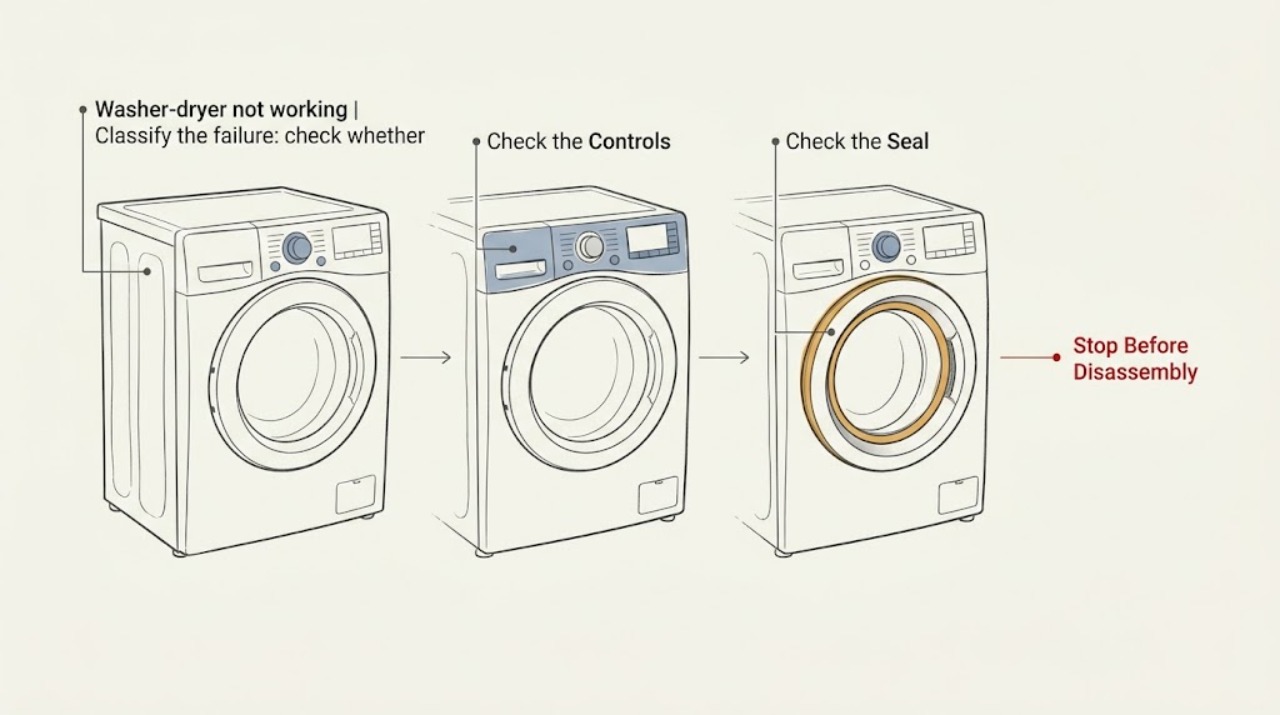
Work through in order
Diagnostic checks
Use only checks that match the exact appliance or system and its official guide.
-
Check 1
Classify the failure: check whether the panel is completely blank, whether it lights but Start is ignored, whether the drum begins and stops, or whether the programme ends with water still in the drum.
Expected result: A blank panel has no visible response; a lit panel with no movement has a start, door, supply, or control clue; a stopped programme with water has a drain-stage clue.
Next step: Record the symptom and any displayed message, then use the matching checks below rather than replacing a pump or control based only on the phrase ‘not working.’
Why this matters
Why: The failed stage determines whether to check supply, door or lid closure, water entry, settings, or drainage before service is considered.
-
Check 2
For a blank panel, check that the household outlet switch is on and that the Kenmore power plug and surrounding floor are dry and undamaged; check household electrical protection without opening the appliance.
Expected result: Other appliances also lack power, protection will not stay on, or the outlet works while the Kenmore panel remains blank.
Next step: Restore only an obvious household supply issue. If the panel stays blank, the cord is damaged, or protection trips again, stop using the appliance and arrange qualified service.
Why this matters
Why: A shared supply problem is outside the appliance; a working outlet with a blank washer dryer points toward its cord, internal supply, or controls.
-
Check 3
For a lit panel that will not start, close the washer door or lid firmly and check the model controls for pause, delay, lock, or a cycle option that prevents the expected operation; ensure no garment is trapped at the door seal.
Expected result: The programme starts after an obvious setting or obstruction is corrected, or the lock indication remains, the door or lid will not close, or Start remains ignored.
Next step: Use the exact Kenmore manual for the lock and control behavior. Do not force the door or lid or bypass its interlock; arrange service if the closure or lock remains abnormal.
Why this matters
Why: A door or lid interlock and a selected control state can prevent operation even when the display has power.
-
Check 4
If the washer dryer does not fill or stops soon after starting, check that the household water supply is available and that visible inlet hoses are not kinked, cracked, bulged, or dripping; close the water supply if a connection is spraying or leaking.
Expected result: Water is unavailable, a hose is restricted or damaged, water enters after the supply path is restored, or the machine still fails to fill despite a sound visible connection.
Next step: Correct only an obvious supply or hose-position issue permitted by the model instructions. For a damaged connection, leak, or persistent no-fill fault, stop using the appliance and arrange service.
Why this matters
Why: A missing supply can stop a cycle from progressing, while a damaged hose or persistent no-fill symptom can involve the inlet path or internal control.
-
Check 5
If the cycle stops with water inside or will not advance to spin, check whether the selected programme intentionally retains water and inspect the visible drain hose for a kink; with power isolated and towels ready, use the model manual for any accessible drain-filter check.
Expected result: The selected programme intentionally retains water, the visible drain path is restricted, or the drain path is clear but water remains in the drum.
Next step: Follow the exact Kenmore manual for safe filter and drain access. If the filter is inaccessible, water remains after the check, or the pump does not operate, stop and request service.
Why this matters
Why: Some cycles hold water by design, but a blocked hose, household drain, filter, or pump path can also prevent completion.
-
Check 6
After the visible supply, door or lid, setting, and drain checks, note whether the appliance repeats the same stop stage, shows an error, leaks, makes an unusual sound, smells of burning, or trips electrical protection.
Expected result: A repeatable stage or code, leak, burning smell, unusual sound, or electrical trip remains after the safe checks.
Next step: Stop using the washer dryer and provide the model number, cycle, stage, code, water level, and observations to qualified service. Do not open the cabinet or select a replacement part from the symptom alone.
Why this matters
Why: A repeat symptom points to an internal lock, valve, pump, motor, sensor, wiring, or control fault rather than an operating mistake.
Use your observations
Decision map
Find the observation that best matches what you see, then follow the next safe action.
-
PATH 01Safety boundary
What you see
The panel is blank, the cord or plug area is damaged, or household electrical protection trips when the washer dryer is used.
Do this next
Stop using the appliance and arrange qualified electrical or appliance service; do not open the cabinet or repeatedly retry a tripping machine.
Why this path and its safety boundary
Safety stop: Continue with the door or lid, water supply, programme, and drain-stage checks.
-
PATH 02Safety boundary
What you see
The panel is on but Start is ignored, the door or lid will not lock, or the closure is uneven.
Do this next
Check the model's pause, delay, and lock settings and remove only an accessible obstruction. Do not force or bypass the interlock; arrange service if the condition remains.
Why this path and its safety boundary
Safety stop: Continue with water-entry and drain-stage checks.
-
PATH 03Safety boundary
What you see
The cycle stops with water in the drum and the selected programme is not intentionally retaining water.
Do this next
Isolate power, keep towels ready, and follow the model manual for the accessible drain hose or filter check. Escalate if water remains or the pump path is not accessible.
Why this path and its safety boundary
Safety stop: Continue with the water supply, settings, and repeat-symptom checks.
-
PATH 04Safety boundary
What you see
The machine leaks, floods, smells of burning, makes smoke, or repeatedly stops after the safe checks.
Do this next
Close the water supply if safely possible, stop using the washer dryer, keep clear of wet electrical areas, and arrange qualified service.
Why this path and its safety boundary
Safety stop: Run only the model-approved cycle that matches the corrected condition and stop if the symptom returns.
Helpful context
Understand the symptom
‘Not working’ is not one diagnosis. A blank panel suggests a supply or control problem; a lit panel that ignores Start suggests a door or lid lock, cycle setting, or control condition; a programme that stops with water inside suggests a drain path. Note any display message, the selected cycle, and the last stage reached before retrying.
Keep water away from the plug and controls while checking the appliance. Use only visible, owner-level checks and the model's manual. Kenmore's guidance treats worn hoses, leaks, unusual noises, and performance problems as reasons to arrange a professional assessment rather than guessing at an internal part.
Only after diagnosis
Potential parts
- washer door or lid lock
Consider this only when the closure is correct but the interlock remains abnormal and a technician confirms the lock path.
Confirm the complete Kenmore model identifier and the manufacturer's fit information before ordering any part. - washer drain pump
Consider this only after the programme, hose, household drain, and accessible filter path are clear and a technician identifies the pump as the failed component.
Use the exact model identifier and service diagnosis to confirm compatibility before selecting a component. - washer water inlet valve
Consider this only when the household water supply and visible hoses are correct but the appliance still fails to fill and a technician confirms an inlet-path fault.
Do not infer fit from the Kenmore brand alone; confirm the model-specific component and installation requirements.
When checks do not resolve it
Need a professional?
Stop using the Kenmore washer dryer and arrange qualified service for a blank panel with a working outlet, repeated electrical trips, a damaged cord, a door or lid that will not lock, any leak or flood risk, burning smell or smoke, an inaccessible drain blockage, a repeated error, or a cycle that keeps stopping after safe supply, setting, closure, and drain checks.
Common questions
FAQ
Why is my Kenmore washer dryer not working at all?
Separate a blank panel from a no-start or stopped-cycle symptom. Check the safe household supply, door or lid closure, programme settings, water supply, and drain stage. A working outlet with a blank appliance or repeated trip needs service.
Why does my Kenmore washer dryer stop with water inside?
The programme may retain water by design, or the drain hose, household drain, filter, or pump path may be restricted. Follow the exact model manual for any accessible filter check with power isolated; persistent water needs service.
Can the door or lid stop a Kenmore washer dryer from starting?
Yes. An uneven closure, trapped garment, or door or lid lock condition can prevent a cycle from starting. Check the visible closure and model controls, but never force or bypass the interlock.
When should I stop troubleshooting a Kenmore washer dryer?
Stop for leaks, flooding, water near electrical areas, a burning smell, smoke, repeated electrical trips, a damaged cord, an abnormal door or lid lock, or a fault that remains after safe supply, settings, closure, and drain checks. Arrange qualified service.
Read the exact guide
Official sources
- Kenmore ManualsKenmore · Kenmore washer, dryer, and laundry appliance model manuals and guides
- Appliance Maintenance Tips to Help Maximize EfficiencyKenmore Livemore · Kenmore washer and dryer hose, load, lint, and repair-sign maintenance guidance
- Contact UsKenmore · Kenmore product questions and appliance repair support routing
- How to Move AppliancesKenmore Livemore · Kenmore washer and dryer water, hose, and power isolation guidance
Community feedback
Share a repair observation
Share a plain-text repair observation. Accepted observations are published automatically; this page may take a moment to update.