
On this page
Start here
Quick answer
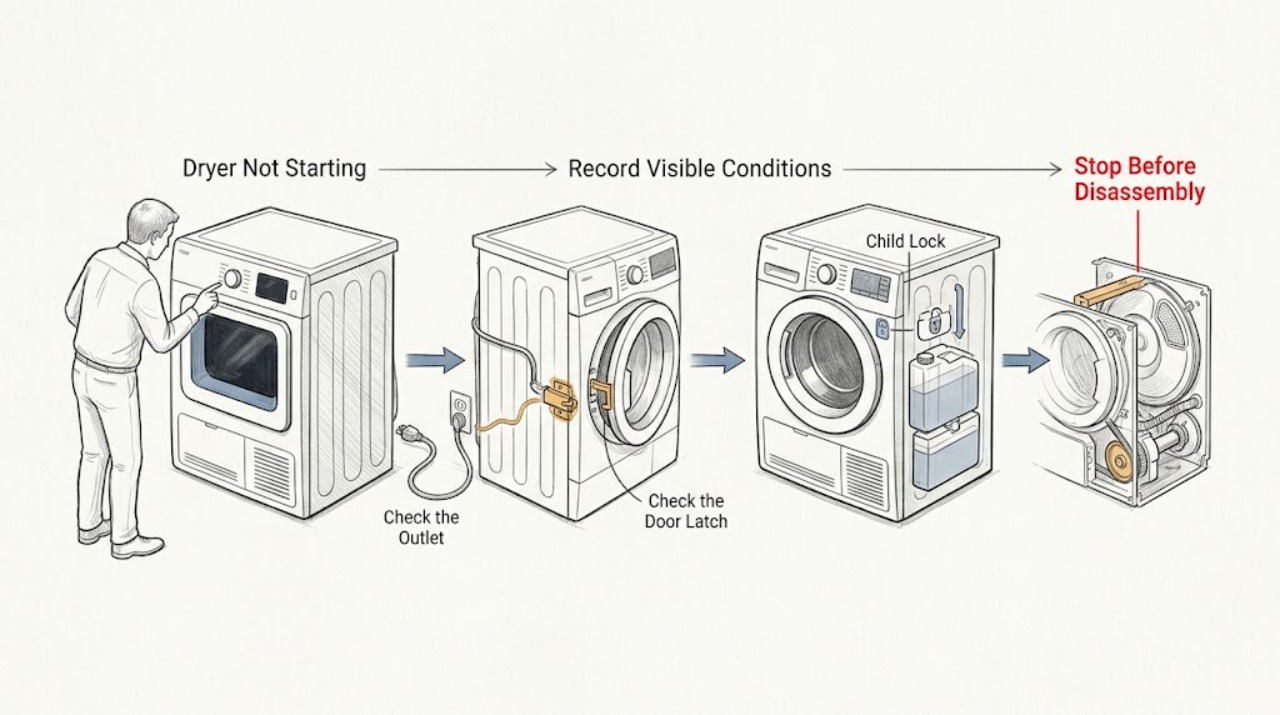
First separate a Blomberg dryer with no lights from one whose panel is on but will not run, and from a program that starts then stops. Check the accessible power supply, close the loading door securely, select a program, press Start/Pause, and check whether the child lock is active. If a cycle was interrupted, drain the water tank where fitted and try Start/Pause once after the door is closed. With power disconnected, a drum that turns unusually easily can point to a drive-belt problem. If the dryer remains idle after these model-appropriate checks, or the cord, outlet, drum, or controls show damage, stop using it and arrange appliance repair.
Work through in order
Diagnostic checks
Use only checks that match the exact appliance or system and its official guide.
-
Check 1
Record whether the dryer is completely dark, has a lit panel but will not start, starts and then stops, or stops with a warning light or symbol; note the exact model number.
Expected result: The symptom is repeatable in one state, or it changes after a door, program, power, or tank check.
Next step: Keep the model and symptom record while following the matching checks below; do not assume a warning light identifies a failed part.
Stop if: Stop immediately for smoke, burning smell, sparking, a damaged cord or outlet, water near electrical parts, or a drum that moves dangerously.
Why this matters
Why: No lights, no accepted start, an interrupted program, and a warning symbol lead to different checks. Model identity is needed for the child-lock, tank, and control procedure.
-
Check 2
Check that the power cord is securely connected to a working socket and inspect the accessible cord and outlet for visible damage; check the dryer circuit or fuse without opening the appliance.
Expected result: Another device also has no power, the dryer-only circuit has tripped, or the socket works but the dryer remains dark.
Next step: Restore household power only when safe and make one start attempt. If the dryer-only supply remains absent or trips again, arrange qualified electrical or appliance service.
Stop if: Do not use a scorched socket, damaged cord, extension arrangement not permitted by the manual, or a circuit that trips repeatedly.
Why this matters
Why: A wider outage points to household supply. A working socket with a dark dryer points toward the appliance supply path or an internal fault.
-
Check 3
Empty the drum, clear fabric from the door opening, and close the loading door firmly until the latch engages.
Expected result: The dryer starts after the door is correctly latched, or the door closes but the panel still refuses to start.
Next step: Try one normal program with the door fully closed. If an open-door indication remains, stop and arrange service rather than forcing the latch.
Stop if: Do not hold the interlock closed by hand, tape the door shut, or reach into a moving drum.
Why this matters
Why: Blomberg states that an open or ajar loading door prevents the dryer program from starting. A closed door with the same symptom points toward the interlock, controls, power, or another technical condition.
-
Check 4
Select a valid drying program, confirm the dryer is not in Pause or a delayed/end-duration state, and press Start/Pause once.
Expected result: The Start/Pause indicator changes and the drum begins, or the program remains idle and the control only beeps or flashes.
Next step: Cancel or change a delayed setting only as the exact manual describes, then make one start attempt. If controls remain unresponsive, arrange service.
Stop if: Do not repeatedly turn the selector through programs or bypass a control lock to force operation.
Why this matters
Why: Blomberg manuals identify an unselected program, Pause state, or missing Start/Pause command as reasons a dryer may not activate. A delayed function or unaccepted command is a control-state issue until proven otherwise.
-
Check 5
Check the child-lock indicator and use only the exact model manual's unlock sequence; on models with a lock indicator, do not infer the button combination from another Blomberg dryer.
Expected result: The lock indicator is active and buttons are disabled, or no lock indicator is active but the panel still will not accept a program.
Next step: Deactivate the lock using the model instructions, then press Start/Pause once. If the lock state will not clear, arrange appliance repair.
Stop if: Do not remove the control panel or short controls to defeat the child lock.
Why this matters
Why: Blomberg manuals state that an active child lock deactivates most buttons and can prevent a new program from starting. Procedures vary with the control panel.
-
Check 6
If the program started and then stopped, check the water-tank warning where fitted, drain the tank, refit it securely, and press Start/Pause once with the loading door closed.
Expected result: The tank was full and the program resumes, or the tank is empty and correctly fitted but the dryer stops again.
Next step: Run one supervised program. If the warning returns or the dryer stops again, stop repeated restarts and arrange service.
Stop if: Do not operate with a leaking tank, damaged housing, or water reaching the electrical controls.
Why this matters
Why: Blomberg identifies a full water tank as a cause of an interrupted program on condenser models. A repeated stop with an empty tank moves the problem toward drainage, sensing, or technical diagnosis.
-
Check 7
With the dryer unplugged, the drum empty, and the door open, turn the drum by hand only enough to compare its resistance with the normal feel described by the model guidance.
Expected result: The drum turns unusually easily or has normal resistance, while the dryer still will not start.
Next step: If the drum is unusually easy to turn, do not run the dryer and arrange service. Otherwise continue only with external checks and the exact manual.
Stop if: Do not remove panels, reach around the belt or motor, or reconnect power while inspecting the drum.
Why this matters
Why: Blomberg states that a drum that spins too easily can indicate a drive-belt problem. Normal resistance does not prove the motor or controls are healthy; it only removes that specific clue.
-
Check 8
If the dryer starts but does not heat or repeatedly stops, check the accessible lint filter, condenser or filter drawer, ventilation, load size, and water tank only as applicable to the model; do not run without the filter.
Expected result: A filter or condenser is blocked, the load is excessive, ventilation is restricted, or all accessible conditions are correct but the dryer remains unable to run normally.
Next step: Clean and fully dry the applicable filter or condenser, reduce the load, and make one supervised attempt. If the failure returns, arrange service.
Stop if: Do not use the dryer with a blocked, wet, damaged, or missing filter, or with a restricted exhaust that cannot be safely cleared.
Why this matters
Why: Blomberg links blocked filtration, poor ventilation, overloading, and a full tank with extended or impaired drying. A clean, correctly loaded dryer that still fails needs technical diagnosis rather than a guessed heating part.
-
Check 9
Prepare a service record with the model, panel state, door result, selected program, child-lock status, tank warning, drum resistance, and whether the same failure returned after one normal start attempt.
Expected result: The no-start symptom is repeatable, is tied to one program or control, or remains unexplained after the external checks.
Next step: Give the record and any display photo to an authorized appliance technician. Do not select a replacement component from the symptom alone.
Stop if: Stop all further testing if the dryer cannot be switched off normally or any electrical, heat, or water hazard appears.
Why this matters
Why: A repeatable state helps a technician distinguish supply, interlock, control, belt, tank, or technical faults without unsafe disassembly.
Use your observations
Decision map
Find the observation that best matches what you see, then follow the next safe action.
-
PATH 01Next step
What you see
The dryer and other appliances have no power.
Do this next
Restore power when safe and retry once.
Why this path and its safety boundary
Why it matters: A household supply interruption is more likely than a dryer fault.
-
PATH 02Next step
What you see
The socket works but the Blomberg dryer remains dark.
Do this next
Do not open the cabinet; arrange qualified electrical or appliance service.
Why this path and its safety boundary
Why it matters: The dryer supply path or an internal electrical fault may be involved.
-
PATH 03Next step
What you see
The door is ajar or an open-door indication remains.
Do this next
Clear the obstruction and close the door firmly; arrange service if the indication persists.
Why this path and its safety boundary
Why it matters: The door interlock condition prevents a program from starting.
-
PATH 04Next step
What you see
No program is selected, the dryer is paused, or Start/Pause was not pressed.
Do this next
Select the model-appropriate program and press Start/Pause once.
Why this path and its safety boundary
Why it matters: The control state can prevent activation without a failed motor.
-
PATH 05Next step
What you see
The child-lock indicator is active.
Do this next
Use the exact model manual's unlock sequence, then retry once.
Why this path and its safety boundary
Why it matters: Most buttons may be disabled until the lock is deactivated.
-
PATH 06Next step
What you see
The program stopped and the water-tank warning is active or the tank is full.
Do this next
Drain and refit the tank, then press Start/Pause once; service a returning warning.
Why this path and its safety boundary
Why it matters: A full tank can interrupt a condenser dryer program.
-
PATH 07Next step
What you see
The empty drum turns unusually easily with power disconnected.
Do this next
Do not run the dryer; arrange appliance repair.
Why this path and its safety boundary
Why it matters: Blomberg identifies a possible drive-belt problem.
-
PATH 08Next step
What you see
The dryer runs but heating or airflow is poor and a filter, condenser, load, or ventilation issue is visible.
Do this next
Correct only the model-approved filter, condenser, load, or ventilation condition, then monitor one cycle.
Why this path and its safety boundary
Why it matters: The accessible maintenance condition may be restricting normal drying.
-
PATH 09Next step
What you see
Power, door, program, lock, tank, and external maintenance checks pass but the dryer still will not start or stops again.
Do this next
Stop using the dryer and arrange qualified appliance repair with the complete symptom record.
Why this path and its safety boundary
Why it matters: The remaining problem is technical and cannot be identified safely from the external symptom alone.
-
PATH 10Next step
What you see
Smoke, burning smell, sparking, a damaged cord or outlet, water near electrical parts, or abnormal drum movement is present.
Do this next
Keep clear, isolate power only if safe, and arrange qualified electrical or appliance service.
Why this path and its safety boundary
Why it matters: This is an immediate stop-use condition, not a normal no-start check.
Helpful context
Understand the symptom
“Not starting” has more than one cause
Blomberg's dryer guidance separates a missing power supply, an open loading door, an unselected or paused program, an active child lock, a full water tank, and a technical fault. A panel light or warning symbol may also describe a normal condition, so record the display and the point at which the dryer stopped before changing settings.
Keep user checks external
The model manual controls button combinations, tank location, condenser arrangement, and child-lock behavior. Safe household checks stop at the plug, controls, door, accessible tank, and an unplugged drum feel. Internal electrical, motor, belt, and interlock diagnosis belongs to a qualified technician.
Only after diagnosis
Potential parts
- door interlock or loading-door latch
Consider this category only when the door is aligned and firmly closed but an open-door state persists after the external obstruction and control checks.
Door hardware varies by model; confirm the complete model and manufacturer fit information before selection. - drive belt
Consider this part class only when the unplugged empty drum turns unusually easily and a qualified diagnosis confirms a belt fault.
Confirm the exact model and manufacturer fit information before selecting a belt. - control board or timer interface
Consider this category only after power, door, program, child-lock, and tank checks pass but the panel remains unresponsive or the no-start condition returns.
Control assemblies differ by model and revision; use technician diagnosis and exact model fit information. - water-tank sensor or pump
Consider this category only when a tank warning or interruption persists with an empty, correctly fitted tank and a qualified technician isolates the water-management fault.
Condenser layouts vary; confirm the exact model and diagnosis before selecting an internal component.
When checks do not resolve it
Need a professional?
Arrange appliance repair when the dryer remains dark with a working socket, will not start after the door, program, Start/Pause, and child-lock checks, stops again with an empty tank, has a drum that turns unusually easily, or still fails after accessible filter and ventilation checks. Use a qualified electrician for a damaged supply or repeated circuit trip. Stop immediately for smoke, burning smell, sparking, water near electrical parts, damaged wiring, or abnormal drum movement.
Common questions
FAQ
Why is my Blomberg dryer completely dark?
Check whether the socket and household supply work, then inspect the accessible cord and outlet for damage. If the dryer alone remains dark or the circuit trips again, arrange qualified electrical or appliance service.
Why will my Blomberg dryer not start even though the panel is lit?
Close the loading door firmly, select a valid program, press Start/Pause, and check the child-lock indicator. If the controls still will not accept a start command, use the exact model manual and arrange service.
What should I do if my Blomberg dryer stops during a program?
Check the loading door and, on condenser models, the water-tank warning. Drain a full tank, refit it, and press Start/Pause once. A repeated stop with an empty tank needs service.
Does a freely turning drum explain a Blomberg dryer that will not start?
It can. Blomberg's guidance says a drum that turns too easily may indicate a drive-belt problem. Check only with power disconnected and do not run the dryer if this clue is present; arrange repair.
Can the child lock prevent a Blomberg dryer from starting?
Yes. Blomberg manuals state that child lock disables most buttons. Use the unlock procedure for the exact model, because the control combination can vary.
Read the exact guide
Official sources
- My Blomberg washer dryer is not powering on, what should I do?Blomberg · Power supply, cord, circuit, door latch, control settings, child lock, manual lookup, and service boundary; used here for shared Blomberg start-control logic.
- Why is my tumble dryer not heating?Blomberg · Load, airflow, drum resistance, drive-belt, and professional-service boundaries.
- Dryer User ManualBlomberg · Model-specific example of no-start, door, program, child-lock, water-tank, filter, and technical-fault checks; not a universal button sequence for every Blomberg dryer.
- Why is my tumbler dryer not spinning?Blomberg · Drive-belt, motor, door-switch, control, and power clues when the drum does not turn.
Community feedback
Share a repair observation
Share a plain-text repair observation. Accepted observations are published automatically; this page may take a moment to update.