
On this page
Start here
Quick answer
A GE dryer may not start because the door is not fully closed, clothing or lint is preventing the latch from engaging, the cycle or start control is wrong, the control panel is locked or asleep, or the dryer has lost power. A recently moved or installed dryer may also have a model-specific configuration or connection issue. Remove the load and check the door and latch from the outside, confirm the intended cycle and start control, and check only the user-accessible outlet or breaker. Do not bypass the door switch, open the terminal block, or work on gas or live electrical parts. Stop for smoke, burning smell, a hot or damaged connection, a damaged cord, exposed wiring, or a door switch that is scorched or pushed in; if safe checks do not restore operation, arrange qualified service.
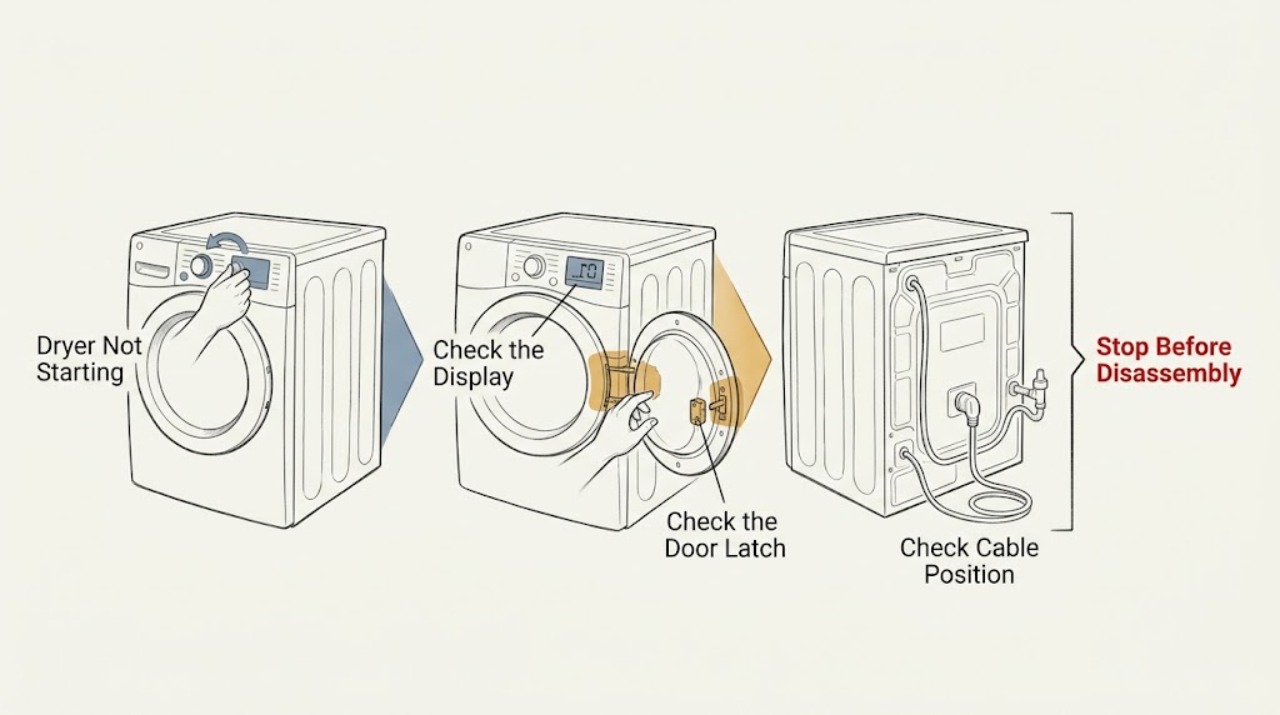
Work through in order
Diagnostic checks
Use only checks that match the exact appliance or system and its official guide.
-
Check 1
Turn the dryer controls off and check from outside for smoke, a burning or electrical smell, a hot or damaged plug, a damaged cord, exposed wiring, a loose door, or sharp or broken door material. Keep hands away from the drum and do not try to start a dryer with visible damage.
Expected result: A fire, electrical, mechanical, or sharp-edge hazard is present, or the dryer is intact and safe for external checks.
Next step: If a hazard is present, stop using the dryer and isolate power only if safe without touching damaged parts; arrange qualified appliance or electrical service. If no hazard is present, continue with the door and controls.
Why this matters
Why: A hazard takes priority over finding why the start command failed. Continued operation or touching damaged parts can worsen fire, shock, or moving-part risk.
-
Check 2
Open the empty dryer door and inspect the gasket area, cabinet lip, latch, and strike for lint, clothing, or another accessible obstruction. Close the door gently and listen or feel for normal latch engagement. Do not slam the door, hold the switch closed, or insert a tool into the latch.
Expected result: A visible obstruction is removed and the door now sits flush and latches, or the opening is clear but the latch does not engage or the door springs back.
Next step: If the door latches securely, continue to the cycle and start check. If it will not latch without force, leave the dryer unused and arrange qualified service.
Why this matters
Why: GE requires the door to be closed tightly for operation. A door that cannot engage the latch points to alignment, hinge, latch, strike, or switch service rather than a start-button problem.
-
Check 3
Confirm the dryer is awake and set to a normal cycle, fabric setting, and drying time or temperature as applicable. Press or turn the model's START control as described in its guide, and check that a control lock or other user lock is not active. Do not repeatedly press controls while the door is open or a hazard is present.
Expected result: The display or controls respond and the dryer starts, or the panel remains unresponsive or the dryer still does not start despite a latched door and valid cycle.
Next step: If the dryer starts, monitor one attended cycle. If it remains unresponsive, continue to the external power check; do not remove the console or bypass an interlock.
Why this matters
Why: GE lists cycle selection and fully actuating the START control as basic start conditions. A responsive panel with no start after a secure latch suggests power, switch, or internal control diagnosis.
-
Check 4
Check the plug is fully seated in the correct wall outlet and look at the household breaker or fuse from the user-accessible panel. Reset a tripped breaker only as the installation instructions permit and only if there is no smell, heat, water, or visible damage. Do not open a terminal-block cover or reconnect a rear cord yourself.
Expected result: The outlet or breaker is interrupted and operation returns after a safe correction, or power appears present but the dryer remains inactive.
Next step: If power is still absent, have the household circuit checked by a qualified person. If power is present but the dryer does not start, stop repeated resets and request appliance service.
Why this matters
Why: GE identifies a loose plug or tripped fuse or breaker as a cause of a no-start condition. A damaged cord or terminal connection is an electrical service issue even when the display has some power.
-
Check 5
With the dryer off and the door open, inspect the visible door-switch area without pressing it with a tool. Look for a switch that is scorched, cracked, pushed in, or out of alignment with the closed door. If the start problem began after reversing the door, compare the model-specific hinge, latch, and strike arrangement with the installation instructions.
Expected result: The switch and door arrangement look intact and aligned, or the switch is damaged, displaced, or does not meet the door correctly.
Next step: If the switch or door arrangement is damaged or uncertain, leave the dryer unused and arrange service. If it looks intact, continue only with a normal start check and stop if the dryer reports an open door.
Why this matters
Why: GE states that a scorched or pushed-in door switch may prevent the dryer from operating. Door-swing hardware is model-specific, so a misaligned switch or strike should not be corrected by force.
-
Check 6
If the model displays a configuration indicator after installation or service, use only the exact model guide to identify the setting for the dryer type. Do not guess between gas and electric configurations or alter wiring. After the documented setting is confirmed, close the door and perform one attended start check.
Expected result: The model-specific configuration was incorrect and the dryer starts, or the configuration is correct and the dryer still will not start.
Next step: If the dryer starts, monitor its operation. If it does not, stop repeated attempts and provide the model, display, door-switch observation, and power result to qualified service.
Why this matters
Why: Some GE models use a model-specific configuration state that can prevent normal operation. A correct configuration with a persistent no-start symptom points to power, door interlock, control, or internal service causes.
Use your observations
Decision map
Find the observation that best matches what you see, then follow the next safe action.
-
PATH 01Next step
What you see
The door is blocked, misaligned, or does not latch flush
Do this next
Clear only accessible lint or clothing and close gently. If the latch, hinge, strike, or door will not hold, do not run the dryer; arrange service.
-
PATH 02Next step
What you see
The controls respond after the correct cycle, start command, or lock-state correction
Do this next
Run one attended start check with the door latched and stop if an open-door indication or abnormal sound appears.
-
PATH 03Next step
What you see
A plug, breaker, or fuse issue is found and the dryer resumes operation after a safe external correction
Do this next
Monitor the dryer and have a qualified person investigate any recurring trip, hot connection, or damaged power part.
-
PATH 04Next step
What you see
The door switch is scorched, pushed in, cracked, or out of alignment
Do this next
Stop using the dryer and arrange qualified service. Do not press, bypass, or electrically test the interlock.
-
PATH 05Next step
What you see
The dryer was recently moved or the door was reversed and the model-specific arrangement is uncertain
Do this next
Use the exact installation instructions or qualified installation service. Do not force the door or copy another model's hinge and latch layout.
-
PATH 06Next step
What you see
Smoke, burning smell, damaged cord, exposed wiring, water near electrics, or a hot connection is present
Do this next
Stop immediately, isolate power only if safe without touching damaged or wet parts, and arrange qualified appliance or electrical service.
-
PATH 07Next step
What you see
The door latches, controls and external power appear normal, but the dryer still does not start
Do this next
Stop repeated start attempts and request qualified GE appliance service with the model, display state, door-switch result, and power checks.
Helpful context
Understand the symptom
Start with the door and control state
A dryer will not run when its door is open, and a door can look closed without moving the switch far enough to signal a secure latch. A cycle may also appear unresponsive when the panel is asleep, locked, or set to a control position that does not request a start. Identify what the display, latch, and start control actually do before investigating power.
Power checks must stay outside the cabinet
Check the plug and household breaker only from safe, user-accessible points. The rear terminal block, cord connections, gas valve, and internal controls are not owner-level test points. A dryer can have a partial electrical supply and still show some signs of life while refusing to operate correctly; a qualified person should diagnose a damaged or uncertain connection.
Door changes and model exceptions matter
Many GE dryers have reversible doors, but some unitized and portable models are exceptions. If the dryer stopped starting after the door was reversed, moved, or installed, compare the hinge and latch arrangement with the exact installation instructions. Do not force a door or use a different model's hardware arrangement.
Only after diagnosis
Potential parts
- dryer door switch or interlock
Consider this category only after qualified service confirms a failed, scorched, pushed-in, or misaligned door switch with the door and latch otherwise correct.
The door switch is a safety component and varies by model. Never bypass or test it live. - dryer door latch, strike, or hinge hardware
Consider this category only when service confirms worn, broken, or misaligned door hardware after accessible obstruction and model-specific installation checks.
Door hardware and reversible-door arrangements are model-specific. Do not force a sagging or damaged door. - dryer control or power-supply component
Consider this category only after qualified service confirms a control or supply fault with the door, settings, outlet, and breaker checks complete.
Control and power parts may be mains-connected and model-specific. Do not open the cabinet or terminal block.
When checks do not resolve it
Need a professional?
Stop and seek professional help for smoke, burning smell, damaged cord or wiring, hot electrical connections, water near electrics, a scorched or pushed-in door switch, a door that will not latch, repeated breaker trips, or a no-start condition that remains after safe external checks.
Have this ready
- Provide the full model identity, display state, selected cycle, door and latch behavior, whether the door was reversed or the dryer moved, door-switch observations, outlet and breaker result, and any smoke, smell, heat, water, or damage. Do not bypass the interlock, open the terminal block, or work on gas or live electrical parts.
Common questions
FAQ
Why is my GE dryer not starting?
Check that the door closes tightly, the latch is clear, the correct cycle and START control are selected, and the accessible plug and breaker are supplying power. If the door switch is damaged or the dryer remains inactive, arrange service.
Can a GE dryer have power but still not start?
Yes. A dryer may have some signs of power while a door switch, control, partial supply, or internal connection prevents operation. Check only the plug and user-accessible breaker; do not open the terminal block or perform live tests.
What should I do if my GE dryer stopped starting after the door was reversed?
Compare the hinge, latch, and strike arrangement with the exact model installation instructions. Some GE unitized and portable models have door-swing exceptions. If the door is not square or the switch does not align, do not force it; arrange service.
When should I stop troubleshooting a GE dryer that will not start?
Stop for smoke, burning smell, damaged wiring, a hot connection, water near electrics, a scorched or pushed-in door switch, a door that will not latch, repeated breaker trips, or a no-start condition that remains after safe door, control, and external power checks.
Read the exact guide
Official sources
- Frequently Asked Questions About GE DryersGE Appliances · GE dryer support topics, manuals, and appliance service pathway
- Dryer - Door SwingGE Appliances Support · GE dryer reversible-door arrangements, model-specific instructions, and door-swing exceptions
- Dryer - Will Not Run or StartGE Appliances Support · GE dryers; door closure, cycle and start controls, door switch, power, model configuration, and service checks
Community feedback
Share a repair observation
Share a plain-text repair observation. Accepted observations are published automatically; this page may take a moment to update.