
On this page
Start here
Quick answer
First identify whether the Bosch cooktop is electric, induction, or gas, then stop using it if there is smoke, sparking, a gas smell, a cracked surface, or a hot electrical connection. With the appliance cool and no active hazard, check the control panel for a lock, moisture, or an error code; check the external circuit breaker or gas shutoff; and, for induction, verify that a suitable pan is centered on the zone. A repeated trip, persistent code, no ignition after a brief safe check, or any wiring, glass, gas, or electronics fault needs a qualified appliance or electrical professional rather than cover removal or live testing.
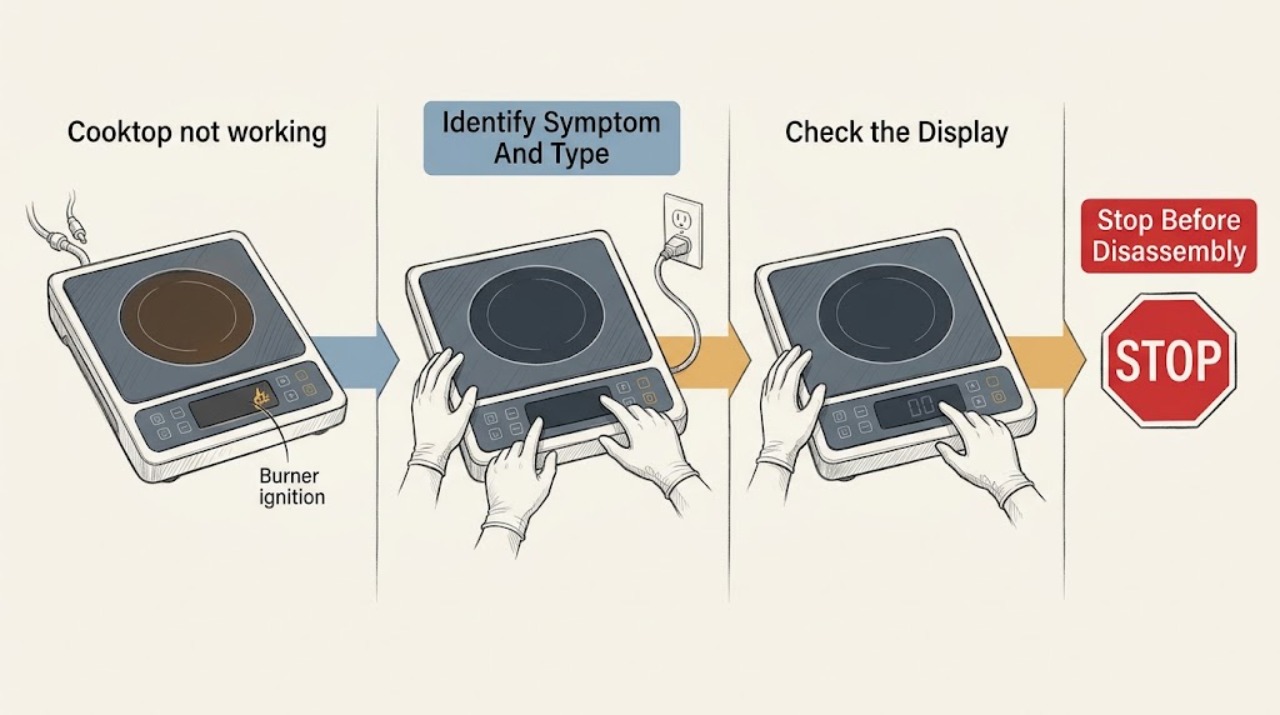
Work through in order
Diagnostic checks
Use only checks that match the exact appliance or system and its official guide.
-
Check 1
With the cooktop off and cool, identify whether it has gas burner caps and knobs or a flat electric/induction surface, and note whether the display is dark, the controls respond, a single zone fails, or a burner will not ignite.
Expected result: Record the appliance type, affected zone or burner, any flashing symbol or code, clicking or no clicking on a gas model, and whether the failure affects the whole cooktop or one area.
Next step: Use the matching power/control, induction, or gas check below and have the exact model number ready before using model-specific instructions.
Stop if: If there is smoke, visible arcing, a gas odor, a cracked glass surface, or a hot connection, do not continue identification by touching the appliance; leave it off and follow the service or emergency boundary.
Why this matters
Why: A dark display points toward supply or electronics; a responding control with no induction heat can be a pan-detection or control-state issue; a gas burner symptom follows the gas and ignition branch. The same symptom should not be diagnosed as one universal Bosch part.
-
Check 2
Look at the Bosch control panel without touching a hot or damaged surface. Remove a pan or object from the controls, wipe away moisture only when the surface is cool, and check for the lock symbol, a blank display, or an error code.
Expected result: The lock indicator, wet-panel behavior, or an exact code may disappear after the documented user control action; a blank display or a code that returns identifies a supply or fault path instead of a simple setting.
Next step: For a lock, use only the model-specific control described in the owner manual. For a code, record it exactly and consult the matching Bosch error guidance; if it returns, stop troubleshooting and arrange service.
Stop if: Do not remove the cooktop, probe the controls, or attempt an internal reset when the panel is damaged, hot, wet inside, or showing smoke or arcing.
Why this matters
Why: A lock or covered/wet panel can prevent commands. Bosch error pages associate different codes with demo mode, overheating, incorrect supply voltage, and electronics faults, so the exact code changes the next step.
-
Check 3
Check the cooktop's external electrical supply at the accessible circuit breaker or fuse only if there is no burning smell, heat, smoke, water, or visible damage. On a gas model, confirm from a safe position that the appliance gas shutoff and household supply have not been intentionally turned off.
Expected result: A tripped electrical protection device or absent gas supply can explain a completely inactive cooktop; a breaker that trips again, an unknown switch position, or a supply that appears present but leaves the cooktop dark requires diagnosis rather than repeated resets.
Next step: If the protection device can be restored once without any hazard and the cooktop returns normally, observe it during a cautious test. If it trips again or remains inactive, leave the circuit/appliance off and call a qualified professional.
Stop if: Do not open an electrical panel, touch conductors, change a breaker rating, bypass protection, or manipulate a gas connection. If gas odor is present, do not operate switches or create sparks; leave the area and contact the appropriate emergency or gas authority.
Why this matters
Why: The supply path is a possible cause, but a repeated trip can indicate a fault in the cooktop or circuit. A gas model also needs electrical power for its ignition system, so no clicking is not by itself proof of a bad igniter.
-
Check 4
If the Bosch cooktop is induction and the display responds, remove other objects from the zone, center a pan of suitable size on the marked zone, and use cookware known to be induction-compatible. Do not test with a cracked, wet, or unstable pan.
Expected result: The zone heats with the compatible pan, or the display indicates no pan/does not heat even though the controls work. A pan that is too small, off-center, or non-magnetic can be rejected by induction detection.
Next step: If only one pan fails, stop using that pan for this test and follow the model manual's cookware guidance. If multiple suitable pans or zones fail, record the display and arrange Bosch or qualified appliance service.
Stop if: Do not lift the glass, access the induction module, or continue if the surface is cracked, smells burned, or becomes unusually hot outside the cooking zone.
Why this matters
Why: Heating with a suitable centered pan points to cookware or placement rather than a dead cooktop. Failure with known-suitable cookware across more than one zone points toward control, sensing, or power diagnosis.
-
Check 5
If the Bosch cooktop is gas, ensure every knob is off before looking at a cool burner. Check that the cap is seated, the visible ports are not blocked by residue, and the igniter area is clean and dry; then make only a brief normal ignition attempt if there is no gas odor.
Expected result: A click with no flame, no click at one burner, no click at every burner, or a flame that lights and goes out are different observations. A damp igniter, misplaced cap, blocked port, absent gas supply, or ignition/electrical fault can lead to different service paths.
Next step: Turn the knob off promptly after a failed attempt, ventilate only as appropriate without operating electrical switches, and use the Bosch manual/model guidance. Persistent no-ignition or any abnormal flame requires qualified service.
Stop if: If you smell gas, hear an unexpected leak, see a damaged gas component, or the burner does not ignite promptly, stop attempts, leave the area, and follow emergency/gas-supplier guidance. Do not disassemble the burner gas path.
Why this matters
Why: A clean, dry, correctly seated burner that still will not ignite does not justify replacing a guessed part. If gas is present without ignition, continuing attempts can create an unsafe accumulation of gas.
-
Check 6
If the cooktop stopped after extended heating or shows an overheating-related code, turn all controls off and allow the appliance to cool naturally. Observe the display after cooling without repeatedly cycling power or restarting a hot zone.
Expected result: The code may clear and normal control may return, or the same code, blank display, or shutdown may recur. Bosch documents overheating and automatic time-limit states separately from incorrect supply voltage and other faults.
Next step: Record the code, affected zone, cookware position, and elapsed cooking context. If the fault persists or returns, leave the cooktop unused and arrange qualified diagnosis.
Stop if: Do not cool the surface with water, cover vents, force a restart, or continue cooking through a recurring protection shutdown.
Why this matters
Why: A one-time protective shutdown can be consistent with a temporary heat or time-limit state; recurrence means the underlying condition has not been established and should not be treated as normal operation.
-
Check 7
Before service, document the Bosch model number, the exact display or code, which zones or burners fail, the breaker or gas-supply behavior, and any visible discoloration, crack, odor, or cord/connection damage from a safe distance.
Expected result: A complete symptom sequence distinguishes a whole-appliance supply issue from a single-zone, ignition, cookware-detection, or control fault and lets the technician select model-specific documentation.
Next step: Keep the affected cooktop or circuit off as directed, give the record to Bosch support or a qualified appliance/electrical professional, and do not resume use until the cause is assessed.
Stop if: Do not remove the glass or control panel, test live voltage, alter wiring or gas fittings, or install a part based only on the symptom.
Why this matters
Why: Because Bosch cooktop configurations and codes differ, the model and repeatable symptom are more useful than a guessed replacement part.
Use your observations
Decision map
Find the observation that best matches what you see, then follow the next safe action.
-
PATH 01Safety boundary
What you see
There is smoke, visible arcing, a gas odor, a cracked surface, melted material, or an electrical connection that is hot or discolored.
Do this next
Stop using the cooktop, keep people away, and contact the appropriate emergency service, gas authority, or qualified professional from a safe location. Only operate an accessible shutoff if doing so is clearly safe.
Why this path and its safety boundary
Why it matters: The symptom is an active fire, shock, glass, or gas hazard rather than a routine control setting.
Safety stop: No further user troubleshooting, resets, ignition attempts, cover removal, or live testing.
-
PATH 02Safety boundary
What you see
The entire Bosch cooktop display is dark and there is no active hazard.
Do this next
Check the accessible breaker/fuse once if safe, then stop if it trips again or the display remains dark and arrange service.
Why this path and its safety boundary
Why it matters: Loss of supply, an accessible protection trip, incorrect connection, or electronics fault is more likely than an induction pan issue.
Safety stop: Do not open the panel or reconnect hardwired conductors.
-
PATH 03Safety boundary
What you see
The panel has a lock indicator, is covered or wet, or responds only partially.
Do this next
With the surface cool, remove objects and moisture, then use only the model-specific unlock instruction. If the state returns, record it and call service.
Why this path and its safety boundary
Why it matters: A control-state condition can prevent operation without proving that a heating or ignition part has failed.
Safety stop: Do not pry buttons, spray liquid into controls, or access the control electronics.
-
PATH 04Safety boundary
What you see
An induction Bosch cooktop powers up but reports no pan or does not heat a zone.
Do this next
Try one known-compatible, centered pan on a single zone and record the result. If suitable pans and multiple zones fail, arrange service.
Why this path and its safety boundary
Why it matters: Pan material, size, placement, selected zone, pause/lock state, or a sensing/control fault can all produce the symptom.
Safety stop: Stop if the glass is cracked, there is an abnormal odor, or the electronics repeatedly shut down.
-
PATH 05Safety boundary
What you see
A gas burner has no flame, no clicking, or lights and immediately goes out, with no gas odor.
Do this next
Verify the knob is off, inspect only the cool visible burner parts, and stop after a brief normal attempt. Use qualified service for persistent failure.
Why this path and its safety boundary
Why it matters: Gas supply, cap/port condition, moisture, igniter, or ignition control may be involved; the observation does not identify a replacement part.
Safety stop: Any gas odor, delayed ignition, abnormal flame, or suspected leak ends user troubleshooting immediately.
-
PATH 06Safety boundary
What you see
A Bosch error code returns, the appliance shuts down again after cooling, or the breaker trips again.
Do this next
Leave the cooktop off, record the exact code and circumstances, and arrange Bosch or qualified appliance/electrical service.
Why this path and its safety boundary
Why it matters: The protection response is repeatable and needs fault diagnosis; repeated resets can obscure or worsen the problem.
Safety stop: Do not install a larger breaker, bypass protection, or continue operating the cooktop to test recurrence.
Helpful context
Understand the symptom
Why the symptom is not one single Bosch fault
"Not working" can mean that the display is completely dark, the controls respond but a zone does not heat, an induction zone does not detect a pan, or a gas burner has no ignition or flame. Bosch publishes different checks for electric, induction, and gas cooktops, so the useful next step depends on which of those symptoms is present. Keep the model number available for any model-specific code or service decision.
Use the panel and protection behavior as evidence
A lock symbol, wet touch panel, error code, or automatic shutoff is evidence about the control state, not proof that a part should be replaced. Bosch documents lock, moisture, supply-voltage, overheating, and time-limitation states separately. Record the exact display and what happened immediately before the failure instead of repeatedly resetting the appliance.
Where troubleshooting ends
A built-in cooktop can involve high-voltage wiring, heat-damaged connections, gas, and model-specific safety controls. User checks should stay external and non-invasive. If the safe checks do not restore operation, or if a protection device trips again, leave the cooktop out of service and arrange qualified diagnosis.
Safety boundary
Stop conditions
- Stop immediately for smoke, visible arcing, gas odor, a cracked cooktop surface, melted material, shock, or a hot/discolored connection; use emergency or qualified professional help from a safe location.
- Do not remove covers, touch internal wiring, test live voltage, alter gas fittings, bypass protective devices, or change breaker ratings.
- Do not repeatedly reset a breaker, error state, or overheating shutdown. Leave the cooktop off when the symptom returns.
- Do not resume use of a gas burner after delayed ignition, abnormal flame, or suspected leak.
- Do not order or install a heating element, induction module, igniter, valve, or control board from the symptom alone; model fit and the failed diagnostic must be confirmed by a qualified professional.
Only after diagnosis
Potential parts
- cooktop control or touch-control assembly
Only consider this category if supply is verified, the panel remains unresponsive or repeatedly faults, and a technician's model-specific diagnosis identifies the control assembly.
Confirm the exact Bosch model and fitment from the owner or service documentation before ordering; the symptom alone does not establish compatibility. - induction power module or heating element
Only relevant when a known-compatible pan and correct controls are confirmed, supply is sound, and a qualified diagnosis isolates a zone or power module fault.
Induction modules and heating assemblies are model-specific and involve hazardous internal electrical work; verify fitment and have installation performed professionally. - gas igniter or ignition component
Only relevant after gas supply, burner cap/port condition, and safe visible checks do not explain persistent no-ignition and a technician confirms an ignition fault.
Confirm the exact Bosch model, burner position, and approved component before any service; do not disassemble the gas path based on clicking behavior alone. - branch-circuit or appliance protection component
Only consider this category if a qualified electrician confirms a supply-side or protection-device fault; a repeated trip may instead indicate a cooktop fault.
Electrical ratings and installation requirements must be verified against the model documentation and local requirements by a qualified professional.
When checks do not resolve it
Need a professional?
Call a qualified appliance or electrical professional when the display remains dark after a safe external supply check, a breaker trips again, an error code returns, or a suitable induction pan fails across zones., Arrange gas-appliance service for persistent no-ignition, no clicking, delayed ignition, an abnormal flame, or any suspected gas-supply or ignition fault., Use emergency guidance for smoke, active arcing, fire, gas odor, or shock rather than attempting a repair.
Have this ready
- Bosch model number and appliance type
- Exact display or error code, if any
- Whether the whole cooktop or one zone/burner is affected
- Breaker, gas-supply, cookware, ignition, odor, and visible-damage observations
- What changed immediately before the failure and whether a reset or cooldown changed it
Common questions
FAQ
Why is my Bosch cooktop completely dark?
With no smoke, heat, water, or visible damage, check the accessible breaker or fuse once and record whether it trips. A dark display that remains after a safe supply check can indicate wiring, connection, or electronics trouble and needs qualified diagnosis; do not open a hardwired cooktop.
Why does my Bosch induction cooktop turn on but not heat?
Use one known induction-compatible pan centered on the selected zone and remove objects from the control area. If the pan is rejected or multiple suitable pans and zones fail, record the display and arrange service rather than assuming the heating module is bad.
What should I do if a Bosch gas burner clicks but does not light?
Turn the knob off promptly after a brief failed attempt. When cool and with no gas odor, check that the cap is seated and visible ports and igniter are clean and dry. Persistent no-ignition, delayed ignition, or any gas odor is a stop condition requiring qualified or emergency help.
Can a Bosch cooktop error clear after cooling?
Some Bosch electric and induction error states are associated with overheated electronics, an overheated zone, or an automatic time limit and may clear after the appliance cools. If the code returns, the cooktop shuts down again, or the supply protection trips, leave it off and arrange diagnosis.
When should I stop troubleshooting a Bosch cooktop?
Stop for smoke, arcing, gas odor, a crack, shock, melted material, a hot or discolored connection, a repeated breaker trip, or a recurring error. Do not remove covers or perform live electrical or gas work; use the appropriate emergency or qualified-service route.
Read the exact guide
Official sources
- Bosch Gas Cooktop Troubleshooting & Repair | Bosch – Fix Cooktops Not Heating, Overheating, Uneven Heating & MoreBosch Home Appliances · Bosch induction cooktops; the opened page's induction section applies to power-on and no-heat symptoms.
- Bosch Cooktop & Rangetop Error CodesBosch Home Appliances · Bosch electric, induction, and gas cooktops/rangetops; exact code interpretation is model-dependent.
- Bosch Electric Cooktop Troubleshooting & Repair | Bosch – Fix Cooktop Not Heating, Not Turning on & Other ProblemsBosch Home Appliances · Bosch electric cooktops; use model documentation when controls or codes differ.
- 9000882399_GasCktop_RevA_ENU-FRC.bookBosch Home Appliances · The specific Bosch gas cooktop manual opened; use the user's own model manual for final instructions.
- Bosch Gas Cooktop Troubleshooting & Repair | Bosch - Fix Burners Not Lighting, Low or Uneven Flames & Other ProblemsBosch Home Appliances · Bosch gas cooktops and rangetops.
Community feedback
Share a repair observation
Share a plain-text repair observation. Accepted observations are published automatically; this page may take a moment to update.