
On this page
Start here
Quick answer
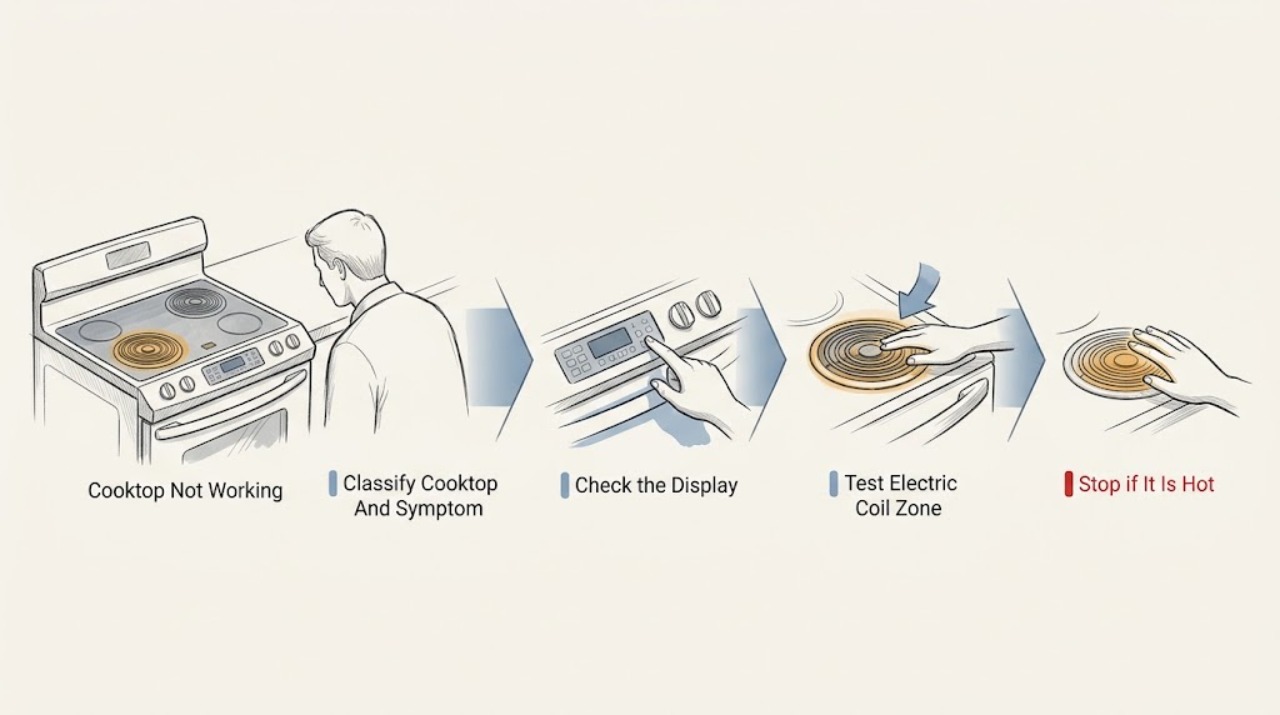
First identify the cooktop type and whether the whole appliance is dead or only one cooking zone fails. From a safe position, check that power is present, the controls are set according to the model manual, and a gas burner has its cap seated with clean visible ports. For an electric coil model, a failed zone can be compared with another zone; for a glass or induction model, use the model’s reset and cookware instructions, and induction cookware must be suitable for the zone. Do not open the cooktop, probe live terminals, bypass a safety device, or keep trying a gas burner when you smell unburned gas. If every zone remains off, a newly installed unit has a suspected wiring or voltage issue, the glass is cracked, the gas flame is abnormal, or safe checks do not restore operation, stop and arrange qualified appliance service.
Work through in order
Diagnostic checks
Use only checks that match the exact appliance or system and its official guide.
-
Check 1
Identify whether the Frigidaire cooktop is gas, electric coil, smooth glass or ceramic, or induction, then observe the display or indicators and test only the normal controls from a dry, safe position.
Expected result: Record whether every zone and indicator is off, one zone is off while others work, gas clicks but does not ignite, an induction zone shows no heat with a pan, or the glass is damaged.
Next step: Follow the corresponding gas, coil, glass, or induction branch below and use the model manual for control symbols and lock functions.
Stop if: Stop for gas odor, smoke, sparking, a cracked or shattered glass surface, exposed wiring, or a control area that is hot, wet, or physically damaged.
Why this matters
Why: An all-zone failure points toward supply, control, or installation. A single-zone failure supports a zone-specific check. Gas ignition and induction detection have different causes, so a pan or burner-cap adjustment cannot diagnose an electric control fault.
-
Check 2
With no cookware or loose objects on the surface, verify from outside that the cooktop has its intended power, the controls are not locked or paused, and the selected control sequence matches the exact owner’s manual; do not remove the junction-box or control cover.
Expected result: The display or indicator returns and controls respond, only one zone remains inactive, or the entire cooktop stays dead after a model-approved reset or power check.
Next step: For a glass cooktop, use only the reset interval specified by Frigidaire or the model manual; if all zones remain off or wiring is suspected, arrange qualified appliance or electrical service.
Stop if: Do not probe live terminals, bypass a lock or safety switch, change a breaker rating, use improvised wiring, or repeatedly reset a tripping protective device.
Why this matters
Why: A responsive display with one failed zone moves the diagnosis to that zone. A dead whole cooktop, a recent installation, or a failed reset can indicate voltage, wiring, supply, or control trouble that cannot be safely confirmed by touching terminals.
-
Check 3
For an electric coil cooktop only, disconnect power as the model instructions require, inspect the visible coil for damage, confirm its center safety switch moves normally, and reseat the coil without forcing it; compare the result with another compatible zone only if the manual permits.
Expected result: The coil is visibly damaged, the center switch does not return, the same coil fails in another receptacle, the receptacle fails with another compatible coil, or both zones behave normally.
Next step: Reinstall only a sound coil that seats correctly. Arrange service for a damaged coil, abnormal safety switch, failed receptacle, or any need to access internal wiring.
Stop if: Do not test or swap coils while energized, bend terminals, bypass the safety switch, or open the cooktop base.
Why this matters
Why: A fault that follows the coil supports a coil problem; a fault that stays with one receptacle supports the receptacle or control path. A stuck switch or damaged coil is not a cleaning issue and should not be bridged.
-
Check 4
For a smooth glass or induction cooktop, inspect the surface from above for cracks or impact damage, then use a clean, flat pan of the appropriate material and size while following the model’s control sequence; do not slide rough cast iron across the glass.
Expected result: The surface is intact and a suitable pan heats, the pan is not detected, the pan is unsuitable or uneven, only one zone fails, or the glass is cracked.
Next step: Use cookware and settings specified by the owner’s manual. If a model-approved reset does not restore a zone or the surface is damaged, stop using it and arrange qualified service.
Stop if: Do not operate a cooktop with cracked glass, use a pan as a test on a damaged zone, lift or remove the glass, or touch the underside.
Why this matters
Why: Frigidaire says cookware affects glass heating and that induction cookware must be suitable; a magnet sticking to the base is a useful material check for induction, but it does not prove the zone or control is sound. A cracked surface or one zone that stays off with suitable cookware requires service.
-
Check 5
For a gas cooktop, with the area cool and the control off, confirm the burner cap is present, level, and seated on the burner head; inspect visible ports for food debris, then use only the Frigidaire-approved cleaning method before trying the burner again.
Expected result: The cap is displaced, ports are visibly blocked, the igniter clicks with no flame, the flame is uneven or too high, or there is a gas odor without normal ignition.
Next step: Correct only a plainly mis-seated cap and clean visible ports as directed; if the burner still does not light, the flame remains abnormal, or gas is suspected, stop and obtain qualified gas or appliance service.
Stop if: Do not use abrasive cleaners, steel wool, oven cleaner, open flame, compressed gas, or a tool that enlarges a port; leave the area and follow local emergency guidance for a strong gas odor.
Why this matters
Why: A displaced cap or blocked port can interrupt gas flow or produce an uneven flame. Clicking without ignition can also involve gas supply or ignition hardware. Unburned gas odor is a stop condition, not a cue to keep clicking or to disassemble the burner.
-
Check 6
After one safe correction appropriate to the cooktop type, observe a single zone or burner at normal operation without leaving cookware unattended and record whether heat or flame returns consistently.
Expected result: Operation returns normally, the same zone remains dead, all zones remain dead, the control trips, the glass heats unevenly, or a gas flame remains unstable.
Next step: Stop further testing and arrange qualified appliance service; provide the model and serial information, cooktop type, affected zones, control or flame behavior, installation history, and checks already completed.
Stop if: Do not keep operating a cooktop with a crack, abnormal flame, smoke, sparking, damaged wiring, repeated trips, or a hot control area.
Why this matters
Why: A repeatable recovery after a seated coil, suitable pan, clean port, or model-approved reset supports that external condition as the contributor. Persistent failure, an all-zone problem, unstable gas, or electrical interruption points to service-level diagnosis.
Use your observations
Decision map
Find the observation that best matches what you see, then follow the next safe action.
-
PATH 01Safety boundary
What you see
No display, indicator, ignition response, or heating zone works after safe power and control checks.
Do this next
For a recent installation, have the installer or qualified electrician verify the installation; otherwise arrange qualified appliance service.
Why this path and its safety boundary
Why it matters: A supply, voltage, wiring, lock, or main control issue is more likely than a single burner or coil failure.
Safety stop: Do not open the junction box, probe terminals, bypass a lock, or repeatedly reset a tripping protective device.
-
PATH 02Safety boundary
What you see
Other electric zones work but one coil or glass zone does not heat.
Do this next
Use the limited coil comparison only when the model allows it, or test the glass zone with suitable cookware; arrange service if the fault follows the zone or remains after reset.
Why this path and its safety boundary
Why it matters: The failed zone, coil, receptacle, element control, or surface-level zone circuit is more plausible.
Safety stop: Do not bridge a coil safety switch, access live wiring, or lift the glass surface.
-
PATH 03Safety boundary
What you see
An induction zone powers but does not heat or indicates no suitable pan.
Do this next
Try one clean, flat, suitable pan and verify the control sequence in the model manual. If a suitable pan fails on one zone, arrange service.
Why this path and its safety boundary
Why it matters: Cookware material, base flatness, size, placement, or the zone’s detection circuit may be involved; an unsuitable pan does not prove a cooktop failure.
Safety stop: Do not use rough cookware that can scratch the glass, slide cast iron, or remove the glass to inspect the coil.
-
PATH 04Safety boundary
What you see
A gas burner clicks but does not ignite, has a weak or uneven flame, or its cap or ports are visibly displaced or blocked.
Do this next
With gas off and the surface cool, restore a plainly mis-seated cap and clean visible ports only as Frigidaire directs; obtain service if ignition or flame remains abnormal.
Why this path and its safety boundary
Why it matters: Cap placement, food debris, moisture, gas flow, or ignition hardware can affect the burner.
Safety stop: Stop for unburned gas odor, repeated failed ignition, yellow or unstable flame, or any need to disassemble the gas path.
-
PATH 05Safety boundary
What you see
The glass is cracked or shattered, a burner head is damaged, or the control surface is wet or physically broken.
Do this next
Stop using the affected cooktop, keep people away from the damage, and arrange qualified appliance service.
Why this path and its safety boundary
Why it matters: The cooktop can present burn, shock, gas, or glass-cut hazards and should not be treated as a simple setting issue.
Safety stop: Do not cover a crack as a repair, operate the zone, scrape broken glass, or reach under the surface.
-
PATH 06Safety boundary
What you see
Power, controls, suitable cookware or cap placement, and visible cleaning checks are correct, but the cooktop still does not work.
Do this next
Stop owner troubleshooting and arrange qualified appliance service with the model, affected zone, symptom, and test history.
Why this path and its safety boundary
Why it matters: An internal element, ignition system, sensor, control, wiring, or power component may need diagnosis.
Safety stop: Do not replace internal parts by appearance, bypass safety devices, or work inside the cooktop while connected to power or gas.
Helpful context
Understand the symptom
Start by separating a dead cooktop from one failed zone
If the display, indicators, igniters, and every zone are inactive, begin with the supply, controls, and installation path. If one zone fails while others work, the fault is more localized: a coil, receptacle, burner cap or port, induction cookware interaction, or one control channel. Frigidaire notes that models vary, so the exact control sequence and reset method must come from the owner’s manual for the model on the rating label.
Use the cooktop-type branch instead of mixing procedures
Gas cooktops need a seated cap, clear burner ports, the control in the lighting position, and safe gas conditions. Electric coil units allow a limited visual coil and receptacle comparison after power is disconnected. Glass and induction units need intact surfaces, correct controls, and suitable cookware; an induction zone may appear inactive when the pan material is not detected. Never use a gas cleaning instruction on an induction surface or remove a glass panel to reach wiring.
Stop at wiring, gas, and damaged-glass boundaries
A cooktop combines high electrical energy or gas with hot surfaces. Frigidaire directs owners to the owner’s manual and service when the basic checks do not resolve a failure. A cracked glass surface, exposed conductor, repeated protective trip, gas odor, yellow or unstable flame, or a failure that affects every zone is a service condition, not an invitation to bridge a switch, clean inside the appliance, or replace a part by guesswork.
Safety boundary
Stop conditions
- Stop immediately for unburned gas odor, smoke, sparking, exposed wiring, repeated protective trips, a hot control area, or water near electrical parts.
- Do not open the junction box or cooktop base, probe live terminals, bypass a switch or lock, change protective-device ratings, or improvise wiring.
- Do not operate a glass or ceramic cooktop with a crack or shattered surface, and do not scrape, lift, or cover broken glass as a repair.
- Do not enlarge gas ports, use an open flame to test ignition, disassemble the gas path, or keep clicking a burner when gas does not ignite.
- Do not replace a coil, element, sensor, or control by appearance alone; stop and use qualified service when the fault persists.
Only after diagnosis
Potential parts
- electric surface element or coil
Consider this only if a qualified diagnosis shows that one electric element or coil is faulty after the comparison and power checks.
Confirm the exact model and manufacturer fit information before ordering; do not use a coil to bypass a safety switch or damaged receptacle. - gas burner cap or ignition component
Consider this only if the cap is damaged or a qualified technician confirms an ignition or burner component fault after ports and placement are checked.
Confirm the exact model and gas configuration before any replacement; gas-path work requires qualified service. - induction surface control or sensor
Consider this only when a suitable pan fails on one zone after the manual control sequence and a qualified technician identifies a sensor or control fault.
Use model-specific fit and service information; do not open the glass assembly or substitute a control by appearance.
When checks do not resolve it
Need a professional?
Arrange qualified appliance service when every zone remains inactive, a newly installed unit may have a wiring or voltage problem, an electric zone fails after the coil or cookware checks, a gas burner still will not ignite, a flame is unstable, or an induction zone fails with suitable cookware. Stop immediately for gas odor, smoke, sparking, repeated protective trips, damaged wiring, a cracked or shattered glass surface, or a hot or wet control area.
Common questions
FAQ
Why is my Frigidaire cooktop completely off?
Check the supply and model-specific controls from a safe position. If every indicator and zone remains off, especially after a recent installation, a voltage, wiring, lock, or main control issue needs qualified service rather than internal testing.
Why does one Frigidaire electric burner not work?
For a coil model, a qualified-safe comparison of the coil and another compatible zone can show whether the problem follows the coil or stays with the receptacle. For a glass model, use suitable cookware and the model reset instructions; a persistent single-zone failure needs service.
Why will my Frigidaire gas cooktop not light?
Confirm the knob is in the lighting position, the cap is seated level, the visible burner ports are not blocked, and the power connection is present. If it still does not ignite, or you smell unburned gas, stop and obtain qualified service.
Why does my Frigidaire induction cooktop not heat my pan?
Use a clean, flat pan that is suitable for induction and follow the model’s control sequence. Frigidaire says a magnet sticking to the pan base indicates a suitable material, but a suitable pan that fails on one zone still requires service assessment.
Can I reset a Frigidaire glass cooktop that is not heating?
Frigidaire’s no-heating guidance includes a short power reset for a glass cooktop. Use only the model-approved procedure; if no zones heat afterward, or the unit was recently installed, arrange qualified wiring or appliance service.
When should I stop troubleshooting a Frigidaire cooktop?
Stop for gas odor, smoke, sparking, repeated protective trips, damaged wiring, a cracked glass surface, unstable gas flame, or any need to open the cooktop. Persistent failure after safe external checks belongs with qualified appliance service.
Read the exact guide
Official sources
- Ranges - No HeatingFrigidaire · Frigidaire electric coil and glass cooktop surface heating problems
- Gas Cooktop Ignition Port Cleaning GuideFrigidaire · Frigidaire gas cooktop ignition ports and burner heads
- Ranges - What type of cookware do I use with Induction?Frigidaire · Frigidaire induction cooking zones and cookware detection complaints
- What should I do if some or all of my burners are not lighting?Frigidaire · Frigidaire gas cooktops and gas ranges with burners that do not light
- How do I use my display or controls?Frigidaire · Frigidaire cooktop controls, settings, timers, and child-lock behavior
Community feedback
Share a repair observation
Share a plain-text repair observation. Accepted observations are published automatically; this page may take a moment to update.