
On this page
Start here
Quick answer
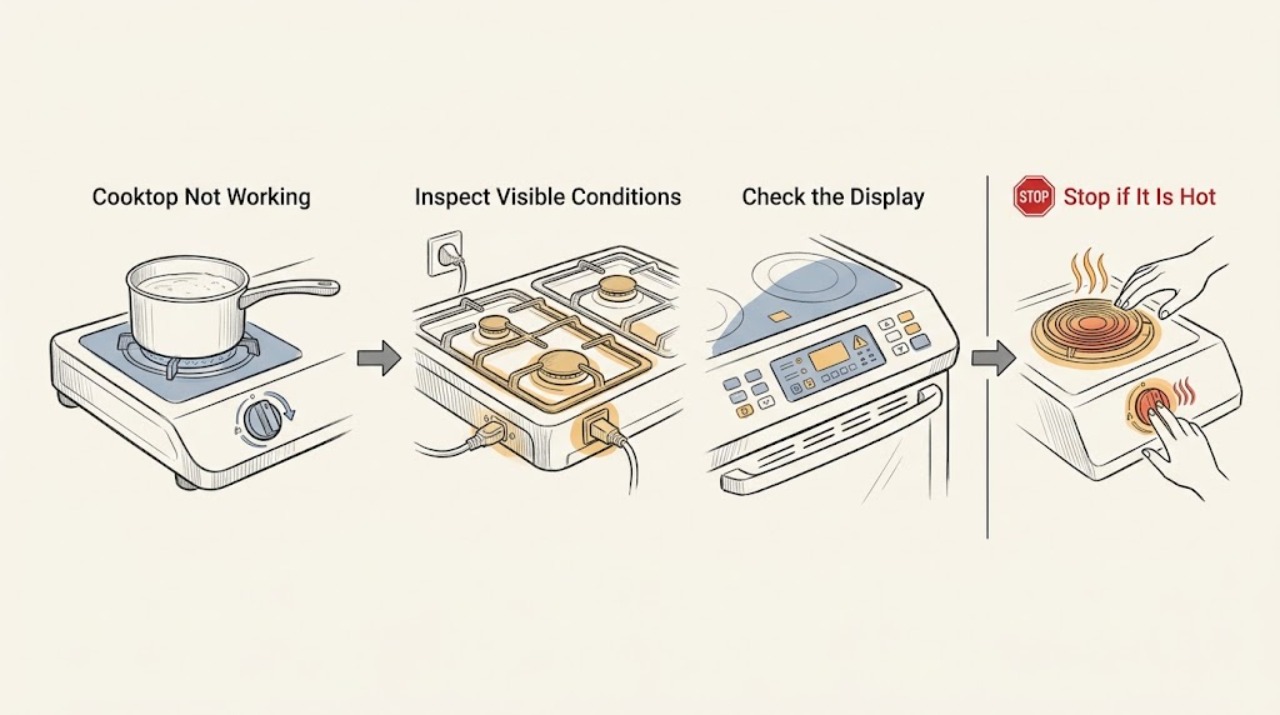
First separate a cooktop with no display or no power from one where only a burner or zone fails. From a dry, safe position, check for an outage, control lock, incorrect setting, or tripped supply protection; then identify whether the surface is gas, electric radiant or coil, or induction. Gas smell, abnormal flame, arcing, smoke, a cracked glass surface, burning odor, or repeated breaker trips are stop conditions. For induction, a suitable flat pan centered on the marked zone is required. For gas, a correctly seated burner cap and the correct control matter. If the safe external checks and one model-approved reset do not restore operation, leave the cooktop off and arrange qualified service.
Work through in order
Diagnostic checks
Use only checks that match the exact appliance or system and its official guide.
-
Check 1
Before testing a control, identify whether the surface uses gas burners, electric coils, radiant glass, or induction. Look for a complete blank panel, a single unresponsive zone, a displayed message, or a visible safety concern without touching hot, wet, cracked, or arcing areas.
Expected result: The whole cooktop is dark, the controls light but one area fails, the display shows a lock or error message, or a gas, fire, glass, or electrical hazard is visible.
Next step: Use the matching technology branch. If any gas, fire, arcing, damaged glass, or electrical danger is present, stop and arrange emergency or qualified service instead of testing further.
Why this matters
Why: The affected scope selects the power/control, local burner or element, cookware, or immediate safety branch; a hazard is not a normal no-heat symptom.
-
Check 2
From a dry and safe position, confirm that the intended control is selected and that a control lock, child lock, showroom or demo state, timer, or other mode is not blocking operation. Use only the owner's manual procedure for clearing a mode.
Expected result: The control lock or an incorrect mode is active, or the selected control responds but the zone still does not heat or ignite.
Next step: Clear the mode only as the exact model manual directs. If the zone remains dead, continue with the gas, induction, or electric branch rather than repeating button presses.
Why this matters
Why: A control state can prevent normal operation without a failed heating part; a responsive control with a dead zone needs a technology-specific check.
-
Check 3
From a dry, safe position, check whether the home has power and whether the cooktop's fuse or breaker has opened. If protection has tripped, reset it only once when there is no water, smoke, heat damage, or other electrical warning, and do not open the cooktop.
Expected result: The panel returns after power is restored, the breaker trips again, or the panel stays blank while other appliances have power.
Next step: Leave a recurring trip or damaged supply off and call a qualified electrician or appliance technician. If power is stable, continue with the affected-zone branch.
Why this matters
Why: An outage or supply interruption can explain a blank or inactive surface. A repeated trip or persistent blank panel suggests an electrical or appliance fault, not a user setting.
-
Check 4
For an induction zone, place a clean, dry, flat, magnetic pan centered within the marked zone and select the zone and heat setting as the manual shows. Keep hands away from any hot surface and do not use a pan that rocks or does not contact the glass.
Expected result: The zone detects the pan and heats, or the power level flashes and turns off even with a suitable centered pan.
Next step: Use a pan that meets the model's stated requirements. If multiple zones fail or the zone still refuses a suitable pan, stop and request service; do not remove the glass or test internal wiring.
Why this matters
Why: A pan's material, size, position, or flat contact can prevent induction activation. Continued failure with a suitable pan points to power, control, or sensor service.
-
Check 5
For a gas surface, verify from outside the burner area that the intended knob matches the burner and that the removable cap is seated on the correct burner and is dry. If there is no gas smell and the manual permits normal ignition, observe whether the igniter clicks and a stable flame appears; do not keep releasing gas when it does not ignite.
Expected result: The cap is misplaced or wet, the igniter does not click, other burners also fail, or a flame is yellow, unstable, delayed, or absent after gas is released.
Next step: Correct only a safe, visible cap or control mismatch. If ignition remains absent, the flame is abnormal, or gas is smelled, turn controls off if safely reachable, leave the area for a suspected leak, and arrange qualified service.
Why this matters
Why: A cap or control mismatch can prevent proper ignition, while no clicking across burners or an abnormal flame needs service or gas-system attention. A gas smell changes this into an immediate evacuation condition.
-
Check 6
For an electric coil or radiant zone, select the correct zone and setting, then observe from a safe distance whether the element cycles normally or whether the entire zone stays cold after it has had time to respond. Do not touch the glass or coil to judge temperature.
Expected result: The element cycles or the surface remains warm even when it is not glowing, or one zone stays cold while the rest operate.
Next step: Allow a hot surface to cool. If one zone remains inoperative after the model-approved checks, keep the cooktop off and arrange service rather than opening it or swapping components.
Why this matters
Why: Cycling and a non-red warming area can be normal. One persistently cold zone with stable power points toward that zone's element, limiter, sensor, or control path.
-
Check 7
If the model manual allows a power reset, perform one reset only from a dry and safe position after the cooktop is cool and no hazard is present. Record whether operation returns and whether the same fault recurs.
Expected result: The cooktop works after the single reset, or it remains dead, loses power again, or repeats the same symptom.
Next step: Stop using the cooktop if the fault recurs. Provide the model, technology, affected zone, display message, and reset result to qualified service.
Why this matters
Why: A reset can clear a transient control state, but recurrence indicates an unresolved power, control, sensor, heating, or ignition fault.
-
Check 8
Prepare a service record with the cooktop type, model number, all affected zones, exact display message, breaker behavior, pan or burner observations, and any gas, heat, smoke, glass, or arcing event.
Expected result: The symptom is repeatable or the documented evidence shows that safe external checks did not restore operation.
Next step: Leave the cooktop off and arrange qualified appliance service; use an electrician for supply-side faults and the gas supplier or emergency services for suspected gas leaks.
Why this matters
Why: A precise record helps separate a power fault from a local element, induction detection, gas ignition, or control problem without unsafe disassembly.
Use your observations
Decision map
Find the observation that best matches what you see, then follow the next safe action.
-
PATH 01Safety boundary
What you see
Is there a gas smell, abnormal flame, smoke, fire, visible arcing, cracked glass, damaged wiring, or a breaker that trips again?
Do this next
Stop using the cooktop. For suspected gas, leave immediately and contact the gas supplier or emergency services from outside; for fire or smoke, evacuate and call emergency services.
Why this path and its safety boundary
Safety stop: Do not operate switches, flames, ignition controls, or a phone in a suspected gas-leak area, and do not touch wet or damaged electrical equipment.
-
PATH 02Safety boundary
What you see
Is the entire panel blank or is household power unavailable?
Do this next
From a dry position, check the supply protection and restore it only once if safe; leave the cooktop off and call a qualified electrician if it trips again or stays blank.
Why this path and its safety boundary
Safety stop: Stop before touching a breaker if the floor, outlet, cord, or cooktop is wet, hot, smoky, or damaged.
-
PATH 03Safety boundary
What you see
Is a control lock, demo mode, incorrect zone, or incorrect setting shown or suspected?
Do this next
Use the exact model manual to clear the mode or select the intended zone; do not guess a key sequence.
Why this path and its safety boundary
Safety stop: Stop if the control does not respond, the message returns, or abnormal heating begins.
-
PATH 04Safety boundary
What you see
Is the cooktop induction and does a clean, flat, magnetic, centered pan operate the zone?
Do this next
The original problem was likely pan detection or placement; follow the model's cookware requirements.
Why this path and its safety boundary
Safety stop: Do not remove glass, probe internal wiring, or continue using a cracked or overheated surface.
-
PATH 05Safety boundary
What you see
Is the cooktop gas, with a correctly seated dry cap and a normal click and flame?
Do this next
Use the model's normal control procedure and observe the flame without further adjustment beyond the documented setting.
Why this path and its safety boundary
Safety stop: Never keep releasing gas to repeat a failed ignition test or inspect a gas connector by moving the appliance.
-
PATH 06Safety boundary
What you see
Is the surface electric coil or radiant, with stable power but one zone still cold?
Do this next
Allow the surface to cool and request appliance service for the local element, limiter, sensor, or control path.
Why this path and its safety boundary
Safety stop: Stop for a hot surface that will not regulate, smoke, arcing, damaged glass, or repeated power trips.
-
PATH 07Safety boundary
What you see
Did one model-approved power reset restore the cooktop without any safety symptom?
Do this next
Record the reset and monitor only according to the manual, stopping at the first recurrence.
Why this path and its safety boundary
Safety stop: Do not repeat resets to suppress a recurring fault or continue a zone that heats uncontrollably.
Helpful context
Understand the symptom
Identify the failure before touching anything
A completely dark control panel points toward power, while a lit panel with one dead zone points toward a setting, cookware, burner, element, or local control. Gas, radiant, coil, and induction surfaces do not share the same checks. Note the surface type, whether every zone is affected, any displayed message, and what happened immediately before the failure.
Normal behavior can look like a fault
Radiant elements may cycle on and off to limit temperature, and a warming area may not glow red. Induction power can stop when a pan is missing, too small, off-center, nonmagnetic, or not flat against the glass. A dark surface alone does not prove that the cooktop is dead, so check the correct branch before ordering a part.
Safety overrides troubleshooting
Do not continue with a gas smell, yellow or unstable flame, repeated ignition without a flame, smoke, fire, visible arcing, a cracked glass surface, damaged wiring, or a breaker that trips again. Leave a suspected gas leak and contact the gas supplier or emergency services from outside. Keep away from wet or energized equipment and use qualified service.
Safety boundary
Stop conditions
- Stop immediately for a gas smell, yellow or unstable flame, delayed ignition, smoke, fire, visible arcing, burning odor, cracked glass, uncontrolled heat, damaged wiring, or a breaker that trips again.
- For suspected gas, leave the area and contact the gas supplier or emergency services from outside; do not operate electrical switches, use a phone, light a flame, or keep testing the burner.
- Do not open the cooktop, test live wiring, move a gas appliance to inspect its connector, bypass a control lock, or operate a cracked glass surface.
- Do not touch a hot coil or glass surface to determine whether it works; cycling or a dark warming area can be normal.
- Do not repeatedly reset power or continue using a cooktop after the same fault returns.
Only after diagnosis
Potential parts
- cooktop electronic control
Consider only when a technician confirms a control or sensor fault after stable supply and correct user settings are established.
Control designs vary by model and technology; verify the exact model and manufacturer fit information before ordering. - electric heating element or limiter
Consider only when one coil or radiant zone remains cold and qualified diagnosis identifies the element or limiter path.
Coil, radiant, and induction components are not interchangeable; confirm the exact model and technology. - induction pan sensor or control component
Consider only when a suitable centered pan is repeatedly rejected and service confirms a sensor or control fault.
Use the exact model's technical and manufacturer fit information; do not dismantle the glass surface. - gas burner igniter or burner assembly
Consider only after a qualified technician confirms a no-click, ignition, or burner fault and rules out a gas-supply safety condition.
Gas parts require exact model and fuel compatibility; do not bypass safety controls or replace gas components without qualification.
When checks do not resolve it
Need a professional?
Call qualified appliance service when safe external checks do not restore a zone, a suitable induction pan is rejected, a gas igniter does not click, or a fault returns after one permitted reset., Call a qualified electrician for a persistent blank panel, repeated breaker trip, damaged cord, outlet, or supply-side issue., Contact the gas supplier or emergency services for a suspected gas leak, and emergency services for smoke or fire.
Have this ready
- Provide the model number, cooktop technology, affected zones, exact display message, power or breaker behavior, pan or cap observations, and the timing of any smoke, odor, arcing, abnormal flame, or uncontrolled heat.
Common questions
FAQ
Why is my cooktop completely blank?
A power outage, open fuse or breaker, control state, or supply fault is more likely than a single bad burner when the whole panel is dark. Check the supply only from a dry, safe position and leave the cooktop off if protection trips again.
Why does only one induction zone not work?
Induction needs a suitable magnetic, flat pan centered on the marked zone and in full contact with the glass. If a suitable pan is still rejected, the zone's sensor or control needs model-specific service.
Why does my electric cooktop element look off even when it is working?
Radiant elements can cycle on and off, and a warming or simmer area may not glow red. A surface can remain hot after the element cycles off. Follow the exact manual and do not touch the surface to test it.
What can I check when a gas cooktop burner will not light?
With no gas smell and no other hazard, check that the intended knob matches the burner and that the visible cap is seated correctly and dry. If the igniter does not click, the flame is abnormal, or gas is smelled, stop and arrange qualified or emergency help as appropriate.
Can I reset a cooktop that stopped working?
Only use a reset explicitly allowed by the model manual, from a dry and safe position, when the surface is cool and there is no gas, smoke, arcing, damaged glass, or repeated breaker trip. Do it once; a recurring fault needs service.
When should I stop using a cooktop?
Stop for gas odor, abnormal flame, smoke, fire, visible arcing, burning odor, cracked glass, uncontrolled heat, damaged wiring, wet electrical parts, or a breaker that trips again. Leave a suspected gas leak and contact help from outside.
Read the exact guide
Official sources
- CookingU.S. Fire Administration · U.S. government cooking and oven-fire safety guidance
- Appliance and Electrical Fire SafetyU.S. Fire Administration · U.S. government appliance cord, outlet, and electrical fire-safety guidance
- Gas Range & Cooktop - Surface Burners Not Clicking, Not Trying to IgniteGE Appliances · Manufacturer gas cooktop burner selection, cap seating, ignition, power, and service guidance
- Cooktop Not Working - Electric CooktopWhirlpool · Manufacturer electric radiant cooktop normal cycling, warming-area behavior, and service guidance
- Electric Range & Cooktop - Surface Burners Not Heating WellGE Appliances · Manufacturer electric cooktop zone selection, cookware contact, and partial-heating guidance
- Certain Older Gas Connectors May Be DangerousU.S. Consumer Product Safety Commission · Government gas-leak evacuation, no-switch, no-flame, and qualified-inspection guidance for gas appliances
- Electric Range & Cooktop - Induction Burners Not Working or Flashing Power LevelGE Appliances · Manufacturer induction cooktop cookware detection, pan placement, controls, and power guidance
- Not Powering On - Electric CooktopWhirlpool · Manufacturer electric cooktop no-power, control-lock, breaker, model-manual, and single-reset guidance
- Range, Cooktop & Wall Oven - Power Outage Tips and OperationGE Appliances · Manufacturer cooktop operation during power outages for electric, induction, gas, and dual-fuel appliances
Community feedback
Share a repair observation
Share a plain-text repair observation. Accepted observations are published automatically; this page may take a moment to update.