
On this page
Start here
Quick answer
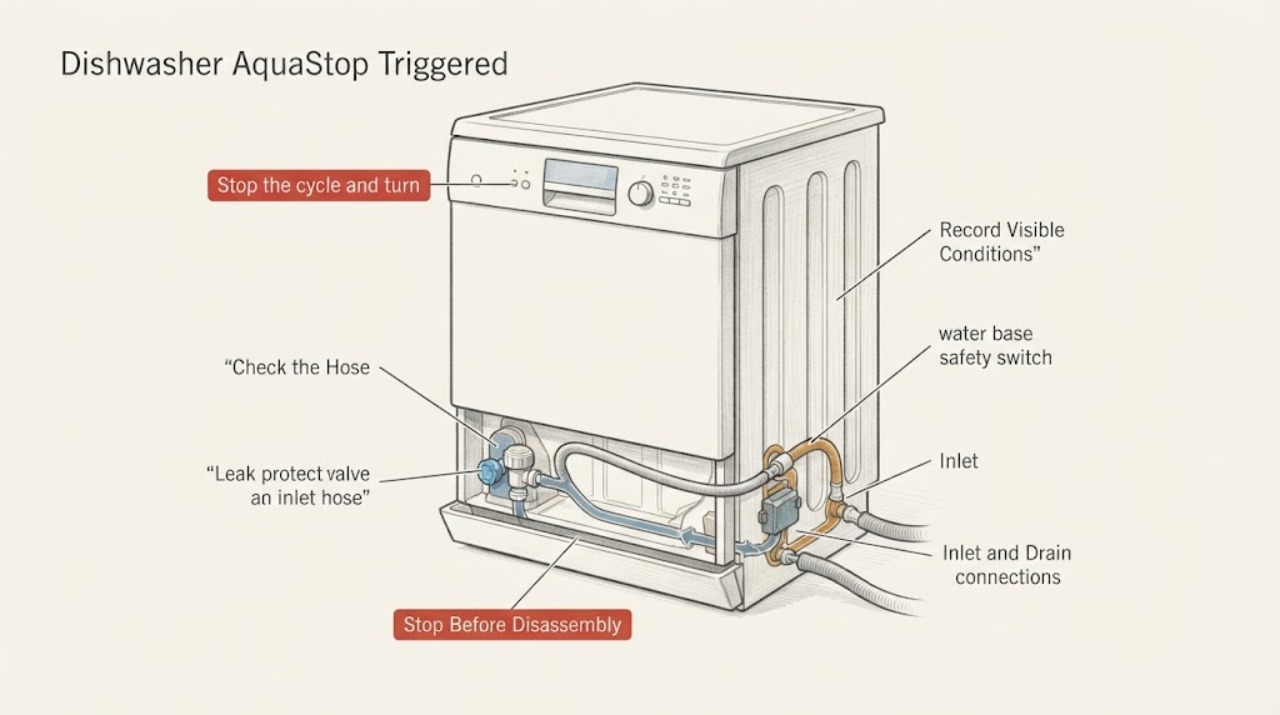
Treat a Bosch dishwasher AquaStop trigger as a possible water-leak protection event. Stop the cycle, turn off the dishwasher's water inflow, and disconnect power only when it is safe to do so; do not keep restarting it or bypass the float/safety switch. Bosch says E15 means the safety switch detected water in the dishwasher base and the leakage-protection system was activated, but AquaStop behavior and displays vary by model. From outside, record any water at the door, hoses, connections, or floor and note whether the machine shows E15, E3100, a water symbol, beeps, or no display. Do not tip the dishwasher, open the base, or reset it until the cause is assessed. If the supply will not shut off, water continues, the alarm returns, or no visible leak explains the trigger, keep water and power isolated when safe and arrange Bosch or qualified appliance service.
Work through in order
Diagnostic checks
Use only checks that match the exact appliance or system and its official guide.
-
Check 1
Stop the cycle and turn off the dishwasher's water inflow at the accessible shutoff valve. Disconnect power at the plug or breaker only when it is safe to reach and there is no active electrical hazard; do not reach into standing water or repeatedly restart the machine.
Expected result: Water continues to enter, the valve cannot be closed, water is near electrical connections, or the dishwasher stops filling after the supply is closed.
Next step: Keep water and power isolated when safe and arrange qualified service. If water is spreading or electrical contact is possible, leave the area and use appropriate emergency help; do not remove the base or bypass the protection system.
Why this matters
Why: An AquaStop response is a water-protection event until proven otherwise. Bosch's E15/E3100 guidance specifically says to turn off water inflow and contact support, while Bosch describes AquaStop as shutting down operation and pumping water when a leak occurs.
-
Check 2
From outside the appliance, look for water at the door edge, door seal, visible inlet/drain hose connections, under-sink plumbing, and the floor. Do not pull out a built-in dishwasher or remove a toe-kick panel while water or power remains connected.
Expected result: Water is visible at the door, a hose or connection, the floor/under-counter area, or no external water is visible.
Next step: Photograph the visible water and leave the appliance isolated. Do not tighten or replace a hidden hose, open the base, or run a test cycle; give the service technician the location and timing.
Why this matters
Why: A visible source narrows the service report but does not prove whether the AquaStop sensor, inlet valve, hose, seal, drain path, or base pan is responsible. No visible water does not clear the base or internal leak because the protection switch may have detected water out of sight.
-
Check 3
Read the display and indicator pattern without applying a model-unknown reset. Record E15, E3100, a water-tap symbol, flashing lights, repeated beeps, or no display, and note whether the dishwasher was mid-cycle or had already drained.
Expected result: E15/E3100 or a safety-switch pattern appears, only beeps appear, a water-supply indicator appears, or the dishwasher has no display.
Next step: Use the exact model manual to identify the indicator, but keep water and power isolated for a confirmed protection state. If the display is absent or the pattern is not documented for the model, arrange service rather than guessing a code or resetting repeatedly.
Why this matters
Why: Bosch documents E15/E3100 and related flashing-active states as water in the base/leakage protection activated; its troubleshooting guide says repeated beeps can indicate water at the base. A water-tap symbol or no display has different possible causes and is not interchangeable with AquaStop.
-
Check 4
Check only the accessible water-supply valve and visible hose condition for a closed valve, kink, crack, or loose connection. Do not disconnect the AquaStop hose, manipulate its safety body, or open a fitting under pressure.
Expected result: The valve is closed, a visible hose kink or damage is present, a connection is wet, or the supply and visible hose appear normal.
Next step: Leave a damaged or wet connection isolated and arrange service. If the visible supply path is normal but AquaStop remains triggered, do not restore water to test it; the unresolved cause requires model-specific inspection.
Why this matters
Why: A visible supply problem may explain the water event or a related filling symptom, but it does not establish that the AquaStop assembly itself failed. Bosch's water-flow guidance separates inlet/filling issues from E15 base-water protection.
-
Check 5
Find the full Bosch E-Nr/model and serial information before consulting reset instructions or ordering any part. Use the exact model's owner manual and service route; do not assume that a Bosch dishwasher's AquaStop indication has the same reset steps as another series or region.
Expected result: The E-Nr selects a matching manual, or the model is missing/unreadable and the protection state remains active.
Next step: Provide the exact E-Nr, display pattern, water location, and power/water isolation status to Bosch or an authorized servicer. Keep the dishwasher unused until service clears the protection state.
Why this matters
Why: Bosch directs owners to have the model number ready and says dishwasher reset and error behavior can vary by model. Without the E-Nr, the safe meaning is limited to the documented protection boundary, not a valve, hose, sensor, pump, or board diagnosis.
-
Check 6
Do not tip, lift, dismantle, or run a rinse cycle solely to clear AquaStop. Do not bypass the float or safety switch, bridge a valve, or probe the dishwasher electrically. If a servicer later confirms the leak is repaired, follow only that model's documented reset/return-to-service procedure.
Expected result: The protection state clears only after service intervention, returns immediately when water is restored, or remains active with no visible water.
Next step: Keep water and power isolated when safe and arrange professional diagnosis. Do not treat a temporary reset or dry floor as proof that the dishwasher is safe to run.
Why this matters
Why: A return or persistent trigger indicates that the protection condition has not been safely resolved, even if the tub looks dry. Bosch's official guidance routes E15/E3100 and unresolved leakage protection to support rather than giving a universal user reset.
Use your observations
Decision map
Find the observation that best matches what you see, then follow the next safe action.
-
PATH 01Next step
What you see
E15, E3100, a documented active-light pattern, or repeated beeps indicate water in the base or leakage protection activated.
Do this next
Turn off the water inflow and keep power isolated when safe. Do not run, tip, or bypass the dishwasher; arrange Bosch or qualified service to locate the leak and clear the protection state.
Why this path and its safety boundary
Why it matters: This matches Bosch's documented water-in-base safety state; it overlaps with E15/leak-protection guidance but does not identify the leaking component.
-
PATH 02Next step
What you see
Water is visible at the door, a hose, a connection, or the floor, even if no E15 text is shown.
Do this next
Close the water supply and isolate power only when safe. Clean up standing water without opening the appliance and arrange service; do not tighten hidden fittings or run another cycle.
Why this path and its safety boundary
Why it matters: A visible leak can trigger or accompany AquaStop, but the source could be an accessible connection, door seal, inlet path, drain path, or an internal component.
-
PATH 03Next step
What you see
No water is visible, but AquaStop remains triggered or the protection indication returns as soon as water is restored.
Do this next
Keep water and power isolated and arrange model-specific service. Do not tip the unit, open the base, or bypass the safety switch to test it.
Why this path and its safety boundary
Why it matters: The protection switch or an internal leak condition may still be active out of sight; a dry floor does not prove the base is safe.
-
PATH 04Next step
What you see
The display shows only a water-tap or filling indication, the inlet hose is visibly kinked, or the supply valve is closed without a documented AquaStop/E15 state.
Do this next
Correct only a plainly closed valve or visible kink if safe and model-appropriate. If filling does not return or the AquaStop state appears, isolate water and arrange service rather than substituting an E15 reset.
Why this path and its safety boundary
Why it matters: This may be a water-entry condition rather than a confirmed leakage-protection trigger. Bosch documents filling and inlet-flow conditions separately from E15/E3100.
-
PATH 05Next step
What you see
The exact model is unknown, the indicator pattern is not documented, or the dishwasher shows a service-related code after water is isolated.
Do this next
Record the E-Nr, display pattern, water location, and isolation status and contact Bosch or an authorized servicer. Keep the dishwasher out of use until the protection event is assessed.
Why this path and its safety boundary
Why it matters: Model scope is unresolved. Bosch's general error list and AquaStop feature description cannot establish a compatible reset, hose, valve, sensor, or pump repair for an unidentified dishwasher.
Helpful context
Understand the symptom
AquaStop is a protection response, not a diagnosis of one failed hose, valve, pump, float, or control board. The task does not supply a model, so the exact display, reset controls, hose design, and service procedure remain model-specific. The immediate decision is to stop water and electrical risk, then identify whether there is an active leak or a persistent protection state.
This topic overlaps with Bosch E15/leak-protection guidance because E15 is one documented representation of water in the dishwasher base. The AquaStop-specific article adds the protection-system identity and the external distinction between water at a connection, water at the door or floor, and a trigger that persists without a visible leak; it does not treat every AquaStop message as a universal E15 code or prescribe an internal reset.
When checks do not resolve it
Need a professional?
Arrange Bosch or qualified appliance service for any AquaStop/E15/E3100 trigger, visible leak, protection state that returns when water is restored, an unexplained dry-base trigger, or a service-related code. Provide the complete E-Nr/model and serial information, display or light pattern, cycle timing, visible water location, and whether water and power were isolated. Do not tip or dismantle the dishwasher, bypass the float or AquaStop, or order a hose, valve, pump, sensor, or control from the symptom alone.
Common questions
FAQ
Is AquaStop triggered the same as Bosch E15?
They describe closely related leakage-protection situations, but the exact display and scope vary by model. Bosch defines E15/E3100 as a safety switch detecting water in the dishwasher base and directs the owner to shut off water inflow and contact support. Do not convert every AquaStop indication into a universal E15 reset or component diagnosis.
Can I reset a Bosch dishwasher after AquaStop activates?
Do not reset it as the first response. Turn off water inflow and isolate power only when safe, then identify and repair the leak through the exact model's service path. Bosch states that reset behavior can vary by model and directs E15/E3100 leakage-protection states to support.
What if there is no water on the floor?
A dry floor does not rule out water in the base or an internal leak path. If AquaStop remains active or the protection state returns when water is restored, keep the dishwasher isolated and arrange service. Do not tip the unit or bypass the safety switch to clear it.
Should I replace the AquaStop hose or inlet valve myself?
Not from the alert alone. The exact model, leak location, hose design, and service documentation are required. Keep water and power isolated when safe and let Bosch or a qualified servicer identify the failed or leaking part; do not open the base or work on a pressurized connection.
Read the exact guide
Official sources
- Bosch Expands Award-Winning Dishwasher Lineup With New 2-Rack 300 SeriesBosch · Opened Bosch's official press release. It states that AquaStop automatically shuts down operation and pumps water out if a leak occurs for the announced 300 Series; it is feature evidence, not proof of the exact task dishwasher's model-specific implementation.
- Bosch Dishwasher Error Codes: Troubleshooting GuideBosch · Opened Bosch's official US dishwasher error-code guide. It directly supports the E15/E3100 water-in-base safety meaning and turn-off-water instruction; exact displays and reset behavior still require the dishwasher E-Nr/model.
- Bosch Dishwasher Troubleshooting & Repair GuideBosch · Opened Bosch's official owner-support guide. It supports model manual lookup, external water/power checks, and service escalation; it does not authorize internal AquaStop or base-pan repair.
- Dishwasher Error Codes | Support | BoschBosch · Opened Bosch's official error-code table directly. It is US regional and model-family guidance; it is used to separate leakage protection from filling codes, not to diagnose an unidentified component.
Community feedback
Share a repair observation
Share a plain-text repair observation. Accepted observations are published automatically; this page may take a moment to update.