
On this page
Start here
Quick answer
A Bosch dishwasher filter that is packed with food soil, damaged, or not locked into its filter system can reduce wash performance and let debris recirculate, but a dirty filter is not the only possible cause of dishes remaining dirty. Check the exact model manual before removing parts, then let the tub and water cool, remove only owner-accessible filter components, rinse them with mild soap and a soft brush, and reinstall them fully. Also check for blocked spray arms, items that prevent spray-arm rotation or the detergent dispenser from opening, an unsuitable load or cycle, poor water supply, or standing water. Do not run the dishwasher without its filter, use sharp tools to probe the pump, open panels, test energized parts, or keep operating with a leak, smoke, electrical odor, severe noise, or standing water near electricity.
Before you begin
Safety first
- This article supports cool, dry, ordinary-access inspection and cleaning only when the exact Bosch manual permits it. Do not run without the filter, force or probe the filter or pump, open panels, disconnect pressurized plumbing, test live heating or electrical parts, bypass a door interlock, or continue operation with a leak, electrical symptom, severe noise, or standing water near power.
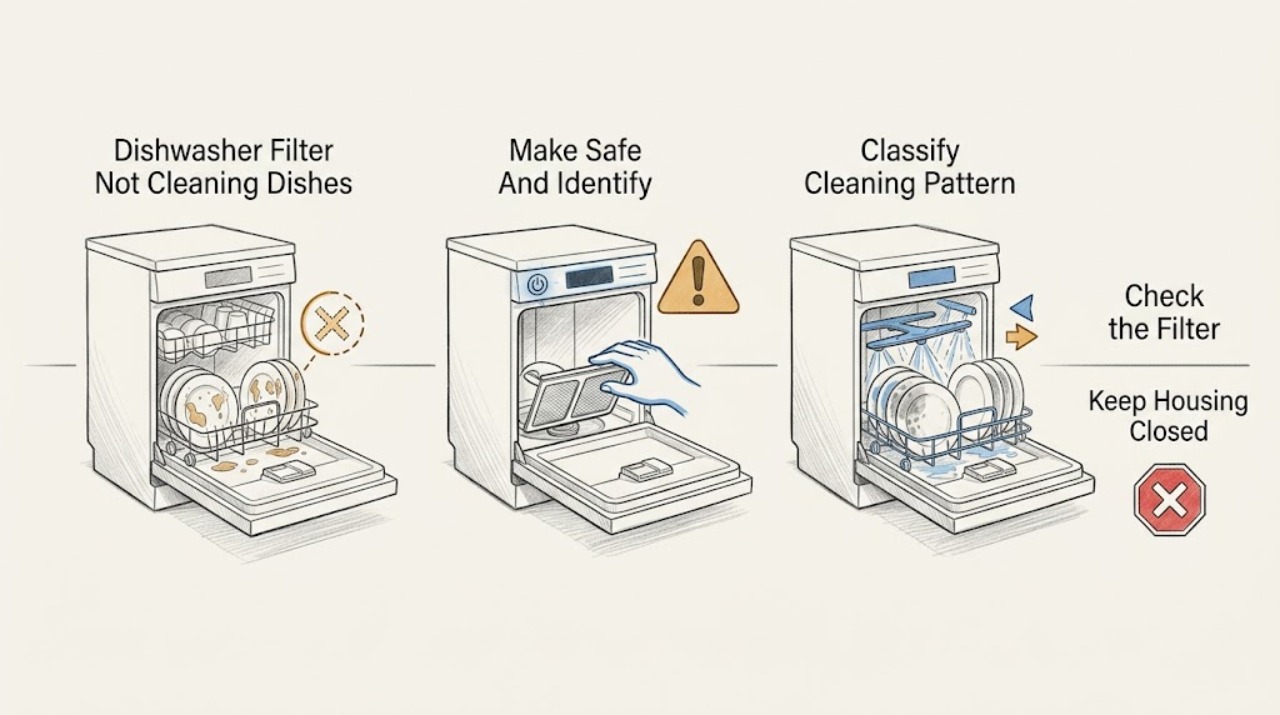
Work through in order
Diagnostic checks
Use only checks that match the exact appliance or system and its official guide.
-
Check 1
End the cycle with the normal control, wait until the spray action has stopped and the tub and water are cool enough to handle safely, then identify the exact Bosch model from a safe visible label or the manual. Look from outside for a leak, steam or burn injury risk, smoke, electrical odor, a hot or damaged cord, or water near the power area.
Expected result: Record the model, whether the issue is food soil, detergent film, mineral film, or debris, and whether there is standing water, a leak, unusual noise, an error indication, or an electrical warning.
Next step: Keep the dishwasher off and obtain qualified appliance, electrical, or plumbing help for a hazard. If the area is dry and safe, use the exact model manual for the next ordinary-access check.
Stop if: Do not touch a wet plug, cord, outlet, or cabinet, reach into a moving dishwasher, or repeatedly restart a machine with smoke, electrical odor, a leak, severe noise, or an error that requires service.
Why this matters
Why: A hazard or water near electricity is a stop-use condition. A symptom description without the model is not enough to apply one filter-removal design to every Bosch dishwasher.
-
Check 2
Review a representative load after it has cooled: note which rack and surfaces remain dirty, whether the residue is food, detergent, or mineral film, and which cycle and options were selected. Check whether tall items or a crowded rack could have blocked the spray arms or detergent dispenser.
Expected result: Record whether soil is concentrated on one rack or one side, appears across all dishes, or looks like a coating rather than uneaten food; record any item that contacts an arm or dispenser lid.
Next step: Correct only plainly visible loading interference as the manual permits, then inspect the filter and spray path separately rather than ordering a part from the soil pattern.
Stop if: Do not force racks, arms, the dispenser, or a filter assembly, and do not insert a hand into an area that is hot, sharp, or inaccessible.
Why this matters
Why: A one-rack pattern or a blocked arm points toward loading or spray coverage; residue across the load can still involve filter, water, detergent, heat, or circulation. Film is not proof that the filter is blocked.
-
Check 3
With the dishwasher cool and idle, remove the lower rack and follow the exact Bosch manual to access the filter. Inspect the mesh and coarse, fine, or micro-filter pieces for food soil, scale, cracks, missing clips, or a filter that is not seated; rinse only owner-accessible pieces with running water, mild soap, and a soft brush.
Expected result: Record whether the filter is visibly coated, whether debris sits between filter sections, whether any component is cracked or missing, and whether the manual's catches, arrows, or lock position can be restored without force.
Next step: Reassemble every filter section exactly as documented, make sure it locks or aligns, and reinstall the lower spray arm if the manual required removal. Request a model-specific filter assembly only if the exact model confirms a damaged or missing part.
Stop if: Do not run without the filter, force a stuck lock, drop debris into the sump, scrape mesh with a sharp object, remove a pump cover unless the exact owner procedure permits it, or continue if glass or sharp debris cannot be safely handled.
Why this matters
Why: Heavy soil or a loose assembly makes restricted filtration or recirculated debris plausible. A clean, intact, correctly seated filter makes spray coverage, load, water, detergent, heat, circulation, and drain paths more important.
-
Check 4
After the filter is secure, inspect each accessible Bosch spray arm for blocked holes, scale, cracks, or interference from the racks and dishes. If the exact guide permits removal, rinse the arm and clear a hole only with a blunt, non-damaging method such as a toothpick; refit it so it rotates freely.
Expected result: Record whether an arm was blocked, could not rotate, was cracked, or was free and clear; record whether tall dishes or the rack position prevented spray coverage.
Next step: Correct the visible obstruction once, run the model-permitted test only if the dishwasher remains safe, and stop for a damaged arm or a removal step that requires force or panel access.
Stop if: Do not drill nozzles, use a knife or wire to probe them, bypass a rack or door interlock, open panels, or operate with a cracked arm that could release fragments.
Why this matters
Why: A blocked or obstructed arm can leave a rack dirty even with a clean filter. Clear arms and correct loading shift suspicion toward water delivery, circulation, heating, detergent dispensing, or a drain issue.
-
Check 5
From ordinary-access areas, verify that the water supply valve is open, the inlet hose is not visibly kinked, the detergent dispenser is not blocked by dishes, and the tub does not retain abnormal standing water after a completed cycle. Follow the manual for detergent, rinse aid, cycle, and water-softening settings.
Expected result: Record weak or absent fill, a blocked dispenser lid, detergent left behind, standing water, a drain error, or normal filling and draining without a visible fault.
Next step: Correct only a plainly closed valve, visible hose kink, or loading obstruction when safe and model-appropriate. Leave the appliance off for persistent standing water, a leak, or a drain symptom and arrange service or plumbing help as indicated.
Stop if: Do not disconnect pressurized hoses, pour drain chemicals into the dishwasher, remove a pump cover by guesswork, or reach into residual water near electricity.
Why this matters
Why: Insufficient water, blocked dispensing, wrong cycle or detergent conditions, or poor draining can produce dirty dishes without a filter failure. Standing water or an inaccessible drain obstruction requires a separate drain diagnosis.
-
Check 6
Only when the filter is installed and locked, the spray arms are clear, the load is correctly spaced, the floor is dry, and no hazard is present, run one normal or model-recommended cycle from a safe distance. Do not open the door during a wash phase just to inspect spray action.
Expected result: Record whether cleaning improves, whether the same rack remains dirty, whether detergent dissolves and dispenses, whether the cycle fills and drains, and whether any error, leak, harsh sound, heat, or odor appears.
Next step: Stop after this comparison. If the result is still poor or a hazard appears, provide the model and observations to qualified Bosch appliance service instead of repeating cycles or buying parts from a symptom alone.
Stop if: Stop immediately for smoke, sparks, electrical odor, active leaking, standing water near power, severe grinding, repeated errors, or a hot or damaged connection.
Why this matters
Why: Improvement after filter and spray-path maintenance supports a maintenance or loading cause. A repeat failure with normal fill and drain points toward circulation, heating, dispensing, water quality, or another model-specific fault; abnormal symptoms override further testing.
-
Check 7
Prepare the exact model and serial information if safely visible, a description or photograph of filter condition and lock position, the rack and soil pattern, cycle and detergent used, spray-arm observations, water and drain behavior, and any code, leak, noise, heat, or odor before requesting service.
Expected result: Confirm whether the issue improved after one safe filter and spray-path check, whether it recurs across cycles, and whether any unsafe or inaccessible step remains.
Next step: Arrange qualified Bosch dishwasher service for persistent poor cleaning, damaged or missing filter parts, poor fill or drain, an error, or any internal diagnosis. Use plumbing or electrical help when the evidence points outside the dishwasher or to a power hazard.
Stop if: Do not order a filter, pump, heater, valve, or motor solely from the phrase 'not cleaning dishes,' and do not open the cabinet or test live components.
Why this matters
Why: This record helps a technician distinguish filter maintenance from spray coverage, loading, inlet, detergent, heating, circulation, drain, or control faults without guessing at compatibility.
Use your observations
Decision map
Find the observation that best matches what you see, then follow the next safe action.
-
PATH 01Next step
What you see
The filter or filter sections are visibly packed with food soil, the filter is not locked or aligned, and debris or poor cleaning occurs across more than one rack without a separate leak or electrical hazard.
Do this next
Clean and reassemble the filter exactly as the model manual shows, reinstall the spray arm if removed, and run one safe comparison. If the filter is damaged, missing, or cannot lock, leave the dishwasher off and obtain the exact model-specific part or service diagnosis.
-
PATH 02Next step
What you see
The filter is clean and secure, but one rack or a defined area remains dirty, a spray arm is blocked or cannot rotate, or tall items interfere with an arm or detergent dispenser.
Do this next
Correct the visible loading obstruction and clean the accessible spray arm according to the Bosch guide. If the arm is cracked, still blocked, or the same rack remains dirty with clear arms, request service rather than replacing a pump from the pattern alone.
-
PATH 03Next step
What you see
The filter and spray paths are clear, but dishes show detergent residue or film, the dispenser is blocked, the cycle does not appear to fill normally, or the result remains poor across the load without a drain symptom.
Do this next
Verify model-specific loading, detergent, rinse-aid, cycle, water-softening, and visible supply conditions. Persistent poor fill, dispensing, heating, or circulation requires qualified Bosch service; do not perform live heater or valve tests.
-
PATH 04Next step
What you see
Standing water remains after a cycle, the filter area is flooded or leaking, a drain error appears, or the dishwasher has a visible or suspected drain restriction.
Do this next
Leave the dishwasher off, keep water away from electricity, and use only the exact owner procedure for any designed filter or pump access. Arrange appliance service and plumbing assessment when the household drain or hose is implicated.
-
PATH 05Next step
What you see
A correctly seated filter, clear spray path, suitable loading, and one safe test do not restore cleaning, or the dishwasher develops a leak, smoke, electrical odor, harsh noise, hot connection, repeated error, or water near power.
Do this next
Treat the appliance as out of service and arrange qualified Bosch appliance service; use electrical or plumbing professionals when the symptom is outside the dishwasher. Provide the model, observations, and any code without opening panels or selecting an internal part.
Helpful context
Understand the symptom
A filter problem can look like a wash problem
The filter sits at the bottom of the dishwasher and catches soil before water is recirculated and drained. A coated mesh, an incompletely assembled filter, or a filter that is not locked as the manual shows can leave food on dishes or carry debris back onto them. It can also coexist with a blocked spray arm, a crowded rack, a blocked detergent dispenser, or poor draining. The word filter identifies the first inspection path; it does not prove that the filter is the failed part.
Clean only the filter access your model provides
Stop the cycle normally, wait for the dishwasher and water to cool, and remove the lower rack. Bosch's general guidance says to use the exact owner's manual for filter removal. Depending on the model, the assembly may twist out or include coarse, fine, and micro-filter pieces. Keep foreign objects out of the sump, rinse accessible filter pieces under running water with mild soap and a soft brush, reassemble any locking catches, and confirm the manual's arrow or lock alignment. Never run a Bosch dishwasher with the filter omitted, loose, or forced into place.
The spray path and load still matter
After the filter is secure, look at the spray arms without forcing them. Bosch advises rinsing accessible spray arms and clearing blocked holes with a toothpick; the exact manual controls how each arm is removed and refitted. Arrange items so the arms can rotate and the detergent dispenser can open. Scrape large food remnants rather than pre-rinsing everything, use the detergent and rinse aid instructions for the model, and record whether residue is food, detergent film, or mineral scale.
Use one safe test, then decide whether service is needed
When there is no leak, electrical warning, standing water near power, or abnormal noise, run one model-permitted cycle with a normal, correctly spaced load and note the result. Persistent soil after a clean, locked filter and clear spray path makes water inlet, circulation, heating, detergent dispensing, or drain performance more likely than a filter-only fault. If the dishwasher leaves standing water, develops a leak, shows an error, smells electrical, or sounds harsh, stop using it and give the exact model and observations to qualified service.
Safety boundary
Stop conditions
- The tub or water is hot enough to burn, or steam appears; stop the cycle normally and allow it to cool before any ordinary-access inspection.
- Smoke, sparks, burning or electrical odor, a hot or damaged cord or connection, repeated circuit trips, or water near an outlet, plug, cord, or wiring is present.
- There is active leaking, abnormal standing water, wastewater, or a drain symptom that cannot be reached through the exact owner procedure without opening the appliance.
- The filter, filter lock, spray arm, rack, sump cover, or another component is cracked, missing, seized, or requires force, a sharp tool, or access behind a panel.
- Broken glass, sharp metal, or other hazardous debris is present; do not handle it casually or probe the pump or sump.
- The dishwasher makes harsh grinding or repeated unusual noise, shows a recurring error, fails to fill or drain, or leaks during the test cycle.
- A step would require removing panels, reaching live electrical or heating parts, disconnecting pressurized plumbing, bypassing an interlock, or testing an energized component.
- Cleaning remains poor after one model-permitted safe comparison with a correctly installed filter, clear spray arms, and an appropriate load; stop repeating cycles and request diagnosis.
- Do not operate the Bosch dishwasher without its complete filter system correctly assembled and locked as the exact manual requires.
Only after diagnosis
Potential parts
- dishwasher filter assembly
Consider only when inspection confirms a cracked, missing, deformed, or non-locking filter assembly after the exact model manual has been checked.
Verify the complete Bosch model and revision; filter sections and lock geometry are model-specific, so do not substitute a visually similar screen. - dishwasher spray arm
Consider only when a spray arm is cracked, damaged, or remains unusable after safe cleaning and the manual or service diagnosis identifies replacement.
Confirm the exact model, rack position, mounting method, and rotation clearance before selecting a spray arm. - dishwasher drain pump or pump cover
Consider only after standing water or a drain symptom is confirmed and qualified diagnosis separates a pump fault from a filter, hose, or household drain restriction.
Do not remove a pump cover or order a pump from dirty dishes alone; verify model, safe residual-water handling, and the diagnosed assembly. - dishwasher circulation pump or wash motor
Consider only when the filter, spray arms, loading, fill, detergent, and drain checks are satisfactory but qualified service confirms inadequate wash circulation.
Circulation assemblies and electrical connections vary by Bosch model; replacement requires exact model verification and qualified repair. - dishwasher inlet valve or heating component
Consider only when a technician confirms a fill or heating fault; dirty dishes do not identify an inlet valve or heater by themselves.
Do not perform live tests or order a valve or heater without the complete model, wiring configuration, and service diagnosis.
When checks do not resolve it
Need a professional?
Arrange qualified Bosch dishwasher service when a damaged or missing filter cannot be safely identified, cleaning remains poor after the filter, spray-path, loading, and one safe cycle checks, or the dishwasher has poor fill or drain, a recurring error, a leak, harsh noise, heating concern, or an electrical symptom. Use plumbing help for a household drain or supply problem and electrical help for a wet, hot, damaged, or repeatedly tripping power connection.
Safety scope: This article supports cool, dry, ordinary-access inspection and cleaning only when the exact Bosch manual permits it. Do not run without the filter, force or probe the filter or pump, open panels, disconnect pressurized plumbing, test live heating or electrical parts, bypass a door interlock, or continue operation with a leak, electrical symptom, severe noise, or standing water near power.
Common questions
FAQ
Can a Bosch dishwasher filter cause dirty dishes?
Yes. A filter packed with food soil or not locked into its filter system can allow debris to remain in the wash water or return to dishes. It is only one possible cause, so also check spray coverage, loading, detergent, water, and draining.
How do I clean the filter on a Bosch dishwasher?
Use the exact owner's manual for removal because Bosch designs differ. Bosch's general guidance is to access the filter at the bottom, wash accessible filter pieces under running water with mild soap and a soft brush, then reinstall the filter and spray arm securely.
Why are only the top or bottom rack dishes still dirty?
A one-rack pattern can point to a blocked or obstructed spray arm, a tall item, rack placement, or a loading issue rather than a filter alone. Check rotation and nozzles only through the model-appropriate owner procedure.
Should I run a Bosch dishwasher without the filter to test it?
No. Keep the complete filter system assembled and locked as the exact manual requires. Running without it can let debris reach the pump and does not safely identify why dishes are dirty.
What if the filter is clean but the dishwasher still does not clean?
Check loading, spray-arm blockage, detergent dispensing, visible water supply, cycle settings, and draining. If one safe comparison still fails, the cause may involve circulation, heating, inlet, dispenser, drain, or another model-specific system and needs qualified service.
When should I stop troubleshooting and call for service?
Stop for a leak, standing water near electricity, smoke, electrical odor, harsh noise, repeated errors, a damaged or missing filter, or any step that needs panels, live tests, force, or pressurized plumbing access. Also call when cleaning remains poor after the safe filter, spray-path, loading, and one-cycle checks.
Read the exact guide
Official sources
- Use and Care Manual SHP65CC5UC | BoschBosch · Illustrates why the exact Bosch manual controls filter-system assembly, spray-arm removal, loading, and internal troubleshooting; it is not a claim that every Bosch model has identical parts.
- How to clean your dishwasher filter | BoschBosch · Directly supports the filter-first inspection and the need to use the exact owner's manual for removal.
- Dishwasher Troubleshooting: Dishwasher Not Cleaning DishesBosch · Directly addresses Bosch dishwashers that do not clean dishes and gives general maintenance and loading checks.
- How to Clean your Dishwasher Spray ArmsBosch · Supports the alternate spray-coverage branch when a clean filter does not resolve a rack-specific soil pattern.
Community feedback
Share a repair observation
Share a plain-text repair observation. Accepted observations are published automatically; this page may take a moment to update.