
On this page
Start here
Quick answer
When a Bosch dishwasher leaves food or grit on dishes, start with the mechanical path that delivers clean water: scrape large food pieces, load dishes with space between them, make sure tall items do not block the spray arms, and inspect the filter at the bottom of the tub. Clean the filter and spray-arm openings only as the exact Bosch model instructions allow, and use the specified detergent and rinse-aid guidance. If dishes are still dirty, check whether the dishwasher is filling, washing, and draining normally rather than assuming the pump or heater has failed. Leave it off and arrange qualified service for standing water, a leak, a damaged door or spray arm, repeated error codes, a failure to fill or drain, unusual electrical or burning odor, smoke, or persistent poor cleaning after these checks.
Before you begin
Safety first
- This article supports emptying and reloading, cool visual checks, model-approved filter and spray-arm cleaning, detergent observations, and one supervised cycle only. Pump, heater, circulation, drain, water inlet, latch, wiring, cabinet, and electrical diagnosis belong to qualified service.
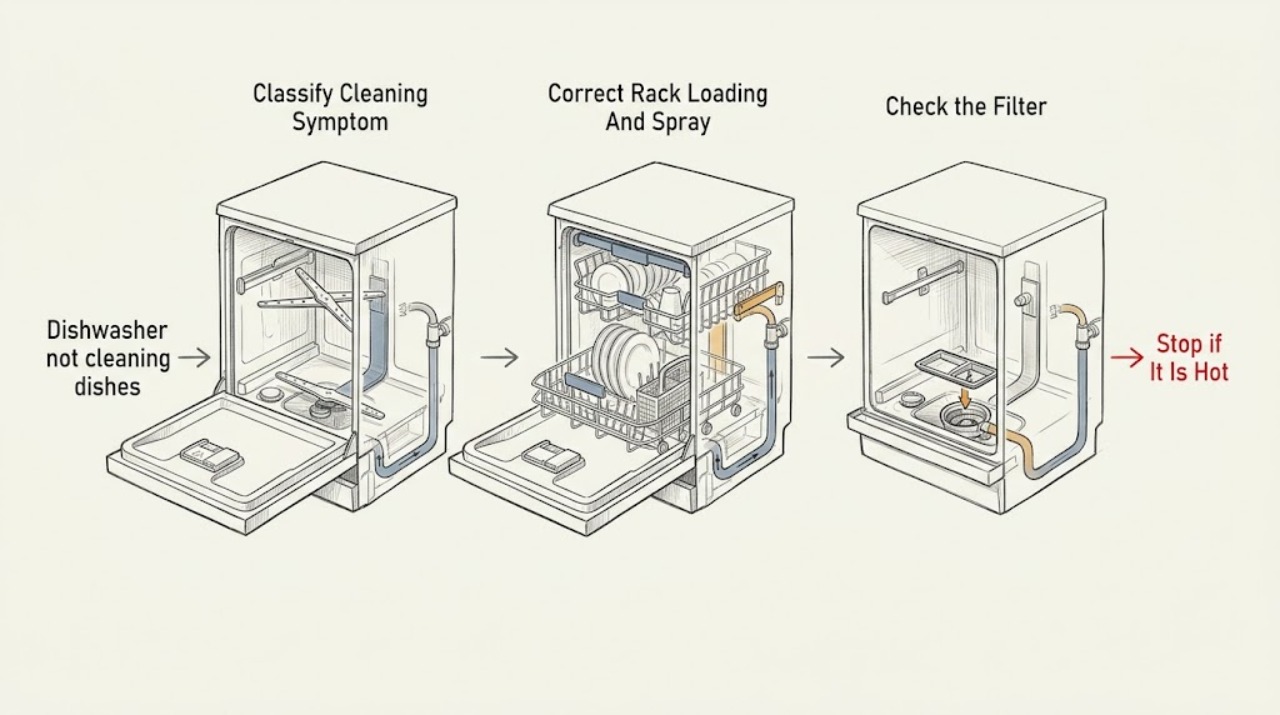
Work through in order
Diagnostic checks
Use only checks that match the exact appliance or system and its official guide.
-
Check 1
Empty the racks and record what remains on the dishes: loose food, fine grit, greasy film, detergent residue, or water spots; also note whether the dishwasher fills, sounds like it is spraying, completes the cycle, and leaves standing water.
Expected result: Soil is concentrated on dishes facing a blocked direction, grit is widespread, residue is on all items, the wash is unusually quiet, the cycle stops, or water remains in the tub.
Next step: Continue with a cool, empty, powered-off visual inspection. If there is a leak, standing water that does not drain, or a burning or electrical smell, leave the dishwasher off and arrange service before cleaning.
Stop if: Do not run the dishwasher for smoke, sparking, melting, burning odor, a leak near electrical parts, overflow, or exposed wiring.
Why this matters
Why: Localized soil supports a loading or spray-coverage problem, while widespread grit points toward filtration or circulation. Quiet operation, a stopped cycle, or standing water adds a fill, circulation, drain, door, or control branch that ordinary cleaning alone may not resolve.
-
Check 2
Reload the empty racks with soiled faces toward the spray, leave space between items, scrape large food pieces without fully pre-rinsing, and rotate each spray arm by hand only while the dishwasher is off to confirm tall dishes or utensils do not block it.
Expected result: A large item touches the door or spray arm, dishes are nested tightly, a spray arm cannot rotate freely, or the rack and arms have clear movement and coverage.
Next step: Correct only the visible loading obstruction and run one normal load with the model-approved settings. If an arm is damaged, binds, or cannot be reached safely, stop using the dishwasher and request service.
Stop if: Do not force a spray arm, remove rack hardware, place sharp items where they can fall, or operate with an arm that is cracked or loose.
Why this matters
Why: Bosch identifies spacing, correct orientation, and unobstructed spray arms as direct cleaning decisions. If coverage is clear but dishes remain uniformly dirty, filter, spray-arm openings, water, detergent, or circulation becomes more likely.
-
Check 3
With the dishwasher off and the interior safe, use the exact Bosch manual to remove the lower rack, applicable spray arm, and filter; rinse the filter with mild soap and a soft brush, and rinse the spray arm while checking its openings for debris without damaging the parts.
Expected result: The filter has food debris, the spray-arm openings are blocked, the filter or arm is clear, the filter style does not match the instructions, or a hard object is below the filter.
Next step: Reinstall the filter and spray arm exactly as the model instructions show before any test. If parts are stuck, damaged, or the pump area is exposed, stop and arrange service rather than probing deeper.
Stop if: Do not operate without the filter and spray arm properly installed, use abrasive or sharp cleaning tools, or reach into the pump or sump opening.
Why this matters
Why: Bosch states that food caught in the filter can recirculate onto dishes or clog the pump, and that clogged spray-arm holes reduce water coverage. A clear path makes fill, circulation, heating, detergent, or loading causes more likely; a hard object below the filter may need professional removal.
-
Check 4
Check the exact Bosch manual for the required detergent type and amount, verify rinse aid is available if the model uses it, and during one supervised start confirm that water enters and the door closes and latches without a rack or dish pressing it.
Expected result: Detergent is wrong or excessive, rinse aid is empty, the dishwasher does not fill, the door is obstructed or fails to latch, or water enters and the door remains secure.
Next step: Correct only the documented detergent, rinse-aid, loading, or visible door obstruction. If water does not enter, the latch is damaged, or the door cannot close safely, stop using the dishwasher and arrange service.
Stop if: Do not add unapproved chemicals, bypass the door latch, run with the door ajar, or remove panels to inspect the inlet or latch wiring.
Why this matters
Why: Bosch explains that detergent and rinse aid affect cleaning and drying, while a failure to fill or a door that cannot latch is a separate operating fault. A secure door and normal fill shift attention back to spray coverage, filter, circulation, and drain results.
-
Check 5
After the filter, spray arm, loading, detergent, door, and visible water checks are normal, run one model-approved cycle with a small, correctly loaded test load; observe the spray sound, completion, final water level, and whether the same dishes remain dirty.
Expected result: The load cleans normally, the wash is quiet or weak, the dishwasher stops mid-cycle, water remains at the end, dishes are still uniformly dirty, or only blocked or overloaded areas remain dirty.
Next step: Use the dishwasher only if it completes normally and remains dry. If the symptom repeats, leave it off and provide service with the cycle stage, sound, water level, filter findings, and error or door observations.
Stop if: Stop for a leak, overflow, smoke, sparking, burning odor, abnormal electrical noise, severe vibration, or a cycle that cannot fill, wash, or drain.
Why this matters
Why: A normal result supports a loading, filter, spray-arm, detergent, or rinse-aid condition. Weak or absent spray, a stopped cycle, standing water, or uniform residue points toward fill, circulation, heater, drain, door, or control diagnosis; localized residue still points toward coverage.
Use your observations
Decision map
Find the observation that best matches what you see, then follow the next safe action.
-
PATH 01Safety boundary
What you see
Only items behind a tall pan, nested dishes, or a blocked spray-arm path remain dirty, and the spray arm moves freely after reloading.
Do this next
Keep soiled faces toward the spray, leave clearance around the arms, and run one correctly loaded test load. If the same area remains dirty with clear coverage, clean the filter and arm openings.
Why this path and its safety boundary
Why it matters: Loading or spray coverage is more likely than a failed dishwasher component.
Safety stop: Do not force or operate a cracked, loose, or obstructed spray arm.
-
PATH 02Safety boundary
What you see
Fine grit or food particles are widespread, the filter is visibly soiled, and cleaning it improves the next load.
Do this next
Maintain the filter at the model-specified interval and keep the spray-arm openings clear. If grit or poor cleaning returns quickly, arrange circulation or drain diagnosis.
Why this path and its safety boundary
Why it matters: Filter debris and recirculation are more likely than a detergent-only issue.
Safety stop: Do not operate with a missing or loose filter, or probe below the filter to remove a lodged object.
-
PATH 03Safety boundary
What you see
The dishwasher fills and sprays, but residue or drying-related film follows an incorrect detergent amount, empty rinse-aid dispenser, or unapproved detergent condition.
Do this next
Follow the exact Bosch detergent and rinse-aid instructions and retest once with a correctly loaded small load. If residue persists with correct use, arrange service rather than adding more detergent.
Why this path and its safety boundary
Why it matters: Chemical use and drying support are more likely contributors than a blocked spray path.
Safety stop: Do not mix cleaning chemicals, use hand dish soap, or run an appliance that is foaming, leaking, or overheating.
-
PATH 04Safety boundary
What you see
The dishwasher does not fill, the door does not latch securely, the cycle stops, or a visible door or water-supply issue accompanies dirty dishes.
Do this next
Check only the visible, model-approved door and supply conditions. Leave the dishwasher off and arrange service if water does not enter, the latch is damaged, or the cycle stops again.
Why this path and its safety boundary
Why it matters: A fill, door-latch, water-supply, or control condition is more likely than a filter or loading problem.
Safety stop: Do not bypass the latch, open electrical panels, disconnect water lines, or continue with a door that can open during operation.
-
PATH 05Safety boundary
What you see
Loading is clear, the filter and spray openings are clean, detergent use is correct, but spray is weak or quiet, the cycle leaves standing water, or dishes remain uniformly dirty.
Do this next
Stop repeating cycles and arrange qualified dishwasher service. Report the filter and spray-arm condition, fill result, wash sound, final water level, and whether the issue affects all racks.
Why this path and its safety boundary
Why it matters: A circulation pump, drain restriction, water-level, heating, or related internal fault is possible; user checks cannot identify the part safely.
Safety stop: Do not remove the pump, heater, sump, wiring, or cabinet panels as a cleaning experiment.
-
PATH 06Safety boundary
What you see
Poor cleaning persists after the model-approved loading, filter, spray-arm, detergent, and one-cycle checks, or there is a leak, overflow, smoke, sparking, burning odor, damaged glass or door, or repeated error code.
Do this next
Leave the dishwasher off and arrange qualified appliance or electrical service. Provide the exact model, symptom pattern, cycle stage, water behavior, maintenance findings, and any code or hazard.
Why this path and its safety boundary
Why it matters: An unresolved internal, electrical, water, door, or physical-safety fault is possible and routine cleaning is no longer an appropriate test.
Safety stop: Do not restart the dishwasher, touch wet electrical parts, bypass safety devices, or keep adding detergent or cleaner to mask the problem.
Helpful context
Understand the symptom
Start with water coverage, not a guessed part
Poor cleaning can be caused by food soil caught in the filter, a rack or tall pan blocking a spray arm, clogged spray-arm holes, incorrect loading, or detergent and rinse-aid conditions. If the dishwasher is not filling, heating, circulating, or draining normally, the same dirty-dish symptom can have a different cause. Separate what the dishes look like from what the machine does during the cycle.
The filter protects circulation and the dishes
Bosch explains that the filter catches food particles, helps protect the pump, clears wash water, and prevents debris from returning to dishes. Filter access varies by model, so use the owner's manual before twisting or lifting anything. A filter and spray arm must be fully and correctly reinstalled before operating the dishwasher.
Use a result-based retest
After the safe loading, filter, and spray-arm checks, run one normal or model-approved test and observe whether water enters, spray arms move freely, the wash sounds normal, and water drains at the end. A clean filter with weak spray or standing water points toward circulation or drain diagnosis; a good wash pattern with residue only on certain items points back to loading, detergent, or rinse-aid conditions.
Safety boundary
Stop conditions
- Leave the dishwasher off for smoke, sparking, melting, burning or electrical odor, overflow, or a leak near electrical components.
- Do not bypass the door latch, open panels, disconnect water lines, remove the pump or heater, or work on wiring as an ordinary cleaning check.
- Do not operate without the model-required filter and spray arm correctly installed, or with a cracked, loose, or damaged component.
- Stop after the model-approved loading, filter, spray-arm, detergent, visible water, and one controlled-cycle checks if poor cleaning, standing water, or a code returns.
- Do not replace a pump, heater, control, filter, spray arm, or water valve based only on dirty dishes; confirm the exact model-specific diagnosis first.
Only after diagnosis
Potential parts
- Bosch dishwasher filter assembly
Consider this part class only when the exact model uses a removable filter and the filter is cracked, distorted, missing, or unable to seat after cleaning and qualified diagnosis confirms it affects cleaning.
Confirm the exact Bosch model, filter style, locking features, and manufacturer fit information before ordering. - Bosch dishwasher spray arm
Consider this part class only when a spray arm is cracked, warped, loose, or confirmed unable to provide proper coverage after its openings are clean and loading is correct.
Confirm the exact Bosch model, rack position, attachment method, and manufacturer fit information before ordering. - Bosch dishwasher circulation pump or motor assembly
Consider this part class only after qualified diagnosis finds weak or absent circulation with clear loading, filter, spray-arm, detergent, and water-entry conditions.
Confirm the exact Bosch model and diagnostic result; do not infer pump failure from dirty dishes or a quiet cycle alone. - Bosch dishwasher water inlet valve or heating component
Consider this part class only when qualified diagnosis confirms inadequate water entry or heating as the cause after the visible loading and maintenance checks.
Confirm the exact Bosch model, electrical and water connections, diagnostic result, and manufacturer fit information before replacement.
When checks do not resolve it
Need a professional?
Arrange qualified Bosch dishwasher service when dishes remain dirty after the model-approved loading, filter, spray-arm, detergent, water-entry, and one-cycle checks; when spray is weak, the cycle stops, water remains, the dishwasher will not fill or latch, or an error code returns. Seek prompt appliance or electrical help for smoke, sparking, burning odor, melting, overflow, a leak near electrical parts, damaged glass or door hardware, or exposed wiring.
Safety scope: This article supports emptying and reloading, cool visual checks, model-approved filter and spray-arm cleaning, detergent observations, and one supervised cycle only. Pump, heater, circulation, drain, water inlet, latch, wiring, cabinet, and electrical diagnosis belong to qualified service.
Common questions
FAQ
Why are my Bosch dishwasher dishes still dirty after a cycle?
Start with spray coverage: dishes may be nested, facing away from the spray, or blocking an arm. Then inspect the model-specific filter and spray-arm openings, detergent and rinse-aid use, water entry, and final draining. Dirty dishes with weak spray or standing water need service diagnosis.
How often should I clean a Bosch dishwasher filter?
Use the exact Bosch model manual or the maintenance interval it specifies. Bosch says the filter should be cleaned regularly and provides model-dependent removal and soft-brush cleaning guidance. Do not operate without a correctly seated filter.
Can loading block Bosch dishwasher spray arms?
Yes. Tall items, nested dishes, or utensils can prevent an arm from rotating or keep water from reaching a rack. With the dishwasher off, check that each arm moves freely and reload with space between items and soiled faces toward the spray.
Should I pre-rinse dishes before loading a Bosch dishwasher?
Bosch advises scraping large food particles rather than fully pre-rinsing in the cited quick-start guidance. Follow the exact model's loading and detergent instructions, and keep hard objects out of the filter and pump area.
When should I stop troubleshooting a Bosch dishwasher that is not cleaning?
Stop for standing water, a leak near electrical parts, overflow, smoke, sparking, burning odor, a damaged door or spray arm, a cycle that stops, or a recurring error. Also stop after the model-approved loading, filter, spray-arm, detergent, water, and one-cycle checks fail; do not replace a pump or heater by guesswork.
Read the exact guide
Official sources
- How to clean your dishwasher filter | BoschBosch Home Appliances · Official Bosch filter guide; removal and exact filter design vary by model, so the owner's manual takes precedence.
- 24-BOS-1812 - Dishwasher Quick Start Guide Pr2Bosch Home Appliances · Official Bosch quick-start PDF for a named dishwasher design; use as supporting context and defer to the exact model manual.
- Bosch Dishwasher Troubleshooting & Repair Guide | Bosch – Fix Common Dishwasher ProblemsBosch Home Appliances · Official Bosch dishwasher owner-support troubleshooting guide; exact model manual and service guidance control appliance-specific procedures.
- Dishwasher Not Cleaning Dishes | Dishwasher Troubleshooting | BoschBosch Home Appliances · Official Bosch troubleshooting page for dishwashers that are not cleaning dishes; exact model instructions control removal and care procedures.
Community feedback
Share a repair observation
Share a plain-text repair observation. Accepted observations are published automatically; this page may take a moment to update.