
On this page
Start here
Quick answer
If water enters the dishwasher tub but dishes remain dirty, the problem is usually water distribution, filtration, loading, detergent release, or insufficient wash conditions rather than a simple no-fill fault. Start with the cleanable filter, spray-arm movement and blocked nozzles, rack loading, detergent dispenser, selected cycle, and any visible food or mineral buildup. Scrape large food pieces without pre-rinsing, use detergent made for automatic dishwashers, and follow the model manual for filter and spray-arm removal. Water in the tub does not prove that the wash pump is creating adequate spray: weak or absent spray, standing water, a recurring error, unusual noise, a leak, or poor results after the safe cleaning and loading checks can require qualified appliance service. Do not reach into a running machine, use drain-opening chemicals, open electrical panels, or remove pump and inlet components as a general check.
Before you begin
Safety first
- A homeowner may correct ordinary loading and detergent choices, inspect accessible spray-arm clearance, and clean the user-accessible filter according to the manual with the appliance stopped. A qualified technician should handle appliance removal, electrical work, water valves, pumps, wash motors, heaters, controls, concealed hoses, and internal circulation or water-level faults.
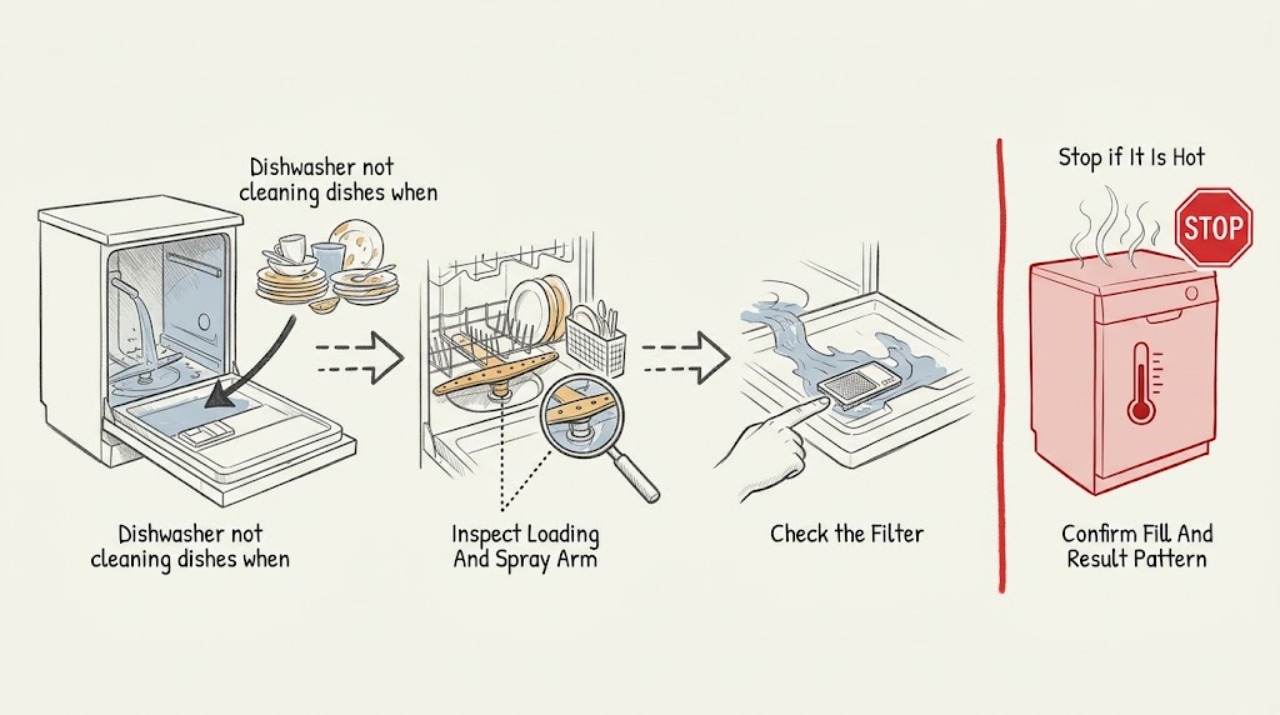
Work through in order
Diagnostic checks
Use only checks that match the exact appliance or system and its official guide.
-
Check 1
After the cycle is complete and the appliance is stopped, record whether water entered the tub, whether detergent released, whether spray coverage seemed normal from the dishes' wet pattern, and whether water or food debris remains at the bottom.
Expected result: Classify the result as water present with detergent still in the dispenser, water present but dishes mostly dry or only one rack wet, water present with dirty water and food debris, or water present with normal wet coverage but persistent soil.
Next step: Keep the machine stopped while checking the load, dispenser, filter, and spray arms. Do not open the door during an active wash or use a hand as a spray-pressure test.
Stop if: Stop for a leak, standing water near electrical parts, broken glass, a burning smell, abnormal grinding, or any need to reach into a running machine.
Why this matters
Why: Detergent left behind or a dry rack suggests the dispenser or spray distribution is blocked. Dirty water and debris can point to filter or drain-path problems. Normal wet coverage with soil remaining shifts attention to loading, detergent, cycle conditions, temperature or water hardness, and eventually wash-system diagnosis.
-
Check 2
With racks pulled out and the appliance off, rearrange nested dishes so soiled faces point toward the spray path; check that tall items do not touch or block the spray arms or detergent door, and rotate each accessible arm by hand only as the model design permits.
Expected result: Record whether an arm turns freely, stops against a dish, has clogged-looking nozzles, or whether a rack or item covers the dispenser; note if one rack is consistently dirtier than the other.
Next step: Reload with space between items and the manufacturer's rack positions, then follow the model instructions for safe spray-arm cleaning if a nozzle is visibly obstructed. Use one appropriate test cycle after the correction.
Stop if: Do not force an arm, enlarge a nozzle, remove a rack assembly, or run the dishwasher with a loose or damaged spray arm.
Why this matters
Why: An item blocking rotation or the dispenser can leave a rack dirty even when the tub fills. A free-moving arm with clear space makes filter, detergent, water quantity, cycle, or circulation causes more likely; one-sided results help locate the blocked spray path.
-
Check 3
Remove the lower rack and clean the user-accessible filter only as described in the owner's manual; rinse it with water and a soft brush, then inspect the visible sump area for food debris without removing a pump cover or reaching into standing water.
Expected result: Record whether the filter is coated or blocked, whether food is collecting beneath it, whether the filter was seated and locked, and whether water remains in the tub after the cycle.
Next step: Reinstall the filter exactly as the manual shows and remove only loose visible debris that can be reached safely. If standing water, recurring debris, or poor cleaning remains, arrange service rather than opening the pump area.
Stop if: Do not use drain-opening chemicals, abrasive tools, sharp objects, or a pump-cover removal procedure as a generic fix. Stop for broken glass, a damaged filter, a leak, or water near electrical equipment.
Why this matters
Why: A clogged or incorrectly seated filter can let food redeposit, hinder drainage, and reduce wash performance. A clean, correctly installed filter with persistent dirty dishes makes spray, detergent, water quantity, wash motor, or heating causes more likely.
-
Check 4
Confirm that only automatic-dishwasher detergent was used, the dispenser was not blocked or overfilled, large food pieces were scraped off, and the selected cycle matches the load; check the rinse-aid setting or supply only according to the model manual.
Expected result: Note whether the detergent door opened, the tablet or powder dissolved, suds or a film are present, the selected cycle was a rack-limited or light program, and whether the detergent amount or water hardness may be unsuitable for the product instructions.
Next step: Correct the detergent type, dispenser clearance, loading, and cycle once, then compare the result on one appropriate test load. If detergent still does not release or cleaning remains poor, document it for service.
Stop if: Do not use hand dish soap, mix cleaners, overdose detergent, or repeat cycles while foam is present or water is leaking.
Why this matters
Why: A blocked dispenser or unsuitable detergent can delay cleaning chemistry even when spray water is present. A rack-limited program can leave another rack unwashed. Suds or a residue can interfere with washing and should not be treated as a circulation failure.
-
Check 5
From a dry, ordinary-access position, check whether the supply valve is fully open and the visible inlet hose is kinked or worn; compare the fill result with the model's manual and record any error, weak spray, unusual wash-motor sound, leak, or recurring dirty result.
Expected result: Record whether water quantity appears reduced, the inlet hose is restricted, the supply connection is wet, the machine fills but does not spray strongly, or the safe checks made no improvement.
Next step: Leave the appliance off and arrange qualified appliance repair or plumbing service when the water supply path is wet, the amount remains uncertain, spray is weak or absent, or poor cleaning persists after the safe corrections. Provide the model, cycle, and observations.
Stop if: Do not pull the dishwasher out, disconnect a pressurized hose, remove a toe-kick or electrical panel, test an inlet valve or motor, or continue running with a leak or abnormal noise.
Why this matters
Why: A partially open supply or kinked inlet hose can reduce water entry and cleaning, but correct filling with weak spray points toward circulation, pump, motor, filter, or control diagnosis. A leak, error, or unusual sound is a service boundary rather than evidence for a replacement part.
Use your observations
Decision map
Find the observation that best matches what you see, then follow the next safe action.
-
PATH 01Safety boundary
What you see
Water enters the tub, detergent remains in its compartment or one rack is dry, and a dish or rack blocks the dispenser or spray arm.
Do this next
Rearrange the load, clear only visible obstruction, confirm the dispenser can open, and clean the spray arm under the model instructions before one test load.
Why this path and its safety boundary
Why it matters: A distribution or loading obstruction is more likely than a confirmed wash-motor failure.
Safety stop: Do not force the spray arm or run the machine with a loose arm or active leak.
-
PATH 02Safety boundary
What you see
The filter is coated with food or grease, debris is collecting in the filter area, and dishes have food particles or dirty water after the cycle.
Do this next
Clean and correctly reseat the accessible filter as the manual permits, remove only loose visible debris, and arrange service if standing water or redeposited soil remains.
Why this path and its safety boundary
Why it matters: Filtration and drainage restriction is plausible and can allow soil to remain or return to dishes.
Safety stop: Do not remove a pump cover, use drain chemicals, or reach into standing water or moving components.
-
PATH 03Safety boundary
What you see
The spray arm does not turn freely, nozzles appear blocked, or mineral buildup is visible, and cleaning is poor despite water entering the tub.
Do this next
Clean the spray arm only by the exact model procedure and with a safe stopped appliance; if it remains blocked, damaged, or loose, request service or a compatible part assessment.
Why this path and its safety boundary
Why it matters: Reduced spray coverage or delayed detergent release is more likely than a no-fill condition.
Safety stop: Do not drill, enlarge, scrape aggressively, or substitute a spray arm without model confirmation.
-
PATH 04Safety boundary
What you see
The tub fills and spray seems present, but the dispenser is blocked, detergent does not dissolve, a rack-limited cycle was selected, or foam is visible.
Do this next
Use the correct automatic-dishwasher detergent, clear dispenser space, choose an appropriate cycle, and stop until foam dissipates. If the dispenser still fails or cleaning remains poor, arrange service.
Why this path and its safety boundary
Why it matters: Wash chemistry, program choice, or suds can explain poor cleaning without proving an appliance component is defective.
Safety stop: Do not use hand dish soap, mix cleaning products, or run repeated foamy cycles.
-
PATH 05Safety boundary
What you see
Water enters but the fill appears reduced, the visible inlet hose is kinked or worn, or the supply valve is only partly open.
Do this next
Correct only an obvious, dry-access valve position if safe and leave the hose connected; arrange qualified service if the connection leaks, the hose needs replacement, or the water amount remains inadequate.
Why this path and its safety boundary
Why it matters: Restricted supply or water quantity is plausible and can prevent effective washing even though the tub is not empty.
Safety stop: Do not disconnect the water line, remove the inlet valve, or rely on unverified water-pressure values for a DIY repair.
-
PATH 06Safety boundary
What you see
The filter is clean and seated, spray arms turn and are clear, loading and detergent are appropriate, and water enters, but dishes remain dirty or spray is weak.
Do this next
Stop experimenting and arrange qualified appliance diagnosis. Provide the model, cycle, fill observation, detergent release, rack wet pattern, filter and spray-arm results, remaining water, sounds, and any error.
Why this path and its safety boundary
Why it matters: A wash motor, circulation pump, control, heating, water-level, internal obstruction, or model-specific fault is possible; the symptom does not identify a part.
Safety stop: Do not open electrical panels, test energized parts, bypass a safety device, or replace a pump, motor, heater, or valve based only on dirty dishes.
Helpful context
Understand the symptom
Water in the tub is only the first checkpoint
A dishwasher can fill and still leave soil behind if the spray arms cannot rotate, their nozzles are blocked, the filter is loaded with debris, the racks shield the dishes, or water cannot reach the detergent dispenser. Separate the observations: note whether the tub receives water, whether you hear or see normal spray from a safe stopped-cycle inspection, whether the detergent released, and whether water remains at the end. Do not judge wash pressure by opening the door while the machine is operating or by reaching inside a moving assembly.
Start with distribution and filtration
Remove large food pieces, arrange dirty surfaces toward the spray path, and leave space between items. Check that tall dishes do not block a spray arm and that the detergent door is not covered. With the appliance stopped, clean the user-accessible filter and inspect spray-arm openings according to the owner's manual. Bosch recommends washing a removable filter with mild soap and a soft brush, while manufacturer guidance says a blocked spray arm can delay detergent release and soil removal.
Escalate when circulation or water quantity remains uncertain
If the filter, spray arms, loading, detergent, and cycle choice are appropriate but dishes remain dirty, a wash motor, pump, inlet or water-level problem, heating fault, control issue, or internal obstruction may be involved. If water is not reaching the expected level, a kinked inlet hose or a partially open supply can also affect cleaning. Do not remove the toe-kick or cabinet parts just to inspect a valve or pump unless the exact manual and a dry, de-energized work area make that procedure appropriate; arrange service when the cause is not visible and safe.
Safety boundary
Stop conditions
- Stop the dishwasher for a leak, standing water near electrical equipment, a damaged cord, burning smell, smoke, abnormal grinding, or broken glass.
- Do not reach into a running dishwasher, use a hand to test spray, or open an electrical or pump compartment as a general cleaning check.
- Do not use drain-opening chemicals, mix cleaners, use hand dish soap, or continue cycles while foam is forcing water out.
- Do not disconnect pressurized water lines, pull out or tilt the appliance, bypass a safety device, or replace a component without model-specific diagnosis.
- Arrange qualified appliance repair when water enters but spray is weak or absent, a fill or drain problem persists, an error returns, or safe filter, spray-arm, loading, and detergent checks do not restore cleaning.
When checks do not resolve it
Need a professional?
Arrange qualified appliance repair or plumbing service when cleaning remains poor after the filter, spray-arm, loading, detergent, cycle, and visible supply checks; when water quantity remains reduced; when spray is weak or absent; when an inlet, pump, wash motor, heater, control, or internal obstruction is suspected; or when any leak, error, unusual noise, foam overflow, or electrical hazard is present.
Safety scope: A homeowner may correct ordinary loading and detergent choices, inspect accessible spray-arm clearance, and clean the user-accessible filter according to the manual with the appliance stopped. A qualified technician should handle appliance removal, electrical work, water valves, pumps, wash motors, heaters, controls, concealed hoses, and internal circulation or water-level faults.
Common questions
FAQ
Why are my dishwasher dishes dirty if water enters the tub?
Water can enter without reaching every surface effectively. Check spray-arm clearance and nozzles, rack loading, the filter, detergent release, and the selected cycle. If spray is weak or poor cleaning persists after these checks, service may be needed.
Can a dirty filter cause poor dishwasher cleaning?
Yes. The filter catches food debris and helps keep soil from returning to dishes; a blocked or incorrectly seated filter can also affect drainage and wash performance. Clean it only as the model manual permits.
How do I know if a spray arm is causing dirty dishes?
With the dishwasher stopped, check that the accessible arm turns freely and its openings are not visibly blocked. A tall dish, crowded rack, mineral buildup, or debris can reduce spray coverage or delay detergent release.
Does dishwasher detergent or loading affect cleaning if the machine fills?
Yes. A blocked dispenser, unsuitable detergent, foam from hand dish soap, a rack-limited cycle, or dishes nested too closely can leave soil behind even with water in the tub. Correct one safe variable at a time.
When should I call for dishwasher repair?
Arrange service when water entry is reduced, spray is weak or absent, a leak or error returns, unusual noise occurs, water remains, or dishes stay dirty after correct loading, detergent, filter, and spray-arm checks. A wash motor, pump, valve, heater, control, or internal obstruction needs qualified diagnosis.
Read the exact guide
Official sources
- Dishwasher Troubleshooting: Dishwasher Not Cleaning DishesBosch Home Appliances · Dishwasher poor cleaning, filter, loading, spray-arm clearance, scraping food, rinse aid, and spray-arm cleaning checks
- Dull Surfaces on Dishes - Product HelpWhirlpool Product Help · Dishwasher wash performance, detergent release, spray-arm blockage, dispenser clearance, loading, and soil removal
- How to Properly Clean Your Dishwasher FilterBosch Home Appliances · Dishwasher filter purpose, food debris, overflow prevention, and stopped-appliance filter cleaning
- Spray Arm Not Working - DishwasherWhirlpool Product Help · Dishwasher spray-arm blockage, detergent release, soil removal, mineral buildup, and rack-limited cycle behavior
- Dishwasher - Not Enough WaterGE Appliances · Dishwasher water quantity, inlet hose, supply valve, safe maintenance boundary, and service indication
Community feedback
Share a repair observation
Share a plain-text repair observation. Accepted observations are published automatically; this page may take a moment to update.