
On this page
Start here
Quick answer
When a dishwasher leaves residue, first identify whether it is food soil, greasy film, detergent, or a white mineral haze, and note whether it affects every rack or only certain items. A dirty filter, blocked spray arm, crowded loading, blocked dispenser, unsuitable detergent, low water supply, or insufficient heat can leave residue even when the cycle finishes. Turn the dishwasher off before cleaning its accessible filter or spray arms, scrape large food pieces without fully pre-rinsing, use only automatic-dishwasher detergent and the manual's amount, and keep the spray paths and dispenser clear. If the filter and spray arms are clean but residue persists, water remains in the tub, the dishwasher is not filling or heating, the breaker trips, or there is a leak or burning smell, stop repeated cycles and arrange qualified appliance service.
Before you begin
Safety first
- This article covers external loading, filter, spray-arm, dispenser, detergent, supply, and cycle checks only. Do not open the appliance, handle live wiring, enter the pump or heater area, or substitute internal parts from a residue symptom.
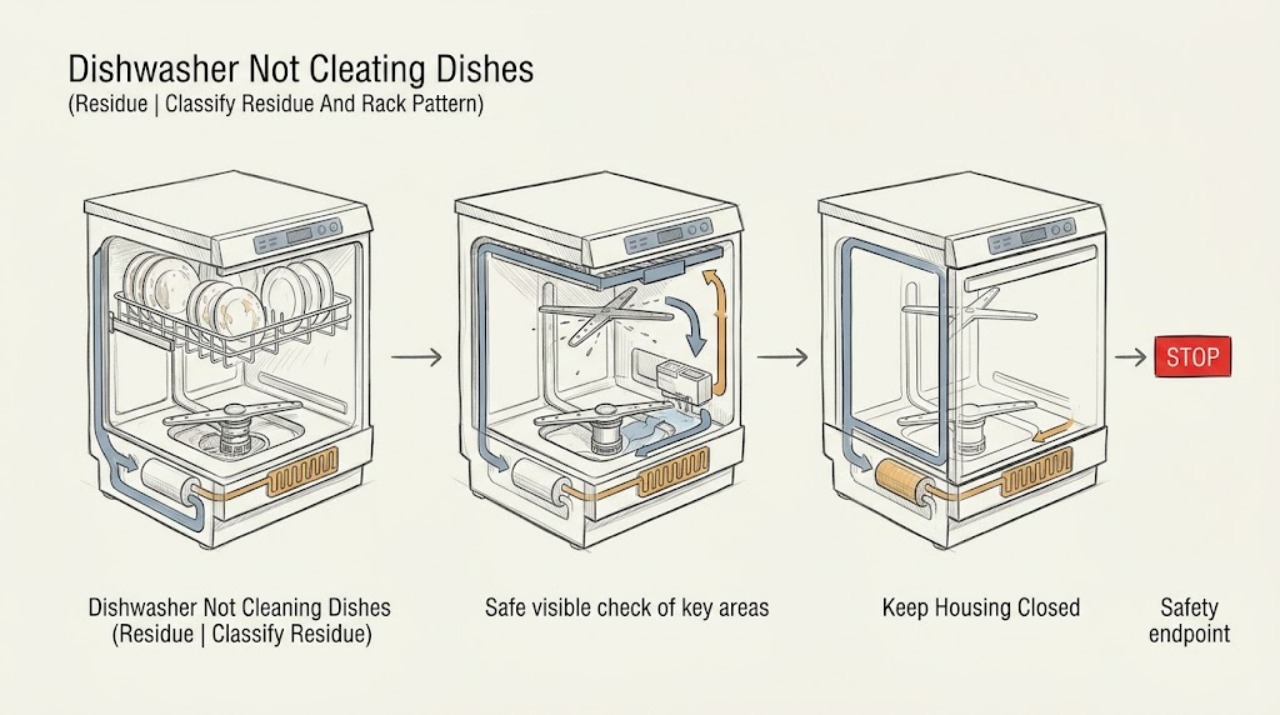
Work through in order
Diagnostic checks
Use only checks that match the exact appliance or system and its official guide.
-
Check 1
Before rewashing, inspect the failed load from a safe position and classify the residue as food or grit, grease, detergent, white or cloudy film, or water spots. Note the rack, item orientation, and whether every item or only a zone is affected.
Expected result: Residue is concentrated on one rack or shielded surfaces, is scattered across all racks, is gritty or food-like, is greasy, or is a white film or spotting.
Next step: Use the residue pattern to prioritize the loading and spray-arm check, filter check, or detergent and water check; do not assume a failed pump from residue alone.
Stop if: Stop handling the load for cracked glass, sharp fragments, chemical residue, or a burning smell from the appliance.
Why this matters
Why: A rack-specific pattern makes loading or a blocked spray path more likely. Whole-load food or grit makes filter, water circulation, or cycle coverage more likely; grease suggests washing or heat limitations; white film or spotting makes detergent, rinse aid, water hardness, or dishware compatibility more likely.
-
Check 2
With the dishwasher off and the racks unloaded enough to see the spray paths, rearrange tall pans, bowls, utensils, and tightly nested items so water can reach the soiled surfaces. Spin each accessible spray arm by hand and check that it turns freely without touching a dish, rack, or filter area.
Expected result: A spray arm hits an item or rack, the arm turns freely but its holes are visibly blocked, only one rack has residue, or all arms and clearances look normal.
Next step: Correct the load and clean only the accessible spray-arm openings according to the manual. If an arm is loose, cracked, warped, or remains blocked, stop using that cycle and arrange service or model-specific replacement guidance.
Stop if: Do not run the dishwasher with a spray arm touching dishes, pry a stuck arm, use a sharp tool that can damage a nozzle, or remove internal fittings without the model instructions.
Why this matters
Why: Blocked rotation or shielded dish surfaces can explain rack-specific residue. A free-turning arm with blocked holes can reduce water coverage. Normal clearance makes filter, detergent, water, heat, or internal circulation issues more likely.
-
Check 3
After the dishwasher is off and the lower rack is removed, inspect the accessible filter area. Follow the model manual to remove the filter, rinse loose soil under running water, use a soft brush for residue if permitted, and reinstall it fully locked before operating the appliance.
Expected result: The filter is coated with food or grease, has hard mineral deposits, is damaged or not locking, or is clean and correctly seated.
Next step: Run one correctly loaded test cycle after the filter is locked. If residue remains or the filter cannot be seated, leave the dishwasher unused for qualified diagnosis; never operate it without the required filters.
Stop if: Do not use a wire brush, abrasive pad, knife, or improvised filter; do not reach into the pump area or operate the dishwasher with a loose or missing filter.
Why this matters
Why: A loaded filter can reduce effective washing and allow soil to recirculate onto dishes. Damage or an unlocked filter can create a circulation or pump risk. A clean, locked filter shifts attention toward spray coverage, detergent, water, heat, or internal components.
-
Check 4
Inspect the detergent dispenser and rinse-aid compartment before the next cycle. Confirm the dispenser door can open, no dish or utensil touches it, the detergent is intended for an automatic dishwasher and is dry and within its use instructions, and rinse aid is used only as the manual directs.
Expected result: The dispenser stayed closed or blocked, detergent remains caked or undissolved, the wrong soap was used, the dispenser is empty or damaged, or the dispenser and detergent appear normal.
Next step: Correct the load or detergent arrangement using the exact manual's instructions and run one suitable cycle. If the dispenser remains closed, leaks, or the tablet or powder does not dissolve despite clear access, arrange service.
Stop if: Do not use hand dish soap, mix cleaning products, overfill the dispenser, or run a cycle with uncontrolled suds or a leaking dispenser.
Why this matters
Why: Late or absent detergent release can leave food residue, while too much or unsuitable detergent can leave film or suds. Rinse aid affects water runoff and drying but does not replace detergent or repair a circulation fault.
-
Check 5
Verify from accessible controls and plumbing that the dishwasher water supply valve is open, the inlet hose is not visibly kinked, and the selected cycle matches the soil and load. If the manual calls for it, run hot water at the nearby sink before starting so the dishwasher is not beginning with a cold supply line.
Expected result: The dishwasher fills normally, the cycle is a light or top-rack-only program despite heavy or lower-rack soil, the supply is restricted or not open, or the dishwasher does not fill, heats poorly, or stops early.
Next step: Correct only an accessible valve, hose position, or cycle selection allowed by the manual. If fill, heat, or cycle completion remains abnormal, stop repeated cycles and arrange qualified appliance service.
Stop if: Do not disconnect water lines, open the electrical junction box, test heater terminals, or run repeated cycles with a leak or water near electrical parts.
Why this matters
Why: Insufficient water, an unsuitable cycle, or a selected rack-only program can leave residue. Failure to fill, heat, or complete the cycle points toward an inlet, heater, sensor, door, control, or supply issue that is not solved by detergent changes.
-
Check 6
After correcting only the confirmed external issue, load a small, normally spaced test load with soiled surfaces facing the spray paths and run one appropriate cycle. Compare the same item locations and residue type afterward instead of repeatedly re-running a failing load.
Expected result: The residue clears, improves only in the previously blocked area, remains across the load, or the dishwasher leaves standing water, an error, unusual noise, or a leak.
Next step: Document the model, cycle, detergent, load pattern, residue photos, and result for service when the issue persists. Do not open the pump, heater, or control area as the next test.
Stop if: Stop the cycle for smoke, burning odor, sparking, a leak, uncontrolled suds, unusual grinding, a breaker trip, or water near electrical equipment.
Why this matters
Why: A lasting improvement supports the corrected loading, filter, spray, detergent, or cycle condition. Partial or absent improvement after those checks makes water circulation, heating, inlet, drain, sensor, or control faults more likely; standing water or an error adds a separate service issue.
Use your observations
Decision map
Find the observation that best matches what you see, then follow the next safe action.
-
PATH 01Next step
What you see
Residue is concentrated on one rack or shielded sides, and a dish or rack prevents a spray arm from turning or reaching the load.
Do this next
Rearrange the load, restore spray-arm clearance, and run one suitable test cycle. If the arm still resists, is damaged, or residue persists, arrange service.
Why this path and its safety boundary
Why it matters: Loading or spray coverage is more likely than a failed dishwasher-wide wash system.
-
PATH 02Next step
What you see
Food or gritty residue is widespread, and the filter is loaded or spray-arm holes are visibly blocked.
Do this next
Clean the accessible filter and spray arms as the manual permits, lock the filter, then run one correctly loaded test. Persistent soil after that test needs qualified diagnosis.
Why this path and its safety boundary
Why it matters: Soil capture or water distribution is more likely limiting cleaning and allowing material to remain on dishes.
-
PATH 03Next step
What you see
Residue is mainly detergent film, white haze, or spotting, and the dispenser was blocked, detergent was unsuitable or excessive, or rinse-aid and water conditions differ from the manual.
Do this next
Correct only the detergent, dispenser access, rinse-aid, and cycle settings covered by the exact manual, then compare one test load. Stop for uncontrolled suds, dispenser leakage, or persistent film.
Why this path and its safety boundary
Why it matters: Dispensing, detergent chemistry, rinse-aid, or water-hardness conditions are more likely than a blocked pump.
-
PATH 04Next step
What you see
The filter, spray arms, loading, and dispenser are normal, but the dishwasher does not fill normally, leaves dishes greasy and cool, stops early, or repeats the residue across a correctly loaded test cycle.
Do this next
Leave the dishwasher out of service if fill, heat, drain, or cycle completion is abnormal and arrange qualified appliance diagnosis. Provide cycle, residue, filter, spray, dispenser, and water observations.
Why this path and its safety boundary
Why it matters: An inlet, heater, temperature sensor, circulation pump, drain, door, or control fault is more likely than an ordinary loading issue.
-
PATH 05Next step
What you see
A leak, standing water, uncontrolled suds, smoke, burning smell, sparking, grinding noise, breaker trip, or water near electrical equipment appears during or after the cycle.
Do this next
Stop the cycle, keep people away from the affected area, and arrange qualified appliance or electrical service. If there is immediate fire, smoke, or electrical danger, leave the area and contact emergency help from a safe location.
Why this path and its safety boundary
Why it matters: This is no longer a routine cleaning-performance check and may involve a water, electrical, motor, heater, or internal safety fault.
Helpful context
Understand the symptom
Residue type changes the next check
Food particles or gritty soil usually point toward water circulation, filter, spray-arm, loading, or wash-cycle coverage. A greasy film can follow weak washing or insufficient heat, while a white or cloudy film may relate to detergent, rinse aid, water hardness, or the dishware itself. Photograph the residue before rewashing and check whether it is on the upper rack, lower rack, glasses, cookware, or every item; that pattern is more useful than simply running another cycle.
Water has to reach both the dishes and the detergent
A tall pan, crowded load, or item against the dispenser can block the spray arm or delay detergent release. Bosch recommends spacing items, keeping spray arms clear, scraping large food pieces rather than fully pre-rinsing, and cleaning the filter and spray arms. Whirlpool also notes that a selected top-rack-only cycle will not wash the lower rack.
Keep cleaning and repair boundaries separate
The filter and spray arms are accessible maintenance points on many models, but the pump, heater, inlet valve, wiring, and internal circulation path are not established by a residue pattern alone. Use the exact owner manual for removal and reinstallation, keep filters locked in place, and stop before opening panels or testing live components.
Safety boundary
Stop conditions
- Do not open the dishwasher base, pump, heater, wiring, or electrical junction box, and do not test live components.
- Do not operate the dishwasher without its required filters properly installed and locked.
- Do not use hand dish soap, mix chemicals, overfill the dispenser, or continue a cycle with uncontrolled suds.
- Stop for a leak, standing water with an abnormal cycle, smoke, burning odor, sparking, grinding noise, breaker trip, or water near electrical equipment.
- Do not assume residue proves a failed pump or heater; stop repeated cycles and arrange qualified diagnosis when external checks do not restore cleaning.
Only after diagnosis
Potential parts
- dishwasher filter assembly
Consider this category only when the exact model's filter is cracked, missing, or unable to lock after correct cleaning and the technician confirms it is contributing to soil recirculation or circulation problems.
Confirm the exact dishwasher model, filter design, locking arrangement, and manufacturer fit information before ordering. - dishwasher spray arm
Consider this category only when a spray arm is cracked, warped, loose, or remains blocked after approved cleaning and qualified diagnosis links it to inadequate coverage.
Confirm the exact rack position, connector, arm geometry, and model fit; do not assume upper and lower arms interchange. - dishwasher circulation pump or motor
Consider this category only when the filter, spray paths, load, detergent, and water supply are normal and qualified testing confirms inadequate wash-water circulation.
Confirm the exact model, pump assembly, seals, electrical requirements, and technician diagnosis before ordering. - dishwasher heater or temperature sensor
Consider this category only when persistent greasy residue or an incomplete cycle is traced by a qualified technician to a heating or temperature-sensing fault.
Confirm the exact model, heater or sensor specification, wiring, sealing, and safety procedure; do not infer the part from residue alone.
When checks do not resolve it
Need a professional?
Arrange qualified appliance service when residue remains after the filter, spray-arm, loading, dispenser, detergent, and cycle checks, or when the dishwasher does not fill, heat, drain, or complete the cycle normally. Call promptly for a leak, standing water, damaged filter or spray arm, uncontrolled suds, unusual grinding, breaker operation, smoke, burning odor, sparking, or water near electrical equipment.
Safety scope: This article covers external loading, filter, spray-arm, dispenser, detergent, supply, and cycle checks only. Do not open the appliance, handle live wiring, enter the pump or heater area, or substitute internal parts from a residue symptom.
Common questions
FAQ
Why does my dishwasher leave residue on the dishes?
The residue may result from a loaded filter, blocked spray arm, crowded or shielded dishes, blocked detergent dispenser, unsuitable detergent or rinse-aid setup, insufficient water, an unsuitable cycle, or a fill, heat, circulation, or drain fault. The residue type and rack pattern help choose the next check.
Should I fully rinse dishes before putting them in the dishwasher?
Bosch recommends removing or scraping large food pieces rather than fully pre-rinsing. Follow the exact appliance manual, because some dishwashers use soil sensing and may respond differently to an almost-clean load.
Can a clogged filter cause food residue to remain?
Yes. A filter captures food debris, and a loaded filter can impair cleaning or allow soil to recirculate. Clean it only as the model manual permits, reinstall it locked, and never operate the dishwasher without the required filters.
Why are only the bottom-rack dishes still dirty?
Check whether a top-rack-only cycle was selected, whether the lower spray arm can rotate freely, and whether tall items block its path. Whirlpool notes that a top-rack-only cycle does not engage the lower spray arms.
What if the residue is a white film instead of food?
A white or cloudy film can relate to detergent amount or type, rinse aid, water hardness, cycle conditions, or the dishware. Check the dispenser and manual settings first; do not keep adding detergent or mix cleaners. Persistent film after the external checks needs model-specific diagnosis.
When should I stop using a dishwasher that leaves residue?
Stop for a leak, standing water with an abnormal cycle, uncontrolled suds, smoke, burning odor, sparking, grinding noise, a breaker trip, or water near electrical equipment. Also stop repeated cycles when filter, spray-arm, loading, detergent, and supply checks do not restore cleaning, and arrange qualified appliance service.
Read the exact guide
Official sources
- Dishwasher Troubleshooting: Dishwasher Not Cleaning DishesBosch Home Appliances · Manufacturer guidance for Bosch dishwashers; exact model instructions control filter, spray-arm, detergent, and cycle procedures on other appliances.
- Spray Arm Not Working - DishwasherWhirlpool Product Help · Manufacturer guidance for Whirlpool dishwashers; use the exact model manual for arm removal, cleaning, and cycle selection.
- How to Clean the Dishwasher FiltersWhirlpool Product Help · Manufacturer filter-care guidance for Whirlpool dishwashers; filter construction and removal vary by model.
- Bosch Dishwasher Troubleshooting & Repair GuideBosch Home Appliances · Manufacturer troubleshooting index used to separate cleaning checks from fill, drain, power, and internal service conditions; exact model manual controls.
Community feedback
Share a repair observation
Share a plain-text repair observation. Accepted observations are published automatically; this page may take a moment to update.