
On this page
Start here
Quick answer
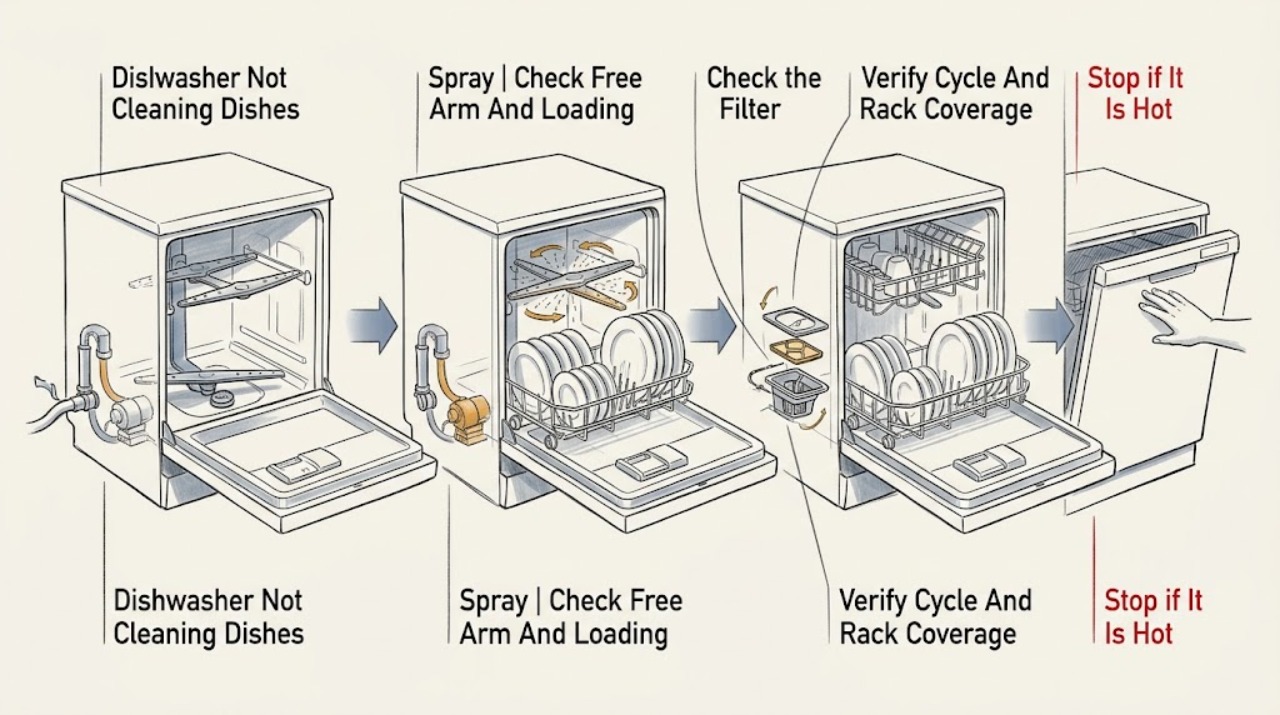
If a dishwasher is not cleaning and its spray arms do not rotate, first turn the dishwasher off and let hot parts cool, then spin each arm by hand to find a rack, utensil, tall pan, misaligned docking tube, or debris obstruction. Clean only removable spray arms and the filter as the exact owner's manual permits. A blocked nozzle or loaded rack can stop circulation in one area; a cycle that does not fill correctly, an obstructed filter, a disconnected upper-arm feed tube, or a failed wash pump can leave every arm still and the dishes dirty. Confirm that the selected cycle is intended to wash the affected rack, because some rack-only cycles do not engage every arm. Do not reach into a running dishwasher, remove panels, test live wiring, or replace a pump based on the symptom alone. Arrange qualified appliance service if the arms still do not move after safe external checks, the tub does not fill, a pump only hums, the breaker trips, or there is leaking, smoke, or burning odor.
Work through in order
Diagnostic checks
Use only checks that match the exact appliance or system and its official guide.
-
Check 1
Turn the dishwasher off before touching anything. Remove or pull out the racks as the manual permits and rotate each spray arm by hand through a full revolution. Check for tall utensils, cutting boards, pans, hanging items, a rack, or a door-mounted item that intersects the arm.
Expected result: An arm hits a dish or rack; only one arm is blocked; every arm turns freely; or an arm is loose, cracked, warped, or rubbing its support.
Next step: Rearrange the load for clearance and recheck hand rotation. If all arms were free or a damaged arm remains, continue with the cool, model-approved cleaning and filter checks without running the unit open.
Stop if: Do not reach into a running dishwasher, force an arm past resistance, bend a rack, or continue if glass, sharp debris, a cracked arm, or water is present where it should not be.
Why this matters
Why: A physical obstruction can stop an arm and leave the obstructed rack dirty. A free arm with poor cleaning keeps water delivery, nozzle, filter, feed-tube, cycle, and pump causes in consideration. A damaged or loose arm cannot be diagnosed by loading changes alone.
-
Check 2
With the dishwasher off and cool, remove only the spray arm and filter parts that the exact owner's manual identifies as user-removable. Rinse visible arm openings and the filter using the manual's method; use a soft tool for nozzle debris only if the manufacturer permits it, and do not push debris into the arm.
Expected result: Nozzle holes or the filter are clogged; the arm is clean but still has resistance; the filter is missing, damaged, or not seated; or the parts are clean and the arm turns freely.
Next step: Reinstall every part exactly as the manual shows and verify free rotation by hand. If cleaning does not restore wash action, stop disassembling and arrange service rather than reaching into the sump or pump.
Stop if: Do not remove a sealed pump cover, use a knife or wire to enlarge holes, use harsh chemicals not approved by the manual, or operate with a missing filter or loose spray arm.
Why this matters
Why: Clogged nozzles or a filter restriction can reduce circulation and cleaning. A filter that is missing or incorrectly seated can allow debris into the circulation path. Clean, freely turning parts make obstruction less likely and shift attention to water fill, the feed path, wash pump, or control.
-
Check 3
Check the selected cycle and the owner's manual for which racks and spray arms it uses. Load soiled faces toward the spray paths, leave space between items, and make sure the detergent dispenser and upper-arm docking or feed path are not blocked by a dish or rack position.
Expected result: A rack-only or specialized cycle was selected; one rack is dirty while another cleans; the upper arm is not aligned with its feed connection; or all racks remain dirty on a normal full-wash cycle.
Next step: Use a suitable cycle and correct the rack or feed alignment only as the manual permits, then recheck cleaning. If the arms remain still or all sections remain dirty, continue to the fill and service boundary rather than repeatedly running cycles.
Stop if: Do not force the rack, remove a feed tube from a running unit, or open the door during operation to reach a moving or pressurized spray arm.
Why this matters
Why: A rack-only cycle can intentionally leave another arm inactive, and a blocked docking path can deprive an upper arm of water. Dirty dishes throughout a normal cycle are less consistent with loading alone and keep fill, circulation, filter, or pump issues in consideration.
-
Check 4
Using only the exact model's normal operating guidance, note whether the dishwasher completes its fill, wash, drain, and heat stages and whether the sound is a normal spray-and-circulation sound, a repeated hum, a grinding noise, or silence during the wash portion. Do not remove panels or place hands in the tub during a cycle.
Expected result: The tub appears not to fill, there is little or no wash-spray sound, a pump hums without circulation, the unit drains but never washes, or the cycle operates normally but dishes remain dirty.
Next step: Keep the dishwasher off when fill or circulation is abnormal and arrange qualified appliance service. If the cycle sounds normal, repeat only after safe loading and cleaning checks; persistent poor cleaning still needs model-specific diagnosis.
Stop if: Stop for leaking water, a burning odor, smoke, repeated breaker trips, exposed wiring, a grinding or seized-pump sound, or a tub that fails to fill or drain as expected.
Why this matters
Why: A low fill condition can leave a lower or middle arm still and points toward water supply, inlet, float, or control diagnosis. A hum without spray or a grinding sound keeps the circulation pump or trapped debris in consideration. Normal wash sound with dirty dishes shifts attention toward loading, detergent, temperature, nozzles, filter, or a particular arm's feed path.
-
Check 5
Record the dishwasher model, cycle, affected rack, hand-rotation result for each arm, filter and nozzle condition, loading changes, fill and drain behavior, and any unusual sound or error indication. Photograph only visible parts and labels without removing panels.
Expected result: One arm remains still after safe cleaning; every arm remains still; the issue began after a filter, rack, or spray-arm change; or the problem persists on a normal cycle with clear loading and clean parts.
Next step: Arrange qualified appliance service and provide the model, observations, cycle behavior, and photos. Use the exact owner's manual and parts diagram for any model-specific part identification.
Stop if: Do not remove the door, kickplate, pump cover, inlet valve, wiring, or control panel, and do not test live voltage or run the dishwasher with a damaged or missing spray arm or filter.
Why this matters
Why: The record helps separate a local arm or feed problem from a system-wide fill or circulation fault and prevents ordering a pump or arm from a symptom alone. A persistent system-wide failure requires internal electrical, inlet, pump, or control diagnosis.
Use your observations
Decision map
Find the observation that best matches what you see, then follow the next safe action.
-
PATH 01Next step
What you see
Do this next
Rearrange the item, confirm a full free revolution with the dishwasher off, and use a suitable cycle. Service is needed if the arm still binds when empty or cleaning remains poor.
Why this path and its safety boundary
Why it matters: The dirty section is most likely missing spray coverage because of loading clearance rather than a failed wash motor.
-
PATH 02Next step
What you see
Do this next
Clean and reinstall the removable parts exactly as the manual directs. If the arm remains still or cleaning does not improve, stop disassembly and request service.
Why this path and its safety boundary
Why it matters: Restricted nozzles or filtration can reduce water distribution and soil removal; cleaning the parts is a reasonable model-approved first path.
-
PATH 03Next step
What you see
Do this next
Select the correct cycle and correct rack or docking alignment only under the exact manual. Persistent arm inactivity on the proper cycle needs service.
Why this path and its safety boundary
Why it matters: The selected cycle or upper water-feed connection can explain the pattern without proving a pump failure.
-
PATH 04Next step
What you see
Do this next
Keep the dishwasher off and arrange qualified appliance service. Do not reach into the sump, open panels, test wiring, or replace a pump based only on sound.
Why this path and its safety boundary
Why it matters: A water inlet, float, circulation pump, trapped debris, control, or related internal fault is more likely than rack loading or a nozzle blockage.
-
PATH 05Next step
What you see
Do this next
Use the model's detergent, loading, temperature, and filter guidance once, then arrange service for persistent poor cleaning or any recurring abnormal sound or error.
Why this path and its safety boundary
Why it matters: Detergent, water temperature, loading, filter or nozzle restriction, cycle choice, or a weakening wash system may be involved; hand rotation alone does not confirm wash pressure.
Helpful context
Understand the symptom
One still arm and three still arms are different clues
Start with the arm that serves the dirty dishes. If only an upper or middle section is dirty, a rack item, upper-arm feed tube, docking connection, or that arm's nozzles may be limiting water. If every arm remains still, a fill, filter, circulation-pump, control, or cycle-selection issue is more plausible. A hand spin proves only that the arm is not physically stuck; it does not prove that the dishwasher is filling or producing wash pressure.
Clean only what the exact model makes removable
With the dishwasher off and cool enough to touch, use the owner's manual to identify the filter, lower arm, middle arm, and any upper feed tube. Rinse removable arms and clear visible nozzle debris only by the model-approved method. Bosch's general guidance uses water and a soft tool for spray-arm openings, while other designs use different clips or retainers. Never pry an arm, remove a filter that is not designed for user removal, or reach below the filter into the pump sump.
Water delivery is the next decision point
Spray arms rotate from water pressure and flow; they are not driven by a separate visible motor at the arm. A free arm that never moves during a normal wash can therefore reflect low fill, a clogged filter or nozzle, a disconnected feed path, a circulation pump, or a control or cycle issue. Do not open the door of a running dishwasher to watch an arm or touch water. Use the end-of-cycle water, sound, and cleaning results described in the manual, then leave internal diagnosis to service.
Safety boundary
Stop conditions
- Turn the dishwasher off and let it cool before touching spray arms, filters, racks, or standing water; never reach into a running cycle.
- Do not remove panels, pump covers, inlet components, wiring, or a sealed sump, and do not test live voltage.
- Do not force a spray arm, bend a rack, enlarge nozzle holes, run without the filter, or operate with a cracked, loose, or missing arm.
- Stop for leaking water, smoke, burning odor, repeated breaker trips, grinding or seized-pump sounds, or a tub that fails to fill or drain as expected.
- Arrange qualified service for persistent arm inactivity or poor cleaning after model-approved loading, cycle, filter, nozzle, and feed-path checks.
Only after diagnosis
Potential parts
- dishwasher spray arm or arm support
Consider this only when the exact model's arm is cracked, warped, loose, or fails a qualified inspection after loading, nozzle, filter, and feed-path checks.
Arm shape, hub, clip, support, and water-feed interface vary by model; confirm the complete dishwasher model before ordering. - dishwasher circulation or wash pump
Consider this only when a qualified diagnosis confirms low or absent wash circulation, abnormal pump noise, or a pump fault after fill, filter, arm, feed, and control causes are evaluated.
Pump assembly, seals, connectors, voltage, and mounting are model-specific; do not infer fit or failure from a still spray arm alone. - dishwasher filter or spray-arm feed component
Consider this only when the exact model has a damaged filter, blocked or cracked feed tube, docking seal, or related water-distribution component confirmed after safe cleaning and alignment checks.
Filter mesh, feed-tube geometry, docking seal, and rack connection vary by model; use the manufacturer's parts diagram and installation instructions.
When checks do not resolve it
Need a professional?
Call qualified appliance service when all arms remain still after safe loading and cleaning checks, the tub does not fill, a pump hums or grinds without spray, an arm or filter is damaged, poor cleaning persists on a normal cycle, or the unit leaks, trips a breaker, smokes, or smells hot.
Have this ready
- Dishwasher make and complete model number
- Selected cycle and whether one rack or all racks are dirty
- Which spray arms rotate freely by hand and which do not
- Filter, nozzle, loading, rack, and upper feed or docking observations
- Fill, wash, drain, sound, leak, error, breaker, or odor symptoms
Common questions
FAQ
Why are my dishwasher spray arms not rotating?
First check for a dish, rack, utensil, or board blocking an arm, then check removable nozzles and the filter under the exact manual. If all arms turn freely but do not move during a normal cycle, low fill, a feed-path problem, circulation pump, inlet, or control issue is more likely and needs service diagnosis.
Can a loaded dish stop a dishwasher spray arm?
Yes. Large utensils, cutting boards, pans, or items hanging below a rack can stop an arm or cause it to strike the load. Rearrange the dishes and confirm a full free revolution with the dishwasher off; do not force the arm.
Should I remove and clean the dishwasher spray arms?
Only if the exact owner's manual identifies them as removable and gives the procedure. Rinse visible openings and clear debris only by an approved method, reinstall every retainer, and verify free hand rotation. Do not pry an arm or enter the pump sump.
Why is only one dishwasher rack not getting clean?
A single dirty rack points toward that rack's spray arm, loading clearance, nozzle restriction, or upper feed or docking path. A rack-only cycle may intentionally leave another arm inactive. If the correct cycle and clear loading do not restore coverage, arrange service.
When should I call for dishwasher service?
Call when the arms remain still after safe clearance and model-approved cleaning, the tub does not fill, a pump hums or grinds without spray, an arm or filter is damaged, or dishes remain dirty on a normal cycle. Stop for leaks, smoke, burning odor, repeated breaker trips, or exposed wiring.
Read the exact guide
Official sources
- Dishwasher Not Cleaning Dishes | Dishwasher TroubleshootingBosch · Official Bosch consumer troubleshooting used for general dishwasher cleaning checks; use the installed dishwasher's manual for exact removable parts and procedures.
- Dishwasher - Lower Spray Arm Not SpinningGE Appliances · Official GE support used for general dishwasher spray-arm and fill distinctions; the exact installed dishwasher manual controls model-specific access and procedures.
- How to Clean your Dishwasher Spray ArmsBosch · Official Bosch cleaning guidance used for the principle of model-approved arm removal and nozzle cleaning; other dishwasher designs may use different retainers.
- Spray Arm Not Working - DishwasherWhirlpool · Official Whirlpool product help used for general spray-arm obstruction, cleaning, cycle-selection, and model-manual guidance; exact dishwasher design controls the procedure.
- Dishwasher - Rhythmic Knocking NoiseGE Appliances · Official GE support used for the symptom of an arm contacting dishware; it is not a diagnosis of an unidentified dishwasher's pump or arm.
Community feedback
Share a repair observation
Share a plain-text repair observation. Accepted observations are published automatically; this page may take a moment to update.