
On this page
Start here
Quick answer
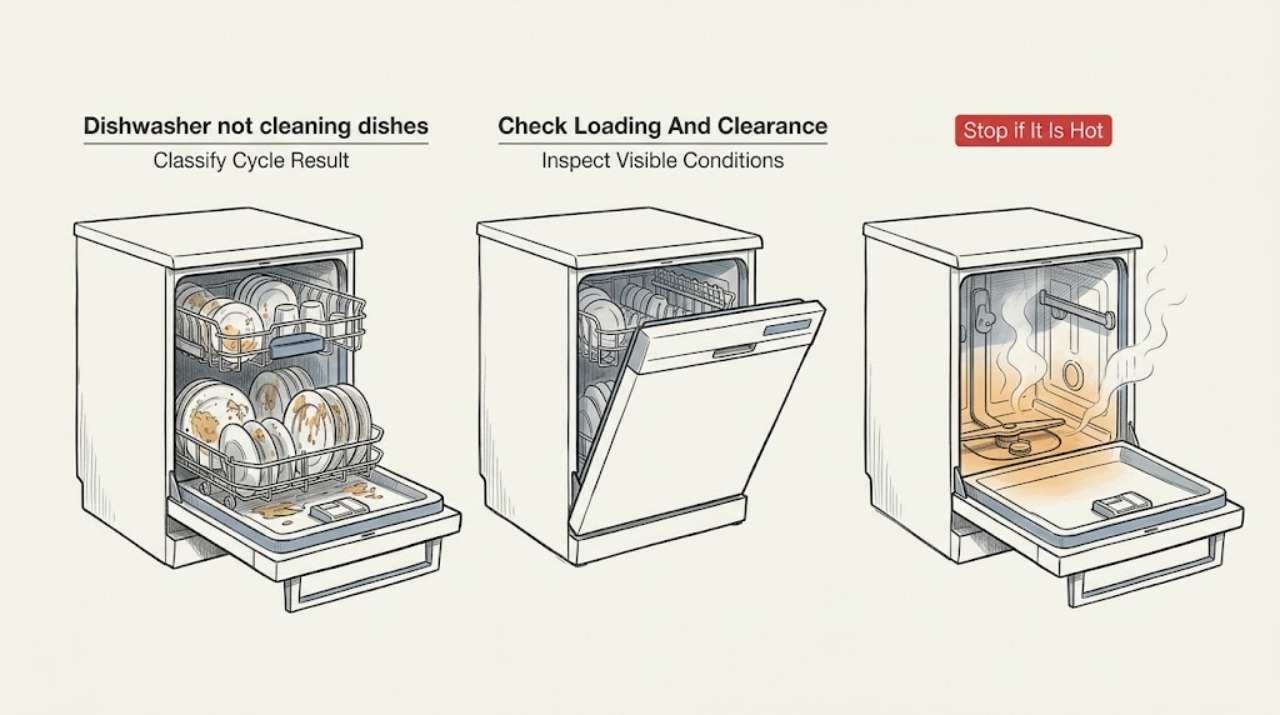
Use the dirty-dish pattern to narrow the cause: note which rack or surfaces remain dirty, whether the chosen cycle matches the soil, whether loading blocks visible spray-arm paths, whether the filter looks obstructed when safely accessible, and whether detergent and incoming water conditions appear normal. Do not reach into a running dishwasher, mix cleaners or detergents, remove pump or spray-arm assemblies, or access live wiring. If the filter, spray arms, water circulation, heating, or controls still seem abnormal after safe user checks, stop experimenting and arrange appliance service.
Work through in order
Diagnostic checks
Use only checks that match the exact appliance or system and its official guide.
-
Check 1
Photograph the result after a completed cycle and record which rack, dish surfaces, soil type, residue, film, or undissolved detergent was affected; do not run repeated cycles just to reproduce a failure.
Expected result: Note whether the problem is on the upper rack, lower rack, both racks, only glasses or plastics, only baked-on food, or a general film or redeposit across the load.
Next step: Use the pattern to choose the next observation and provide the photos and cycle name to the appliance professional if the issue persists.
Stop if: Stop and arrange service if the result includes standing water, a leak, burning odor, unusual noise, broken glass, or a control/electrical warning.
Why this matters
Why: A rack-specific pattern can point toward loading or a spray-path issue, while a whole-load pattern makes filter, water, detergent, temperature, circulation, or cycle selection more relevant. A film is not the same symptom as retained food.
-
Check 2
With the dishwasher stopped and cool, compare the load with the owner’s loading diagram and visually confirm that tall items, plates, utensils, or the detergent dispenser are not blocking the visible spray-arm paths; do not reach into a running appliance.
Expected result: Record whether dishes are crowded, nested, placed with soil facing away from the spray, or positioned where a rack or item obstructs an arm or dispenser.
Next step: Use the model’s loading guidance for the next ordinary load and compare the result once; if the same area remains dirty, continue to the filter and spray observations or call service.
Stop if: Stop if an item is sharp, broken, hot, stuck, or positioned near a moving or electrical component that would require force to remove.
Why this matters
Why: Blocked spray paths can leave one rack or a group of dishes dirty even when the dishwasher is otherwise circulating water. A correctly spaced load with the same failure points away from loading as the only cause.
-
Check 3
With the appliance idle, cool, and safely isolated as directed by its manual, visually inspect the accessible spray-arm openings and clearance for obvious food or mineral blockage; do not remove an arm, insert a tool, or test it during a cycle.
Expected result: Note whether the arm is visibly obstructed, has deposits at openings, appears loose or damaged, or has clear paths but the same rack remains dirty.
Next step: Follow only the model’s user-care instructions for an accessible part; otherwise preserve the observation for a technician and do not force the assembly.
Stop if: Stop if inspection would require disassembly, contact with standing water, sharp deposits, exposed wiring, or any component that does not move freely without force.
Why this matters
Why: An obvious accessible obstruction can explain a rack-specific result, while a clear arm with poor cleaning suggests water circulation, filter, pressure, cycle, or control issues that cannot be identified from the arm alone.
-
Check 4
If the owner’s manual identifies the filter as user-accessible and the appliance is stopped, cool, and safely isolated, observe whether the visible filter area is clear, heavily coated with food or mineral debris, damaged, or missing; do not open the pump area or remove parts beyond the manual’s user-care boundary.
Expected result: Record whether debris is concentrated at the filter, whether the filter looks intact, and whether the dirty-dish pattern includes food redeposited on otherwise clean items.
Next step: Use the model’s filter-care instructions only if the task is explicitly user-accessible; if the filter is damaged, inaccessible, or the symptom remains, arrange service.
Stop if: Stop if the filter area contains standing water, glass, sharp debris, chemical residue, or any cover that requires tools or force.
Why this matters
Why: A restricted filter can reduce water flow and allow soil to redeposit, but a clean filter does not rule out a circulation pump, spray-arm feed, water-level, heating, or control fault.
-
Check 5
Record the selected cycle, detergent form and amount, rinse-aid state, whether the detergent visibly dissolved, and whether the nearby sink water was already warm before the cycle; do not mix detergents, add chemicals, or use a hand-held test inside the appliance.
Expected result: Note whether the problem follows a quick or light cycle, heavy soil, undissolved detergent, cold incoming water, hard-water film, or a consistent failure across cycles.
Next step: Use only the detergent and cycle guidance in the owner’s manual for one controlled comparison, then give the result and water-temperature context to service if cleaning remains poor.
Stop if: Stop if there is a leak, steam or heat damage, chemical odor, foaming overflow, electrical smell, or any need to mix products or open internal components.
Why this matters
Why: Cycle choice, detergent behavior, incoming water temperature, and mineral deposits can change cleaning results. A consistent failure across suitable cycles with clear loading, spray, and filter observations points toward a professional water-circulation, heating, or control diagnosis.
Use your observations
Decision map
Find the observation that best matches what you see, then follow the next safe action.
-
PATH 01Next step
What you see
Only one rack or a group of blocked dishes remains dirty and a visible loading or spray-path obstruction is present.
Do this next
Use the model’s loading guidance for one ordinary comparison load and keep the appliance out of service if the obstruction cannot be safely removed.
-
PATH 02Next step
What you see
The accessible filter is visibly blocked or food is redeposited across the load, or the spray path is clear but water coverage appears poor.
Do this next
Follow only the manual’s user-care boundary; arrange service for inaccessible filter, circulation, pump, water-level, or internal spray-feed problems.
-
PATH 03Next step
What you see
The issue follows a light cycle, undissolved detergent, unsuitable detergent, hard-water film, or cold incoming water context.
Do this next
Make only the manual-supported cycle or detergent adjustment for one controlled comparison, without mixing products; call service if the same result persists.
-
PATH 04Next step
What you see
Cleaning remains poor after safe observations, or there is leakage, overheating, chemical residue, electrical odor, unusual noise, or standing water.
Do this next
Stop using the dishwasher and arrange qualified appliance service; do not disassemble or perform live inspection.
Helpful context
Understand the symptom
Start with the result, not a part guess
A dishwasher that leaves food can have a loading or spray obstruction, a filter or water-flow issue, an unsuitable cycle or detergent result, hard-water deposits, or a circulation, heating, or control fault. Bosch and Whirlpool guidance both connect specific cleaning patterns with the filter, rack loading, spray-arm clearance, cycle choice, detergent, and water conditions. The observations below keep those possibilities separate without asking the reader to disassemble a wet appliance.
Keep access safe
Only inspect an item that the owner’s manual identifies as user-accessible, with the appliance stopped, cool, and safely isolated according to the manual. Never reach into a running cycle, remove a pump cover, handle wiring, mix chemical cleaners, or force a component. A service professional should handle circulation, heating, electrical, and internal water-flow diagnosis.
Only after diagnosis
Potential parts
- dishwasher spray arm
Consider this category only if a model-specific diagnosis confirms a damaged or blocked spray arm after safe loading and visual observations; dirty dishes alone do not identify the part.
Confirm the dishwasher model, rack position, arm connection, and manufacturer fit information before ordering. - dishwasher circulation pump
Consider this category only when a qualified technician confirms inadequate circulation or a failed pump; do not infer pump failure from a dirty load or attempt live testing.
Confirm exact model fit and the technician’s diagnosis before selection; pump assemblies and wiring vary by dishwasher. - dishwasher filter
Consider this category only if the user-accessible filter is confirmed damaged or missing and the model documentation supports replacement; a dirty filter may need care rather than a new part.
Match the model and filter system exactly, and do not access the pump or internal sump to install or test it.
When checks do not resolve it
Need a professional?
Arrange appliance service when the same rack or whole load remains dirty after safe loading, cycle, temperature, spray-path, and filter observations, or when circulation, heating, water-level, or internal components are suspected. Stop using the appliance for leaks, standing water, unusual noise, overheating, chemical residue, or electrical odor.
Have this ready
- Provide photos of the dirty-dish pattern, rack affected, cycle name, detergent and rinse-aid details, water-temperature context, visible spray/filter observations, and whether the detergent dissolved.
Common questions
FAQ
Why are only the bottom-rack dishes still dirty?
A bottom-rack pattern can follow loading, a blocked lower spray path, filter or water-flow issues, or a model-specific cycle choice. Photograph the pattern and inspect only accessible clearance with the appliance stopped and cool.
Can a dirty filter make a dishwasher leave food on dishes?
Yes, a restricted filter can reduce water flow or allow soil to redeposit, but a clean filter does not rule out circulation, heating, water-level, or control problems. Follow the manual’s user-care boundary and call service if the symptom remains.
Does water temperature affect dishwasher cleaning?
Incoming water and the selected cycle can affect detergent and soil removal. Record whether nearby water was already warm and whether the detergent dissolved, but do not use improvised hot-water tests or open the appliance to measure internal temperature.
Should I run a stronger cycle or add more detergent?
Use only the cycle and detergent guidance in the owner’s manual for the observed soil level. Do not mix products or add extra chemicals; excessive or incorrect detergent can create residue or suds and obscure the real problem.
When should I call for dishwasher service?
Call when the same cleaning failure persists after safe loading, cycle, water, spray-path, and filter observations, or when you hear unusual noise, see standing water or leaks, notice overheating or chemical residue, or suspect circulation, heating, or electrical faults.
Read the exact guide
Official sources
- Spray Arm Not Working - DishwasherWhirlpool · This manufacturer page links blocked spray arms and a top-rack-only cycle to poor rack cleaning and notes mineral deposits as a possible contributor; model-specific procedures remain controlling.
- Why is My Dishwasher Not Cleaning Dishes Properly?Whirlpool · The manufacturer article supports connecting dirty-dish patterns with filter, water-supply/temperature, loading, detergent, cycle, and interior conditions; it does not replace the owner’s model manual or service diagnosis.
- Dishwasher Troubleshooting: Dishwasher Not Cleaning DishesBosch Home Appliances · The manufacturer page supports observations of filter condition, loading, spray-arm blockage, and rinse-aid context; exact access and care steps vary by model.
Community feedback
Share a repair observation
Share a plain-text repair observation. Accepted observations are published automatically; this page may take a moment to update.