
On this page
Start here
Quick answer
A clogged dishwasher filter can let food circulate, reduce cleaning performance, and contribute to an unpleasant odor, but a filter is only one part of the wash path. Note whether soil is on every rack or only one area, then turn the dishwasher off and follow the exact manual to inspect and clean the accessible filter. Check that spray arms rotate freely and their holes are not blocked, that dishes and the detergent dispenser are not blocking water, and that the cycle has adequate water and detergent for the load. If the filter is clean and correctly locked but dishes remain dirty, odor is accompanied by standing water, the dishwasher leaks, or a pump, heater, inlet, or electrical fault is suspected, stop repeated cycles and arrange qualified appliance service. Never run a model that requires its filter without the filter installed.
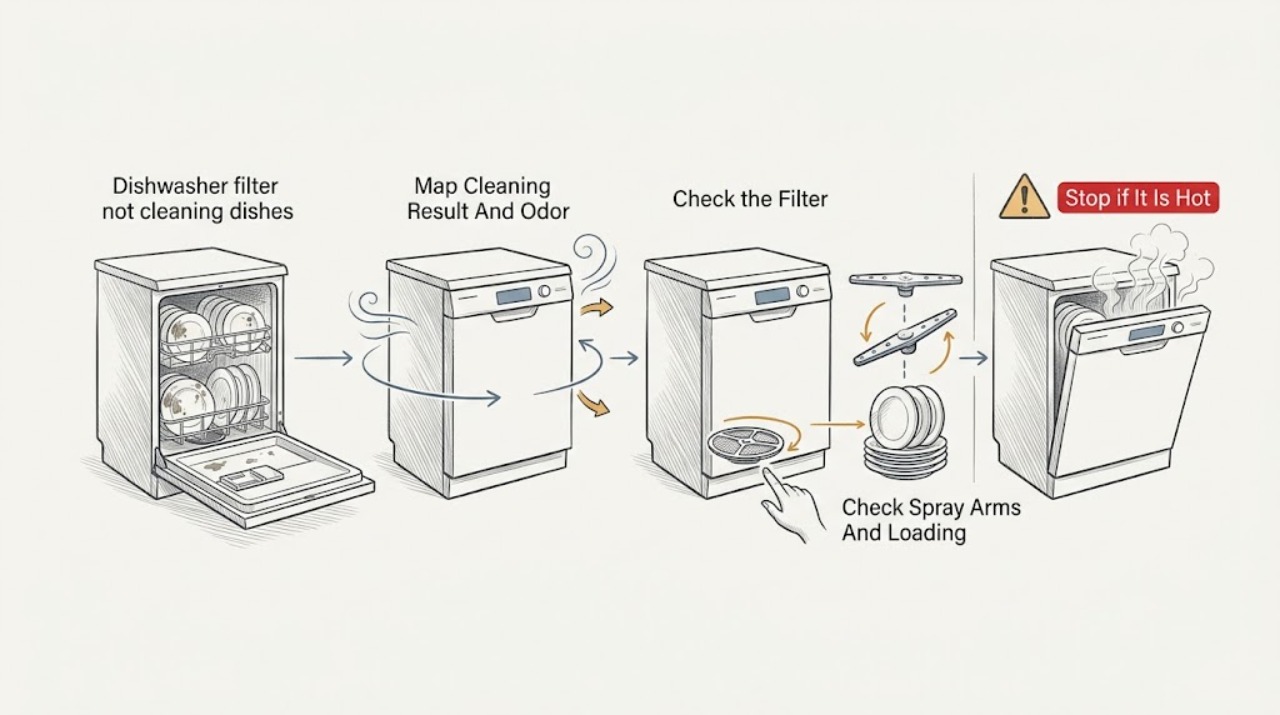
Work through in order
Diagnostic checks
Use only checks that match the exact appliance or system and its official guide.
-
Check 1
After a completed cycle, record where soil, grit, white film, or odor remains: across both racks, only the upper or lower rack, near the filter and sump, or mainly on glassware. Note whether standing water remains and whether the detergent dispenser opened.
Expected result: Food particles are redeposited throughout the load, one rack is consistently dirty, a white film is present without food soil, or odor is paired with standing water, slow draining, or a leak.
Next step: Photograph the pattern and continue only with the matching accessible check. If there is a leak, water in the base, damaged wiring, burning smell, or unsafe water exposure, stop using the dishwasher and arrange service.
Stop if: Do not reach into standing water near power, run another cycle to hide an odor, or scrape deposits from components.
Why this matters
Why: Whole-load food redeposit keeps filter and recirculation in scope. A one-rack pattern makes spray-arm coverage or loading more likely. White film can be water or detergent chemistry rather than a clogged filter. Odor with standing water or leakage points toward a drain, sump, water-flow, or base-leak condition that should not be treated as routine filter care.
-
Check 2
Turn the dishwasher off and allow hot parts to cool. Following the exact owner manual, remove only the accessible lower rack, spray arm, or filter assembly required for filter care; rinse the filter and use a soft brush for debris or mineral residue, then reinstall and lock every filter exactly as shown.
Expected result: The filter mesh is coated with food or scale, the assembly is damaged or not locking, the filter is missing or incorrectly seated, or it is clean, intact, and securely installed.
Next step: Run the dishwasher only with all required filters correctly installed and continue to the spray-arm and loading check. If the filter cannot be removed or locks incorrectly, stop and use the manual or qualified service rather than forcing it.
Stop if: Do not operate without the required filter, use a wire brush or scouring pad, pry the filter housing, or reach into the pump or heater area.
Why this matters
Why: A loaded filter can allow food to recirculate and can reduce wash performance; a missing or loose filter can expose the pump or let soil bypass the filter. A clean and locked filter makes spray coverage, loading, detergent, water flow, heating, or drain performance more likely causes.
-
Check 3
With the dishwasher off, arrange dishes so soiled surfaces face the spray path and tall items do not touch a spray arm or detergent door. Gently spin each accessible spray arm by hand and look at its holes for visible debris; clean only as the manual permits.
Expected result: A spray arm catches on a dish, does not rotate freely, has blocked holes, or rotates freely with open holes while the same rack remains dirty.
Next step: Rearrange the load or remove only loose visible debris according to the manual, then make one controlled wash observation. If the arm remains stiff or the rack remains dirty, arrange appliance service.
Stop if: Do not force a spray arm, insert sharp tools into unknown passages, remove pump covers, or run the appliance with a loose arm or filter.
Why this matters
Why: Blocked rotation or nozzles can leave one rack dirty even when the filter is clean because water does not reach the intended surfaces or dispenser. A freely rotating, clear spray arm makes water fill, circulation pressure, detergent, temperature, or a hidden pump issue more likely.
-
Check 4
Check the selected cycle, detergent dispenser, rinse aid, and the water supply context against the owner manual. Confirm the dispenser is not blocked by a dish and that detergent has dissolved after the cycle; do not change several detergent or water settings at once.
Expected result: The dispenser stayed closed or retained detergent, the load was tightly nested or heavier than the selected cycle, water appears insufficient or not hot as expected, or the cycle and dispenser behave normally.
Next step: Correct only the clear loading, dispenser, cycle, or manual-approved detergent issue, then run one appropriate cycle. If cleaning remains poor, stop changing consumables and call a qualified technician.
Stop if: Do not add hand soap, mix chemicals, alter plumbing, open the heater area, or infer a pump fault from detergent residue alone.
Why this matters
Why: A blocked dispenser, unsuitable cycle, poor loading, inadequate water flow, or temperature problem can leave dishes dirty while the filter is fine. Normal dispensing and cycle conditions make spray circulation, drain, heater, or another appliance fault more likely.
-
Check 5
After one correctly installed filter, unobstructed spray path, and manual-appropriate cycle, compare the next load with the original result and check the filter, sump area, odor, and remaining water without disassembling the appliance.
Expected result: Food redeposit and odor improve, one rack remains dirty, white film remains without food soil, standing water or odor persists, or a leak, fault message, unusual noise, or heating problem appears.
Next step: Log the result and arrange qualified appliance service for any persistent or safety-related pattern. Provide the model, filter condition, rack pattern, cycle, detergent, water, and odor or leak observations.
Stop if: Stop repeated cycles for persistent standing water, active leakage, electrical odor, damaged wiring, abnormal heating, or a fault message that returns.
Why this matters
Why: Improvement after filter and wash-path care supports a maintenance or loading cause. A single-rack problem points toward spray coverage or circulation. Persistent film may involve water chemistry or etching. Standing water, persistent odor, leaks, alerts, noise, or poor heating indicates a drain, pump, inlet, heater, control, or safety issue beyond the filter.
Use your observations
Decision map
Find the observation that best matches what you see, then follow the next safe action.
-
PATH 01Safety boundary
What you see
Food particles are redeposited across both racks, the filter is visibly loaded or incorrectly seated, the spray arms rotate freely, and there is no leak or fault message.
Do this next
Clean and lock the filter according to the manual, run one suitable cycle, and record whether food redeposit and odor improve.
Why this path and its safety boundary
Why it matters: Filter bypass or recirculation contamination is more likely than a rack-specific spray obstruction.
Safety stop: Do not run without the required filter or use abrasive tools on its mesh.
-
PATH 02Safety boundary
What you see
Only one rack remains dirty, a spray arm catches on a dish or has blocked holes, or the filter is clean and locked.
Do this next
Correct the load or clean visible spray-arm debris as the manual allows. If the arm remains restricted or the rack remains dirty, arrange service for circulation and water delivery diagnosis.
Why this path and its safety boundary
Why it matters: Loading, spray-arm rotation, nozzle blockage, or circulation coverage is more likely than the filter itself.
Safety stop: Do not force the arm, insert sharp objects into unknown passages, or open the pump.
-
PATH 03Safety boundary
What you see
The dishes have a white or cloudy film without much food redeposit, the filter is clean, and detergent or rinse-aid and water-hardness conditions differ from the manual guidance.
Do this next
Follow the manual for water-hardness, detergent, rinse-aid, and descaling care, changing one factor at a time. If the film persists or glass appears etched, ask the manufacturer or a technician for guidance.
Why this path and its safety boundary
Why it matters: Water chemistry, detergent amount, rinse aid, mineral buildup, or permanent glass etching is more likely than a blocked filter.
Safety stop: Do not overdose detergent, mix cleaners, or use an unapproved chemical treatment.
-
PATH 04Safety boundary
What you see
An unpleasant odor returns with standing water, slow draining, visible water in the base, leakage, or a drain or water-flow message after the filter is clean and locked.
Do this next
Stop using the dishwasher, shut off the water supply if the manual or local procedure safely identifies it, and arrange qualified appliance service; provide the odor, water, and message details.
Why this path and its safety boundary
Why it matters: A drain, sump, pump, inlet, hose, or leak-protection condition is more likely than ordinary filter maintenance.
Safety stop: Do not reach into standing water near power, remove pump covers, disconnect hoses, or keep running cycles to clear the odor.
-
PATH 05Safety boundary
What you see
The filter is clean and installed correctly, the load and spray arms are clear, but dishes remain dirty with weak circulation, poor heating, unusual noise, a recurring error, or an active leak.
Do this next
Stop repeated cycles and call a qualified appliance technician for water-flow, heating, pump, drain, and electrical diagnosis. Do not order a pump or heater from symptoms alone.
Why this path and its safety boundary
Why it matters: A circulation pump, water inlet, heater, control, wiring, drain, or internal mechanical fault is more likely than the filter.
Safety stop: Do not open the base, test live parts, bypass a leak sensor, or reset a recurring fault indefinitely.
Helpful context
Understand the symptom
What the filter can explain
The filter catches food particles and keeps them from returning to the wash water or reaching the pump. When its mesh is coated with soil or mineral buildup, dishes may emerge dirty or gritty and the machine may smell because old food remains in the wash path. Bosch and Whirlpool both direct owners to follow the model manual for filter removal and to use a gentle, non-abrasive cleaning method. A clean filter does not by itself prove that the spray system, water level, detergent release, heater, or drain is working.
Read the residue pattern before changing parts
Soil on all racks with a dirty filter suggests recirculation or wash-water handling. Soil mainly on one rack points more toward a blocked or non-rotating spray arm, loading, or rack-specific water path. A white film or cloudy glass can involve water hardness, detergent amount, or etching rather than food debris. An odor plus standing water or a slow drain is a different branch from an odor that improves when the filter is cleaned.
Keep checks limited to accessible care
Filter and spray-arm care can be model-specific. Do not operate a dishwasher without required filters, use abrasive tools, reach into an energized appliance, open the pump or heater area without the exact procedure, or treat a fault message as permission to dismantle the unit. Water in the base, a leak, a damaged cord, burning odor, or a persistent error needs service rather than another wash cycle.
Safety boundary
Stop conditions
- Do not operate the dishwasher without all required filters correctly installed.
- Do not reach into standing water near power, open the base or heater area, disconnect hoses, or test live parts.
- Do not use abrasive tools, mix cleaners, add hand soap, or insert sharp objects into unknown pump or spray passages.
- Stop for active leakage, water in the base, damaged wiring, burning odor, abnormal heating, unusual noise, or a recurring error message.
Only after diagnosis
Potential parts
- dishwasher filter
Consider this category only when the installed filter is damaged, missing, warped, or unable to lock after the model-specific cleaning and fit check.
Confirm the exact dishwasher model, filter assembly, locking method, and manufacturer instructions; do not operate without required filters. - dishwasher spray arm
Consider this category only when the correct rack's spray arm is damaged, remains restricted after safe cleaning, or fails a model-specific service diagnosis.
Confirm the model, rack position, water-feed connection, and rotation clearance before selection; a visually similar arm may not deliver water correctly.
When checks do not resolve it
Need a professional?
Call a qualified appliance technician when the filter and accessible wash-path checks do not restore cleaning, odor returns with standing water, there is a leak or base-water warning, a pump or heater may be involved, or a recurring fault message appears.
Have this ready
- Dishwasher brand, model, and visible error message
- Whether soil is on both racks or one rack and whether it is food, grit, or white film
- Filter condition, locking result, spray-arm rotation, and loading observations
- Cycle, detergent, rinse-aid, water-flow, and heating context
- Odor timing, standing water, leaks, unusual noise, and any safe maintenance already attempted
Common questions
FAQ
Can a dirty dishwasher filter cause dishes not to get clean?
Yes. A loaded filter can let food circulate and return to dishes, reduce wash performance, and contribute to odor. But a clean filter does not rule out a blocked spray arm, loading, detergent, water-flow, heating, drain, pump, or control problem.
How do I clean the dishwasher filter safely?
Turn the appliance off and let hot parts cool, then follow the exact model manual for filter removal. Rinse and use a soft brush for debris or mineral residue, reinstall every piece securely, and never run a model that requires its filter without it.
Why are dishes dirty on only one rack?
A rack-specific result is more consistent with loading, a spray arm that cannot rotate, blocked nozzles, or a rack-specific water path than with the filter alone. Rearrange the load and inspect the accessible arm; arrange service if the arm remains restricted or the rack stays dirty.
Why does my dishwasher smell after cleaning the filter?
If odor improves after filter care, trapped food may have been contributing. If odor returns with standing water, slow draining, leakage, or a water-flow message, stop running cycles and arrange drain, sump, pump, or leak diagnosis.
What if dishes have white film instead of food particles?
White film or cloudy glass can involve water hardness, detergent amount, rinse aid, mineral buildup, or permanent etching rather than a blocked filter. Follow the manual's water and detergent guidance and ask for service if the condition persists.
Read the exact guide
Official sources
- How to Clean the Dishwasher Filters - Product HelpWhirlpool · Whirlpool dishwasher filter guidance; use the actual model manual for filter type and access.
- Dishwasher Troubleshooting: Dishwasher Not Cleaning DishesBosch Home Appliances · General Bosch dishwasher care guidance; the installed dishwasher manual controls model-specific removal and cleaning procedures.
- Dishwasher Error Codes | SupportBosch Home Appliances · Bosch error-code guidance; error meanings and user steps vary by model and should be verified in the installed manual.
- Dull Surfaces on Dishes - Product HelpWhirlpool · General Whirlpool wash-performance guidance; water chemistry and model instructions govern the actual appliance.
- How to Properly Clean Your Dishwasher FilterBosch Home Appliances · Bosch dishwasher filter guidance; other manufacturers and models may use different filter assemblies and instructions.
Community feedback
Share a repair observation
Share a plain-text repair observation. Accepted observations are published automatically; this page may take a moment to update.