
On this page
Start here
Quick answer
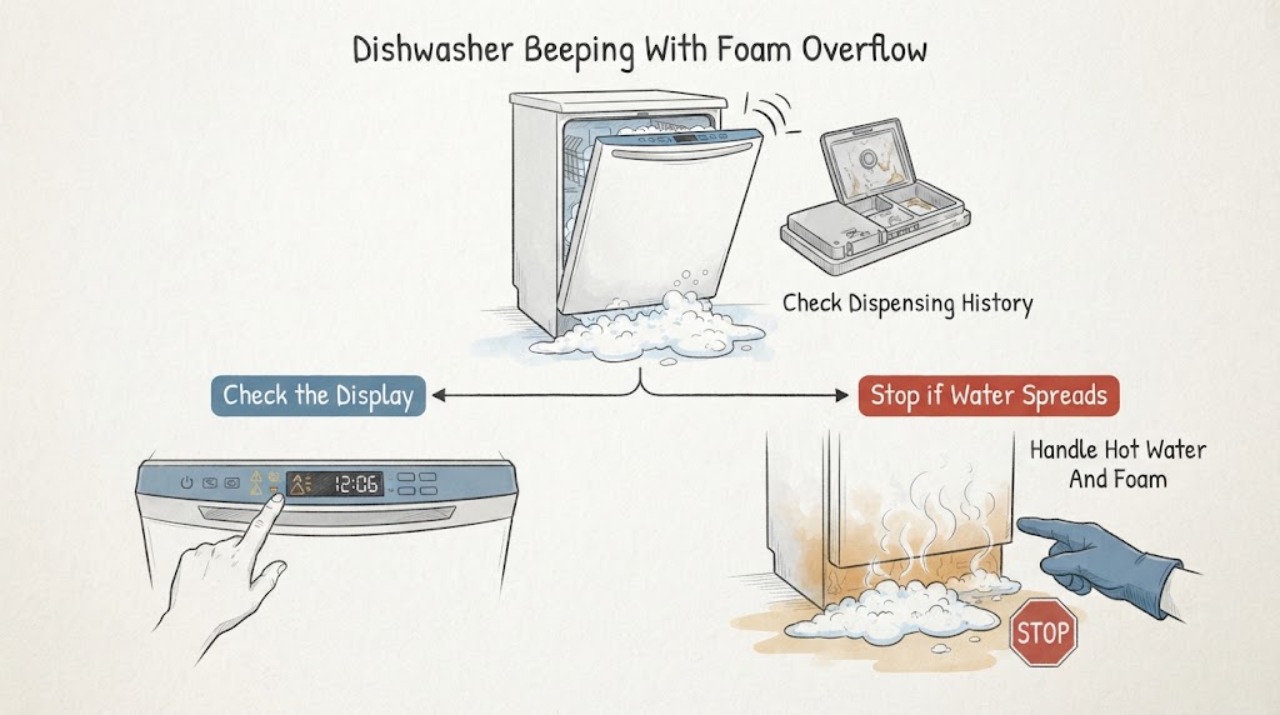
Stop the cycle and do not add more detergent. Bosch manuals identify excessive foam as commonly linked to hand soap in the rinse-aid dispenser, spilled rinse aid, or a detergent/machine-care product that foams excessively. Keep the dishwasher stopped, wipe accessible spilled liquid only after it is safe, and do not open the door into hot water or steam. If water is in the base, the dishwasher is actively filling, the beeping is paired with an error/display, or the overflow returns, close the water supply and arrange Bosch service. The beep itself is not enough to identify a specific fault code without the exact model and display.
Work through in order
Diagnostic checks
Use only checks that match the exact appliance or system and its official guide.
-
Check 1
Stop the wash cycle with the normal control if safe, note the exact beep pattern/display, and do not add detergent or restart while foam is escaping.
Expected result: The dishwasher stops, continues beeping, shows an error, or continues filling.
Next step: Keep the dishwasher stopped. If water is entering or water protection is indicated, close the water supply and use the service branch; otherwise continue with the cool, external dispensing check.
Why this matters
Why: A sound alone is not a model-independent code; a display, continuous fill or water-protection indication may indicate a separate service condition.
-
Check 2
Wait until water noises and steam have subsided before opening fully; from outside, wipe only accessible foam or liquid from the floor and do not reach under the appliance or remove panels.
Expected result: The door area is still hot/steaming, or foam/water has reached the floor/base.
Next step: Keep the door closed until safe. For water at the base or an active leak, close the water supply and arrange service; do not run another cycle.
Why this matters
Why: Bosch warns that hot water or steam may escape, and water in the base can activate water protection; neither condition is a safe detergent experiment.
-
Check 3
Once cool and dry externally, identify whether hand dish soap entered the rinse-aid dispenser, rinse aid spilled, or a detergent/machine-care product different from the normal dishwasher detergent was used.
Expected result: One of these product/dispensing events occurred, or no cause can be identified.
Next step: For a documented product cause, follow the exact model manual’s rinse-aid/cleaning guidance and do not add more chemicals. If no cause is known or foam returns, stop and contact Bosch service.
Why this matters
Why: Bosch lists each event as a cause of excessive foam; if none occurred, the foam and beeping cannot be narrowed to a user-level product cause from this topic alone.
-
Check 4
Without moving or opening the dishwasher, observe whether the base/floor is wet, the machine is continuously taking in water, or a water-protection indication/error is shown.
Expected result: Water is in the base, continuous filling occurs, or a water-protection indication appears.
Next step: Close the water supply, keep the appliance off, and contact Bosch customer service. Do not reset repeatedly or inspect internal hoses/valves.
Why this matters
Why: Bosch identifies these conditions as water-protection or continuous-fill events requiring the water supply to be closed and service contact.
-
Check 5
Provide Bosch service the model/serial, beep/display details, product history, foam location, water status and any photos taken after the area is safe.
Expected result: Beeping or foam overflow recurs, an error remains, or internal access would be needed.
Next step: Keep water and power off as appropriate and use Bosch support/manual routing. Do not replace a pump, sensor, valve or control based only on the sound.
Why this matters
Why: The exact model and physical water status are needed to distinguish dispensing foam from a leak, fill, drain or control condition; the assigned topic has no model.
Use your observations
Decision map
Find the observation that best matches what you see, then follow the next safe action.
-
PATH 01Next step
What you see
Foam appears at the door, but there is no standing water, continuous fill or water-protection indication, and hand soap/rinse aid/detergent history is known.
Do this next
Stop adding chemicals, follow the exact model manual’s cleanup guidance once cool, and change the implicated detergent/product rather than running repeated tests.
Why this path and its safety boundary
Why it matters: Bosch documents those dispensing/product events as causes of excessive foam.
-
PATH 02Next step
What you see
Water is collecting under the dishwasher, the machine continues filling, or a water-protection indication/error appears with the foam.
Do this next
Close the water supply, keep the dishwasher off and contact Bosch service. Do not restart to see whether the foam clears.
Why this path and its safety boundary
Why it matters: This is not safely narrowed to product foam; Bosch identifies water protection or continuous water entry as a service condition.
-
PATH 03Next step
What you see
The dishwasher is still hot or steaming when the beeping starts, or opening the door would release hot water.
Do this next
Do not fully open the door until water noises stop and steam subsides; then use only the external, cool checks.
Why this path and its safety boundary
Why it matters: The immediate hazard is hot water/steam, and the cause cannot be safely inspected yet.
-
PATH 04Next step
What you see
The dishwasher keeps beeping or the foam returns after the documented product cause is removed, with no model-specific display interpretation available.
Do this next
Keep the appliance stopped, record the model/serial and display, and contact Bosch service instead of inferring an internal component.
Why this path and its safety boundary
Why it matters: The remaining claim is outside a safe generic foam diagnosis; the beep may represent another model-specific condition.
Helpful context
Understand the symptom
Stop the foam source before interpreting the beep
Stop the running cycle using the normal control if it is safe to do so and do not add another detergent product. Bosch documents excessive foam as a product/dispensing problem in its dishwasher manual, including hand soap in the rinse-aid dispenser, spilled rinse aid, and detergent or machine-care products that foam excessively. The sound may be an alert, but without the model and display it does not identify a code.
Handle water, suds and the door safely
Do not fully open the door while water noises or steam are present. Once the appliance is stopped and safe to approach, wipe only accessible foam or liquid from the floor and surrounding surfaces; do not reach under the dishwasher or remove panels. If water is collecting under the unit or the machine keeps filling, close the water supply and stop.
Separate product foam from a water-protection event
Foam at the door with no standing water or display code points first to the detergent/rinse-aid path. Water in the base, continuous filling, or a water-protection indication is a different branch. Bosch manuals list water-protection states and continuous water entry as service conditions, so do not keep restarting the cycle to test them.
Check the exact dispensing history
After the dishwasher is safe and cool, record what was added to the detergent and rinse-aid compartments, whether hand dish soap or machine cleaner was used, whether rinse aid spilled, and the exact model/serial and display. Do not pour an unapproved defoamer, extra detergent or household chemical into the tub. Use the exact Bosch manual for any cleanup or reset instruction.
Escalate recurring beeping or overflow
If the foam returns after the documented product cause has been removed, if water remains in the base, or if the dishwasher continues beeping or displays an error, keep the water supply closed as appropriate and contact Bosch service. Do not diagnose a pump, sensor, inlet valve or control board from the beep alone.
When checks do not resolve it
Need a professional?
Contact Bosch service when water is in the base, the dishwasher continuously fills, a water-protection indication appears, foam/beeping recurs, or an internal component would need inspection.
Have this ready
- Provide the E-Nr/model and serial, exact beep/display pattern, foam location, whether the door was opened while hot, what detergent/rinse aid/cleaner was used, and whether the floor/base is wet.
Common questions
FAQ
What causes excessive foam in a Bosch dishwasher?
Bosch lists hand soap in the rinse-aid dispenser, spilled rinse aid, and detergent or machine-care products that foam excessively. Stop adding products and use the exact model manual’s cleanup guidance.
Does a beeping Bosch dishwasher always mean the pump is bad?
No. A beep without the model display and physical water status does not identify a component. Bosch manuals distinguish product foam from water-protection and continuous-fill conditions; record the display and use service when the condition persists.
What should I do if foam is on the floor?
Stop the cycle and keep the dishwasher off. After hot water and steam have subsided, wipe only accessible liquid; if the base is wet or filling continues, close the water supply and contact Bosch service.
Can I add another chemical to remove the suds?
Do not improvise a defoamer or add more detergent. Identify the product/dispensing cause and follow the exact Bosch manual or service instructions.
Read the exact guide
Official sources
- Bosch Dishwasher Troubleshooting & Repair GuideBosch · Official Bosch US support hub used for exact manual lookup and authorized service routing; not treated as proof of an unseen foam-specific beep code.
- Use and Care Manual SHX78B75UCBosch · Opened official Bosch PDF whose cover/manual identity is SHX78B75UC. Used as a family-scoped example for excessive foam, hot-water/steam handling, water-protection and continuous-fill boundaries; exact model manual remains controlling because the task supplies no model.
- Bosch Dishwasher Error CodesBosch · Official Bosch US error-code page used for water-protection, water-flow and service boundaries; it is not used to infer a beep code absent from the task.
Community feedback
Share a repair observation
Share a plain-text repair observation. Accepted observations are published automatically; this page may take a moment to update.