
On this page
Start here
Quick answer
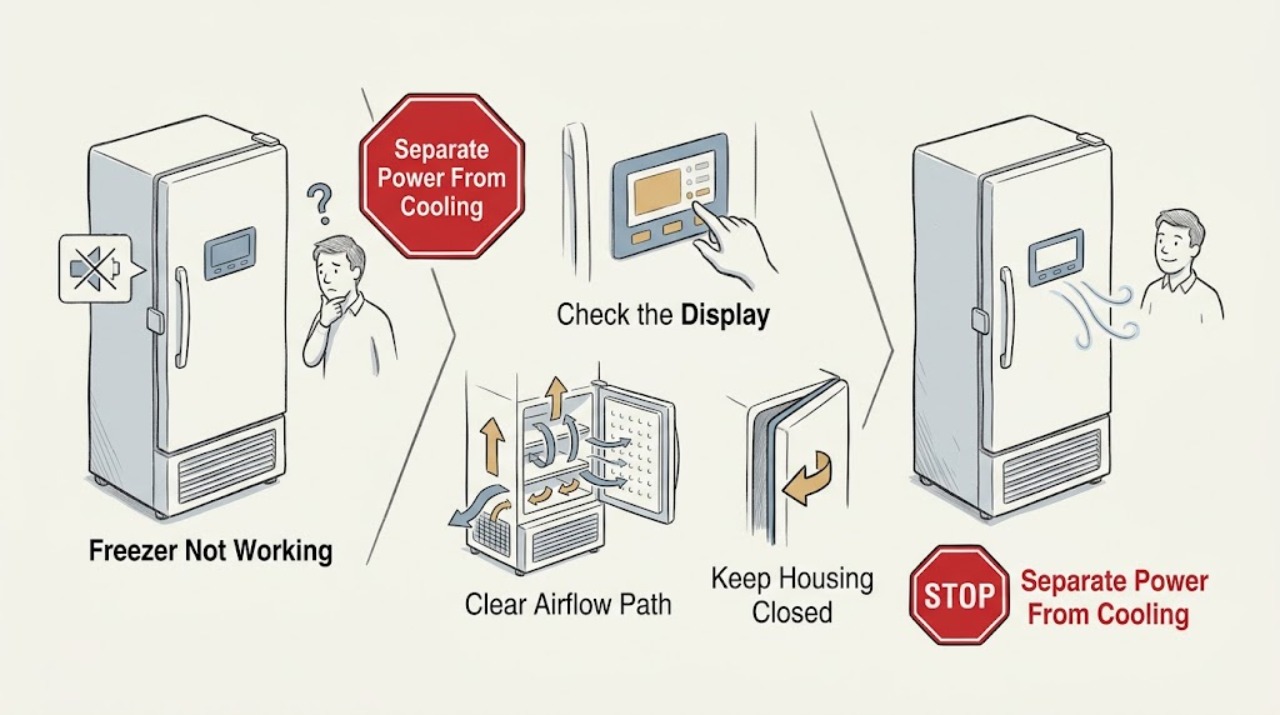
If a Bosch freezer is not working, first separate no power from no cooling: check whether the display or interior light responds, whether the cord and outlet are visibly intact, and whether the freezer is warmer than usual. Then look for an accidentally changed control, an open door or damaged seal, blocked ventilation openings, or excessive frost without removing panels or attacking ice. Bosch says some humming, bubbling, clicking, and cracking can be normal, but a freezer that remains warm, has persistent alarms, a damaged cord, water, smoke, or suspected refrigerant damage needs qualified appliance service. Protect frozen food according to the exact owner's manual while the fault is assessed.
Before you begin
Safety first
- Observation only. No cover removal, fan contact, sharp-object defrosting, heat or steam, refrigerant work, energized electrical checks, heavy-appliance movement, or guessed part replacement.
Work through in order
Diagnostic checks
Use only checks that match the exact appliance or system and its official guide.
-
Check 1
Look at the Bosch freezer's display, interior light, and accessible power cord or plug without pulling, opening panels, or touching damaged parts. Note whether other nearby appliances have power, but do not use a damaged outlet or cord.
Expected result: The display and light are dark; the display is lit but cooling is absent; the cord or plug is visibly damaged; or the freezer appears powered normally.
Next step: Record the display/light pattern and any household outage, then use the exact manual or arrange qualified appliance/electrical service. Do not open the electrical enclosure or repeatedly operate a freezer with a damaged cord.
Stop if: Stop for heat, smoke, burning odor, sparking, shock or tingling, water at electrical parts, a frayed cord, or a loose or scorched receptacle.
Why this matters
Why: A dark appliance points toward power delivery or an internal electrical fault, while a lit appliance with poor cooling points toward controls, airflow, frost, or refrigeration. Bosch warns that a damaged appliance or cord should not be operated and requires trained service.
-
Check 2
From the front, check whether the freezer door closes fully and whether the gasket is visibly detached, folded, or blocked. Read the displayed temperature or alarm and note whether a control was changed accidentally; do not force the door or dismantle the gasket.
Expected result: The door closes and seals evenly; a package holds it open; the gasket is damaged or displaced; the set control differs from the usual setting; or a temperature/door alarm remains active.
Next step: Remove only a loose package that is clearly preventing closure, without forcing shelves or the gasket. Photograph a damaged seal and record the alarm; if the door will not close or the alarm persists, arrange qualified appliance service and limit door openings.
Stop if: Stop if the hinge, door, gasket, or cabinet is distorted, the door could fall, the appliance is unstable, or the inspection requires tools or heavy movement.
Why this matters
Why: Bosch identifies door closure, door seals, and accidentally changed controls as relevant to frost and temperature problems. A persistent alarm or failed seal can explain warming, but it does not prove that the refrigeration system itself is healthy.
-
Check 3
With the door open only briefly, look for food blocking visible interior or exterior ventilation openings and for a heavy frost layer or ice around an interior panel. Do not remove a panel, touch a fan, chip ice, use a sharp tool, or apply heat or steam.
Expected result: Vent openings are clear and frost is minor; food blocks an accessible opening; frost is heavy or returns quickly; or the noise or cooling symptom seems to come from behind a panel.
Next step: Move only loose food that visibly blocks an accessible opening. If frost is heavy, recurring, or behind a panel, keep the freezer closed as practical, protect food using the manual, and request qualified service rather than dismantling or force-defrosting it.
Stop if: Stop if removing an obstruction requires a panel, force, a tool, contact with a fan or tubing, or any heat source.
Why this matters
Why: Bosch identifies blocked ventilation and excessive frost as causes of freezer problems. Heavy or recurring frost can involve door sealing, airflow, defrost, or another internal fault, and the visible frost pattern cannot identify the failed part safely.
-
Check 4
Over a short observation period, note whether the freezer makes its usual motor or fan sound, whether it cycles, and whether the interior remains cold enough to keep food solid according to the exact manual. Record recent power interruption, large fresh-food load, extended door opening, or an increased-freezing mode.
Expected result: The freezer cycles and remains cold; it is silent and warm; it runs continuously but stays warm; or a temperature alarm or thawing food accompanies the symptom.
Next step: Keep doors closed and record the timing, alarm, temperature indication, and recent events. If the freezer remains warm or food is thawing, arrange prompt qualified appliance service and follow the manual's food-safety guidance.
Stop if: Stop for smoke, burning odor, sparking, a damaged cord, water entering the appliance, or any suspected refrigerant leak.
Why this matters
Why: A normal cycle with normal temperature makes a settings or intermittent symptom more plausible. Silence with no cooling, continuous running with warming, or a persistent alarm indicates a fault requiring model-specific diagnosis rather than a generic reset or part choice.
-
Check 5
From a dry, stable floor, inspect only accessible exterior surfaces for water, oil-like residue, crushed tubing, unusual heat, or damage to the cabinet, cord, or plug. Do not reach behind the appliance or open the refrigeration circuit.
Expected result: The exterior is dry and intact; there is water or residue; a cord or cabinet is damaged; or a refrigerant tube or insulation appears breached.
Next step: Keep people away from the damaged area, do not operate a damaged appliance, and arrange qualified appliance or electrical service. Provide photographs, model information, the power/cooling pattern, alarms, frost observations, and timing.
Stop if: Stop immediately for exposed conductors, smoke, fire, sparking, shock, a hot cord, flooding, or a suspected refrigerant release.
Why this matters
Why: A clean exterior does not rule out an internal fan, control, or sealed-system fault. Water, heat, electrical damage, or a breached tube creates a safety boundary; Bosch warns that refrigerant can be flammable and that damaged appliances require service.
Use your observations
Decision map
Find the observation that best matches what you see, then follow the next safe action.
-
PATH 01Next step
What you see
The display and interior light are dark, and the freezer appears to have no power.
Do this next
Do not open the appliance or use a damaged cord or receptacle. Arrange qualified electrical or appliance service and provide the visible power pattern.
Why this path and its safety boundary
Why it matters: The fault may be an outlet, supply, cord, or internal electrical issue rather than a cooling adjustment.
-
PATH 02Next step
What you see
The display or light works but the freezer remains warmer than normal or a temperature alarm persists.
Do this next
Keep the door closed, protect food according to the owner's manual, and arrange prompt qualified appliance service. Do not repeatedly change settings or open panels.
Why this path and its safety boundary
Why it matters: The appliance is powered, but control, airflow, frost, fan, or refrigeration performance needs model-specific assessment.
-
PATH 03Next step
What you see
The door does not seal, a package blocks closure, a vent is visibly blocked, or heavy frost is present.
Do this next
Correct only a loose accessible obstruction without force. If the seal is damaged, frost is heavy or recurring, or the cause is unclear, request qualified service rather than dismantling the freezer.
Why this path and its safety boundary
Why it matters: A door, airflow, or frost condition may be contributing to the freezer not working correctly, but recurring frost or a damaged seal still needs inspection.
-
PATH 04Next step
What you see
The freezer makes normal operating sounds but is not maintaining its expected temperature.
Do this next
Treat the temperature symptom as the priority, keep doors closed, and arrange service if the freezer remains warm or food is thawing.
Why this path and its safety boundary
Why it matters: Bosch describes motors, fans, refrigerant flow, switching, and defrost as sources of normal sound; normal sound does not prove that cooling performance is normal.
-
PATH 05Next step
What you see
There is smoke, burning odor, sparking, shock, water near electrical parts, a damaged cord, flooding, or suspected refrigerant-tube damage.
Do this next
Keep clear and do not operate or touch the damaged area; obtain qualified appliance or electrical help from a safe location.
Why this path and its safety boundary
Why it matters: The immediate fire, electric-shock, water, or refrigerant risk overrides ordinary troubleshooting.
-
PATH 06Next step
What you see
The freezer remains nonfunctional after safe external observations, or the symptom keeps returning.
Do this next
Arrange Bosch or qualified appliance service and provide the model, power pattern, temperature/alarm behavior, frost, door, airflow, and timing observations.
Why this path and its safety boundary
Why it matters: An internal control, fan, defrost, compressor, or sealed-system diagnosis is required; the symptom alone cannot select a compatible part.
Helpful context
Understand the symptom
“Not working” can mean a dark appliance, a running appliance that is no longer cold, a temperature alarm, or a freezer with heavy frost and poor airflow. Start with the visible symptom and the food-safety consequence. A freezer that has power but is warm needs a different response from one with no display at all, and a door-seal or ventilation issue should not be confused with a compressor or control failure.
Keep these checks observational and model-neutral. Do not remove covers, reach for a fan, chip ice with a sharp object, open refrigerant tubing, test energized wiring, or move a loaded freezer. Bosch manuals vary by model, so an unfamiliar display or alarm should be recorded and matched to the exact owner's manual or given to a qualified technician.
Safety boundary
Stop conditions
- Stop immediately for smoke, burning odor, sparking, shock or tingling, a hot or damaged cord, flooding, water at electrical parts, or suspected refrigerant-tube damage.
- Do not remove covers, reach for a fan, chip or scrape ice with a sharp object, use heat or steam, open refrigerant tubing, or perform energized electrical checks.
- Do not lift, tip, or move a loaded freezer to reach the rear or correct leveling; arrange qualified appliance or installation help when stability or clearance is uncertain.
- A freezer that stays warm, has thawing food, heavy or recurring frost, or a persistent temperature alarm needs qualified service rather than guessed parts or repeated control changes.
Only after diagnosis
Potential parts
- freezer door gasket
Consider this category only when inspection confirms a torn, detached, or permanently distorted seal that prevents the door from closing correctly.
Confirm the exact Bosch model and fit information before ordering; do not force a door or gasket into place. - evaporator fan assembly
Consider this category only after qualified diagnosis links a rear-freezer noise, airflow loss, or cooling fault to the fan; an inaccessible sound does not prove fan failure.
Match the exact Bosch model and service requirements; internal fan access is professional work. - defrost or temperature-control component
Consider this category only when a qualified technician confirms a defrost, sensor, or control fault after recurring frost or temperature symptoms are documented.
Confirm model-specific fit and electrical requirements with a qualified appliance professional before selecting a component.
When checks do not resolve it
Need a professional?
Arrange qualified service for no power, persistent warming, thawing food, repeated alarms, heavy or recurring frost, damaged door sealing, internal fan or compressor noise, or any cord, water, fire, or refrigerant concern.
Safety scope: Observation only. No cover removal, fan contact, sharp-object defrosting, heat or steam, refrigerant work, energized electrical checks, heavy-appliance movement, or guessed part replacement.
Common questions
FAQ
What is the first distinction when a Bosch freezer is not working?
Separate no power from no cooling. A dark display and light suggest a power or electrical path issue, while a lit appliance that is warm points toward controls, airflow, frost, fan, or refrigeration performance.
Can normal freezer sounds happen even when the freezer has a problem?
Yes. Bosch identifies motor or fan hum, refrigerant bubbling or gurgling, switching clicks, and defrost cracking as possible normal sounds. If temperature, alarms, frost, or food condition is abnormal, treat the cooling symptom separately and arrange service.
Should I chip away heavy frost to make the freezer work again?
No. Do not chip or scrape ice, remove panels, or apply heat or steam. Heavy or recurring frost may involve the door seal, airflow, defrost system, or another internal fault and should be assessed using the exact manual or by a qualified technician.
When is a Bosch freezer safety issue rather than a troubleshooting issue?
Stop for smoke, burning odor, sparking, shock or tingling, a hot or damaged cord, flooding, water near electrical parts, or suspected refrigerant-tube damage. Keep clear and obtain qualified appliance or electrical help.
Read the exact guide
Official sources
- Freezer problems | Common Freezer ProblemsBosch Home Appliances · Directly supports the assigned Bosch freezer not-working topic and its distinction between not running, excessive frost, and being too warm.
- Information for Use Fridge-freezer 26ABosch Home Appliances · The opened Bosch manual covers a fridge-freezer with a freezer compartment; exact controls and alarm behavior vary by model, so only general observations and safety limits are carried over.
Community feedback
Share a repair observation
Share a plain-text repair observation. Accepted observations are published automatically; this page may take a moment to update.