
On this page
Start here
Quick answer
When a Beko freezer is not working, first separate a completely dead appliance from one that has power but is not getting cold. Check that the plug is fully seated, the outlet has power, and the thermostat or power control is not set to Off; do not use an extension lead as a substitute for a proper outlet. If there was a recent power cut or the freezer was unplugged, a model-specific compressor protection delay may be normal, so use the exact manual rather than repeatedly switching it on and off. If it runs but is warm, keep the door closed, check for heavy frost, blocked internal airflow, a damaged door seal, a hot room or a recent load of warm food. Do not chip ice, drill or cut the cabinet, open the sealed cooling system, or keep resetting a breaker. Stop and arrange authorised service if the plug or cabinet is hot or damaged, the breaker trips, the freezer leaks oil or refrigerant, the compressor will not restart after the model's stated delay, or food is thawing and the temperature cannot be maintained.
Before you begin
Safety first
- Do not open electrical or sealed-system panels, chip ice, drill or cut the cabinet, puncture cooling pipes, recharge refrigerant, force a compressor to start, use an open flame or unapproved heat, bypass a breaker, or touch wet electrical equipment. Beko manuals warn that some cooling circuits may contain flammable R600a.
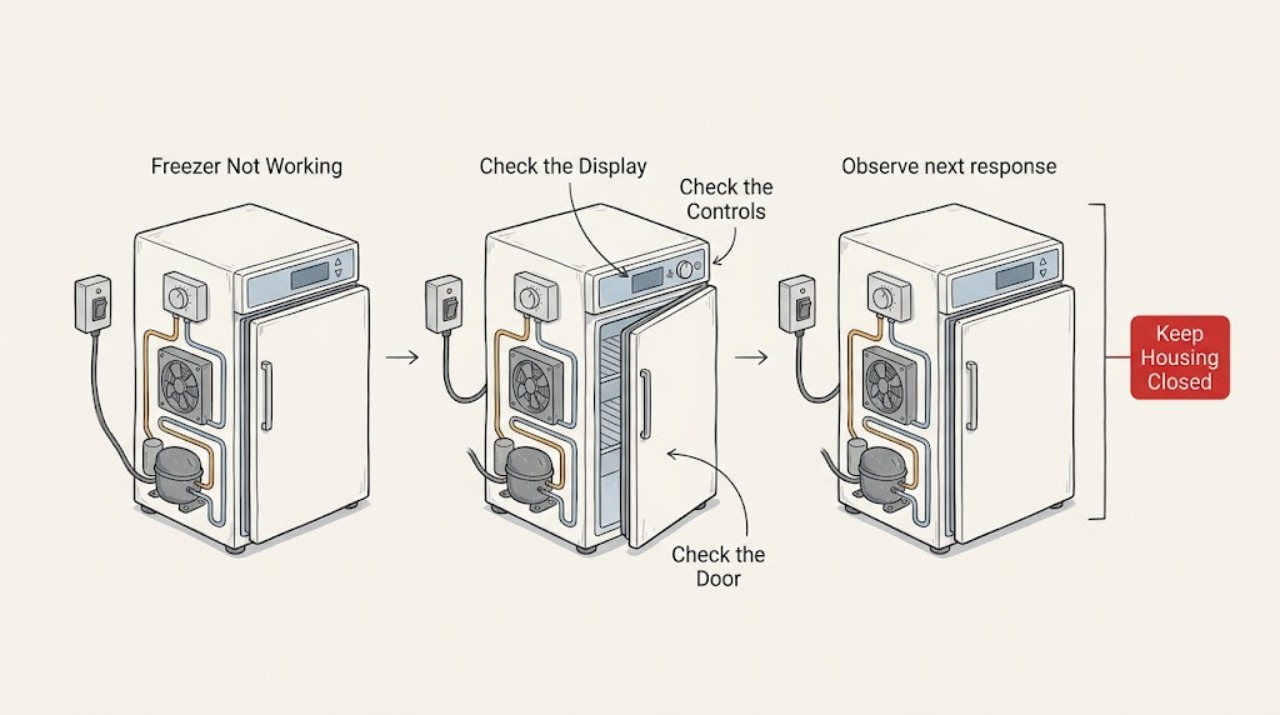
Work through in order
Diagnostic checks
Use only checks that match the exact appliance or system and its official guide.
-
Check 1
Without opening panels, classify the symptom: is the interior light or display dead, is there a normal hum or fan sound but the cabinet is warm, is the alarm or red indicator on, or did the problem begin after transport, a power cut or unplugging?
Expected result: There is no sign of power, there is a hum but food is soft, an alarm/red high-temperature indication is present, or the freezer was recently moved or power was interrupted.
Next step: Record the indicator and timing, keep the door closed, and continue only with the matching visible check below.
Stop if: Stop for a hot or damaged cord/plug, burning smell, water around electrical parts, repeated breaker or GFCI trips, a leaking cabinet, or signs that the freezer has been physically damaged.
Why this matters
Why: No power follows the supply/control branch. A hum with warmth follows the cooling, airflow, frost or seal branch. A high-temperature indicator can remain on while a newly connected cabinet cools. Recent transport or interruption changes the safe waiting step.
-
Check 2
For a dead-looking freezer, check from a dry, safe position that the plug is fully seated, the outlet is not controlled by a switched-off control, and the freezer's thermostat or power control is not set to Off. Check whether another small appliance works at the outlet only if doing so is safe and does not require handling wet equipment.
Expected result: The plug was loose, the outlet has no power, the thermostat/control was Off, or the supply appears normal but the freezer remains dead.
Next step: Restore only an obviously loose connection or a clearly Off control according to the manual. If the outlet supply is missing, use a qualified electrician; if the freezer remains dead or protection trips, leave it off and arrange authorized appliance service.
Stop if: Do not use an extension cord, bypass a fuse or breaker, open the electrical compartment, test live wiring, or keep resetting a protection device.
Why this matters
Why: A loose plug, blown fuse or Off control can explain no operation. If the outlet and control are normal but there is no response, the fault may be inside the appliance or in the building supply; a breaker that trips again is not a reset-and-repeat problem.
-
Check 3
If the freezer was newly installed, transported, unplugged or affected by a power cut, check the exact Beko manual for its settling and restart guidance. Keep the door closed and avoid repeated power cycling while waiting; do not load newly installed storage until the manual's safe temperature guidance is met.
Expected result: The appliance was transported recently, power was just restored, the compressor is silent for a short period, or the waiting period has passed without a restart.
Next step: Wait only for the exact manual's stated period, then check for normal operation without repeatedly unplugging it. If it still will not start, keep the door closed, protect the food as appropriate, and contact an authorized service agent.
Stop if: Do not change the refrigerant system, force the compressor to start, repeatedly reset the breaker, or use a heat source on the cabinet or pipes.
Why this matters
Why: Beko advises upright settling before first connection and says a model-specific compressor thermal safeguard can delay restart after an interruption. A delay can therefore be normal for the stated model, but failure to restart after the manual's period points toward service.
-
Check 4
For a freezer that runs but is warm, keep the door closed except for a quick visual check. Look for heavy frost on the inner walls, packages blocking vents, a door that is not fully closing, gaps or tears in the door seal, excessive warm food, dust at an accessible condenser area, or a very cold garage/outbuilding.
Expected result: Frost is heavy, airflow is blocked, the seal has a gap or tear, warm food was recently loaded, the condenser is dusty, or the ambient room is outside the model's specified range.
Next step: Rearrange food away from vents, close the door, clean only the accessible seal or condenser as the manual permits, and use the model's defrost procedure if it is not a no-frost appliance. If the seal is torn, frost returns quickly, or cooling remains poor, arrange authorized service.
Stop if: Do not chip ice with a knife or tool, pour liquid into vents, use an open flame or unapproved heat, remove sealed panels, or continue storing perishable food while the freezer cannot hold a safe temperature.
Why this matters
Why: Beko links frost and frequent/open-door warm air to reduced performance, identifies seal gaps as a cold-air loss, and warns that ambient temperature can affect operation. Dust, overload and warm food can also lengthen recovery. These findings do not prove a compressor or refrigerant fault.
-
Check 5
After the visible checks, record the model number, serial information, temperature or alarm indication, sounds, time since power was restored, frost and seal observations, and whether the freezer has any oil-like residue or physical damage. Use a thermometer if available without leaving the door open unnecessarily.
Expected result: The freezer returns to normal cooling, or it remains warm/dead after the model-specific waiting and visible checks.
Next step: Keep the door closed and transfer or protect food according to food-safety guidance while arranging authorized service. Give the technician the model, symptoms and exact timeline rather than opening the appliance yourself.
Stop if: Stop all DIY work if the cooling circuit may be damaged, the cabinet is leaking, the cord is hot, the breaker trips, or the freezer has been exposed to water; do not attempt to repair or recharge it.
Why this matters
Why: Recovery after a supply, setting, airflow or seal correction supports that branch. Persistent no-start, abnormal noise, rapid frost return, warming food or a damaged cabinet requires diagnosis of controls, fan, compressor/start components or the sealed cooling system; these cannot be selected safely from symptoms alone.
Use your observations
Decision map
Find the observation that best matches what you see, then follow the next safe action.
-
PATH 01Next step
What you see
The display/light is dead and the plug, outlet and thermostat/power control are visibly correct.
Do this next
Leave the freezer off if it remains unresponsive and arrange qualified electrical or authorized appliance service; do not open its electrical compartment or bypass protection.
-
PATH 02Next step
What you see
The freezer was recently installed, transported, unplugged or affected by a power interruption.
Do this next
Use the exact Beko manual for upright settling and restart timing, keep the door closed, and avoid repeated power cycling. If it does not restart after that model-specific period, call authorized service.
-
PATH 03Next step
What you see
The freezer runs or hums but is not freezing well and has heavy frost, blocked airflow, a damaged seal, warm food or a warm/cold ambient condition that explains the symptom.
Do this next
Correct only the visible low-risk condition allowed by the manual, minimize door openings and follow the model's defrost instructions. Escalate if cooling does not recover or food is thawing.
-
PATH 04Next step
What you see
The freezer remains warm or dead after the visible checks, or it has abnormal compressor/fan noise, a rapidly recurring frost pattern or a suspected sealed-system problem.
Do this next
Keep the door closed, protect the food and arrange authorized appliance service. Do not select a compressor, fan or refrigerant part from symptoms alone.
-
PATH 05Next step
What you see
The cord or plug is hot/damaged, the breaker or GFCI trips, the cabinet or cooling circuit is punctured, or the appliance has been exposed to water.
Do this next
Stop using the freezer and keep clear of the hazard. Do not touch wet electrical equipment or repair the sealed circuit; use qualified electrical and appliance service.
Helpful context
Understand the symptom
“Not working” can mean no power or poor cooling
No lights, no hum and no response point first to the plug, outlet, fuse or control setting. A humming freezer with warm food is a different branch: its compressor, fan, airflow, frost, door seal, room temperature or cooling circuit may be involved. Beko lists these as different checks, so do not diagnose a sealed-system failure from a warm cabinet before checking the accessible conditions.
Allow for installation and restart conditions
A newly installed freezer may need time to settle before it is powered and time afterward to reach storage temperature. Beko also describes a protection delay after a power interruption in one model manual. These are model- and situation-dependent; use the exact manual and keep the door closed rather than repeatedly unplugging and reconnecting the appliance.
Keep the sealed cooling circuit closed
Frost can tempt people to chip or drill ice, but Beko warns against damaging the cooling circuit with cutting or drilling tools and notes that some models use flammable R600a refrigerant. Manual defrosting, if applicable, must follow the model instructions; sealed-system, compressor and refrigerant work belongs to authorized service.
Only after diagnosis
Potential parts
- freezer door gasket
Consider only when an authorized diagnosis confirms a persistent gap, tear or failed seal after the door and cabinet alignment are checked.
Confirm the exact Beko model and manufacturer fit information before ordering; a generic-looking gasket may not seal the cabinet. - thermostat or electronic temperature control
Consider only when the appliance has verified power but the control does not maintain the selected temperature and a technician rules out airflow, frost, door seal and ambient causes.
Confirm the exact model, control type and approved service procedure; do not open the control compartment or substitute a part based on a warm cabinet alone. - compressor start or cooling-system component
Consider only after professional testing confirms a start, compressor or sealed-system fault; a short silence after power restoration can instead be a model-specific protection delay.
Cooling-circuit and compressor work requires authorized service and exact model/fuel-freezer fitment information; do not puncture, recharge or open the circuit.
When checks do not resolve it
Need a professional?
Arrange authorized appliance service when a Beko freezer stays dead or warm after the visible checks and model-specific wait, or when a seal, fan, compressor, control or cooling circuit may be faulty. Use qualified electrical help for missing outlet power, repeated breaker/GFCI trips or damaged/wet wiring. Do not continue storing food in a freezer that cannot maintain a safe frozen temperature.
Safety scope: Do not open electrical or sealed-system panels, chip ice, drill or cut the cabinet, puncture cooling pipes, recharge refrigerant, force a compressor to start, use an open flame or unapproved heat, bypass a breaker, or touch wet electrical equipment. Beko manuals warn that some cooling circuits may contain flammable R600a.
Common questions
FAQ
Why is my Beko freezer not working after a power cut?
A power interruption can leave the compressor in a model-specific protection delay. Use the exact Beko manual and avoid repeatedly unplugging and reconnecting. If the freezer does not restart after that stated period, arrange authorized service.
What should I check when my Beko freezer has no power?
From a dry, safe position, check that the plug is fully seated, the outlet has power, and the thermostat or power control is not Off. If the outlet is dead, a breaker trips again, or the freezer remains unresponsive, use qualified electrical or appliance service rather than opening the appliance.
Can heavy frost make a Beko freezer stop cooling?
Yes, heavy frost can reduce performance and block airflow. Follow the exact manual's defrost procedure and do not use a knife, drill, open flame or unapproved heat to remove it; Beko warns against damaging the cooling circuit.
How long should a newly installed Beko freezer take to cool?
Beko says a newly installed freezer should settle upright and unplugged for at least four hours before connection and may take up to twelve hours to reach safe storage temperature, but the exact model manual prevails. Keep the door closed and do not load food until the appropriate temperature is reached.
Read the exact guide
Official sources
- 7 TroubleshootingBeko · Beko freezer user-manual safety and model-specific troubleshooting example
- How to fix a freezer that is not cold enoughBeko · Beko freezer temperature, frost, seal, door-opening and new-installation cooling guidance
- Help Center ResultBeko · Beko freezer installation, power-loss food protection, temperature and ambient-use FAQ
- How to fix a freezer that's not workingBeko · Beko freezer power, thermostat, condenser, airflow, frost, ambient and door-seal troubleshooting
Community feedback
Share a repair observation
Share a plain-text repair observation. Accepted observations are published automatically; this page may take a moment to update.