
On this page
Start here
Quick answer
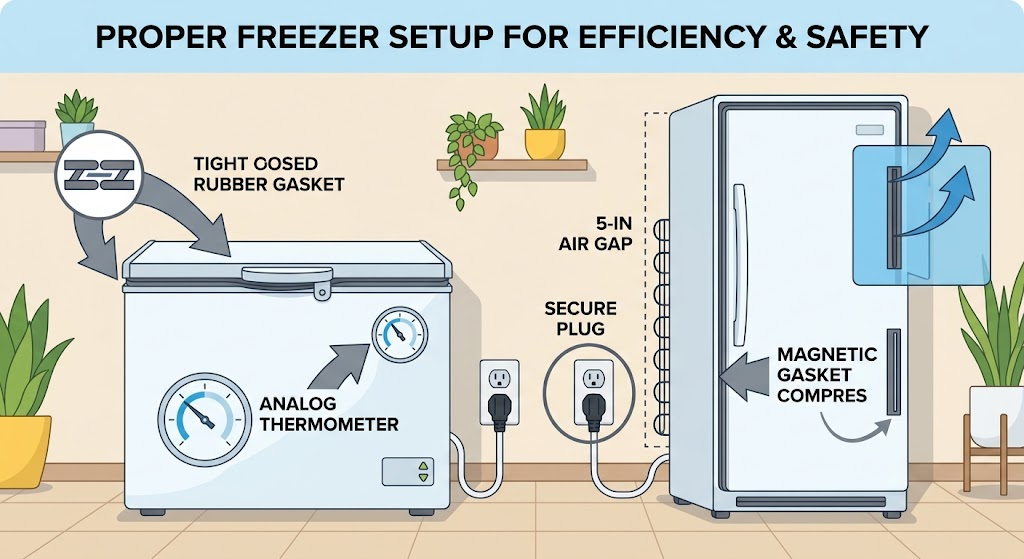
First separate a Danby freezer with no power from one that has power but is not getting cold. Check that the plug is fully seated, the outlet works, the unit is switched on, and the temperature control has not been moved; then check that the door or lid closes and seals, food is not blocking airflow, and the cabinet is away from a heat source. If it was transported on its side or back, leave it upright for at least 6 hours before judging cooling. Do not drill ice, alter the temperature-control or sealed cooling system, use an extension cord, or repeatedly reset a tripping circuit. If the freezer still does not cool after these checks, has damaged wiring, burning odor, repeated electrical trips, or a suspected refrigerant or compressor fault, stop and arrange qualified appliance service.
Work through in order
Diagnostic checks
Use only checks that match the exact appliance or system and its official guide.
-
Check 1
Observe the freezer from outside and note the interior light or display, any normal operating sound, and whether the cabinet is actually cold; do not remove a cover or touch exposed wiring.
Expected result: Classify it as completely dead, powered but warm, intermittently powered, or cooling but not holding the expected temperature; note whether a breaker or outlet protection device has tripped.
Next step: Use the matching check below, and arrange an electrician or appliance technician for repeated trips, damaged wiring, burning odor, or an unexplained intermittent supply.
Stop if: Stop immediately for smoke, burning smell, melted insulation, sparking, water at an electrical connection, or a cord or plug that is hot or damaged.
Why this matters
Why: No light or display suggests a power or control path that should be checked before cooling symptoms. A powered cabinet that is warm needs temperature, closure, loading, airflow, placement, and transport checks. Intermittent power or a tripping circuit is an electrical fault signal, not a reason to keep restarting the appliance.
-
Check 2
With dry hands, verify that the plug is fully seated in the correct outlet, the outlet can power another suitable appliance, the freezer is switched on, and the temperature control has not been turned to a warm setting.
Expected result: The freezer either powers normally and the control is set for freezing, or the outlet, plug, switch, control setting, or supply voltage is wrong or uncertain.
Next step: Use the correct fixed outlet and the model’s instructions; do not use an extension cord or change the supply. If power is still absent or uncertain, stop and obtain electrical or appliance service.
Stop if: Do not open the electrical compartment, bypass a switch, replace a fuse with a different type, or repeatedly reset a breaker or outlet protection device.
Why this matters
Why: A restored light or display after correcting a loose connection or setting makes an external supply or control setting plausible. If the outlet is dead, the plug or cord is damaged, or the required voltage is uncertain, the freezer cannot be diagnosed as a cooling failure yet.
-
Check 3
Close the door or lid slowly and inspect the visible gasket and contact surface for food, ice, tears, gaps, or a cabinet that is not level enough for the closure to meet evenly.
Expected result: The door or lid seals all the way, or it springs back, has a visible gap, is obstructed, or has a damaged or distorted gasket.
Next step: Remove only the visible obstruction, close the freezer, and observe its recovery. If the gasket or alignment is damaged, request a model-specific repair or replacement assessment.
Stop if: Do not pry the door or lid into alignment, remove hinges, or cut, glue, or reshape the gasket while the cause is unknown.
Why this matters
Why: A complete seal helps retain cold; an obstruction, frequent opening, or damaged gasket can let warm air in and create frost or poor cooling even when the freezer runs. A lid or door that cannot close evenly needs a fit or hardware assessment rather than more temperature adjustment.
-
Check 4
Look through the normal storage area for packages pressed against vents or walls, a recent large load of warm food, blocked circulation, or frost that prevents the door or lid from closing; rearrange only what can be reached safely.
Expected result: Record whether air paths are clear, the cabinet is overloaded or recently loaded, and whether frost is light, heavy, or concentrated around the seal or a specific area.
Next step: Clear the manufacturer-designated air paths and allow the freezer to recover with the door or lid closed. If the model calls for manual defrost, follow that model’s instructions and use only the stated method before reassessing.
Stop if: Do not chip ice with a sharp object, use a heat gun or open flame, pour boiling water into the cabinet, or remove interior panels or a defrost component.
Why this matters
Why: Blocked airflow, warm food, and repeated openings can temporarily raise the cabinet temperature. Heavy frost or frost around a gap supports a closure or defrost issue, but frost location alone does not prove a failed component.
-
Check 5
Check that the freezer is upright and stable, has the clearance specified by its model instructions, and is not next to a radiator, oven, direct sun, or another heat source; ask whether it was recently moved on its side or back.
Expected result: The cabinet is in a hot or restricted location, is unstable or not level, or was transported on its side or back within the last several hours; otherwise placement is not an obvious cause.
Next step: Correct only the visible placement issue without blocking ventilation, and if it was transported on its side or back, keep it upright for at least 6 hours before reassessing. If cooling remains poor afterward, escalate.
Stop if: Do not tilt a loaded freezer, move it across stairs or an uneven surface alone, or remove panels to compensate for inadequate clearance.
Why this matters
Why: Heat and restricted airflow can reduce cooling performance. Danby’s guidance says a unit transported on its side should stand upright for 6 hours before operation or evaluation, so a recent move can make an immediate cooling judgment misleading.
-
Check 6
After correcting a setting, closure, load, frost, placement, or transport issue, leave the freezer closed and observe whether it runs and becomes colder over the recovery period described by the model’s instructions.
Expected result: Cooling improves, the freezer remains powered but warm, the compressor or other operating sound is abnormal, or the circuit trips again.
Next step: Record the model, serial number, temperature history, power behavior, transport, placement, closure, load, frost, and checks performed, then arrange qualified appliance service for a persistent failure.
Stop if: Do not continue operating a freezer with smoke, burning odor, sparking, damaged wiring, a leaking sealed system, or repeated trips; isolate it safely and obtain professional help.
Why this matters
Why: Improvement supports an external condition as a contributor. No improvement after the safe checks, abnormal operation, repeated electrical trips, or a return to warm temperatures indicates that further diagnosis may involve internal controls, fans, the compressor, or the sealed cooling circuit.
Use your observations
Decision map
Find the observation that best matches what you see, then follow the next safe action.
-
PATH 01Safety boundary
What you see
The display or light is absent, the outlet is dead, the plug or cord is damaged, or the circuit trips when the freezer is connected.
Do this next
Stop repeated reset attempts, use no extension cord, and arrange electrical or appliance service after making the area safe.
Why this path and its safety boundary
Why it matters: This is a supply or electrical safety path, not a normal temperature-setting problem.
Safety stop: Smoke, heat, burning odor, sparking, melted insulation, or water near an electrical connection requires immediate stopping.
-
PATH 02Safety boundary
What you see
The freezer was moved or transported on its side or back and has not stood upright for 6 hours.
Do this next
Keep it upright for at least 6 hours, then reassess according to the model instructions; escalate if it still will not cool.
Why this path and its safety boundary
Why it matters: The cabinet may not yet be ready for a fair cooling assessment after transport.
Safety stop: Do not repeatedly start and stop a recently transported unit or tilt it again while loaded.
-
PATH 03Safety boundary
What you see
The door or lid has a gap, food blocks closure or airflow, warm food was recently loaded, or frost prevents a proper seal.
Do this next
Clear visible obstructions and air paths, use the model-specific defrost procedure when applicable, close the freezer, and observe recovery.
Why this path and its safety boundary
Why it matters: Warm air entry or restricted circulation can explain a warm cabinet without proving an internal cooling failure.
Safety stop: Do not chip frost with sharp tools or force a damaged door, lid, hinge, or gasket.
-
PATH 04Safety boundary
What you see
The freezer is next to a heat source, in direct sun, in a hot room, or has restricted clearance around the cabinet.
Do this next
Restore the placement and clearance required by the model instructions without removing panels, then reassess with the door or lid closed.
Why this path and its safety boundary
Why it matters: Cabinet conditions can reduce heat rejection and cooling performance; moving the control colder may not solve the cause.
Safety stop: Do not move a loaded unit across an unsafe surface or operate it where ventilation is blocked.
-
PATH 05Safety boundary
What you see
Power is stable, the setting is appropriate, the door or lid seals, load and airflow are reasonable, placement is corrected, and the freezer still does not cool.
Do this next
Stop user troubleshooting and provide the recorded observations to a qualified appliance technician or Danby support channel.
Why this path and its safety boundary
Why it matters: A control, fan, compressor, wiring, or sealed cooling fault becomes more plausible, and it cannot be confirmed safely through external checks alone.
Safety stop: Do not open the sealed system, add refrigerant, bypass controls, or remove electrical or compressor covers.
-
PATH 06Safety boundary
What you see
There is smoke, burning odor, sparking, damaged wiring, repeated circuit trips, an unusual oil-like residue, or a suspected refrigerant leak.
Do this next
Stop using the freezer, keep people away from the hazard, and obtain qualified electrical or appliance service; follow local emergency guidance for an active fire or immediate danger.
Why this path and its safety boundary
Why it matters: The appliance may present an electrical, fire, or sealed-system hazard beyond safe owner checks.
Safety stop: Do not test exposed conductors, puncture tubing, use an open flame, or attempt refrigerant or compressor work.
Helpful context
Understand the symptom
Start by identifying what ‘not working’ means
A dark display or interior light and a silent compressor point to a power, control, or electrical problem. If the light works but food is soft, the freezer has a different path: confirm the setting, closure, loading, airflow, ambient heat, and recent transport before assuming a failed sealed system. Danby’s freezer guidance covers both upright and chest designs, so the exact defrost and control arrangement depends on the model.
Cooling depends on closure, airflow, and cabinet conditions
A door or lid left ajar, a damaged gasket, newly loaded warm food, frequent openings, blocked circulation, or placement near heat can make a working freezer appear ineffective. Check these visible conditions first and allow time for the cabinet to respond after a correction. Keep the freezer level and give it the clearance described by its own manual; do not remove panels to create airflow.
Know when the diagnosis must move to service
A persistent no-cooling condition after safe external checks can involve a control, fan, compressor, wiring, or sealed cooling circuit that cannot be confirmed safely from the outside. Danby directs owners to service when the basic checks do not restore cooling. Record the model and serial information, what the freezer does when powered, the temperature history, and the checks already completed so a technician can start with useful observations.
Safety boundary
Stop conditions
- Stop and obtain electrical or appliance service for smoke, burning odor, sparking, melted insulation, a hot or damaged plug, water near an electrical connection, or repeated circuit trips.
- Do not repeatedly reset a breaker or outlet protection device, bypass a control, use an extension cord, or change the freezer’s supply voltage.
- Do not chip ice with sharp tools, use an open flame or heat gun, pour boiling water into the cabinet, or remove panels to reach frost or airflow parts.
- Do not open the sealed cooling system, puncture tubing, add refrigerant, or diagnose compressor and internal electrical parts without qualified service.
- Stop moving or tilting a loaded freezer when the route is unsafe, and obtain help rather than forcing a door, lid, hinge, or cabinet into alignment.
Only after diagnosis
Potential parts
- freezer door or lid gasket
Consider this only if the visible gasket is torn, permanently distorted, or fails to seal after obstructions and alignment are checked.
Confirm the exact Danby model and the manufacturer’s fit information before ordering or installing a gasket. - temperature control or thermostat
Consider this only after stable power and the external setting checks are complete and a qualified diagnosis identifies a control fault.
Use the exact model information and qualified installation guidance; do not substitute a control based on appearance alone. - evaporator or condenser fan
Consider this only when the freezer has stable power but a qualified technician identifies abnormal fan operation or a related airflow fault.
Confirm model-specific fit and electrical specifications before any replacement; internal access should be handled by a qualified technician.
When checks do not resolve it
Need a professional?
Arrange qualified appliance service when the freezer remains warm after the documented external checks and recovery period, when power is intermittent, or when a control, fan, compressor, wiring, or sealed cooling fault is suspected. Use electrical service for outlet, cord, breaker, or wiring concerns. Stop immediately for smoke, burning odor, sparking, melted insulation, a hot or damaged plug, repeated circuit trips, or suspected refrigerant leakage.
Common questions
FAQ
Why is my Danby freezer running but not getting cold?
Check the temperature setting, door or lid seal, blocked airflow, warm food, frequent openings, heat source, clearance, and recent transport before assuming an internal failure. If it remains warm after these checks, arrange qualified service.
How long should a Danby freezer stand after being moved on its side?
Danby’s guidance says to leave a freezer upright for at least 6 hours after transport on its side or back before judging its cooling operation.
What should I check if my Danby freezer has no power?
Check the plug, outlet, on-state, temperature control, and supply condition from a safe position. If the outlet is dead, the cord is damaged, or the circuit trips, stop resetting it and obtain electrical or appliance service.
Can a Danby freezer’s frost or blocked airflow make it stop working?
A door or lid that does not seal, blocked airflow, warm food, and heavy frost can make cooling ineffective. Clear only visible obstructions and follow the exact model’s manual-defrost procedure; never chip ice or remove panels as a shortcut.
Is it normal for a Danby freezer to make operating sounds?
Compressor operation can produce normal sounds, but an abnormal sound together with a warm cabinet, repeated trips, smoke, or burning odor is not a reason to keep testing. Record the symptom and arrange service when cooling does not recover.
When should I stop troubleshooting a Danby freezer?
Stop for electrical or fire signs, repeated circuit trips, damaged wiring, suspected refrigerant leakage, or any need to open electrical, compressor, or sealed-system compartments. Persistent no cooling after safe external checks also belongs with qualified service.
Read the exact guide
Official sources
- TROUBLESHOOTINGDanby · Danby chest freezer troubleshooting
- The freezer is not cooling properly, what should I do?Danby USA · Danby freezers with a no-cooling complaint
- UPRIGHT FREEZERDanby · Danby upright freezer manual troubleshooting
- Danby 7.2 cu. ft. Chest Freezer - DCF072A2WDB1Danby USA · Danby chest freezer product guidance illustrating model-specific checks
- Faqs Category: FreezersDanby USA · Danby upright and chest freezer troubleshooting topics
Community feedback
Share a repair observation
Share a plain-text repair observation. Accepted observations are published automatically; this page may take a moment to update.