
On this page
Start here
Quick answer
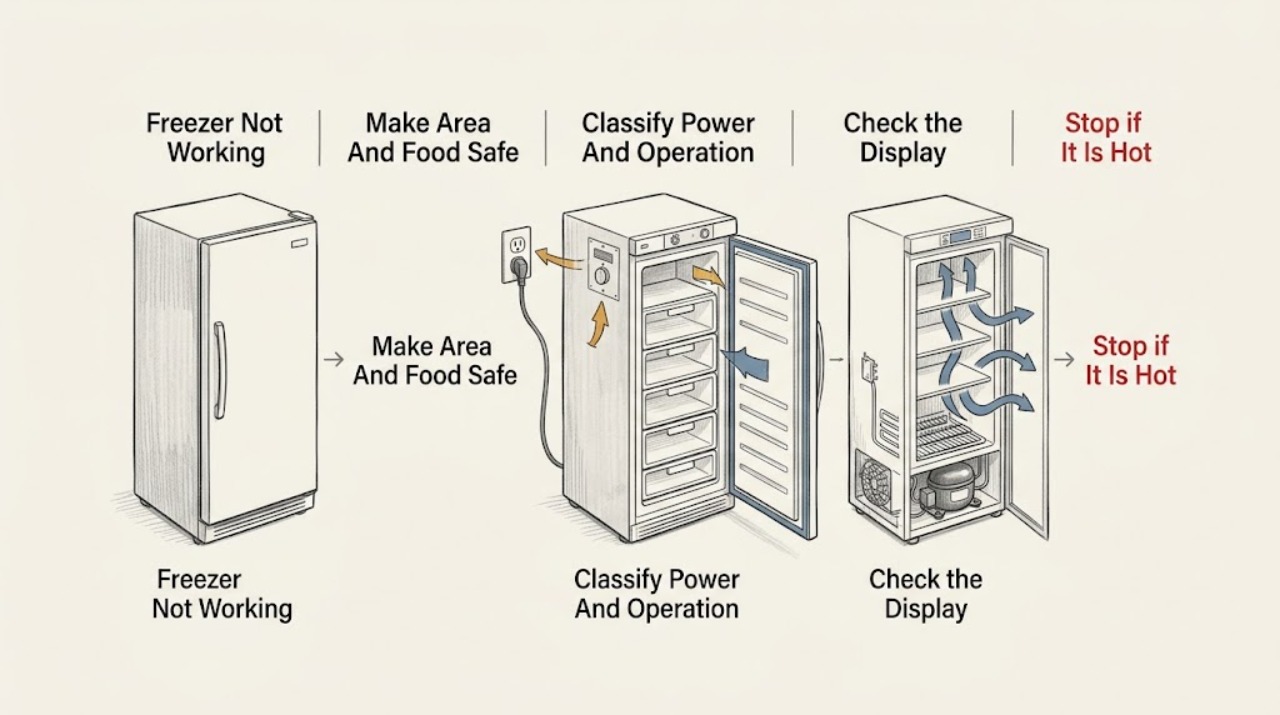
Start by separating a freezer with no display, light, or operating sound from one that has power but is warm. From a dry, safe position, check the plug, outlet, breaker or fuse, control setting, and any cooling-off or demo mode shown by the model manual. If the freezer runs, inspect the door seal, blocked vents, heavy frost, loading, and surrounding temperature. Keep the door closed and protect the food while you diagnose. Water near the cord or outlet, a burning smell, smoke, overheating, repeated trips, damaged wiring, or a compressor that only clicks and stops is a stop condition; do not keep resetting or opening the cabinet. Brand and model are not specified, so use the exact manual for control sequences and defrost instructions.
Before you begin
Safety first
- Protect food first and keep the freezer closed while diagnosing. Use only dry, external, manual-approved checks. Water near electrical equipment, smoke, burning odor, overheating, arcing, damaged wiring, or repeated trips is a stop condition. Refrigerant, compressor, defrost, wiring, and control-board work requires qualified service.
Work through in order
Diagnostic checks
Use only checks that match the exact appliance or system and its official guide.
-
Check 1
Keep the freezer closed and look for immediate hazards without touching the appliance if the floor, cord, outlet, or controls are wet. If there is a burning smell, smoke, sparking, damaged insulation, overheating, repeated breaker trips, or water at electrical equipment, stop and keep people away; use a dry, safe location to seek help.
Expected result: The freezer is in a dry area with no odor, smoke, visible arcing, hot wiring, or active water near electrical parts, or one of those hazards is present.
Next step: For any hazard, do not reset or operate the freezer and arrange qualified electrical or appliance help. If the area is safe, keep the door closed and continue with the identity check.
Why this matters
Why: A hazard takes priority over diagnosis. A dry, quiet area allows external checks; a wet or damaged electrical area can create shock or fire risk.
-
Check 2
From a dry position, note whether the display, interior light, or power indicator works; listen briefly for a normal fan or compressor sound without moving the cabinet. Record whether the freezer is silent, clicks and stops, runs but stays warm, or runs continuously.
Expected result: There is no light or display, the unit clicks without starting, the unit runs but remains warm, or the unit runs continuously with frost or temperature problems.
Next step: Follow the matching branch rather than repeating the same start attempt: check external power for a dead unit, check settings and airflow for a running warm unit, and stop for repeated clicking or abnormal sounds.
Why this matters
Why: No indicators point first to supply, control, or indicator issues. Clicking and stopping can point to a start or compressor problem. Running but warm moves the check toward settings, airflow, frost, door sealing, environment, or cooling-system service.
-
Check 3
If the freezer has no light or display and the area is dry, verify that the plug is fully seated, the outlet switch has not been turned off, and the relevant breaker or fuse has not operated. Check the freezer's power or temperature control and the model manual for a cooling-off, lock, alarm, or demo mode; do not repeatedly reset a breaker.
Expected result: The outlet or breaker is off, the freezer control is off, a cooling-off or demo indication is shown, or external power and controls appear correct.
Next step: Restore only a clearly switched-off external control once, from a dry position, and allow the manual's startup period. If a breaker trips again, the outlet is damaged, or the freezer remains dead, leave it off and call service or an electrician.
Why this matters
Why: An interrupted supply or an off/demo control can make a working freezer appear dead or keep it from cooling. Correct external power with no response makes an internal electrical or control fault more likely.
-
Check 4
If the freezer has power but is warm, inspect only the accessible interior: confirm the door or lid closes fully, check the gasket around its perimeter for gaps or tears, keep packages away from vents, and note whether thick frost covers the back wall or airflow path. Do not force the door, chip ice, or remove panels.
Expected result: The seal leaks, packages block vents, the cabinet is overloaded, heavy frost is present, or the door and airflow path look clear.
Next step: Rearrange only loose packages and close the door. If the manual gives a safe full-defrost procedure, use it after protecting food; otherwise arrange service for damaged seals, panels, or recurring frost.
Why this matters
Why: Warm air entering, blocked airflow, and frost around the cooling path can prevent a freezer from reaching temperature. Clear loading problems can be corrected; a damaged seal or recurring frost needs model-specific service if it persists.
-
Check 5
Record the freezer temperature, room conditions, recent installation or move, recent power outage, large load of warm food, and how often the door has been opened. Compare the setting with the exact manual instead of making a large adjustment, and allow the manufacturer-specified stabilization time after a change.
Expected result: The freezer is in an unsuitable hot or cold location, was recently installed or loaded, has had an outage, is set to cooling-off or an unsuitable setting, or has no obvious environmental explanation.
Next step: Keep the door closed and let a normal stabilization period pass once the manual-approved setting and airflow are restored. If temperature remains unsafe or the compressor/fan behavior is abnormal, arrange service.
Why this matters
Why: Temperature can remain high for a while after installation, an outage, frequent opening, or a large warm load. An appropriate setting and stable environment with no cooling improvement points beyond a simple adjustment.
-
Check 6
Only when the freezer is dry, free of odor or damage, and the manual permits it, perform one normal power reset using the appliance's approved disconnect, then restore the documented setting and observe without repeated cycling. Do not open the cabinet or test sealed-system, defrost, wiring, relay, or compressor parts.
Expected result: The freezer resumes a normal operating sound and begins to recover temperature, or it stays silent, clicks, runs abnormally, leaks, alarms, or remains warm after the manual's recovery period.
Next step: If it does not recover, keep food protected and the freezer out of service as appropriate; provide the technician with all recorded symptoms. If food safety is uncertain, discard or preserve it using official food-safety guidance.
Why this matters
Why: A single reset can clear a transient control state, but persistent failure is evidence for professional diagnosis rather than more resets. A leak or electrical symptom can make continued operation unsafe.
Use your observations
Decision map
Find the observation that best matches what you see, then follow the next safe action.
-
PATH 01Next step
What you see
Water reaches the cord, plug, outlet, controls, or other electrical equipment, or there is smoke, burning odor, arcing, overheating, exposed wiring, or repeated tripping.
Do this next
Do not touch the appliance or switches while wet and do not reset it. Keep people away, move to a dry safe location, and obtain qualified electrical or appliance help; contact emergency help for fire or immediate danger.
-
PATH 02Next step
What you see
The light, display, and operating sound are all absent but the area is safe and dry.
Do this next
Check the plug, outlet switch, breaker or fuse, and the model's power or cooling control once. A repeated trip, damaged outlet, or no response after external power is correct requires service.
-
PATH 03Next step
What you see
The light or display works and the freezer runs or is quiet, but temperature does not fall.
Do this next
Check cooling mode, setting, door seal, blocked vents, heavy frost, load, environment, and recent outage or installation. Use the manual for any stabilization or defrost procedure, then escalate if cooling remains absent.
-
PATH 04Next step
What you see
Heavy frost, blocked vents, an overloaded cabinet, or a door gasket gap is visible.
Do this next
Correct only loose loading and accessible obstructions. Do not chip ice or remove panels; follow the model's full-defrost instructions or arrange service when frost or sealing failure returns.
-
PATH 05Next step
What you see
The unit repeatedly clicks and stops, remains silent with correct external power, runs abnormally, leaks persistently, or does not recover after one safe manual-approved reset.
Do this next
Keep the freezer out of service as needed and schedule qualified appliance diagnosis. Do not open the sealed system, bypass controls, or replace internal parts based only on a sound.
Helpful context
Understand the symptom
Define not working before changing anything
A freezer can be completely dead, powered but not cooling, running continuously, covered in frost, showing an alarm, or leaking water after a thaw. These are different decision paths. Record what the display or indicator light does, whether an interior light works, whether you hear a fan or compressor, the measured temperature if you have an appliance thermometer, and when the problem started. Do not assume a chest freezer, upright freezer, or refrigerator-freezer combination has the same controls or serviceable parts.
Protect the food while you check the appliance
Keep the lid or door closed as much as possible. Move food to a known-working freezer or a cooler with suitable ice if the failure will continue. Use an appliance thermometer when available; do not taste food to decide whether it is safe, and do not rely on odor alone. Food that has thawed, has lost its safe temperature, or has contacted contaminated water should be handled according to current food-safety guidance.
What not to disassemble
The compressor, sealed refrigerant circuit, start device, defrost heater, wiring, and control board are not ordinary user-service checks. A heavy ice layer may explain poor airflow, but do not chip it with a knife, pour boiling water into the cabinet, or bypass a thermostat or safety control. If the manual provides a complete unplugged defrost procedure, follow that procedure only after food is protected and the area is dry and safe.
When a technician is needed
Arrange qualified appliance service when power and controls are correct but cooling does not return, the compressor repeatedly clicks without running, the fan is abnormal, frost returns quickly, the cabinet leaks persistently, or an error or alarm remains after the manual's single reset. Give the technician the model, symptom branch, temperature, sound, frost pattern, recent outage or move, and any water, odor, or breaker history.
Safety boundary
Stop conditions
- Do not touch a wet freezer, cord, plug, outlet, or control, and do not turn on switches while standing in water.
- Stop for smoke, burning odor, overheating, sparking, arcing, exposed wiring, damaged glass or insulation, or a repeated breaker trip.
- Do not repeatedly reset the breaker, keep cycling a compressor that clicks and stops, or bypass a control or safety device.
- Do not chip frost with a sharp tool, pour boiling water into the cabinet, open the sealed refrigerant system, or remove electrical panels as a homeowner.
- Keep food out of service when its safe temperature is uncertain; do not taste questionable food to test it.
When checks do not resolve it
Need a professional?
Call qualified appliance service when a freezer remains warm after the setting, airflow, seal, frost, and external-power checks; when it clicks and stops; when an alarm or error persists; when frost returns quickly; or when it leaks persistently. Call an electrician for a damaged outlet or recurring breaker trips. Stop immediately for water at electrical equipment, smoke, burning smell, overheating, arcing, exposed wiring, or any condition that makes the area unsafe.
Common questions
FAQ
Why is my freezer not working but the light is on?
Power is reaching at least part of the appliance, but cooling may be off, the controls may be in a special mode, airflow may be blocked, frost may cover the cooling path, or an internal component may have failed. Check external settings and accessible airflow, then call service if it remains warm.
Should I keep resetting the freezer breaker?
No. A single check is reasonable only when the area is dry and there is no odor, smoke, heat, damage, or water. If the breaker trips again, leave the freezer off and arrange electrical or appliance service.
Can blocked vents or frost make a freezer stop cooling?
Yes. Packages against vents, heavy frost, and a door that does not seal can interfere with cold-air movement or let warm air in. Rearrange loose packages, but do not chip ice or remove panels; use the exact manual's defrost procedure or call service.
What should I do with food while the freezer is broken?
Keep the door closed, move food to a working freezer or suitable cooler when necessary, and use an appliance thermometer if available. Do not taste food to test it; evaluate temperature and remaining ice crystals using current food-safety guidance.
When does a freezer problem require immediate stopping?
Stop immediately for water at electrical equipment, smoke, burning smell, overheating, visible arcing, exposed wiring, damaged insulation, repeated trips, or unsafe conditions around the appliance. Move to a safe location and obtain qualified help.
Read the exact guide
Official sources
- Upright & Chest Freezer - Not WorkingGE Appliances · GE upright and chest freezer not-working symptoms and service boundary
- Food and Water Safety During Power Outages and FloodsU.S. Food and Drug Administration · Food safety during freezer power outages, failures, and flooding
- Your Family Disaster PlanU.S. Department of Energy; FEMA and American Red Cross · Household electrical safety when water or other damage makes an appliance area unsafe
- 7 Freezer Problems & How to Help Fix ThemWhirlpool Corporation · Whirlpool freezer symptoms including leaks, frost, door seal, compressor, reset, and service boundaries
- Not Cooling - Freezer Section - Refrigerator - Product HelpWhirlpool Corporation · Whirlpool freezer temperature and cooling troubleshooting
- How to Use the Controls (Chest and Upright Freezer)Maytag · Maytag chest and upright freezer controls, startup, temperature stabilization, and power indicators
Community feedback
Share a repair observation
Share a plain-text repair observation. Accepted observations are published automatically; this page may take a moment to update.