
On this page
Start here
Quick answer
First separate a Frigidaire freezer with no power from one that has power but is not getting cold. Confirm the control is not Off, the power cord is firmly in a suitable wall outlet, and the household breaker or fuse has not opened. If the interior light or control indicators work, check the temperature setting, door or lid seal, blocked vents, frost, and whether the compressor or fans are running. A freezer that still does not cool after the manufacturer's stabilization period, or that trips the breaker again, needs service; do not open the sealed refrigeration or electrical system.
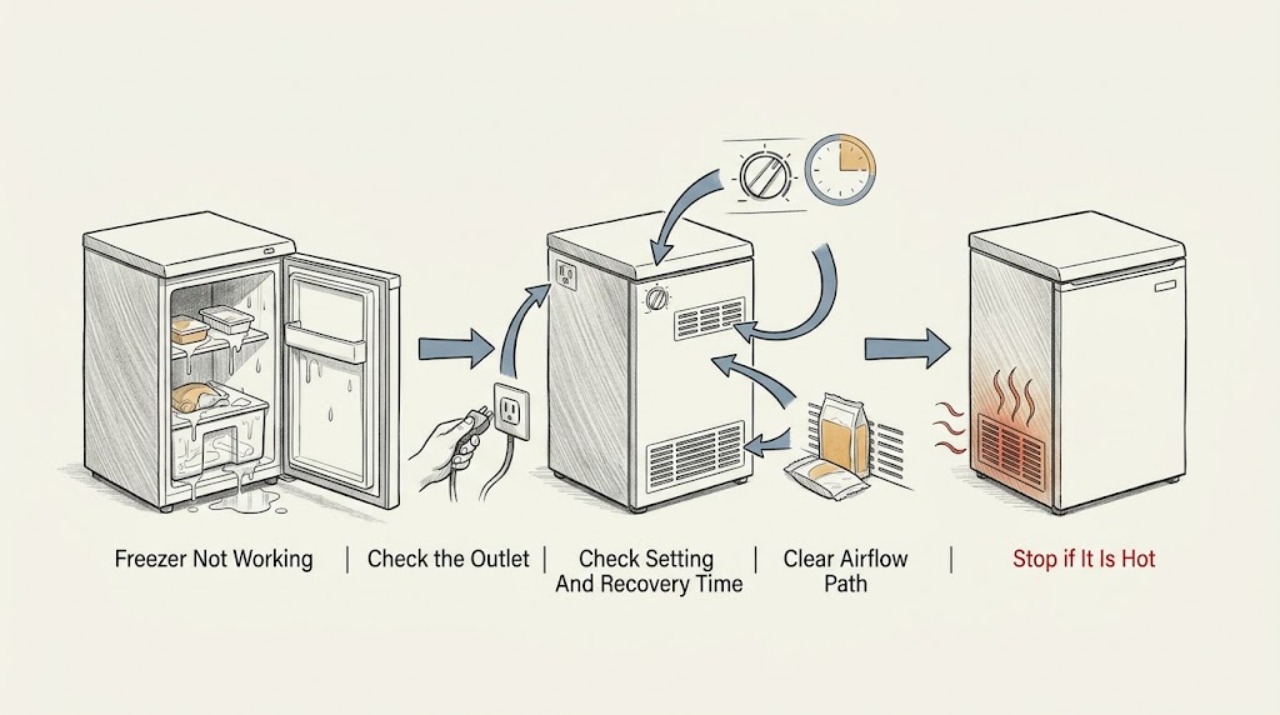
Work through in order
Diagnostic checks
Use only checks that match the exact appliance or system and its official guide.
-
Check 1
Check that the freezer control is set to an operating position rather than Off. Confirm the power cord is firmly seated in the wall outlet, then inspect the household breaker or fuse for the freezer circuit. Do not use an extension cord, and do not repeatedly reset a breaker that opens again.
Expected result: Note whether the interior light, control panel, or other indicator is on, whether the outlet supplies power, and whether the breaker or fuse is open.
Next step: If power is absent, restore the outlet or circuit only once when safe and observe whether the freezer starts. If power is present but the freezer stays dead, stop at this external check and arrange service. If the unit has power, continue to the temperature and recovery check.
Stop if: Stop and arrange service if the breaker trips again, the cord or receptacle is damaged or hot, or the freezer remains without signs of power after the supply is confirmed.
Why this matters
Why: A control set to Off, a loose cord, an opened breaker or fuse, or a recent outage can explain a freezer that is not running. If the freezer remains dark while the outlet and circuit are confirmed good, the fault is inside the appliance rather than a temperature-setting issue.
-
Check 2
If the freezer has power, read the temperature control or display and note whether the unit was newly installed, recently unplugged, or affected by an outage. Set the control according to the model's use-and-care guidance, then keep the door or lid closed while temperature stabilizes.
Expected result: Record whether the setting had been Off or unusually warm, and whether the unit has had enough uninterrupted recovery time after installation or power loss. Do not judge cooling immediately after changing the setting.
Next step: If the freezer begins cooling as it stabilizes, avoid further changes. If it remains warm after the stabilization period, continue with the seal, airflow, frost, and operating-sound checks.
Stop if: Stop using the freezer for food storage if its temperature is rising or food is thawing; keep the door closed while arranging service or safe food handling.
Why this matters
Why: An Off setting or a recent power event can make a working freezer appear not to work. Frigidaire says a newly installed or power-recovered unit may need up to 24 hours to stabilize; the exact control layout varies by model.
-
Check 3
Inspect the door or lid from the outside. Remove items that block the closure or interior vents, look for heavy frost that interferes with the door or airflow, and clean a dirty gasket with warm soapy water. Close the door or lid and check for a continuous seal; on a hinged door, a paper-bill resistance check can reveal a weak seal.
Expected result: Look for a gap, a gasket that is dirty or poorly fitted, an obstructed vent, or frost buildup that prevents closure or reduces airflow.
Next step: Correct only the visible loading, closure, gasket-cleaning, or airflow issue and leave the door or lid closed while the temperature stabilizes. If the seal is damaged, frost returns, or the freezer remains warm, arrange service.
Stop if: Do not chip at frost with a sharp tool or remove internal panels; stop if a safe external correction cannot restore closure or airflow.
Why this matters
Why: A leaking closure lets warm air in, while blocked vents or heavy frost can reduce airflow and leave the freezer too warm even though it has power. A clean, closed seal and clear airflow make a later cooling test meaningful.
-
Check 4
With the door or lid closed, listen from outside for the freezer attempting to run and compare the result after the external checks and stabilization period. Do not remove a cover to reach the compressor or fan.
Expected result: A compressor hum, fan sound, or refrigerant gurgling suggests the unit is attempting to cool; complete silence, repeated clicking, unusual heat, or a unit that runs but never cools is a different result.
Next step: If the freezer is still not cold after the power, setting, seal, airflow, and frost checks, arrange qualified appliance service and provide the observed sounds, temperature, and timing. Do not diagnose or replace sealed-system parts from sound alone.
Stop if: Stop immediately if there is a burning smell, smoke, damaged wiring, repeated breaker trips, or any sign of refrigerant or electrical failure; disconnect power only if it can be done safely and arrange service.
Why this matters
Why: Operating sounds do not prove that cooling is successful, but they distinguish an active cooling attempt from a no-start symptom. Continued operation without cooling after 24 hours, or a freezer with power that never starts, exceeds the safe external troubleshooting boundary.
Use your observations
Decision map
Find the observation that best matches what you see, then follow the next safe action.
-
PATH 01Safety boundary
What you see
The control, interior light, and indicators are off, and the outlet or appliance circuit is not supplying power.
Do this next
Check the cord, outlet, breaker or fuse, and any applicable outlet reset. Restore the supply once when safe and observe whether the freezer starts.
Why this path and its safety boundary
Safety stop: If the supply is good but the freezer remains dead, or the breaker opens again, stop and arrange service.
-
PATH 02Safety boundary
What you see
The freezer has power but is warm or not freezing.
Do this next
Check the setting, recent installation or power loss, door or lid seal, blocked vents, and frost; keep the unit closed while it stabilizes.
Why this path and its safety boundary
Safety stop: If it remains warm after the stabilization period, arrange service instead of opening the refrigeration system.
-
PATH 03Safety boundary
What you see
The door or lid does not close or seal, vents are blocked, or frost interferes with closure or airflow.
Do this next
Correct the visible loading or gasket-cleaning issue, clear airflow space, and allow the temperature to recover with the door closed.
Why this path and its safety boundary
Safety stop: If the gasket is damaged, frost returns, or the freezer cannot close correctly, arrange service.
-
PATH 04Safety boundary
What you see
The freezer makes compressor or fan sounds but still does not cool after the checks and stabilization period.
Do this next
Record the temperature, sounds, and when the symptom began, then arrange qualified appliance service.
Why this path and its safety boundary
Safety stop: Do not remove panels or work on electrical, refrigerant, compressor, or sealed-system components.
Helpful context
Understand the symptom
Not working can describe two different symptoms: the freezer is electrically dead, or it has lights and controls but is not freezing. A dark interior light is useful evidence, but it is not a complete diagnosis; use the control display, outlet, breaker, and the sound of the unit together.
After a power interruption, a newly installed unit, or a major temperature change, the freezer needs time to stabilize. Keep the door or lid closed while it recovers. Repeatedly changing the control or opening the door makes the temperature observation harder to interpret.
The safe homeowner boundary is external: controls, power supply, visible door or lid sealing, interior airflow, and accessible frost. Do not remove covers or work on the compressor, refrigerant circuit, wiring, or sealed components.
When checks do not resolve it
Need a professional?
Arrange service when a powered Frigidaire freezer remains warm after the manufacturer's stabilization period, when it stays dead despite a confirmed working outlet and circuit, when the breaker trips again, when the door or lid cannot seal, or when a visible electrical, smoke, burning, or sealed-system concern appears.
Common questions
FAQ
Why is my Frigidaire freezer not working but the light is on?
The light shows that some power is reaching the unit, but it does not prove that cooling is working. Check the control setting, recent power loss or installation, door or lid seal, blocked vents, frost, and whether the freezer is attempting to run. If it stays warm after stabilization, arrange service.
What should I check first when a Frigidaire freezer is completely off?
Confirm the control is not Off, check that the power cord is secure in the wall outlet, and inspect the household breaker or fuse. A recent power outage can also explain the symptom. If the outlet and circuit are good but the freezer remains dead, service is needed.
How long should a Frigidaire freezer take to cool after power is restored?
Frigidaire says a newly installed or power-recovered unit may need up to 24 hours to stabilize. Keep the door or lid closed during recovery. If it still does not cool after that period, use the service branch.
Can a bad freezer door seal make a Frigidaire freezer stop cooling?
A poor seal lets warm air enter and can create unstable temperatures; a blocked door or heavy frost can also reduce closure or airflow. Check the visible gasket, closure, frost, and vents. If the seal cannot be restored externally or the freezer remains warm, arrange service.
Read the exact guide
Official sources
- Freezer Runs Too MuchFrigidaire · Supports recovery after power loss, door closure, gasket condition, temperature stabilization, and airflow context.
- Freezer - Not Freezing or Not CoolingFrigidaire · Supports power, stabilization, temperature, door seal, frost, airflow, operating-sound, and service checks.
- What should I do if my freezer isn’t running?Frigidaire · Supports checks for the control position, household fuse or breaker, power cord, and recent outage.
Community feedback
Share a repair observation
Share a plain-text repair observation. Accepted observations are published automatically; this page may take a moment to update.