
On this page
Start here
Quick answer
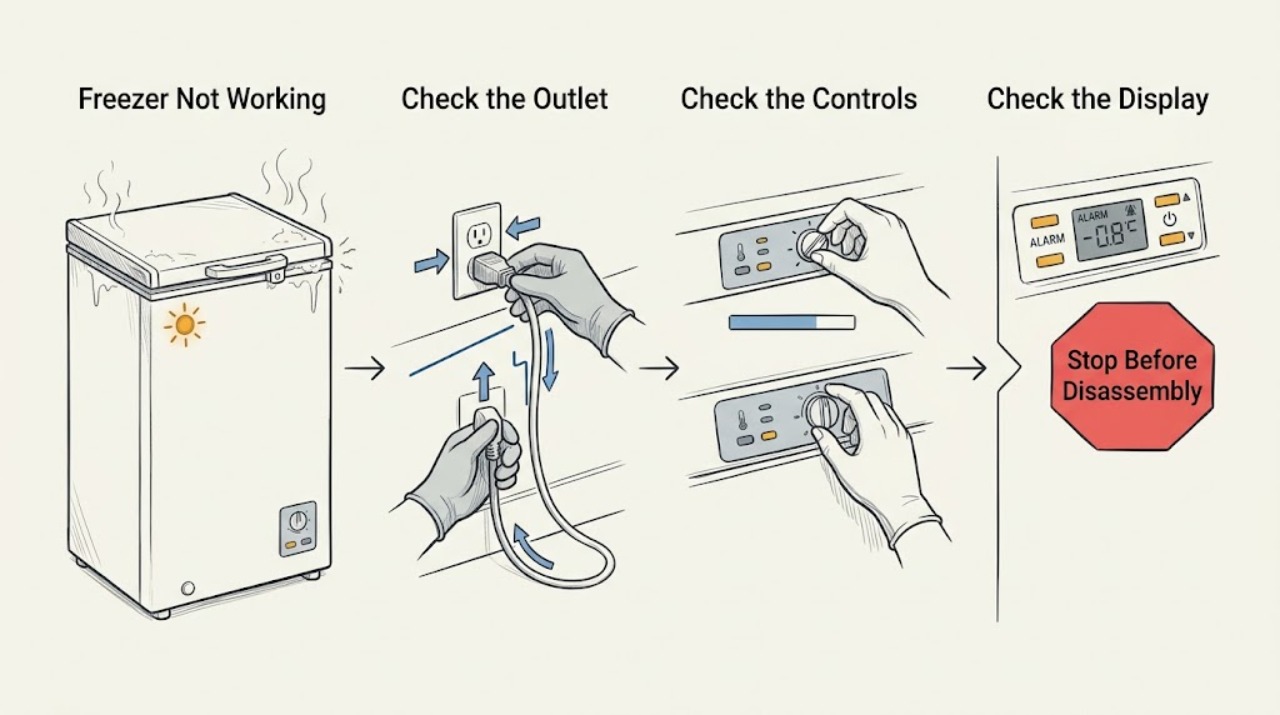
For an Electrolux freezer that is not working, first separate no power or no operation from a freezer that runs but is not getting cold. Check the outlet, plug, breaker or GFCI, OFF or demo-like control settings, door seal, vents, frost, and recent installation or power loss; after a reset or installation, allow the model's stabilization period. If power and settings are correct but the freezer still does not cool, qualified service is needed rather than sealed-system or electrical disassembly.
Work through in order
Diagnostic checks
Use only checks that match the exact appliance or system and its official guide.
-
Check 1
Check whether the freezer has any sign of power: interior light, control display, alarm indicator, compressor hum, or fan sound. Confirm that the plug is fully seated in the wall outlet and that no extension cord is being used.
Expected result: No lights, display, or operating sound means the first branch is power or an OFF control state. A running sound with a warm interior means power exists and the next checks concern cooling.
Next step: Continue to the outlet and control checks for a dead unit, or to temperature, seal, frost, and airflow checks if the freezer is running.
Why this matters
Why: Electrolux lists an OFF control, blown fuse or tripped breaker, loose plug, and power outage as causes of a freezer that is not running; its cooling guide uses lights and operating sounds to verify power.
-
Check 2
Test the wall outlet with a small appliance, then inspect the freezer's breaker or GFCI status. Reset a tripped protection device once only if the area is dry and the reset is safe; do not keep resetting it if it trips again.
Expected result: If the test appliance also fails, the outlet or household supply is the issue. If the outlet works but the freezer immediately trips protection again, there is a fault or overload that should not be bypassed.
Next step: Have the household electrical issue addressed if the outlet is dead. If the freezer alone trips protection, leave it disconnected and arrange qualified diagnosis.
Why this matters
Why: Electrolux recommends verifying the socket with another device and checking for a tripped GFCI; the US guidance also identifies a blown fuse or breaker as a no-run cause.
-
Check 3
Check the freezer control for OFF, 0, showroom or other non-running state, and confirm the temperature control is set to a normal freezing position according to the exact manual. On a refrigerator-freezer, verify the freezer compartment was not disabled independently.
Expected result: The freezer starts after correcting an OFF or disabled setting, while a lit control panel with no compressor or fan response after the correct setting points to a control or start fault.
Next step: Leave the setting at the model's recommended position and observe operation. If it will not start with power available, stop changing settings and request service.
Why this matters
Why: Electrolux identifies an OFF knob or control-panel OFF state as a possible cause, and its guidance notes that rotary controls have a distinct OFF position on some models.
-
Check 4
If the freezer runs but is warm, check that the door or lid closes freely, that no food or basket blocks it, and that the gasket is clean and making continuous contact. Clean the gasket with warm soapy water and close the door promptly.
Expected result: A visible gap, a gasket that does not resist a gentle paper pull, or an obstruction indicates warm air leakage; a sound seal with continued warming moves the diagnosis toward airflow or cooling components.
Next step: Correct only the obstruction or clean the gasket, then keep the freezer closed and allow the temperature to recover. Arrange service if the gasket is damaged or the temperature still rises.
Why this matters
Why: Electrolux states that a non-sealing door causes unstable temperature and recommends checking the seal, cleaning the gasket, and ensuring nothing blocks closure.
-
Check 5
Inspect the interior without dismantling it: make sure food is not packed against air vents, remove a few items if airflow is restricted, and note whether frost is covering vents or preventing the door from closing.
Expected result: Blocked vents or heavy frost can reduce circulation and prevent a proper seal; clear vents and a frost-free air path with continued warming mean the issue is not simple loading.
Next step: Rearrange items to leave the vents clear. Do not chip ice with a sharp tool or apply uncontrolled heat; follow the exact manual's defrost procedure or request service.
Why this matters
Why: Electrolux identifies blocked airflow and over-frosting as contributors to poor cooling and unstable door closure.
-
Check 6
Check the installation and recent events: note whether the freezer was newly installed, recently unplugged, moved, or affected by an outage; verify it is on a suitable dedicated outlet and not in an environment outside the model's permitted range.
Expected result: A new installation or recent power loss can leave the interior warm while the unit stabilizes. A freezer in an unsuitable cold or hot location may run differently even when its controls are correct.
Next step: Keep the door closed and allow the model's documented stabilization period before judging recovery. If it remains warm after that period, schedule service rather than repeating resets.
Why this matters
Why: Electrolux says a newly installed or power-recovered unit may need up to 24 hours to stabilize and advises against locations where temperature drops below 55°F for the cited models.
-
Check 7
Listen for the compressor, fan, or refrigerant circulation while the door is closed, and note whether the freezer runs continuously, cycles briefly, or is completely silent. Do not remove a cover to reach those components.
Expected result: Hum, fan airflow, or gurgling shows that the unit is attempting to cool; silence with a warm interior can point to a start, control, or power-path fault. Operation with no cooling after the stabilization period is not resolved by sound alone.
Next step: If it has run through the stabilization period with no cooling, stop troubleshooting at the external checks and arrange qualified appliance service.
Why this matters
Why: Electrolux lists compressor hum, fans, and refrigerant gurgling as signs that cooling is being attempted and directs service when the unit has run for the relevant period without cooling.
-
Check 8
If an alarm or buzzer is active, read the displayed condition in the model manual, close the door or lid, and leave it closed while the freezer cools. Do not silence an alarm and assume the temperature problem is fixed.
Expected result: On some Electrolux models, the alarm sounds when temperature rises above the model's threshold; an alarm that returns after closure means the temperature or seal problem remains.
Next step: Verify the actual internal temperature after the recovery period. If the alarm persists or food continues warming, arrange service.
Why this matters
Why: The Electrolux alarm guidance treats the buzzer as a high-temperature signal and pairs it with checks of level, closure, and seal.
Use your observations
Decision map
Find the observation that best matches what you see, then follow the next safe action.
-
PATH 01Next step
What you see
The outlet is dead when tested with another appliance.
Do this next
Use a qualified electrician or the responsible utility contact; do not use an extension cord as a workaround.
Why this path and its safety boundary
Why it matters: The freezer cannot be diagnosed until household power is restored.
-
PATH 02Next step
What you see
The outlet works, but the freezer has no light, display, alarm, or operating sound.
Do this next
Verify the model's ON state once, then leave the freezer disconnected and request qualified service if it remains dead.
Why this path and its safety boundary
Why it matters: An OFF control state, internal power fault, or electronic fault is possible.
-
PATH 03Next step
What you see
The freezer starts after correcting an OFF or disabled control setting.
Do this next
Keep the door closed and verify internal temperature after the model's recovery period.
Why this path and its safety boundary
Why it matters: The original issue was a control state rather than a confirmed component failure.
-
PATH 04Next step
What you see
A breaker or GFCI trips again when the freezer is connected.
Do this next
Leave the freezer disconnected and arrange qualified electrical or appliance diagnosis.
Why this path and its safety boundary
Why it matters: The repeat trip is a safety signal, not a reset instruction.
-
PATH 05Next step
What you see
The freezer runs and has airflow, but a door or lid gap, blocked closure, or dirty gasket is found.
Do this next
Clear the obstruction or clean the gasket, close the unit, and observe recovery without repeatedly opening it.
Why this path and its safety boundary
Why it matters: Warm-air leakage can explain the rising temperature.
-
PATH 06Next step
What you see
Frost covers vents or prevents the door from sealing.
Do this next
Follow the exact model defrost procedure; do not chip ice or heat the cabinet with improvised tools.
Why this path and its safety boundary
Why it matters: Airflow and closure are compromised.
-
PATH 07Next step
What you see
The unit was installed or reconnected recently and has not completed its stabilization period.
Do this next
Keep it closed and allow the manual's stabilization period, then reassess temperature.
Why this path and its safety boundary
Why it matters: Warm temperature may be a recovery condition rather than a confirmed failure.
-
PATH 08Next step
What you see
The compressor, fan, or refrigerant circulation can be heard but the freezer remains warm after stabilization.
Do this next
Stop external troubleshooting and schedule qualified service.
Why this path and its safety boundary
Why it matters: The unit is attempting to cool but has not restored temperature; airflow, control, or cooling-system faults remain possible.
-
PATH 09Next step
What you see
An alarm returns after the door is closed and the recovery period has passed.
Do this next
Check the seal and airflow once, then arrange service if temperature continues to rise.
Why this path and its safety boundary
Why it matters: The high-temperature condition remains active.
-
PATH 10Next step
What you see
There is a burning smell, smoke, exposed wiring, water near electrical parts, damaged cord, or repeated protection trip.
Do this next
Stop using the freezer, isolate power only if safe, keep clear, and request qualified help.
Why this path and its safety boundary
Why it matters: This is an immediate safety stop.
Helpful context
Understand the symptom
Start with the symptom, not a part
A dark display and no interior light suggest a power or control-state problem. A running compressor or fan with rising food temperature points instead to airflow, door sealing, frost, ambient conditions, or a cooling-system fault. A chest freezer, upright freezer, and refrigerator-freezer can expose different controls, so use the exact model manual for control names and locations.
Protect food and stay outside the sealed system
Keep the lid or door closed while diagnosing so warm air does not add another variable. Move vulnerable food to a known-cold appliance if it is warming. Do not remove covers, pierce tubing, handle refrigerant, or work on live wiring. A freezer that repeatedly trips protection, smells burnt, has a damaged cord, or shows exposed wiring is an immediate stop.
Only after diagnosis
Potential parts
Only when a technician or model-specific inspection confirms that the gasket is damaged or cannot seal after cleaning and alignment checks.
Only when qualified testing confirms an airflow fault after vents and frost are addressed.
Only after professional electrical and refrigeration diagnosis when the freezer has power but does not start or cannot cool.
Only when model-specific testing confirms that the control is not commanding or regulating cooling.
Only after a qualified technician confirms a refrigerant or sealed-system fault.
When checks do not resolve it
Need a professional?
Arrange qualified appliance service when the freezer remains dead in a known-good outlet, a breaker or GFCI trips again, the correct controls are set but the compressor does not start, or the unit runs without cooling after the model's stabilization period. Also request service for a damaged gasket, persistent high-temperature alarm, heavy recurring frost, or any electrical or burning symptom.
Common questions
FAQ
How do I tell whether my Electrolux freezer has power?
Check the interior light, control display, alarm indicator, and operating sounds, then verify the wall outlet with another appliance. A working outlet with a completely dead freezer needs qualified diagnosis after the ON state is confirmed.
Why is my freezer running but not freezing?
Check door or lid sealing, blocked vents, heavy frost, recent power loss or installation, and whether the freezer has had enough time to stabilize. If it still does not cool after those checks, arrange service.
Should I keep resetting the breaker if the freezer stops?
No. Reset a tripped device only once when safe to do so. If it trips again, leave the freezer disconnected and have the electrical or appliance fault diagnosed.
How long should I wait after reconnecting an Electrolux freezer?
The cited Electrolux guidance says a newly installed or power-recovered unit may need up to 24 hours to stabilize. Use the exact model manual and keep the door closed while it recovers.
Can I open the back and repair the freezer myself?
Do not remove covers, handle refrigerant, or work on live wiring. Once power, controls, seal, airflow, and stabilization have been checked, internal cooling and electrical diagnosis belongs to qualified service.
Read the exact guide
Official sources
- My fridge freezer is not workingElectrolux · No-operation symptoms, outlet test, three-to-five-minute power reset, control state, and post-reset temperature verification.
- What should I do if my freezer isn’t running?Electrolux · OFF control, breaker or fuse, plug, extension-cord, and power-outage checks for a freezer that is not running.
- What does the alarm or “buzzer sound” mean?Electrolux · High-temperature alarm behavior and closure, leveling, and seal checks.
- Freezer Runs Too MuchElectrolux · Stabilization after installation or power loss, ambient conditions, door closure, temperature setting, and gasket air leaks.
- Freezer - Not Freezing or Not CoolingElectrolux · Installation and power, temperature stabilization, lights, outlet, environment, settings, closure, gasket, compressor sounds, frost, and airflow checks.
Community feedback
Share a repair observation
Share a plain-text repair observation. Accepted observations are published automatically; this page may take a moment to update.