
On this page
Start here
Quick answer
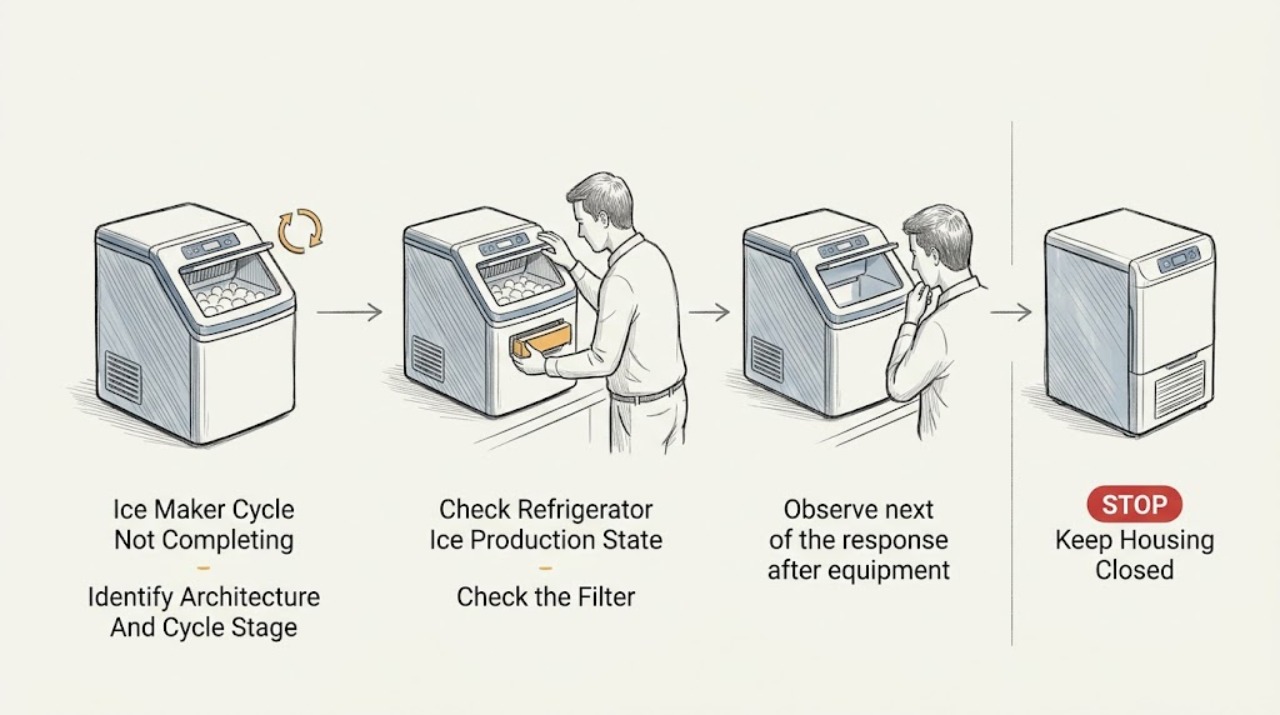
If a Bosch ice maker starts but does not complete its cycle, first identify the architecture: an ice maker inside a Bosch refrigerator uses the freezer compartment, refrigerator water supply, filter, and ice-storage or fill-level sensing, while an independent ice maker has its own tank, controls, and manual. Do not interchange their checks. For a refrigerator ice maker, confirm ice production is enabled, the freezer door closes, the water supply valve is open, the hose is not visibly kinked, the water filter is not due or blocked, and food or ice is not obstructing the storage or fill-level sensor. For a model with a removable ice maker or storage container, follow the exact manual only after switching off and disconnecting power when required. If the cycle stops with an error, the unit is frozen, water leaks, the appliance will not cool, or the fault returns after one documented reset, stop and arrange Bosch service; do not force the ejector, enter a service mode, or open the water or electrical system.
Before you begin
Safety first
- This article covers architecture identification, normal controls, visible water and hose checks, model-approved filter and storage handling, and one exact-manual reset. A qualified professional must handle internal ice-maker mechanisms, valves, sensors, wiring, refrigerant, pressurized connections, built-in removal, service modes, and component replacement.
Work through in order
Diagnostic checks
Use only checks that match the exact appliance or system and its official guide.
-
Check 1
Identify whether the ice maker is inside a Bosch refrigerator or is a standalone appliance, and note where the cycle stops: no response, water fill, freezing, harvest or eject, or release into the storage container. Record any display, indicator, or error without entering a service mode.
Expected result: The unit is refrigerator-integrated or standalone, and the interruption occurs before water enters, during freezing, during harvest, or when ice should drop into storage.
Next step: Use only the branch that matches the architecture. Retrieve the exact Bosch manual and stop for leaks, exposed wiring, abnormal heat, smoke, or a persistent fault indication.
Stop if: Do not combine standalone-unit instructions with a refrigerator ice maker, force a frozen mechanism, or remove covers to see the cycle.
Why this matters
Why: A refrigerator-integrated unit keeps freezer temperature, door closure, water supply, filter, and fill-level sensing in view. A standalone unit needs its own tank, reservoir, and manual. A stage-specific symptom narrows the next safe check but does not prove a pump, valve, motor, or sensor failure.
-
Check 2
For a refrigerator-integrated ice maker, check the exact manual or normal control display to confirm ice production is enabled, the freezer door closes fully, and the freezer is actually maintaining its normal set condition. Do not lower settings blindly or block vents with food.
Expected result: Ice production is switched off, the freezer door is not closing, the freezer is warmer than its normal condition, the display shows a fault, or the settings and door are normal.
Next step: Correct only a clearly documented user setting or door obstruction and allow the appliance to run one normal cycle. If temperature does not recover, a fault remains, or the cycle still stops, arrange service rather than repeatedly changing settings.
Stop if: Do not disable a door sensor, block vents, chip at frozen ice, or open the sealed refrigeration system.
Why this matters
Why: Bosch manuals identify switched-off production, an open freezer door, and a freezer that is too warm as separate reasons for no or incomplete ice production. Normal settings and closure make the water path, sensor, or ice-maker fault more likely, but do not identify a component.
-
Check 3
For a refrigerator-integrated unit, inspect the visible water shut-off position and accessible hose for an obvious closed valve or kink, then check the exact manual's filter status. Replace a model-approved filter only as the manual directs; do not disconnect a pressurized water line or pull out the appliance.
Expected result: The valve is closed, the hose is visibly kinked, the water filter is blocked or due for replacement, the supply and filter appear normal, or water is leaking.
Next step: Restore only an obviously closed valve or straighten a visible kink if it can be done without moving the appliance or stressing the connection. Follow the exact manual for the filter, then observe one cycle. If water still does not enter or the cycle remains incomplete, close the valve if safe, isolate power, and arrange service.
Stop if: Do not loosen water fittings, use tools on the valve, bypass a filter, continue with a leak, or work behind a built-in refrigerator.
Why this matters
Why: Bosch identifies no water supply, a closed valve, a kinked hose, and a blocked water filter as distinct reasons for low or absent ice production. A normal visible supply does not rule out an inlet valve, pressure, sensor, or ice-maker fault. A leak is a stop condition.
-
Check 4
With a refrigerator-integrated ice maker switched off and safe to access, inspect the ice storage container and the normal user-accessible fill-level area for packed ice, food, or another object. Empty or reposition only the removable container as the exact manual allows; do not force an ejector arm or reach into a frozen mechanism.
Expected result: The storage container is overfilled, ice is clumped against the sensing area, food or an object blocks the fill-level sensor, the container is mis-seated, or the storage and sensing area are clear.
Next step: Remove only loose, accessible obstruction and refit the container according to the manual, then make one normal observation. If the sensor area is frozen, inaccessible, or the cycle still does not complete, leave the appliance off and arrange service.
Stop if: Do not chip at ice with a sharp tool, pry the ejector, remove an internal cover, or bypass the fill-level sensor.
Why this matters
Why: Bosch identifies food or objects blocking the ice-maker fill-level sensor as a cause of low production or non-functioning ice production. A clear and correctly seated container makes a water, temperature, harvest, or internal ice-maker fault more likely, not a guaranteed motor failure.
-
Check 5
If the exact Bosch manual identifies a reset or power-cycle for the ice-maker fault, switch the appliance off and disconnect power exactly as directed, wait the documented interval, and reconnect once. For a standalone unit, use its own manual; do not apply a refrigerator reset to it.
Expected result: The cycle completes after the documented reset, the same fault returns, the ice maker remains frozen or locked, or the appliance will not cool or shows another error.
Next step: If the fault returns or another operating problem is present, keep the unit disconnected or switched off as appropriate and arrange Bosch service. Give the technician the architecture, cycle stage, water and temperature observations, and reset result.
Stop if: Do not repeat resets indefinitely, enter diagnostics, thaw with a heat source, or open electrical or refrigeration panels.
Why this matters
Why: A single successful reset can clear a temporary control state, but a repeated fault, locked mechanism, cooling problem, or persistent error makes an ice-maker, water, control, or refrigeration fault more likely. The reset cannot identify or repair an internal component.
Use your observations
Decision map
Find the observation that best matches what you see, then follow the next safe action.
-
PATH 01Safety boundary
What you see
The unit is standalone but refrigerator-specific checks were being used, or a refrigerator-integrated ice maker has ice production switched off, an open freezer door, or a clearly abnormal freezer condition.
Do this next
Use the exact manual for the actual appliance. Correct only a documented setting or door obstruction and observe one normal cycle; arrange service if the state is normal but the cycle still stops.
Why this path and its safety boundary
Why it matters: Architecture or a documented user state is more likely than an internal harvest fault.
Safety stop: Do not apply a refrigerator water or freezer instruction to a standalone unit, defeat a door sensor, or open the refrigeration system.
-
PATH 02Safety boundary
What you see
A refrigerator-integrated ice maker stops before or during filling and there is a closed valve, visibly kinked hose, blocked or due filter, or no other water entering the appliance.
Do this next
Correct only an obvious valve or hose condition without stressing the connection, follow the exact filter procedure, and observe one cycle. Close the valve if safe and call service for persistent no-fill or any leak.
Why this path and its safety boundary
Why it matters: A water-supply or filter condition is more plausible than a harvest motor fault, although an internal inlet valve or pressure issue remains possible when visible checks are normal.
Safety stop: Do not loosen pressurized fittings, pull out a built-in refrigerator, bypass a filter, or operate with a leak.
-
PATH 03Safety boundary
What you see
The refrigerator ice maker has a full or mis-seated storage container, packed ice, food, or another object at the documented fill-level sensing area, and the cycle does not advance to storage.
Do this next
With the unit safely off, remove only loose accessible obstruction and refit the removable container as directed. If the sensing area is frozen, inaccessible, or the cycle still stops, arrange service.
Why this path and its safety boundary
Why it matters: A blocked sensing or storage condition is more likely than an immediate control or motor failure.
Safety stop: Do not chip ice with sharp tools, force the ejector, or bypass the fill-level sensor.
-
PATH 04Safety boundary
What you see
The exact architecture and documented user settings are correct, visible water and storage checks are normal, but the cycle repeatedly stops, the mechanism remains frozen or locked, cooling is abnormal, an error persists, or water leaks.
Do this next
Stop using the affected function, isolate power and water only when safe, and arrange Bosch service. Provide the model, architecture, cycle stage, indicator, temperature, water, filter, storage, and reset observations.
Why this path and its safety boundary
Why it matters: An internal ice-maker, valve, sensor, control, or refrigerator fault is more likely than a user setup issue, but the checks cannot safely identify a component.
Safety stop: Do not enter service mode, remove panels, heat the mechanism, handle wiring or refrigerant, or continue operation with a leak or repeated fault.
Helpful context
Understand the symptom
Confirm which ice-maker architecture you have
A Bosch ice maker may be built into a refrigerator or supplied as a separate appliance. A refrigerator ice maker depends on freezer temperature, the refrigerator's water connection, a filter, a storage container, and model-specific fill-level sensing. A standalone unit follows a different water and control sequence. The Bosch manuals opened for these families are not interchangeable; use the model number before interpreting a cycle that stops early.
A cycle that stops is not automatically a failed motor
On a refrigerator ice maker, a missing water supply, switched-off production, a kinked hose, blocked water filter, freezer temperature, or an obstructed fill-level sensor can prevent the next stage. Bosch also documents normal appliance sounds such as valves switching, refrigerant flow, and ice dropping into the storage container. Listen and observe only from outside; do not use a sound or a partly formed cube to select an internal part.
Keep water, ice, and electrical work within the manual's boundary
Only check a shut-off valve, visible hose, model-approved filter, or removable storage container from its normal user position. If the exact manual requires power disconnection before removing an ice maker or container, follow that instruction. Do not pry out frozen cubes, pierce an ice bridge, remove panels, handle wiring, or bypass a fill-level or door sensor. Bosch manuals reserve internal repair and damaged-cord replacement for trained or qualified personnel.
Safety boundary
Stop conditions
- Stop and isolate the appliance and water supply only if safe for a leak, smoke, sparks, burning smell, damaged cord, repeated electrical trip, or water near electrical parts.
- Do not force an ejector or frozen ice maker, chip ice with a sharp tool, use a heat source to thaw it, enter a service mode, or bypass a fill-level, door, or temperature sensor.
- Do not loosen pressurized water fittings, pull out a built-in refrigerator, remove electrical or refrigeration panels, or handle refrigerant or live wiring.
- If one exact-manual reset or user-accessible water, filter, temperature, or storage check does not restore the cycle, stop repeated testing and arrange Bosch or qualified service.
Only after diagnosis
Potential parts
- Bosch model-matched water filter or inlet component
Consider this category only when the exact model uses the relevant replaceable filter or a qualified technician confirms an inlet restriction or valve fault after visible supply checks and correct seating do not restore filling.
Confirm the full refrigerator model, water system, filter type, and technician-approved component identification before ordering; do not loosen water connections yourself. - Bosch model-matched ice-maker assembly or fill-level sensor
Consider this category only after a qualified technician confirms a harvest or sensing fault when ice production is enabled, freezer condition and water supply are normal, the storage area is clear, and the cycle still does not complete.
Confirm the exact architecture, model revision, and technician-approved part identification; do not infer fit or replace an ice-maker assembly from an incomplete cycle alone.
When checks do not resolve it
Need a professional?
Safety scope: This article covers architecture identification, normal controls, visible water and hose checks, model-approved filter and storage handling, and one exact-manual reset. A qualified professional must handle internal ice-maker mechanisms, valves, sensors, wiring, refrigerant, pressurized connections, built-in removal, service modes, and component replacement.
Common questions
FAQ
Why does my Bosch ice maker start but not finish its cycle?
First identify whether it is inside a refrigerator or standalone, then note whether it stops before filling, during freezing, during harvest, or before ice drops into storage. On an integrated unit, check only the exact manual's production setting, freezer condition, water supply, filter, storage container, and fill-level area. Persistent or repeated failure needs service.
Can a blocked water filter stop a Bosch refrigerator ice maker cycle?
It can reduce or stop water delivery on Bosch refrigerator models that use that filter. Confirm the exact filter status and follow the model manual for replacement. If filling still fails, do not disconnect water fittings; arrange service.
What should I check if my Bosch ice maker does not fill with water?
For a refrigerator-integrated unit, check the documented production setting, visible valve position, visible hose for a kink, filter status, and freezer-door closure. For a standalone unit, use its own manual and water-reservoir procedure. A normal visible supply with persistent no-fill needs professional diagnosis.
Can a full ice bin stop a Bosch ice maker from completing its cycle?
A storage container or fill-level sensing area blocked by ice, food, or another object can stop production on models with that sensing arrangement. With the unit safely off, remove only loose accessible obstruction and refit the container as directed. Do not force or chip the mechanism; call service if it remains frozen or blocked.
When should I call a professional about a Bosch ice maker cycle that will not complete?
Call when the cycle repeatedly stops after the exact manual's user checks or one reset, an error remains, the mechanism is frozen or locked, water leaks, the refrigerator is not cooling, or diagnosis would require panels, water fittings, wiring, refrigerant, or service mode. Treat leaks near electrical parts, smoke, sparks, and loss of refrigeration as urgent.
Read the exact guide
Official sources
- Bosch Refrigeration Error CodesBosch Home Appliances · Official Bosch refrigerator support page; use the exact model manual and displayed code because error meanings and reset behavior are model-specific.
- Use and Care Manual B36CL...Bosch · Official Bosch-hosted B36CL refrigerator manual; apply the ice-maker details to that refrigerator family and use the exact manual for another integrated ice maker.
- Ice makerBosch · Official Bosch-hosted ice-maker manual; it describes a model-specific ice-maker family and must not be assumed to apply to every Bosch refrigerator or standalone unit.
Community feedback
Share a repair observation
Share a plain-text repair observation. Accepted observations are published automatically; this page may take a moment to update.