
On this page
Start here
Quick answer
First establish whether this is an ice maker built into a Bosch refrigerator or freezer, or a separate standalone machine. The Bosch manuals used here cover automatic ice makers integrated into Bosch refrigeration appliances; do not apply their refrigerator-leveling or hidden water-line instructions to a separate unit without its own model manual. For an integrated ice maker, stop ice production, close the accessible water shutoff, and disconnect power only from a dry, safe position. Look for a visible drip at the supply connection or hose, and note whether the leak follows filling, dispensing, or ice production. Bosch directs owners to qualified service for a damaged hose, an unresolved water leak, or an internal ice-maker fault.
Before you begin
Safety first
- The user may identify the architecture, stop ice production, close an accessible water shutoff, observe the first wet point from a dry position, and inspect visible dry hose sections. Qualified service must handle hidden connections, hose replacement, refrigerator movement or leveling, internal valves and ice-maker housing, wiring, controls, and any wet electrical or built-in access.
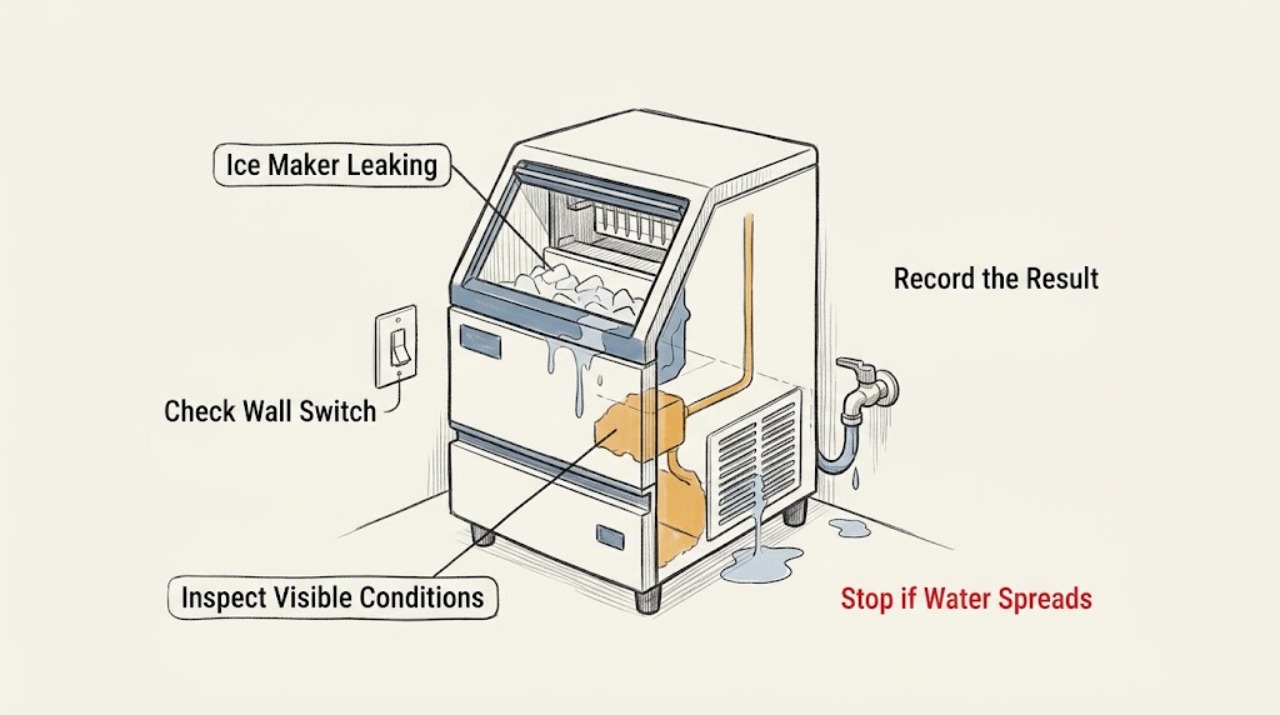
Work through in order
Diagnostic checks
Use only checks that match the exact appliance or system and its official guide.
-
Check 1
Identify the setup from a dry, safe position: is the ice maker inside a Bosch refrigerator/freezer, or is it a separate appliance with its own cabinet and controls? For an integrated unit, switch off ice production using the documented control and close the accessible water shutoff. Disconnect power only when the plug, outlet, and floor are dry and reachable without touching water.
Expected result: The ice maker is integrated into a Bosch refrigerator/freezer, it is a separate unit, the water shutoff is accessible, or water is near electrical parts and the architecture is uncertain.
Next step: For an integrated unit, continue only with the external checks below. For a standalone unit, keep it off and use its exact model manual or qualified service. For wet electrical areas, leave the appliance isolated and arrange service without reaching behind it.
Why this matters
Why: The integrated Bosch documents support checks of the refrigerator's water connection, hose, leveling, and ice-maker fault guidance. A separate unit may use a different reservoir, drain, pump, or water connection, so the integrated procedure cannot identify its leak path. Water near electrics or an uncertain setup exceeds a safe visual check.
-
Check 2
For an integrated ice maker, dry the accessible floor and observe from outside the cabinet where the first water appears. Note whether it occurs immediately after the ice maker fills, while ice is being dispensed, after a batch is made, or continuously while the appliance is idle. Check the display for an ice-maker or refrigeration fault without opening panels.
Expected result: The first wet point is at the rear or supply connection, inside the freezer/ice-bin area, below the cabinet, or the display reports an ice-maker fault.
Next step: Keep the water shutoff closed and record the location, timing, displayed code, and exact model/E-Nr. Do not restart repeatedly to reproduce the leak; arrange service if the source is inside the cabinet, the leak continues, or any code remains.
Why this matters
Why: A rear or supply-side wet point makes a water connection or hose issue more likely. Water confined to the ice-making compartment or a fault display may involve the internal ice-maker assembly, but location and a code do not identify a user-replaceable part. A continuous idle leak needs the water supply left off.
-
Check 3
With the water supply closed, inspect only visible, dry portions of the integrated appliance's supply line and connection near the shutoff or under-sink area. Look for a kink, a visibly wet union, or damage to the hose. Do not loosen a fitting, disconnect a hose, or reach behind a built-in refrigerator to inspect the hidden end.
Expected result: A visible connection is wet or loose-looking, the hose is kinked or damaged, or all accessible line sections are dry.
Next step: Leave the shutoff closed and have the installer or qualified appliance technician verify the connection and replace a damaged hose with the model-approved part. If the accessible line is dry, continue with the architecture-specific installation and fault checks rather than opening the appliance.
Why this matters
Why: A visible connection leak or damaged hose is a credible source of water loss. Bosch directs owners to customer service or a similarly qualified person for a damaged hose; dry accessible sections do not rule out a hidden connection or internal valve leak.
-
Check 4
For an integrated refrigerator/freezer only, check from outside whether the appliance is visibly out of level or has shifted from its installed position. Compare the installation and water-connection arrangement with the exact Bosch installation instructions; do not move a heavy built-in appliance or adjust feet as a leak experiment.
Expected result: The appliance is visibly tilted or recently moved, the installation is known to be incorrect, or the unit appears stable and level.
Next step: Keep water off and have a qualified installer correct leveling or installation when needed. Do not pull out, tip, or dismantle the refrigerator; if the unit appears level, proceed to service rather than changing hidden plumbing.
Why this matters
Why: Bosch's installation instructions state that an appliance that is not level can allow water to flow out of the ice maker. Leveling may explain a leak in an integrated unit, but a stable-looking cabinet does not exclude a hose, valve, or internal assembly fault.
-
Check 5
Check the exact Bosch model manual or official support page for the displayed ice-maker fault, and record the E-Nr/model before requesting service. If the manual permits an external power reset for that specific fault, perform it only with the water off and from a dry, safe position; do not reset an active leak by itself.
Expected result: The refrigeration display shows E02, E03, E or D, another model-specific code, or no code at all.
Next step: Keep the water supply off for an active leak, provide the exact model/E-Nr and code to Bosch or qualified service, and do not remove the ice-maker cover or probe controls.
Why this matters
Why: Bosch's refrigeration error page identifies E02 as an ice-maker or ice-water-control fault and says unresolved errors need Bosch support. A missing code does not prove that the leak is mechanical, and a reset cannot repair a leaking hose, connection, or internal water path.
Use your observations
Decision map
Find the observation that best matches what you see, then follow the next safe action.
-
PATH 01Next step
What you see
The appliance is a separate standalone ice maker rather than an ice maker inside a Bosch refrigerator/freezer.
Do this next
Keep the standalone unit off, close its water supply or empty its accessible reservoir only as its own manual directs, and obtain the exact model manual or qualified service. Do not apply refrigerator leveling or hidden-line instructions to it.
Why this path and its safety boundary
Why it matters: The Bosch integrated-refrigerator manuals used for the water line, leveling, and ice-maker fault checks do not establish the internal layout or safe user procedure for that separate machine.
-
PATH 02Next step
What you see
An integrated Bosch ice maker leaks from a visible supply connection or hose, especially when the ice maker fills, and the hose or union is visibly wet or damaged.
Do this next
Leave the water shutoff closed and have a qualified installer or appliance technician verify the connection and replace a damaged hose with a model-approved part. Do not loosen the wet connection yourself.
Why this path and its safety boundary
Why it matters: A water-connection or hose leak is more likely than a confirmed internal ice-maker failure.
-
PATH 03Next step
What you see
The integrated appliance is visibly out of level or was recently moved, the supply line is dry at accessible points, and water appears at the ice-maker area.
Do this next
Keep the water off and have qualified service or the installer assess leveling and the complete water path. Do not tip or pull out a built-in refrigerator to correct it as a home test.
Why this path and its safety boundary
Why it matters: Installation alignment may be contributing to water flowing out of the integrated ice maker, but a dry external line does not rule out an internal leak.
-
PATH 04Next step
What you see
Water is inside the freezer/ice-making compartment, the external line is dry, or a Bosch refrigeration display reports an ice-maker fault.
Do this next
Stop ice production, keep the water supply off, and arrange Bosch or qualified appliance service with the model/E-Nr, code, leak timing, and location. Do not remove the ice-maker housing or probe wiring.
Why this path and its safety boundary
Why it matters: An internal valve, hose, ice-maker assembly, or control fault is more likely than an accessible supply connection, and the displayed fault does not identify a safe replacement part.
-
PATH 05Next step
What you see
The leak recurs after the appliance has been isolated, the visible line is dry, the integrated unit appears level, and no safe external cause is found, or water has reached an outlet or control.
Do this next
Leave the water and power isolated when safe, keep clear of wet electrical parts, and call Bosch or qualified service. Do not run another batch to reproduce the leak or dismantle the appliance.
Why this path and its safety boundary
Why it matters: The cause is not isolated by user-level observations and may involve a hidden water path or electrical safety hazard.
Helpful context
Understand the symptom
Confirm the appliance architecture before using a check
This page is primarily for a Bosch automatic ice maker installed inside a Bosch refrigerator or freezer, including a built-in or freestanding refrigerator with an ice-making water connection. The opened Bosch manuals describe those refrigerator/freezer systems, not a universal countertop or independent ice-making appliance. If your ice maker is a separate machine, record its exact model and use that appliance's manual for its reservoir, drain, pump, and hose arrangement; the integrated-refrigerator checks below should not be treated as a standalone repair procedure.
Keep wet plumbing, refrigerant, and electrical work professional
Do not reach behind a wet refrigerator, remove an ice-maker housing, open a water valve assembly, probe wiring, or pull a built-in appliance out by its door. If water has reached a plug, outlet, control, or other electrical part, keep clear and have power isolated by a qualified person. Bosch manuals reserve repairs and damaged-hose replacement for customer service or similarly qualified personnel and call for model-specific service information.
Only after diagnosis
Potential parts
- ice-maker water supply hose
Consider this category only when qualified service confirms that the model's water hose is damaged or leaking; an ice-maker leak can also originate at a connection, valve, level, or internal assembly.
Confirm the complete Bosch model/E-Nr, hose function, connection type, and manufacturer fit information before ordering; Bosch guidance calls for qualified replacement of a damaged hose. - integrated refrigerator ice-maker assembly
Consider this category only after a qualified diagnosis identifies an internal ice-maker fault; water in the ice compartment or a fault code alone does not prove the assembly is the failed part.
Confirm the exact Bosch model/E-Nr and manufacturer fit information before ordering; internal ice-maker access and replacement are service work.
When checks do not resolve it
Need a professional?
A technician should assess a recurring leak, internal water or ice-maker area, hidden connection, installation or leveling issue, damaged hose, persistent fault code, or any wet electrical area.
Safety scope: The user may identify the architecture, stop ice production, close an accessible water shutoff, observe the first wet point from a dry position, and inspect visible dry hose sections. Qualified service must handle hidden connections, hose replacement, refrigerator movement or leveling, internal valves and ice-maker housing, wiring, controls, and any wet electrical or built-in access.
Common questions
FAQ
Does this Bosch ice-maker leak advice apply to a standalone ice maker?
The Bosch documents used here cover automatic ice makers integrated into Bosch refrigerators or freezers. A separate machine may have a different reservoir, drain, pump, and water connection, so keep it off and use its exact model manual or qualified service instead of applying refrigerator-leveling or hidden-line checks.
What should I do first when an integrated Bosch ice maker leaks?
Stop ice production, close the accessible water shutoff, and disconnect power only from a dry, safe position. Observe the first wet point from outside the appliance and note whether the leak follows filling, dispensing, or ice production. Do not repeatedly run the ice maker to reproduce the leak.
Can a loose water hose make a Bosch ice maker leak?
Yes. Bosch integrated refrigerator manuals list a water connection that is not tight or a damaged hose as a cause of water leaking from the appliance. Leave the water supply off and have a qualified person verify or replace the hose; do not loosen a wet connection yourself.
Can an unlevel Bosch refrigerator cause the ice maker to leak?
Bosch's installation instructions say that if an integrated appliance is not level, water may flow out of the ice maker. Do not tip or pull out a built-in refrigerator as a home test; have the installation and water path checked by a qualified installer or appliance technician.
Read the exact guide
Official sources
- Instruction manual B36IT900NP B36BT930NS B30IB900SP B30BB930SS Fridge-freezerBosch · Official Bosch instruction manual for the listed B36/B30 fridge-freezer models with integrated ice makers; exact model instructions control procedures.
- Installation Instructions CIB36Bosch · Official Bosch installation instructions for CIB36 built-in refrigeration appliances with automatic ice maker and water connection; not a standalone countertop ice-maker procedure.
- Refrigeration | Error Codes | BoschBosch · Official Bosch refrigeration error-code page for integrated refrigerator ice-maker and ice-water-system faults; displayed codes remain model and region dependent.
- Get Support - Refrigeration | Bosch Home AppliancesBosch · Official Bosch refrigeration support hub that routes owners to model-specific manuals, self-help, error codes, replacement parts, and service.
- User manual RB472304 RB492304 RY492304 RY492504 Fridge-freezerBosch · Official Bosch fridge-freezer user manual for RB472304, RB492304, RY492304, and RY492504; it applies to the integrated automatic ice maker in those refrigerator/freezer appliances, not a universal standalone machine.
Community feedback
Share a repair observation
Share a plain-text repair observation. Accepted observations are published automatically; this page may take a moment to update.