
On this page
Start here
Quick answer
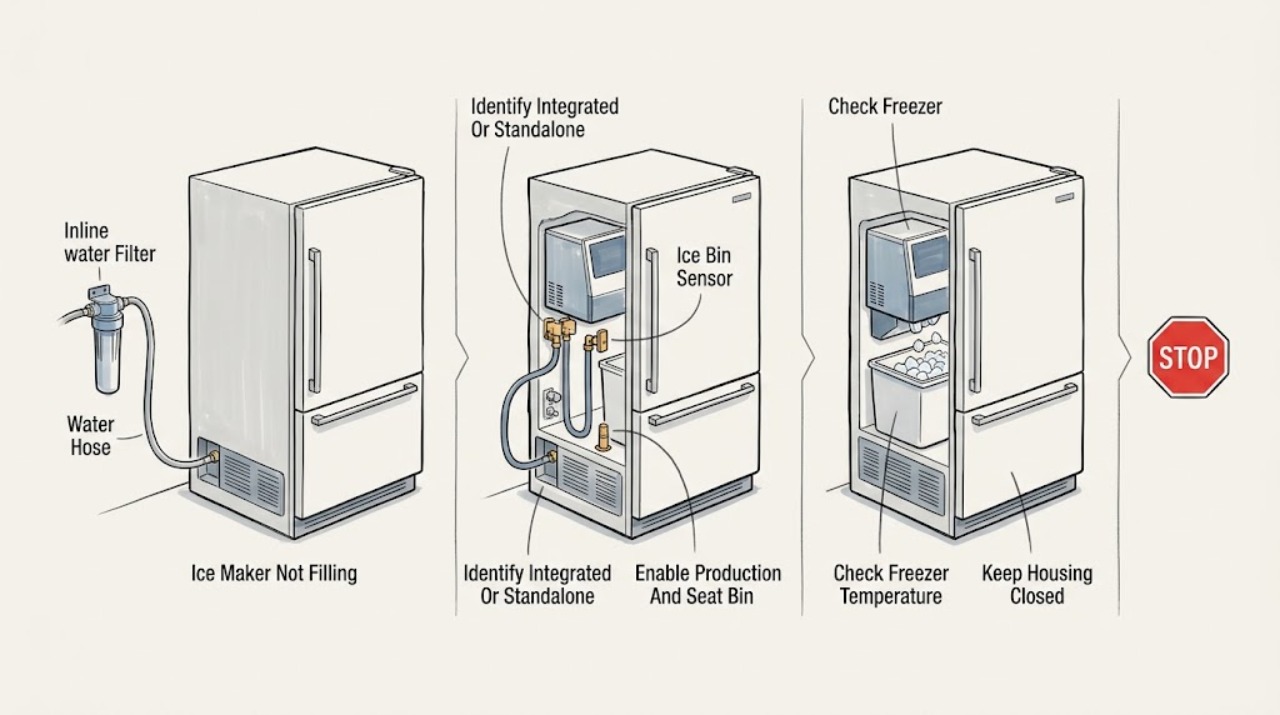
First establish the architecture. The Bosch sources reviewed here document ice makers integrated into Bosch refrigerator/freezer appliances, not a universal countertop or standalone ice-maker design. For an integrated unit, confirm that ice production is switched on, the freezer has reached its set temperature, the ice container is fully inserted and not obstructed, the appliance has a water supply with its shut-off valve open, and the visible water hose is not kinked. A blocked water filter, low water pressure, a fill-level sensor blocked by food or objects, or an ice-maker fault can also stop filling, but the exact remedy is model-dependent. If the appliance or water connection leaks, the ice maker has an error, the freezer is not cold, or a check requires opening panels or changing a valve, stop the water and power when safe and arrange qualified service. If you mean a separate countertop or freestanding ice maker, do not apply these refrigerator checks; use that unit's exact manual because its pump, reservoir, float, and drain architecture is different and is not established by the Bosch refrigerator sources used here.
Before you begin
Safety first
- This article covers integrated refrigerator/freezer ice-maker controls, bin, freezer-temperature, and accessible water-route checks only. A qualified technician must handle internal valves, fill tubes, ice-maker mechanisms, electrical controls, live testing, and any standalone architecture not covered by these sources.
Work through in order
Diagnostic checks
Use only checks that match the exact appliance or system and its official guide.
-
Check 1
Record the complete Bosch model number and determine whether the ice maker is inside a Bosch refrigerator/freezer with a freezer compartment and plumbed water connection, or is a separate countertop/freestanding appliance with its own reservoir or cabinet.
Expected result: The ice maker is integrated into a refrigerator/freezer, or it is a separate standalone unit whose manual and architecture are not yet identified.
Next step: For an integrated unit, continue with the checks below and the exact refrigerator manual. For a standalone unit, stop this workflow and use its own model manual or qualified service; do not infer that a refrigerator shut-off valve, freezer temperature, or ice-bin sensor exists.
Stop if: Do not dismantle either architecture to identify it, and do not connect or disconnect a water line merely to test the design.
Why this matters
Why: The opened Bosch evidence supports the integrated refrigerator/freezer arrangement only. A standalone appliance may use different water, pump, float, drain, and control components, so refrigerator ice-maker checks would not establish its cause.
-
Check 2
For an integrated unit, check the exact manual's ice-production control, then remove and fully reinsert the ice container only as the manual shows. Keep food, bottles, and scoops out of the container and away from the fill-level sensing area.
Expected result: Ice production is switched off, the container is not fully seated, objects obstruct the fill-level sensor, the bin is full, or the control and container appear normal.
Next step: Enable production and reseat the empty container using the exact manual's procedure. If the control will not enable, the bin will not seat, or filling does not resume, continue to the temperature and water checks rather than ordering an ice-maker assembly.
Stop if: Do not force the container, defeat the fill-level sensor, store objects in the ice container, or reach into an ejector mechanism.
Why this matters
Why: Bosch manuals identify switched-off production, a misinserted container, and blocked fill-level sensing as reasons for an integrated ice maker not to function. A full or obstructed bin can stop production even when the water connection is healthy.
-
Check 3
Check that the integrated appliance is powered and that the freezer is at the set temperature shown in the exact manual or control display. Note whether the freezer door has been left open frequently, whether the compartment is visibly warm, or whether the ice maker has only recently been switched on or the appliance recently connected.
Expected result: The freezer is too warm, the appliance was recently connected or restarted, the door has been opened frequently, or the freezer is cold and stable.
Next step: Close the freezer and allow the exact model's documented startup or recovery period to pass. If the freezer cannot reach temperature, or the ice maker still does not fill after stable cooling, arrange appliance service rather than adjusting an unknown part.
Stop if: Do not keep opening the freezer to force a test, disable temperature protection, or continue using the appliance if it has an electrical or refrigeration safety hazard.
Why this matters
Why: Bosch manuals state that integrated ice production depends on the freezer reaching its set temperature; recent installation, warm conditions, or frequent door opening can delay production. A cold stable freezer makes water supply, filter, bin, sensor, or ice-maker fault more likely.
-
Check 4
Inspect the accessible water connection and hose for a closed shut-off valve, kink, sharp bend, visible damage, or a recently disturbed connection. Check only the external water route and follow the exact manual for any filter location or replacement procedure.
Expected result: The valve is closed, the hose is kinked or damaged, the connection leaks, a water filter is blocked or overdue according to the manual, or the external route looks normal.
Next step: Open only an obviously closed valve, straighten a safe accessible kink, or follow the exact model's filter instructions. If the hose is damaged, the connection leaks, water supply is inadequate, or filling still fails, turn off water and arrange qualified service.
Stop if: Do not loosen pressurized fittings, use an unapproved hose or filter, bypass a water valve, or continue with a leak or water near electrical parts.
Why this matters
Why: Bosch manuals identify no water supply, a kinked hose, low pressure, and a blocked water filter as possible contributors to absent or low ice production. A leak or damaged hose is a stop condition; a normal route does not prove that the inlet valve or internal ice maker works.
-
Check 5
Photograph any refrigerator or ice-maker error message and compare it with the exact Bosch model information. If the manual or Bosch error page documents a power reset for that model, perform only that documented reset once after switching off safely; do not start a service test or force a fill cycle.
Expected result: There is no error, a documented ice-maker/control error appears, the error clears after the model-directed reset, or it returns.
Next step: If the error returns or filling remains absent after the external checks, keep the appliance out of service as appropriate and arrange qualified Bosch or appliance support with the code and model number.
Stop if: Do not repeatedly cycle power, enter undocumented diagnostics, bypass controls, or open the ice maker or electrical compartment.
Why this matters
Why: Bosch's refrigeration error guidance includes an icemaker or ice-water-control communication fault and directs support when the error remains. A cleared message does not prove the water valve or ice-maker assembly is healthy; a returning message needs diagnosis.
-
Check 6
If the integrated ice maker is enabled, the freezer is cold, the bin and sensor area are clear, and the accessible water route is normal but no fill occurs, prepare a service request with the model number, water/temperature observations, error code, and the time since the last successful fill.
Expected result: The ice maker remains dry, a fault returns, the appliance leaks, the water filter or valve requires internal access, or no safe external explanation remains.
Next step: Turn off water and isolate power when safe, keep the appliance out of service if leaking or unsafe, and arrange qualified Bosch or appliance service. If the unit is standalone, provide its own manual/model instead of using this integrated-appliance diagnosis.
Stop if: Do not remove panels, thaw hidden tubing with direct heat, force the ice-maker mechanism, handle refrigerant, or test energized valves.
Why this matters
Why: A water valve, internal filter path, fill tube, ice-maker mechanism, sensor, or control fault is possible, but the observed absence of water does not identify which part and does not justify a generic replacement.
Use your observations
Decision map
Find the observation that best matches what you see, then follow the next safe action.
-
PATH 01Safety boundary
What you see
The product is a separate countertop or freestanding ice maker rather than an ice maker inside a Bosch refrigerator/freezer.
Do this next
Use the exact standalone model manual or qualified service. Do not apply freezer-temperature, refrigerator shut-off valve, integrated-bin, or refrigerator error-code assumptions.
Why this path and its safety boundary
Why it matters: The refrigerator-based Bosch sources do not establish the standalone unit's reservoir, pump, float, water inlet, or drain behavior.
Safety stop: Do not open the standalone housing or connect it to a refrigerator water line as a test.
-
PATH 02Safety boundary
What you see
The ice maker is integrated, ice production is switched off, the bin is mis-seated or obstructed, or the freezer has not reached the set temperature.
Do this next
Enable production, clear only the bin/sensor area, seat the container, and allow the model's documented cooling period. Escalate if the freezer is stable and no fill occurs.
Why this path and its safety boundary
Why it matters: A documented operating condition is more likely than a failed water valve or ice-maker assembly.
Safety stop: Do not defeat the sensor, force the bin, or repeatedly open the freezer to test it.
-
PATH 03Safety boundary
What you see
The integrated unit is cold and enabled, but the shut-off valve is closed, the visible hose is kinked, the filter is blocked according to the manual, or the connection leaks.
Do this next
Correct only an obvious accessible valve or kink and follow the exact filter instructions. Turn off water and call service for a damaged hose, leak, low supply, or persistent no-fill condition.
Why this path and its safety boundary
Why it matters: A restricted or unsafe water route is more likely than a confirmed ice-maker mechanism fault.
Safety stop: Do not loosen fittings under pressure, bypass the valve, or continue with a leak.
-
PATH 04Safety boundary
What you see
The integrated ice maker is enabled, the freezer is cold, the bin/sensor area and accessible water route are normal, but no fill occurs or a fault returns after the documented reset.
Do this next
Keep the appliance out of service as appropriate and arrange qualified Bosch or appliance diagnosis with the model, error pattern, and water/temperature observations.
Why this path and its safety boundary
Why it matters: An internal fill valve, tube, filter path, ice-maker mechanism, sensor, or control fault is more likely; the exact part cannot be identified safely from no-fill alone.
Safety stop: Do not remove panels, force an ejector, apply direct heat to hidden tubing, or test energized components.
Helpful context
Understand the symptom
Architecture comes before diagnosis
The evidence used here is for Bosch refrigerator/freezer ice makers connected to the appliance's water system. The B36CL and 800112 manuals describe freezer temperature, a fitted ice container, ice-production controls, a water connection, and a water hose. That is an integrated appliance architecture. A separate countertop or freestanding ice maker may instead use a reservoir, pump, float, or drain arrangement, so these refrigerator checks should not be transplanted to it. Identify the full appliance model first and use its own manual.
Keep water and electrical checks external
Do not remove an ice-maker cover, probe a valve, reach into an ejector mechanism, or open the refrigerator's electrical compartment. Turn off the water supply before any model-directed hose work and isolate power before handling a removable bin or filter if the manual requires it. Stop for a leak, damaged hose, water near electrical parts, smoke, burning odor, or an appliance that repeatedly trips power. Never bypass a fill-level sensor or force the ice maker to cycle.
‘Not filling’ can mean no water, no ice cycle, or no safe fill signal
An integrated ice maker will not make a useful diagnosis from the absence of cubes alone. If production is switched off, the freezer is too warm, the ice container is mis-seated, the filter or supply is restricted, or the fill-level sensor is obstructed, the appliance may not request or complete a fill. A fault code or persistent failure after those external checks can involve the ice maker or its controls. Bosch's manuals do not justify a universal code-to-part table for every model.
Safety boundary
Stop conditions
- Stop using the integrated ice maker and turn off its water supply for a leak, damaged hose, water near electrical parts, or water escaping from the appliance.
- Do not apply refrigerator-based checks to a separate countertop or freestanding ice maker unless its exact manual confirms the same architecture.
- Do not remove ice-maker or electrical covers, force the ejector or bin sensor, thaw hidden tubing with direct heat, bypass controls, or test energized valves.
- Do not order a generic ice-maker assembly, valve, filter, or hose from the no-fill symptom alone; Bosch compatibility and access are model-specific.
When checks do not resolve it
Need a professional?
Safety scope: This article covers integrated refrigerator/freezer ice-maker controls, bin, freezer-temperature, and accessible water-route checks only. A qualified technician must handle internal valves, fill tubes, ice-maker mechanisms, electrical controls, live testing, and any standalone architecture not covered by these sources.
Common questions
FAQ
Why is my Bosch refrigerator ice maker not filling with water?
For an integrated refrigerator ice maker, check that production is enabled, the freezer is cold, the ice container is correctly seated, the water shut-off valve is open, and the visible hose is not kinked. A blocked filter, low pressure, or internal fault can remain; use the exact model manual and call service for a leak or persistent no-fill.
Can a warm freezer stop a Bosch ice maker from filling?
Yes, for the integrated refrigerator/freezer designs covered by the Bosch manuals. Ice production starts after the freezer reaches its set temperature. If the freezer remains warm, resolve that model-specific cooling issue first; do not assume the ice-maker valve has failed.
Can a kinked water hose stop a Bosch ice maker from filling?
Yes, Bosch manuals list a kinked hose and no water supply as possible causes for an integrated refrigerator ice maker. Inspect only the accessible route, turn off water before model-directed hose work, and arrange service for damage, leaks, or persistent no-fill.
Should I replace the Bosch ice-maker assembly because it is not filling?
Not from no-fill alone. First rule out architecture, production setting, freezer temperature, bin seating, water supply, hose condition, and the model's filter guidance. An internal valve, fill tube, sensor, or ice-maker fault requires model-specific diagnosis.
Do these checks apply to a separate countertop Bosch ice maker?
Not automatically. The Bosch sources used here document ice makers integrated into refrigerator/freezer appliances. A separate unit may use a reservoir, pump, float, or different water path; use its own model manual or qualified service instead of applying refrigerator checks.
When should I call a professional for a Bosch ice maker that will not fill?
Call when the integrated unit is enabled, cold, correctly seated, supplied with water, and still does not fill; when an error returns; or when a valve, filter path, fill tube, sensor, or electrical panel requires access. Stop immediately for a leak, water near electrical parts, smoke, burning odor, or damaged wiring.
Read the exact guide
Official sources
- Use and Care Manual (8001124202_B)Bosch · Official Bosch refrigerator/freezer manual example; the ice-container, freezer-temperature, water-supply, and hose guidance is model-specific and does not establish a countertop or freestanding architecture.
- Use and Care Manual B36CL..Bosch · Official Bosch manual for B36CL refrigerator/freezer models; its integrated ice-maker controls, water connection, temperature, and sensor behavior must not be generalized to standalone ice makers or other models.
- Get Support - Refrigeration | Bosch Home AppliancesBosch Home Appliances · Official Bosch refrigeration support hub for refrigerator/freezer manuals, service assistance, and model-specific information.
- Refrigeration | Error Codes | BoschBosch Home Appliances · Official Bosch US refrigeration error reference; displayed codes and reset behavior depend on the refrigerator model and control generation, not a standalone ice maker.
Community feedback
Share a repair observation
Share a plain-text repair observation. Accepted observations are published automatically; this page may take a moment to update.