
On this page
Start here
Quick answer
An ice maker that is not filling needs water-flow and operating-state checks before a part diagnosis. Confirm the supply valve is open and the line is not kinked, verify the freezer is cold enough, confirm the ice maker is on, and check a recently installed or clogged filter.
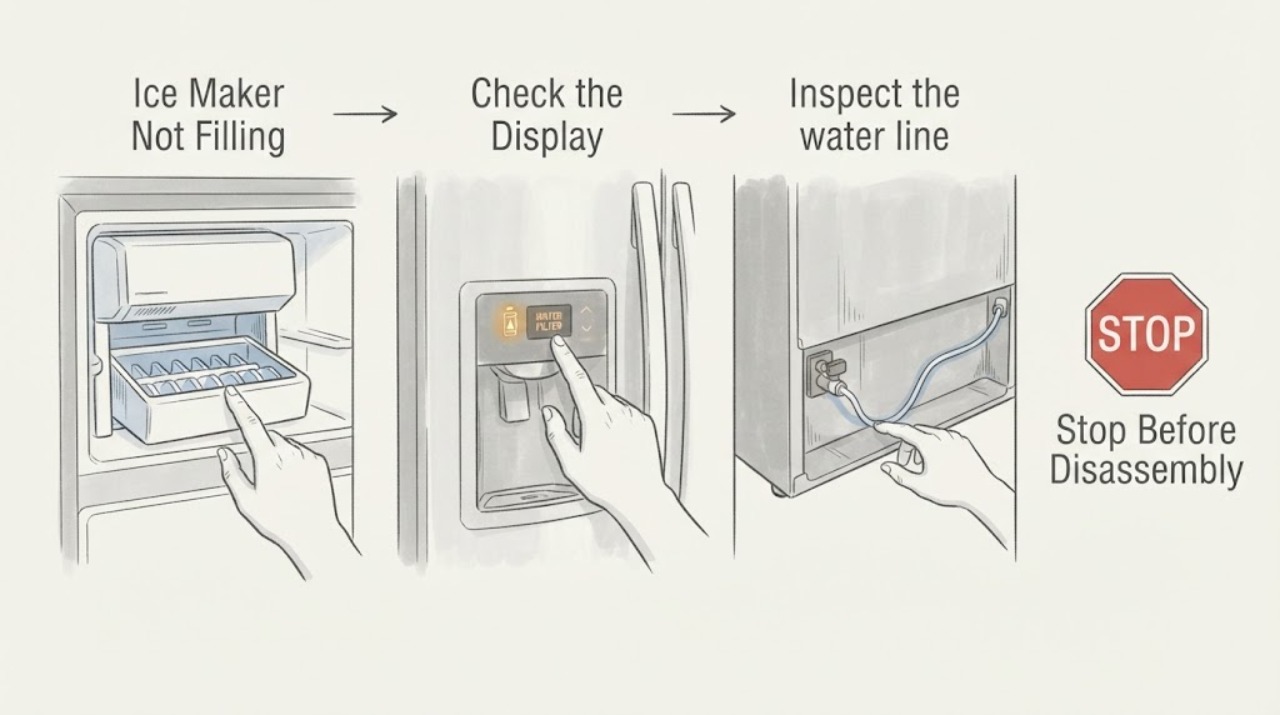
Work through in order
Diagnostic checks
Use only checks that match the exact appliance or system and its official guide.
-
Check 1
Inspect the ice-maker control and mold; confirm it is on and the mold is empty rather than holding a frozen batch.
Expected result: The ice maker is off, the mold holds a frozen batch, or the mold is empty while on.
Next step: Turn it on using model instructions and allow a normal cycle; do not force the ejector.
Why this matters
Why: An off control or harvest cycle is different from a water-fill failure.
-
Check 2
Inspect the water line from shutoff valve to cabinet for a closed valve, kink, or compression against the wall.
Expected result: The valve is closed, the line is pinched, or the line is straight and open.
Next step: Open the valve or straighten an accessible kink without disconnecting a pressurized line.
Why this matters
Why: A restricted line can prevent filling even when the refrigerator has power.
-
Check 3
If the filter was recently changed, reseat it and check that it locks and seals; compare flow without it only if the model permits.
Expected result: Flow returns after reseating or removing the filter, or remains absent with it seated.
Next step: Install the exact filter if it is the restriction; do not leave an unfiltered bypass as a permanent solution.
Why this matters
Why: A mis-seated or clogged filter can reduce or stop water flow.
-
Check 4
Check freezer temperature against the model guidance using the display or a separate appliance thermometer.
Expected result: The freezer is warmer than the ice-maker range, or near 0 to 5 F while the mold remains empty.
Next step: Correct the setting and allow stabilization; arrange model-specific service if it still does not fill.
Why this matters
Why: A warm freezer can delay production; a cold freezer with water available makes the fill circuit more likely, not a specific part.
Use your observations
Decision map
Find the observation that best matches what you see, then follow the next safe action.
-
PATH 01Next step
What you see
The ice maker was off or the freezer was too warm, and correcting it restores a cycle.
Do this next
Monitor a normal cycle using the model instructions.
Why this path and its safety boundary
Why it matters: The symptom was an operating-state or temperature condition, not proof of a failed part.
-
PATH 02Next step
What you see
The supply is open, filter seated, and freezer suitable, but the mold remains empty.
Do this next
Record the model and arrange service; do not replace a valve solely from an empty mold.
Why this path and its safety boundary
Why it matters: An assembly, fill circuit, or control fault needs model-specific diagnosis.
-
PATH 03Next step
What you see
Water flow is weak or absent after a filter change while home supply is present.
Do this next
Reseat or replace the exact filter and flush the water system as directed.
Why this path and its safety boundary
Why it matters: The filter or its installation is the leading explanation.
Helpful context
Understand the symptom
This guide focuses on an empty ice-maker mold. The symptom is a starting point, not a part diagnosis; use each observation to choose the next safe check.
Manufacturer guidance supports these symptom-level checks. Model-specific controls, parts, and service procedures must be confirmed in the appliance manual.
Only after diagnosis
Potential parts
- refrigerator water filter
Relevant only when flow changes with a correctly installed or removed filter.
Confirm the exact appliance model and manufacturer instructions before ordering.
When checks do not resolve it
Need a professional?
Call qualified appliance service when supply and filter flow are normal, the freezer is cold enough, and the ice maker still does not fill.
Common questions
FAQ
What freezer temperature supports ice production?
Whirlpool gives 0 to 5 degrees Fahrenheit as the freezer range for optimal ice production.
Can a filter stop the ice maker from filling?
Yes. Whirlpool says an incorrectly installed or clogged filter can reduce or stop flow to the ice maker.
Read the exact guide
Official sources
- Ice Maker Not Working - TroubleshootingWhirlpool · ice-maker water, temperature, control and filter checks
Community feedback
Share a repair observation
Share a plain-text repair observation. Accepted observations are published automatically; this page may take a moment to update.