
On this page
Start here
Quick answer
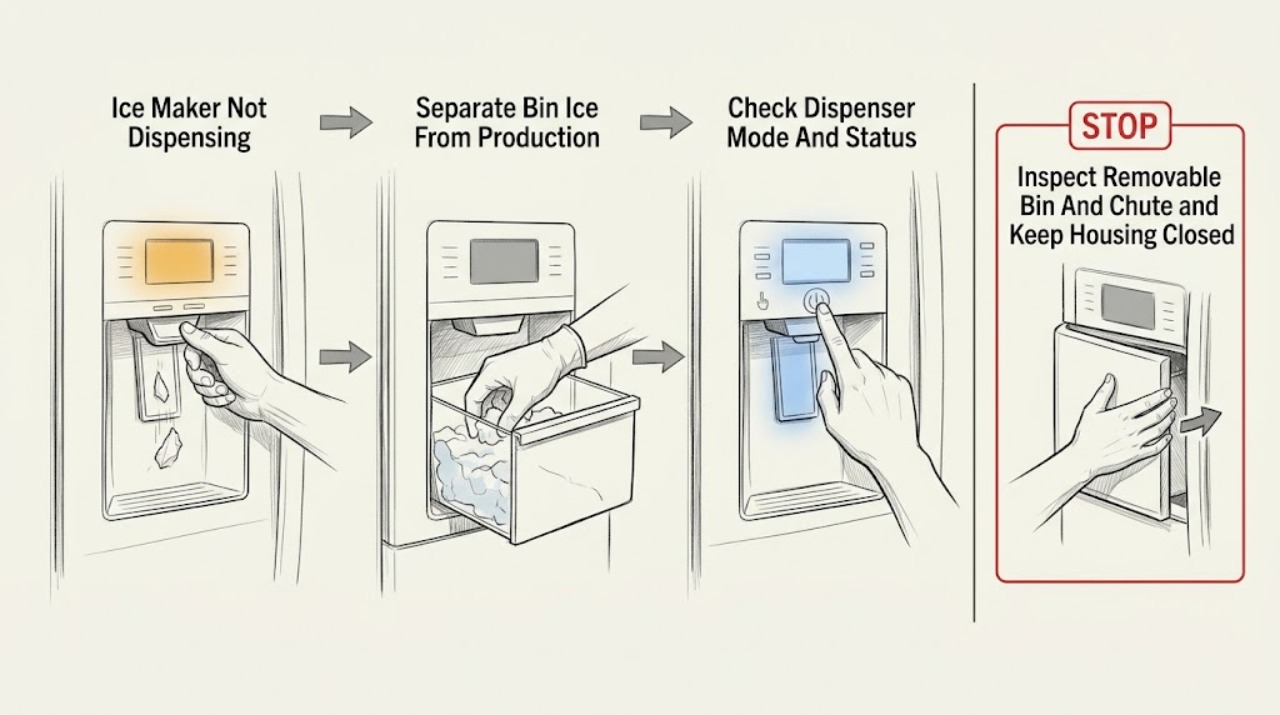
This page applies to a Bosch refrigerator with a built-in ice maker and an ice or ice-and-water dispenser; it does not describe a separate countertop ice machine. First decide whether cubes are present in the ice bin. If the bin contains ice but nothing comes through the chute, check the dispenser mode or lock, whether the removable bin is seated, and whether cubes are clumped or blocking the outlet. If the bin is empty, the ice maker may not be producing ice, which is a different water, freezer, or ice-maker branch rather than an ejection problem. Bosch's refrigeration error guidance distinguishes an icemaker fault from a dispenser user-interface fault. Use the exact model manual for a documented reset or filter step, and stop for leaks, a jam that cannot be cleared without force, an error that returns, a warm freezer, or any need to remove a panel or test wiring. Do not force the auger, bypass a lock, apply heat, or dismantle the ice maker or dispenser.
Before you begin
Safety first
- This article covers architecture identification, visible controls, user-removable bin and chute inspection, accessible filter and supply observations, and one model-documented reset. Qualified service must handle dispenser and ice-maker covers, auger or valve access, sensors, wiring, pressurized connections, and sealed cooling work.
Work through in order
Diagnostic checks
Use only checks that match the exact appliance or system and its official guide.
-
Check 1
Open the freezer or ice-box door and look only at the accessible ice bin. Determine whether it contains loose cubes, a solid clump, very little ice, or no ice at all. Do not remove the ice maker or reach into a moving mechanism.
Expected result: The bin has plenty of ice but the dispenser releases none, the cubes are clumped, the bin is nearly empty, or no ice is being made.
Next step: Follow the matching branch: inspect the bin and controls when ice is present, or check the model's ice-maker, water, and freezer conditions when the bin is empty. Do not order a dispenser part before confirming which side of the system is failing.
Stop if: Do not force the auger, chip ice inside the assembly, remove an ice-maker cover, or continue if the freezer is warm, leaking, or electrically unsafe.
Why this matters
Why: Ice in the bin separates a dispenser or chute problem from an ice-production problem. A clump can physically block the outlet; a nearly empty or empty bin requires a water, freezer, enabled-setting, or ice-maker diagnosis before the dispenser can work.
-
Check 2
With the refrigerator controls accessible, check whether ice-cube or crushed-ice mode is selected, the dispenser or ice maker is enabled, and a lock, vacation, filter, or error indicator is active. Use the exact model manual to change only a documented user setting.
Expected result: The dispenser or ice maker is off, a lock or vacation mode is active, a filter or error indicator appears, or the selected ice mode and controls look normal.
Next step: Restore only the documented user setting or filter status for the exact model, then make one normal dispense attempt. Arrange service if the setting cannot be changed, the interface remains unresponsive, or an error returns.
Stop if: Do not bypass a lock, bridge a control, enter an undocumented service mode, or continue if smoke, arcing, burning odor, or water near electrics is present.
Why this matters
Why: A disabled mode or lock can prevent output even when ice is being made. Bosch's error guidance distinguishes an icemaker fault from a dispenser interface fault, so an error or unresponsive control should not be treated as a simple chute blockage.
-
Check 3
Disable the ice function as the model manual directs, then inspect the user-removable ice bin, chute opening, and visible outlet for clumped cubes, a bin that is not seated, or loose debris. Remove only loose cubes or the bin itself if the manual permits; do not use a knife, screwdriver, hot air, or force.
Expected result: The bin is not seated, cubes are frozen together or wedged at the outlet, the chute is visibly blocked, the bin and chute are clear, or the obstruction cannot be reached without dismantling.
Next step: Clear only loose accessible cubes, reseat the bin according to the manual, and make one normal dispense attempt. Arrange service for a recurring clump, a bin that will not engage, no motor response, or a blockage behind a cover.
Stop if: Do not pry the bin, reach into the auger, chip ice in the assembly, apply direct heat, or remove a dispenser or ice-maker panel.
Why this matters
Why: A displaced bin or accessible clump can stop the dispenser while the ice maker continues producing normally. A clear chute with no output points toward the auger drive, dispenser switch, interface, or control path; an inaccessible jam needs service.
-
Check 4
If the bin is empty or the dispenser is also unable to provide water, inspect only the accessible water shutoff, visible supply line, user-accessible filter status, and freezer cooling condition. Use the model manual for filter replacement or purge steps; do not disconnect tubing or move a built-in refrigerator.
Expected result: The freezer is warm, the water supply is off or visibly kinked, a filter warning is active or flow changed after a filter change, both water and ice fail, or cooling and visible supply look normal.
Next step: Correct only an obvious accessible setting, shutoff, or model-approved filter step. If the freezer is warm, water leaks, a line is inaccessible, or no ice returns after the documented procedure, arrange refrigerator service.
Stop if: Do not disconnect a pressurized line, pierce frozen tubing, bypass a filter, apply heat to hidden lines, or keep using the appliance with a leak.
Why this matters
Why: An empty bin may reflect a production or water problem rather than an ice-dispenser failure. When both water and ice stop, a shared supply, filter, mode, or control condition is more likely; normal cooling and supply narrow the concern back to the dispenser or ice-maker assembly.
-
Check 5
After recording the model, indicators, bin condition, and which output works, use the exact Bosch manual or official error guidance for one documented power reset or dispenser restart. Keep doors closed during the reset and then make one normal ice request without touching the mechanism.
Expected result: Ice dispenses normally, the display clears but output remains absent, an E02 or E03 or other error returns, the dispenser is silent, or the freezer and water functions are also abnormal.
Next step: Stop repeated resets, leave the affected function unused, and arrange qualified Bosch service for a returning error, silent dispenser, no output with ice in the bin, or combined cooling and water symptoms.
Stop if: Do not cycle power repeatedly, remove covers, test the paddle or valve with live power, or continue if there is smoke, burning odor, a leak, or exposed wiring.
Why this matters
Why: A one-time recovery supports a control-state or temporary communication condition but does not prove the underlying fault is fixed. Bosch identifies E02 with an icemaker or ice-water control communication fault and E03 with a dispenser interface fault; recurring codes or no output need service diagnosis.
Use your observations
Decision map
Find the observation that best matches what you see, then follow the next safe action.
-
PATH 01Safety boundary
What you see
The ice bin is empty or nearly empty, the freezer is warm, or water and ice stopped together.
Do this next
Check only the model-documented ice-maker setting, visible water supply, filter status, and freezer condition. Arrange service for a warm freezer, leak, persistent no-ice condition, or any internal water or cooling diagnosis.
Why this path and its safety boundary
Why it matters: The immediate problem is more likely ice production, water supply, filter, freezer cooling, or a shared control state than the mechanical ice chute.
Safety stop: Do not remove the ice maker, thaw hidden tubing with heat, disconnect water lines, or open the sealed cooling system.
-
PATH 02Safety boundary
What you see
Ice is present, but cubes are clumped, the bin is displaced, or loose cubes visibly block the outlet.
Do this next
Disable the function, clear only loose accessible cubes, reseat the removable bin as the manual shows, and make one dispense attempt. Arrange service if the jam returns or cannot be reached without dismantling.
Why this path and its safety boundary
Why it matters: An accessible storage or chute obstruction is more likely than a failed ice-making motor.
Safety stop: Do not chip ice, pry the bin, reach into the auger, or apply direct heat.
-
PATH 03Safety boundary
What you see
Ice is present and the chute is clear, but a lock or vacation mode is active, the selected mode is wrong, the interface is unresponsive, or an error appears.
Do this next
Use the exact model setting or one documented reset. Arrange service for E02, E03, a returning error, a silent interface, or a setting that cannot be changed.
Why this path and its safety boundary
Why it matters: A dispenser control, user-interface, filter state, or communication condition is more likely than a physical ice blockage.
Safety stop: Do not bypass a lock, enter an undocumented test mode, bridge a switch, or remove the dispenser housing.
-
PATH 04Safety boundary
What you see
Ice remains in the bin and controls, filter, supply, and visible chute are normal, but no ice dispenses after one documented restart; or the freezer, water path, or dispenser leaks or behaves abnormally.
Do this next
Leave the affected function unused and arrange qualified Bosch appliance service. Provide the model, bin condition, control indicators, water result, freezer condition, and reset behavior.
Why this path and its safety boundary
Why it matters: An auger drive, paddle switch, interface, valve, sensor, wiring, or related assembly fault is more likely and cannot be safely confirmed from visible checks.
Safety stop: Do not dismantle the ice maker or dispenser, test live wiring, substitute a part by appearance, or continue through a leak, smoke, burning odor, or exposed wiring.
Helpful context
Understand the symptom
Confirm which Bosch ice function is failing
A Bosch refrigerator can make ice in a freezer or ice box and then use a separate bin, chute, auger, and dispenser control to release it. If there are no cubes in the bin, the immediate issue is ice production or water supply, not simply dispensing. If cubes are present but the paddle or button produces no ice, the dispenser path is the useful starting point. Bosch's product information shows this built-in refrigerator architecture; a portable or countertop ice machine is outside this article's scope.
Use the exact Bosch model instructions
Bosch refrigerator controls vary by model. Find the model or E-Nr and use its owner manual for the dispenser mode, child lock, filter, bin removal, and reset sequence. The opened Bosch manuals show that some models use a dedicated ice-dispenser button while others combine ice and water controls, so do not assume that a control label or button hold has the same meaning on every refrigerator.
Keep the inspection safe and non-invasive
Use only the display, dispenser controls, ice bin, chute opening, and other user-removable parts identified by the model manual. Switch the ice or water function off before clearing loose cubes, keep fingers away from the auger, and unplug before cleaning. Do not remove the dispenser housing, reach behind a panel, probe a switch or valve, apply direct heat to a frozen line, or work on energized wiring.
Safety boundary
Stop conditions
- Stop the ice and water functions for a leak, water near electrical parts, smoke, arcing, burning odor, exposed wiring, or a damaged power cord.
- Do not remove dispenser or ice-maker covers, reach into an auger or moving mechanism, chip ice, apply direct heat, disconnect pressurized tubing, or open the sealed cooling system.
- Do not bypass a dispenser lock, ice-maker switch, filter requirement, sensor, valve, or other protective device.
- If ice remains in the bin but still will not dispense after the model-documented visible checks and one reset, or if the freezer is warm or an error returns, arrange qualified service.
When checks do not resolve it
Need a professional?
Safety scope: This article covers architecture identification, visible controls, user-removable bin and chute inspection, accessible filter and supply observations, and one model-documented reset. Qualified service must handle dispenser and ice-maker covers, auger or valve access, sensors, wiring, pressurized connections, and sealed cooling work.
Common questions
FAQ
Does a Bosch ice maker that is not dispensing mean it is not making ice?
Not necessarily. If cubes are present in the bin, the ice maker has produced ice and the problem is more likely the bin, chute, auger, dispenser control, or interface. If the bin is empty, investigate production, water, freezer, and enabled-setting conditions instead.
Why does my Bosch ice maker have ice but dispense nothing?
Check that the ice mode is selected, the dispenser or ice maker is enabled, the lock or vacation mode is off, the removable bin is seated, and loose cubes are not clumped in the chute. Persistent no output with a clear path needs service diagnosis.
Can Vacation mode stop Bosch ice and water dispensing?
It can be a model-specific shared-control state. Check the exact manual and display rather than assuming the ice maker has failed. A community Bosch report says disabling Vacation mode restored both outputs for that owner, but this is not proof for every model.
What do Bosch E02 and E03 mean for ice dispensing?
Bosch's refrigeration guidance identifies E02 with an icemaker or ice-water control communication fault and E03 with a dispenser user-interface fault. Follow the official model reset direction once; if the code returns, arrange service.
Can I force the Bosch ice bin or remove the dispenser panel?
No. Remove only a user-removable bin as the exact manual permits and clear only loose accessible cubes. Do not pry the bin, chip ice, reach into the auger, remove a panel, test wiring, or apply heat; use qualified service for an inaccessible jam or persistent no-dispense condition.
Read the exact guide
Official sources
- Bosch Refrigeration Error CodesBosch · Official Bosch refrigeration error-code guidance; exact displays and reset methods depend on model.
- B20CS30SNS Freestanding Counter-Depth Side-by-Side Refrigerator | BOSCH USBosch · Official Bosch product page for a refrigerator model with an integrated ice maker and dispenser; exact model controls and bin layout vary.
- Bosch refrigerator/freezer not dispensing ice or waterr/appliancerepair community · Community report from a Bosch Series 6 refrigerator owner who had ice production but no ice or water dispenser output; not a universal diagnosis or repair instruction.
- Get Support - Refrigeration | Bosch Home AppliancesBosch · Official Bosch refrigeration support hub; exact appliance instructions and filter compatibility require the model or E-Nr.
- Refrigerator-Freezer Instruction ManualBosch · Opened Bosch refrigerator-freezer manual; button labels, bin layout, and waiting behavior vary by model.
Community feedback
Share a repair observation
Share a plain-text repair observation. Accepted observations are published automatically; this page may take a moment to update.