
On this page
Start here
Quick answer
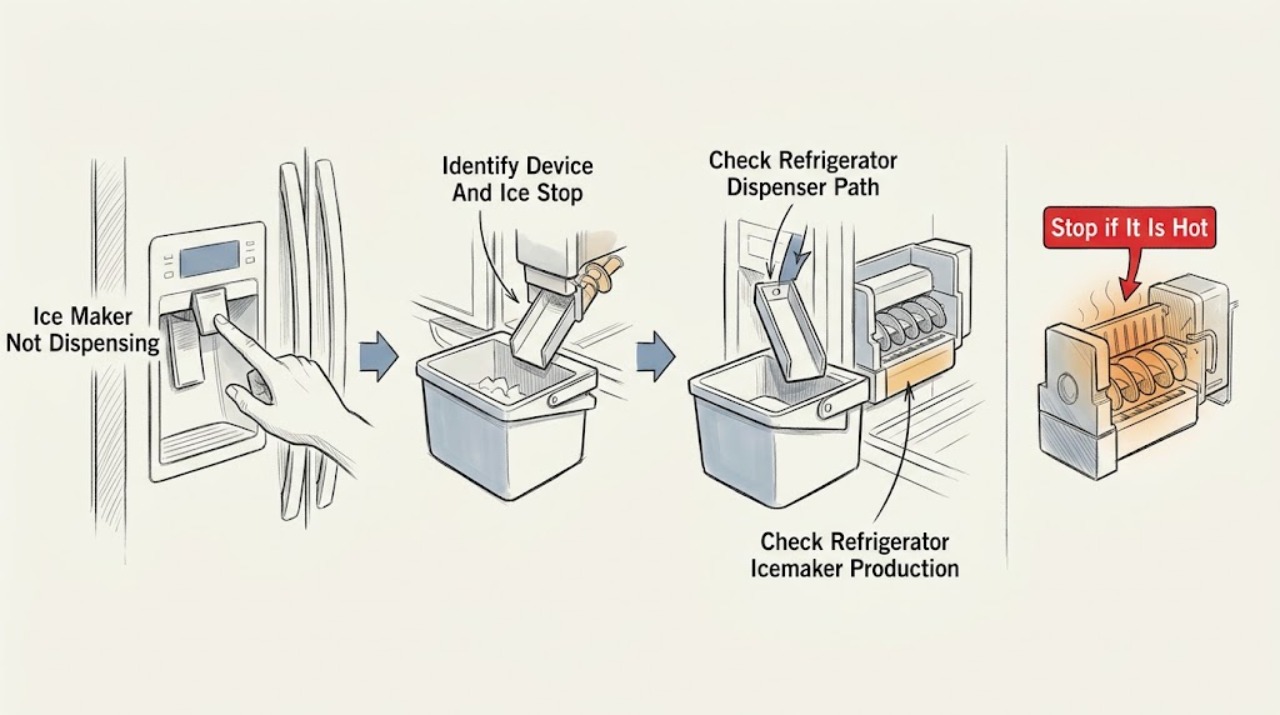
First identify the machine and where ice stops. A refrigerator door dispenser with ice in its bucket calls for fully closed doors, a correctly seated bucket, clumped cubes, and a visible chute jam check; GE says recurring clumping can indicate icemaker leaking or overfilling and needs service. If the refrigerator icemaker is not producing/ejecting ice, check only the model-authorized ON state, freezer temperature, water filter/supply, and accessible cubes blocking the mold; do not remove the icemaker or force its feeler arm. A standalone GE Profile Opal has its own modes, bin, water reservoir, auger, and clearance requirements, and Opal dispenser model P4INDOS6RBB has model-specific button behavior. Do not apply refrigerator checks to an Opal or vice versa. If ice is jammed behind a panel, the auger or water valve is inaccessible, or the unit has a leak, damaged wiring, smoke, or repeated electrical trip, stop and arrange qualified service.
Before you begin
Safety first
- The owner may identify the device, inspect accessible bins/buckets/chutes, correct model-authorized seating or mode settings, and clear only accessible ice with the exact manual's nonmetallic method. Qualified service must handle internal icemakers, augers, water valves, heaters, pumps, control boards, wiring, hidden frost, and live tests.
Work through in order
Diagnostic checks
Use only checks that match the exact appliance or system and its official guide.
-
Check 1
Record the full GE model number and identify the device: refrigerator door dispenser, refrigerator internal icemaker, standalone GE Profile Opal, or Opal dispenser. Note whether ice exists in a bucket/bin, whether the machine is making ice, whether the failure is cubed/crushed/auger output or all output, and whether water is also affected.
Expected result: Ice is present in a refrigerator bucket but will not exit, the refrigerator bucket is empty, an internal mold is not harvesting, an Opal bin has ice but its dispense button does nothing, or the Opal is not making ice.
Next step: Follow the matching branch below and the exact owner's manual/support page. Do not run a different device's diagnostic sequence.
Stop if: Stop for a leak, damaged housing/cord, water near electrical parts, smoke, sparks, burning odor, or a protection device that trips again.
Why this matters
Why: The first pattern is a storage/chute/auger path; an empty refrigerator bucket is a production path; an Opal has separate water, mode, bin, auger, and airflow controls. Device identity prevents cross-architecture instructions.
-
Check 2
For a refrigerator door dispenser, confirm the refrigerator doors are fully closed and the ice bucket is seated as the model manual shows. With the bucket removed and the refrigerator safe to handle, look for clumped/frozen ice and a visible chute obstruction; use only a wooden utensil for the accessible chute procedure described by GE, never metal or fingers.
Expected result: The doors are open or misaligned, the bucket is not seated, cubes are frozen together, the chute is visibly jammed, or no accessible obstruction is found.
Next step: Correct only a seating issue, discard/break up accessible clumps as appropriate, and clear a visible chute jam with the model-approved nonmetallic method. If the problem recurs or no accessible cause exists, arrange service.
Stop if: Do not reach behind the freezer wall, force the auger, use a sharp/metal tool, or run the dispenser with the bucket or guard improperly installed.
Why this matters
Why: GE says closed doors, clumped bucket ice, and chute jams can prevent dispensing. Recurrent clumping may indicate an icemaker leak or overfill, while an unobstructed bucket shifts suspicion toward the auger motor or internal mechanism.
-
Check 3
For an internal refrigerator icemaker with no or insufficient ice, check the exact manual's ON/OFF state and observe the freezer temperature, water-supply/filter condition, and any accessible cube blocking the ejector path. Do not remove the icemaker or pour water into its mold unless the exact model documentation explicitly authorizes that user test.
Expected result: The icemaker is OFF, freezer temperature is too warm, water flow/filter is restricted, cubes block the mold/ejector, the icemaker is newly installed, or no external cause is found.
Next step: Correct only the exact manual's ON state, accessible filter/supply condition, or visible cube obstruction. If the bucket remains empty or the ejector/mold requires removal or testing, arrange service.
Stop if: Do not force the feeler arm, bypass the shutoff, remove the icemaker, touch a potentially hot mold, or perform live valve/heater tests.
Why this matters
Why: GE says production depends on the ON state, temperature, water flow/filter, and a free ejector path; a newly installed icemaker can require a model-dependent waiting period. These observations do not identify a failed valve, motor, heater, or control.
-
Check 4
For a standalone GE Profile Opal, read the exact front indication and confirm the bin, water reservoir/side tank, and clearance. Round-button models distinguish Ice/Cleaning behavior; no-round-button models may show Making Ice, Add Water, Cleaning, or Defrosting. For the P4INDOS6RBB dispenser, check only the accessible chute/bin/button behavior in its model-specific troubleshooting page.
Expected result: The Opal is in Cleaning or Defrosting mode, shows Add Water or Ice Bin Full, the bin is not seated, vents are blocked, the side-tank tube has air/bends, or ice is present but the dispense button/auger path fails.
Next step: Use only the model-specific Opal control, bin, side-tank, clearance, or mode instruction. If an internal pump/auger or inaccessible blockage is implicated, contact Opal support/service.
Stop if: Do not open the Opal housing, insert tools into the auger, overfill the reservoir, use non-potable liquid, or apply a refrigerator icemaker procedure.
Why this matters
Why: GE documents different Opal model families and separate dispenser behavior. A mode message or blocked airflow can prevent production; an ice-filled bin with no output points to the dispenser/chute/auger path instead.
-
Check 5
If the correct device mode, bin/bucket seating, accessible clump or chute, water/filter condition, temperature, and airflow checks do not explain the failure, document the model, ice location, controls/indicators, timing, and any leak or unusual sound. Leave the unit out of service if a mechanism is jammed behind a panel or an electrical/water hazard is present.
Expected result: The refrigerator auger, icemaker valve/motor/heater, Opal pump/auger, control, or water path would need internal access or live testing.
Next step: Arrange qualified refrigerator/ice-maker service, or use GE Profile Opal support for an Opal model. Provide the exact model and the architecture-specific observations.
Stop if: Do not repeatedly actuate a jammed dispenser, bypass interlocks, remove covers, probe wiring, handle refrigerant/water valves, or keep operating after smoke, sparks, leaks, or electrical damage.
Why this matters
Why: A persistent no-dispense or no-production condition can arise from different internal components depending on the architecture; the symptom alone cannot establish a compatible replacement or safe owner repair.
Use your observations
Decision map
Find the observation that best matches what you see, then follow the next safe action.
-
PATH 01Safety boundary
What you see
A refrigerator bucket contains ice, but the door dispenser produces no cubes or only crushed/slow output.
Do this next
Check doors, bucket seating, accessible clumps, and a visible chute jam using only GE's nonmetallic/manual procedure. Persistent or recurrent clumping needs service because GE says the icemaker may be leaking or overfilling.
Why this path and its safety boundary
Why it matters: A door/chute obstruction, clumped ice, bucket seating, closed door, moisture/frost around the auger motor, or a dispenser mechanism is more likely than a no-production problem.
Safety stop: Do not force the auger, reach behind the wall, use metal tools, or continue if the bucket/chute is damaged or leaking.
-
PATH 02Safety boundary
What you see
The refrigerator ice bucket is empty or the internal icemaker is not ejecting/filling.
Do this next
Use the exact model's ON state and accessible temperature/filter/supply checks. If the ejector, fill tube, valve, heater, or mold needs removal or testing, arrange service.
Why this path and its safety boundary
Why it matters: The issue is upstream of the door dispenser: OFF state, freezer temperature, water filter/supply, visible mold obstruction, new-installation delay, or an internal icemaker fault.
Safety stop: Do not force the feeler arm, remove the icemaker, pour water into the mold without exact-model authorization, or touch a hot mold.
-
PATH 03Safety boundary
What you see
A standalone Opal shows Making Ice, Add Water, Cleaning, Defrosting, or Ice Bin Full, or its bin/side tank/vents are not in the model-required state.
Do this next
Follow the exact Opal model's mode, bin, water, side-tank, and clearance instruction. If the Opal remains unable to make or dispense ice, use Opal support.
Why this path and its safety boundary
Why it matters: The Opal may be intentionally paused by mode, water status, bin state, or airflow rather than having a failed dispenser. The exact round-button/no-round-button family and dispenser model matter.
Safety stop: Do not use refrigerator controls, open the housing, block or remove vent guards, overfill the reservoir, or add anything except potable water.
-
PATH 04Safety boundary
What you see
A GE Profile Opal dispenser has ice in the bin, but pressing the model's dispense control produces no ice or a visible chute jam.
Do this next
Use only the P4INDOS6RBB or exact model manual's accessible dispense/chute instruction. If the auger remains jammed or the model differs, contact Opal support rather than borrowing a button sequence.
Why this path and its safety boundary
Why it matters: This is the Opal dispenser/auger path, not refrigerator bucket or freezer-icemaker production. GE's P4INDOS6RBB troubleshooting is specific to that model.
Safety stop: Do not insert tools into the auger, disassemble the dispenser, or run the motor while hands are near the chute.
Helpful context
Understand the symptom
“Not dispensing” is not one GE ice-maker fault
A refrigerator dispenser moves stored ice through a chute, while an internal refrigerator icemaker must freeze, harvest, and fill a bucket. An Opal makes nugget ice in a countertop reservoir and may also dispense it. Start by locating the ice bin and the button/lever that was pressed; otherwise a correct fix for one architecture can be unsafe or irrelevant to another.
Visible ice and hidden ice paths lead to different decisions
Ice in a refrigerator bucket with no output suggests a door, chute, clump, or auger path. An empty bucket may instead be a production, temperature, water, or icemaker-state issue. On an Opal, a full bin, Add Water, Cleaning, Defrosting, blocked vents, or a side-tank air bubble has its own model-specific meaning.
Keep hands and tools out of energized or hidden mechanisms
Only inspect accessible bins, doors, switches, chute openings, and model-approved controls. Do not remove an internal icemaker, reach behind a freezer wall, force an auger, bypass a feeler arm, open an Opal housing, or perform a live motor/valve test. Stop for leaks, damaged cords, burning odor, smoke, sparks, or a repeated protection trip.
Only after diagnosis
Potential parts
- model-matched refrigerator ice bucket, chute, or auger component
Consider only after the refrigerator architecture is confirmed and a qualified technician identifies a failed bucket, chute, auger, or related dispenser component after accessible clump and seating checks.
Door-dispenser layouts and buckets vary by GE refrigerator model; verify the complete model number and official fit information. - model-matched refrigerator icemaker or water-path component
Consider only when an internal refrigerator icemaker has a confirmed production fault after ON state, temperature, filter, water supply, and visible obstruction checks.
A no-ice or no-dispense symptom does not identify a valve, heater, motor, sensor, or icemaker assembly; never select from the symptom alone. - exact-model GE Profile Opal dispenser or auger component
Consider only for a confirmed Opal model when model-specific support or qualified service identifies a dispenser/auger failure after bin, mode, airflow, and chute checks.
Opal models and dispenser/non-dispenser designs differ; verify the exact model and official fit information before any part decision.
When checks do not resolve it
Need a professional?
Arrange qualified service when a refrigerator dispenser remains blocked after safe bucket/chute checks, clumping returns, an internal icemaker needs removal or testing, or a standalone GE ice maker remains unable to produce/dispense ice after its exact manual checks. For an Opal, use exact-model Opal support for persistent mode, bin, side-tank, auger, or pump faults. Stop and disconnect power when safe for leaks, damaged wiring, smoke, sparks, burning odor, water near electrical parts, or repeated protection trips. Do not force augers, bypass feeler arms, open housings, or mix device-specific procedures.
Safety scope: The owner may identify the device, inspect accessible bins/buckets/chutes, correct model-authorized seating or mode settings, and clear only accessible ice with the exact manual's nonmetallic method. Qualified service must handle internal icemakers, augers, water valves, heaters, pumps, control boards, wiring, hidden frost, and live tests.
Common questions
FAQ
How do I know whether my GE ice maker is a refrigerator dispenser or an Opal?
A refrigerator dispenser is built into the refrigerator door and draws from a bucket; an internal refrigerator icemaker freezes and ejects cubes into that bucket. A GE Profile Opal is a standalone countertop unit with its own reservoir, bin, modes, and usually an Opal Dispense control. Record the exact model before troubleshooting.
Why does my GE refrigerator have ice but not dispense it?
Check that the doors and bucket are correctly closed/seated, then look for clumped ice or a visible chute jam. GE says recurring clumping may mean the icemaker is leaking or overfilling and needs service. Do not force the auger or use metal tools.
Why is my GE refrigerator ice bucket empty?
That is an icemaker-production issue rather than only a dispenser issue. Check the exact model's ON state, freezer temperature, filter/water supply, and accessible cubes blocking the mold. If the mold, fill tube, valve, or icemaker needs removal or testing, arrange service.
What does Add Water or Cleaning mean on a GE Profile Opal?
GE's Opal guidance says Add Water indicates a water need, while Cleaning or Defrosting modes do not produce ice. Round-button and no-round-button models display different states, so use the exact model's instructions and do not apply refrigerator icemaker controls.
Why is my GE Profile Opal full of ice but not dispensing?
If the model is the P4INDOS6RBB dispenser, use its model-specific troubleshooting for a chute jam, side-tank/airflow condition, bin state, and dispense button. Do not insert tools into the auger or use refrigerator dispenser procedures on an Opal.
Read the exact guide
Official sources
- Opal Ice Maker Dispenser - Installation and Getting StartedGE Appliances · GE Profile Opal ice-maker dispenser installation, clearance, water, bin, and dispense operation
- Refrigerator - How to Turn Icemaker On or OffGE Appliances · GE refrigerator icemaker feeler-arm, toggle, slide-switch, and dispenser-control ON/OFF variations
- Refrigerator - Icemaker Not Producing IceGE Appliances · GE refrigerator internal icemaker ON state, temperature, filter, mold obstruction, and service guidance
- GE Profile™ Opal™ Ice Maker Dispenser - TroubleshootingGE Appliances · GE Profile Opal P4INDOS6RBB dispenser-specific chute, side-tank, airflow, bin, dispense, and mode troubleshooting
- Ice Maker - No Ice ProductionGE Appliances · GE standalone ice maker no-production power, water, auger overload, and manual/service boundary
- Opal Ice Maker - Not Making IceGE Appliances · GE Profile Opal round-button/no-round-button model modes, bin, water, cleaning, defrost, and support guidance
- Refrigerator - New Icemaker Not Producing IceGE Appliances · GE refrigerator new-icemaker temperature, ON state, water-line purge, and initial ice-production guidance
- Refrigerator - Dispenser Takes Too Long to Dispense IceGE Appliances · GE refrigerator dispenser slow/clumped ice and bucket output behavior
- Refrigerator - Not Dispensing IceGE Appliances · GE refrigerator door ice dispenser doors, bucket clumps, chute jams, auger frost, and service guidance
Community feedback
Share a repair observation
Share a plain-text repair observation. Accepted observations are published automatically; this page may take a moment to update.