
On this page
Start here
Quick answer
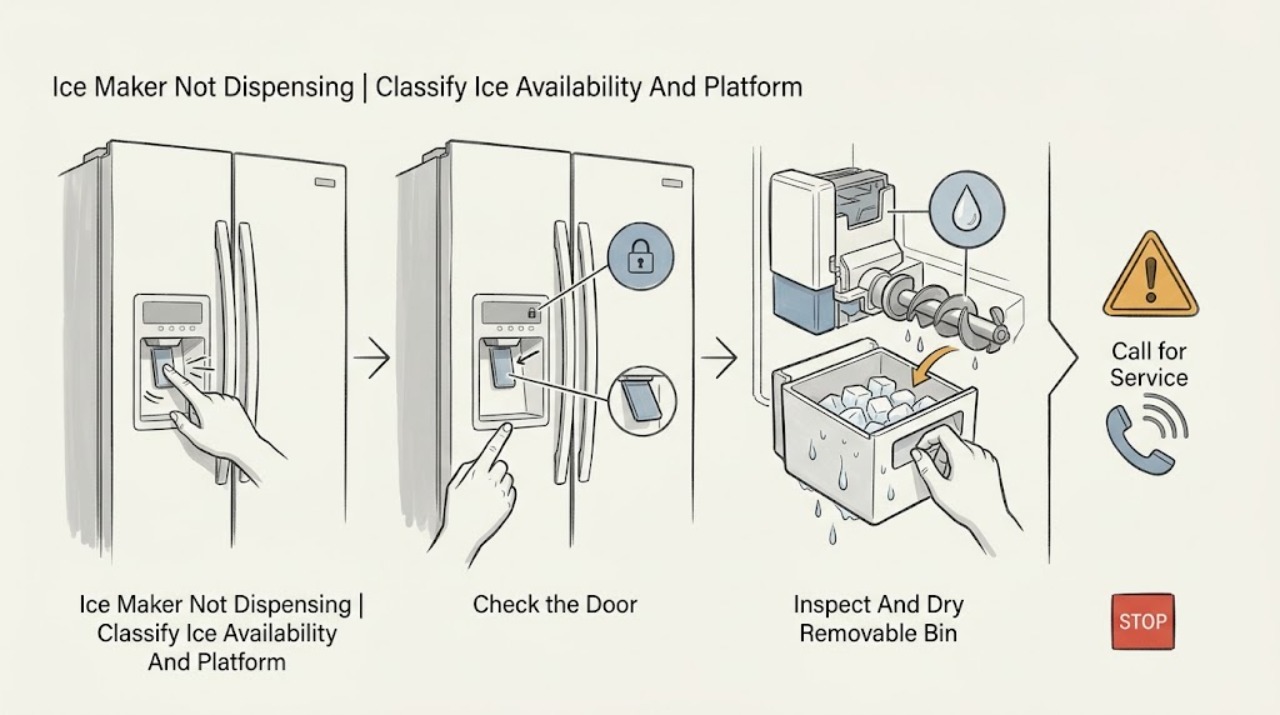
First separate “there is no ice” from “there is ice but it will not come out.” Frigidaire's dispenser guidance applies to French Door, Side-by-Side, and Top Freezer refrigerators with an ice dispenser, and says to check the control lock, closed doors, ice in the bin, and the dispenser's shutoff after prolonged paddle use. If ice is present, look for a clump or jam in the chute, between the maker and bin, or around the bin auger; infrequent use, temperature changes, and power outages can melt and refreeze ice. With the dispenser stopped and dry hands, remove the bin only as the exact model guide permits, thaw and empty it away from the appliance, wipe it completely dry, and reinstall it correctly. If the bin auger was moved, use only the model's documented alignment procedure. If the bin is empty, diagnose the automatic maker, water/filter path, and freezer temperature instead; a dispensing symptom does not prove that the maker is producing ice. Stop for a damaged chute, repeated jam, leak, electrical odor, or any diagnosis that requires panels, wiring, or forced motor work.
Before you begin
Safety first
- The user may identify the model and symptom branch, use normal controls, close doors, release an overheld paddle, and remove/thaw/dry a removable ice bin only as the exact model guide permits. Qualified personnel must handle the auger motor/coupling, maker assembly, chute mechanism, water valve, door interlock, evaporator/defrost system, controls, wiring, live testing, and any wet or electrically damaged appliance.
Work through in order
Diagnostic checks
Use only checks that match the exact appliance or system and its official guide.
-
Check 1
Identify the exact Frigidaire refrigerator model and confirm it has an automatic ice maker with a delivery/dispenser mechanism. Without removing panels, note the refrigerator platform, ice-maker location, whether the bin contains loose ice, whether the chute contains a visible clump, and whether the water dispenser or other refrigerator controls respond normally.
Expected result: The bin is empty; the bin has ice but the chute is blocked; the bin has ice but nothing moves; only one platform or drawer has the issue; or the appliance has no accessible ice-dispenser mechanism.
Next step: Use the no-ice branch or the ice-present branch that matches the observation. Keep the exact model manual available because bin release, control lock, chute, and platform behavior vary.
Stop if: Do not remove the maker, open a door panel, or put fingers or tools into the chute or auger while identifying the symptom.
Why this matters
Why: An empty bin is an ice-production, water, temperature, or maker-state branch, not automatically an auger failure. Ice in the bin with no delivery is a chute, bin, auger, control, or door-interlock branch. A manual tray or standalone ice machine is outside this page.
-
Check 2
From a dry position, check the normal control display for a lock indicator, verify the refrigerator doors are fully closed, and press the dispenser paddle only through the ordinary short request described by the model guide. If the paddle has been held for a long period, release it and allow the built-in motor shutoff to reset before one normal retry.
Expected result: The display is locked; a door is ajar; the paddle was held continuously; the control responds but no ice comes out; or the lock, doors, and normal paddle request are all correct.
Next step: Unlock only with the exact model control, close the door, release the paddle, and make one ordinary request. If the dispenser remains silent or blocked, stop repeated requests and inspect the removable bin path only as the manual permits.
Stop if: Do not bypass the door interlock, hold the paddle down for extended periods, enter an unknown service mode, or test the motor live.
Why this matters
Why: Frigidaire says a locked display or open door prevents dispensing, and a built-in device can shut the dispenser off after three minutes of continuous use to protect the motor. A normal control state with ice still present moves the diagnosis toward a jam, bin seating, auger, chute, or internal drive issue.
-
Check 3
If the exact model has a removable ice bin, stop the dispenser, keep hands dry, and remove the bin using the documented release path. Inspect the bin, the rear interface, the chute opening, and the visible auger area for a fused clump, loose pieces, or ice jammed between the maker and bin. Thaw and empty the bin away from the refrigerator only if the model guide permits, then wipe it completely dry and reinstall it in the proper position.
Expected result: The bin contains a solid clump; ice is jammed at the rear or chute; the bin is not seated; the bin and visible path are clear; or the bin cannot be removed normally.
Next step: Remove only loose or thawed bin ice by the model-approved method, dry the container and interface, reinstall it normally, and make one short test request. Escalate if the bin will not seat, the jam is behind a cover, or the failure returns.
Stop if: Do not chip ice with a knife or pick, pour hot water into the appliance, rotate or force the auger, remove the rear drive, or reach into the chute.
Why this matters
Why: Frigidaire identifies melted/refrozen ice around the auger and ice jammed between the maker and bin as common dispensing obstructions. A dry, correctly seated bin with no visible jam leaves the auger drive, chute, control, or door interlock unresolved. A bin that cannot release normally should not be forced.
-
Check 4
After the bin is dry and seated, check only the model's normal cube/crushed selector and visible bin alignment. If the bin was removed and the model guide documents an auger alignment step, follow that exact step; do not infer an alignment angle from another Frigidaire model. Close the door fully before a single normal dispense request.
Expected result: The selector is in an unexpected mode; the bin does not fit or the door will not close; the bin seats and the door closes but the auger is silent; or the dispenser works after reseating.
Next step: Use the exact model procedure for the selector or alignment and make one normal request. If the bin still cannot seat, the door will not close, or the auger does not operate with ice present, arrange service.
Stop if: Do not rotate the auger repeatedly, force the bin into place, operate with the door open, bypass the interlock, or run a prolonged paddle test.
Why this matters
Why: Frigidaire notes that an accidentally rotated or misaligned bin auger can prevent dispensing and can keep the door from closing. A correct fit with a silent motor or repeated slip points toward an internal drive, coupling, control, or interlock issue rather than a simple ice clump.
-
Check 5
If the bin is empty or the ice supply is too low to test dispensing, check only normal ice-maker controls, visible freezer temperature setting, water-filter status, and accessible water flow as the exact model guide permits. For a new installation or new filter, use the official priming instructions if applicable, and allow the model's stabilization period rather than repeatedly requesting ice.
Expected result: The maker is off; the freezer is too warm; the filter is overdue or water is slow; the unit is newly installed or recently filtered; or the maker is on and the visible water/temperature conditions are normal but the bin stays empty.
Next step: Correct only a visible control, filter, or supply condition using the exact manual, then allow the documented production period. If the bin remains empty or frost, leak, or cooling symptoms accompany it, arrange service instead of replacing the auger.
Stop if: Do not open the water valve, disconnect tubing, bypass the maker switch, force an ejector, or order a water or ice-maker part from an empty-bin symptom alone.
Why this matters
Why: No ice means the dispenser cannot be isolated from ice production. Frigidaire connects production to maker state, freezer temperature, filter and water flow, door use, installation/priming, and model-specific features. Normal visible conditions with an empty bin can leave the maker fill valve, mold, sensor, control, or supply system for service diagnosis.
-
Check 6
Record the exact model, platform, ice-maker location, bin level, control-lock and door state, selector state, jam or clump location, bin seating, water/filter and temperature observations, and whether a single model-authorized cleanup restored dispensing. Include any error display, frost, leak, odor, heat, or abnormal noise.
Expected result: Dispensing returns after a dry bin and normal reseating; the bin is empty after the production checks; a jam returns; the auger is silent or slips; the door will not close; or a water/electrical hazard appears.
Next step: Use the appliance only when the bin is correctly seated, the door closes, dispensing is normal, and there is no hazard. Otherwise leave the dispenser or maker off if the exact model allows and arrange Frigidaire or qualified appliance service.
Stop if: Do not dismantle the dispenser, maker, door, chute, wiring, motor, or water system, and do not continue retrying a jammed or hazardous appliance.
Why this matters
Why: A one-time removable ice jam is different from a recurring obstruction, empty-bin production fault, misalignment, failed drive, or interlock problem. The visible symptom cannot identify a safe motor, auger, valve, maker, or control replacement.
-
Check 7
Before contacting service, photograph the frost or jam only from a safe external position and preserve the exact control display or error text. Do not remove an inaccessible cover to improve the photograph. Give the technician the model, platform, bin result, and whether the water dispenser and refrigerator cooling are normal.
Expected result: The issue is fully resolved by a visible, model-authorized correction; or the fault is persistent, inaccessible, recurring, leaking, noisy, or associated with cooling or electrical symptoms.
Next step: Arrange qualified Frigidaire appliance service for persistent, recurring, inaccessible, or hazardous symptoms, and keep the appliance off when the service boundary requires it.
Stop if: Do not perform live electrical tests, bypass a door or maker interlock, apply heat, or disassemble the appliance to continue diagnosis.
Why this matters
Why: A documented result helps distinguish a delivery-path obstruction from an empty-bin production failure or concealed drive/control fault. Persistent or inaccessible conditions need trained diagnosis and should not be converted into a guessed part order.
Use your observations
Decision map
Find the observation that best matches what you see, then follow the next safe action.
-
PATH 01Safety boundary
What you see
The bin contains ice, but a visible clump blocks the chute, the rear interface, or the auger area.
Do this next
Stop the dispenser, remove and thaw the removable bin only as the model guide permits, wipe it dry, remove loose ice without sharp tools, reinstall it correctly, and make one short request.
Why this path and its safety boundary
Why it matters: An ice jam is more likely than an empty-bin maker fault. Frigidaire links melted/refrozen ice to infrequent use, temperature fluctuations, power outages, and jams between the maker and bin.
Safety stop: Do not chip, pry, heat, or reach into the chute, auger, or motor path.
-
PATH 02Safety boundary
What you see
The bin is full and correctly seated, the doors are closed, the control is unlocked, but the auger is silent or ice does not move after one normal request.
Do this next
Stop repeated paddle requests and arrange service with the model and control observations. Do not remove the motor or test voltage.
Why this path and its safety boundary
Why it matters: A drive motor, coupling, selector, control, or door interlock may be involved after the documented external checks. A silent dispenser is not evidence that the automatic maker is not producing ice.
Safety stop: Do not bypass the door interlock, run a prolonged motor test, or open the dispenser housing.
-
PATH 03Safety boundary
What you see
The bin is empty or has too little ice to dispense, and no delivery-path obstruction can be observed.
Do this next
Check the exact model's normal maker control, visible filter/water condition, and documented temperature or priming guidance. Allow the documented production period; arrange service if the bin remains empty.
Why this path and its safety boundary
Why it matters: This is an automatic-ice-maker production branch. Maker state, freezer temperature, water/filter flow, installation or priming, sensor, fill valve, mold, and control are more relevant than the auger.
Safety stop: Do not replace an auger or force an ejector solely because the dispenser has nothing to deliver.
-
PATH 04Safety boundary
What you see
The display is locked, a refrigerator door is not fully closed, or the paddle was held until the dispenser stopped responding.
Do this next
Unlock using the exact model control, close the doors, release the paddle, and make one ordinary request. If the state returns or dispensing remains absent, arrange service.
Why this path and its safety boundary
Why it matters: Frigidaire documents lock and door conditions as dispensing interlocks and says a three-minute continuous request can trigger a motor-protection shutoff. This pattern does not prove a jam or failed motor.
Safety stop: Do not bypass the interlock or hold the paddle down repeatedly.
-
PATH 05Safety boundary
What you see
The bin will not seat, the door will not close after bin removal, or a cube/crushed selector and auger arrangement does not match the model guide.
Do this next
Stop forcing the bin and use only the exact model procedure. If normal seating and alignment cannot be restored, leave the unit off and arrange service.
Why this path and its safety boundary
Why it matters: Frigidaire says an accidentally rotated auger can prevent dispensing and can keep the door from closing. Platform-specific bin and selector geometry means another model's alignment instructions may be wrong.
Safety stop: Do not rotate the auger by guesswork, force the bin, or operate with the door ajar.
-
PATH 06Safety boundary
What you see
Frost or ice returns quickly, blocks a chute or fan, water leaks below the maker, the freezer is broadly frosted or warm, or odor, smoke, heat, or electrical damage is present.
Do this next
Stop the maker or dispenser if the model allows, disconnect power only from a safe accessible control when necessary, and arrange qualified appliance service.
Why this path and its safety boundary
Why it matters: A continuing door/chute seal, airflow, temperature, defrost, water, maker, drive, or control fault is possible. Water near electrical parts and inaccessible frost are stop-use conditions.
Safety stop: Do not use sharp tools or heat, remove covers, wipe energized wet areas, reset repeatedly, or continue operation with smoke, sparks, or burning odor.
Helpful context
Understand the symptom
“Not dispensing” can mean two different failures
A refrigerator can have a full bin and a blocked delivery path, or it can have no ice because the automatic maker has not produced or filled the bin. Check the bin before diagnosing an auger. A dispenser paddle, control lock, closed-door interlock, chute flap, bin seating, auger, water/filter path, and freezer temperature are not interchangeable parts of the same symptom. Frigidaire's support pages cover several refrigerator platforms, so the exact model guide controls the location and operation of the ice maker and bin.
A jam usually leaves physical clues
Frigidaire says ice can melt and refreeze around the auger after infrequent use, temperature fluctuations, or a power outage. Ice can also jam in the chute or between the ice maker and the rear of the bin. A packed chute, fused clump, or bin that will not seat is a different branch from a completely empty bin. Remove and dry only the removable bin when the exact manual permits; do not reach into the chute, force the auger, or chip ice in place.
Platform and control differences matter
French Door, Side-by-Side, and Top Freezer refrigerators can all have automatic ice makers, but a dispenser may be in a door or freezer compartment, and not every model has the same lock key, crushed/cube selector, paddle, bin release, or reset behavior. A normal click or a dispenser shutoff after prolonged use does not establish a failed motor. Follow the exact model guide for any control or bin sequence, and stop when the guide would require internal access.
Safety boundary
Stop conditions
- Stop the dispenser or refrigerator for water near electrical parts, smoke, burning odor, sparks, a hot or damaged cord, repeated electrical trips, a blocked fan, or exposed/damaged panels.
- Do not use a knife, screwdriver, pick, scraper, hair dryer, heat gun, flame, boiling water, or other heat source to clear ice or frost.
- Do not reach into the chute, auger, or motor, bypass a door or maker interlock, force a frozen ejector, or hold the dispenser paddle for an extended test.
- Remove and thaw a bin only when the exact model guide permits; wipe it completely dry and reinstall it correctly before a normal request.
- An empty bin, recurring jam, misaligned bin, silent drive, broad frost, leak, or inaccessible blockage requires qualified service rather than a guessed part.
When checks do not resolve it
Need a professional?
Safety scope: The user may identify the model and symptom branch, use normal controls, close doors, release an overheld paddle, and remove/thaw/dry a removable ice bin only as the exact model guide permits. Qualified personnel must handle the auger motor/coupling, maker assembly, chute mechanism, water valve, door interlock, evaporator/defrost system, controls, wiring, live testing, and any wet or electrically damaged appliance.
Common questions
FAQ
Why does my Frigidaire refrigerator have ice but not dispense it?
Check the control lock, fully closed doors, the paddle shutoff, bin seating, chute, and auger path. Frigidaire says melted/refrozen ice can jam around the auger or between the maker and bin. Remove and dry a removable bin only as the exact model guide permits; recurring or concealed jams need service.
How do I tell whether the ice maker is not making ice or the dispenser is blocked?
Look in the ice bin. An empty bin is a production branch involving the maker state, freezer temperature, water/filter path, and installation or priming; a bin with ice but no delivery is a chute, jam, bin, auger, control, or door-state branch. Do not replace an auger just because the dispenser has nothing to deliver.
Can a power outage or infrequent use cause a Frigidaire ice dispenser jam?
Yes. Frigidaire says ice can melt and refreeze around the auger after infrequent use, temperature fluctuations, or power outages. Stop the dispenser, remove and thaw the removable bin if the model guide permits, wipe it dry, and reinstall it correctly. Do not chip ice in place or force the auger.
Why will my Frigidaire ice bin not fit back in or let the door close?
Frigidaire notes that an accidentally rotated or misaligned bin auger can prevent dispensing and can keep the door from closing. Do not force the bin or copy an alignment sequence from another model; use the exact Owner's Guide. If it will not seat normally, arrange service.
When should I stop troubleshooting a Frigidaire ice dispenser?
Stop for a recurring jam, bonded frost, a bin or door that will not seat or close, water near electrical parts, smoke, burning odor, sparks, a blocked fan, or a silent drive after the visible checks. Do not use sharp tools or heat, bypass an interlock, or open the chute, maker, motor, control, or wiring; arrange qualified service.
Read the exact guide
Official sources
- Refrigerators | FrigidaireFrigidaire · Supports the distinction among French Door, Side-by-Side, Top Freezer, ice-maker, dispenser, frost, water, and cooling topics; it is not a substitute for the exact model guide.
- Refrigerators - Auger FixFrigidaire · Applies to all refrigerators in the official article, but its crushed/cube and auger sequence remains model-dependent; this page uses it to warn against guessing alignment or prolonged motor tests.
- Refrigerator Too ColdFrigidaire · Supports the empty-bin/temperature branch and model-aware freezer setting discussion; it does not identify a specific ice-maker or dispenser part.
- Refrigerator Error Code DI SP or DISP - Ice JamFrigidaire · Supports chute, auger, and maker-to-bin jam identification and removable-bin thawing/drying; model-specific code clearing and service instructions control.
- What should I do if the dispenser on my refrigerator is not dispensing ice?Frigidaire · Applies to refrigerators, French Door, Side-by-Side, and Top Freezer refrigerators; supports lock, door, bin, paddle shutoff, jam, bin drying, and auger/bin seating checks, while exact model instructions govern.
- What should I do if my ice maker is not making enough ice in my refrigerator?Frigidaire · Applies to refrigerators, French Door, Side-by-Side, and Top Freezer refrigerators; supports maker state, filter, water line, door use, model-specific Quick Freeze, and freezer-temperature checks when the bin is empty or low.
- Refrigerators / Freezer - Frost Build UpFrigidaire · Supports the branch for frost around the chute, door gasket, vents, or freezer; internal frost, defrost, and evaporator diagnosis remains service-only.
- Refrigerator Prime and Purge GuideFrigidaire · Supports the new-installation or recent-filter branch when an empty bin may reflect air in water lines; it does not diagnose or authorize internal ice-maker repair.
Community feedback
Share a repair observation
Share a plain-text repair observation. Accepted observations are published automatically; this page may take a moment to update.