
On this page
Start here
Quick answer
This guidance applies to an ice maker built into a Bosch refrigerator or freezer. The Bosch sources opened for this topic do not establish that the same controls or water path apply to a standalone ice maker, so identify the appliance form and exact model first. For an integrated unit, check that the ice maker is switched on, the ice container is seated and not packed with a jammed cube, the freezer door closes, and the refrigerator has a connected water supply with the shutoff open and no visible kink. Bosch says a newly switched-on ice maker may need about 24 hours to produce ice, and a large recent draw can also require recovery time; the exact manual controls. Check the water filter only as the model manual directs and do not open water connections or electrical covers. If the unit has no water, a damaged hose, a recurring fault indication, an internal leak, or still makes no ice after one model-authorized recovery period, arrange Bosch or qualified appliance service.
Before you begin
Safety first
- This article covers ordinary-access observation only. Do not open the refrigerator or ice-maker housing, probe or bridge electrical terminals, bypass the shutoff arm or sensor, loosen pressurized water connections, test a valve electrically, move a built-in appliance, or reconnect a leaking or damaged unit repeatedly.
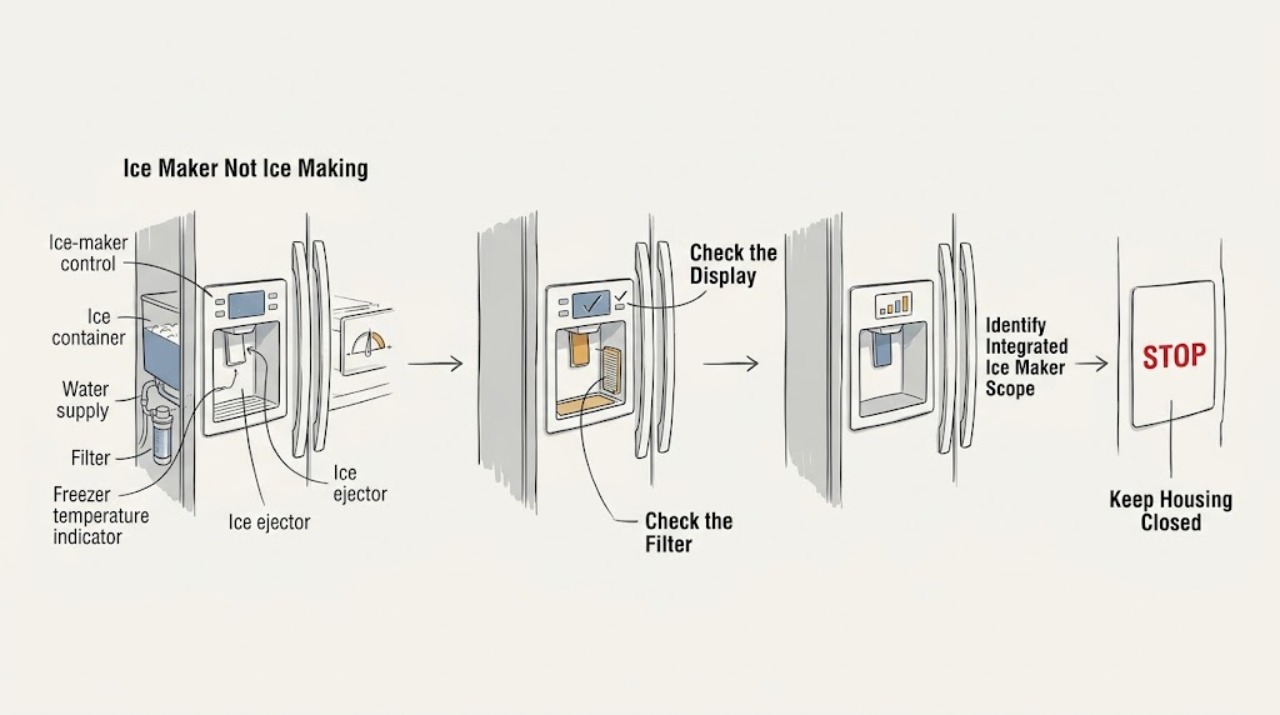
Work through in order
Diagnostic checks
Use only checks that match the exact appliance or system and its official guide.
-
Check 1
Identify whether the ice maker is physically inside a Bosch refrigerator or freezer, and record the exact model or E-Nr from the rating label if it can be read without moving or opening the appliance. Note whether the ice container, control panel, water dispenser, or freezer compartment described in the manual is present.
Expected result: Classify the appliance as refrigerator-integrated, standalone or uncertain, and record the model, control style, ice container position, and whether the refrigerator itself is cooling normally.
Next step: For an integrated unit, continue with the checks below. For a standalone or uncertain unit, stop troubleshooting at this point and use the exact manual or qualified service route; do not remove panels to identify the mechanism.
Stop if: Do not apply refrigerator water-line or freezer-temperature instructions to a standalone unit without its exact manual.
Why this matters
Why: The opened Bosch sources support refrigerator-integrated ice makers and their connected water and freezer conditions. A standalone or uncertain appliance may have a different mechanism and cannot safely inherit these steps.
-
Check 2
For an integrated unit, use the exact Bosch manual to confirm that the ice maker is switched on and that the ice container or bin is fully inserted and locked. From ordinary access only, look for a container packed with fused cubes or an ejector area visibly blocked by ice; do not force the bin or reach into a moving mechanism.
Expected result: Record whether the ice-maker control is on, the container is correctly seated, the container is overfilled or stuck, and whether an indicator, alarm, or fault message appears.
Next step: Correct only an obvious off setting or container seating issue as the model manual permits, then allow one normal production period. If the bin is stuck, the ejector is damaged, or the symptom returns, arrange service.
Stop if: Do not pry the container, bypass a wire shutoff arm or switch, insert hands into the ejector path, or operate with cracked ice-maker parts.
Why this matters
Why: Bosch says an ice maker that is switched off will not dispense ice or water, and its manuals identify a mis-seated container, a switched-off control, or a jammed ejector as no-ice causes. A normally seated, empty container keeps water supply, freezer temperature, timing, or internal ice-maker faults in view.
-
Check 3
For an integrated unit, inspect only the visible water-supply route and shutoff position from a dry, ordinary-access location. Look for a closed valve, a kinked or crushed hose, a wet connection, or a water filter that the exact manual identifies as replaceable or incorrectly installed. Do not loosen the connection or pull the refrigerator out.
Expected result: Record whether the water supply is connected and open, the hose is clear and dry, the filter is due or visibly mis-seated, the water dispenser also lacks flow, or the water route is hidden or damaged.
Next step: Correct only an obvious external valve or hose-routing issue allowed by the manual. Leave a damaged or leaking connection unused and arrange a qualified plumber or Bosch technician; do not remove a filter or alter the water line by trial and error.
Stop if: Do not loosen pressurized fittings, open the rear water panel, use a substitute filter or hose without model confirmation, or touch water near electrical parts.
Why this matters
Why: Bosch identifies missing water supply, a kinked line, low pressure, and a clogged or incorrectly installed filter as causes of no or low ice. A wet, damaged, or hidden connection needs plumbing or appliance service rather than user tightening.
-
Check 4
Check the integrated unit's freezer display or control setting and confirm that the freezer door closes completely without an obstructing bin, shelf, or food package. Do not make repeated extreme temperature changes; use the exact model manual for the normal setting and allow the freezer to stabilise.
Expected result: Record whether the freezer is warmer than the model's normal range, the door remains ajar, the ice maker was recently switched on, or a large amount of ice was recently removed.
Next step: Correct only an obvious door or setting issue according to the manual, then allow the model-specific production period. Arrange service if the freezer cannot hold temperature or ice production does not return.
Stop if: Do not block vents, leave the door ajar to test production, dismantle a fan or thermostat, or use the freezer if water is leaking onto electrical parts.
Why this matters
Why: Bosch lists a freezer that is too warm, an incompletely closed freezer door, a recent startup, and a large recent ice draw as reasons production may be absent or delayed. A normal temperature and closed door make water, control, filter, container, or internal ice-maker faults more likely.
-
Check 5
After the integrated unit's control, container, visible water route, filter, freezer temperature, and door checks are normal, follow the exact Bosch manual for one ordinary recovery period. Do not repeatedly cycle the ice maker, remove and reinstall the bin in rapid succession, or power the appliance up to probe an internal part.
Expected result: Record whether a batch appears, the ice maker fills partially or makes hollow or small cubes, the water dispenser also fails, the unit shows a recurring indication, or no ice is produced at all.
Next step: Stop repeated attempts and arrange Bosch or qualified appliance service. Provide the exact model, integrated-unit confirmation, control and bin state, water observations, freezer condition, and production history.
Stop if: Stop immediately for water near electrical parts, a damaged hose, smoke, burning odor, abnormal heat, exposed wiring, or an ice maker that jams or moves unexpectedly.
Why this matters
Why: A normal batch after a control, seating, water, temperature, or timing correction supports that user-level cause. Persistent no ice, partial or deformed cubes, a water leak, or a recurring fault after normal conditions points to the inlet valve, filter path, ice-maker assembly, control, or freezer system and needs diagnosis.
Use your observations
Decision map
Find the observation that best matches what you see, then follow the next safe action.
-
PATH 01Next step
What you see
The appliance is standalone or its form and exact model cannot be established from ordinary access.
Do this next
Do not continue with the integrated refrigerator steps. Use the standalone unit's exact manual or arrange Bosch or qualified service using its model information.
Why this path and its safety boundary
Why it matters: The opened Bosch evidence covers refrigerator-integrated ice makers, so the water path, controls, bin, and temperature assumptions may not apply.
-
PATH 02Next step
What you see
The ice maker is integrated, its control is off, the ice container is not locked in place, or a visible cube jam prevents normal movement.
Do this next
Follow the exact manual to turn the ice maker on, seat the container, or clear only a visible obstruction with a safe non-metal utensil. Allow one normal production period and arrange service if it jams again.
Why this path and its safety boundary
Why it matters: A control, seating, or user-accessible ice obstruction is more likely than a water-pressure or freezer-temperature fault.
-
PATH 03Next step
What you see
The integrated unit has no water at the dispenser or ice maker, a closed shutoff, a visibly kinked line, a wet connection, low flow, or a suspected filter restriction.
Do this next
Correct only an obvious external valve or route issue allowed by the manual. Leave a damaged, wet, hidden, or pressurized connection for a qualified plumber or Bosch technician.
Why this path and its safety boundary
Why it matters: Water supply, pressure, filter, or hose routing is more likely than an ejector or freezer-temperature fault.
-
PATH 04Next step
What you see
The integrated unit's freezer is too warm, the door is not closing completely, or the ice maker was recently switched on or heavily emptied.
Do this next
Correct the visible door or setting issue according to the manual and allow the model-specific recovery period. Arrange service if the freezer cannot hold temperature or production does not return.
Why this path and its safety boundary
Why it matters: Insufficient freezing or normal recovery time is more likely than an immediate ice-maker assembly failure.
-
PATH 05Next step
What you see
The unit is integrated, the ice maker is on, the container is seated, water and filter checks are normal, the freezer door closes and temperature is normal, and no ice appears after the model-authorized period.
Do this next
Keep the unit in service only if there is no leak or safety symptom and arrange Bosch diagnosis. Do not open the ice maker, bridge its controls, or test the valve electrically.
Why this path and its safety boundary
Why it matters: An internal inlet valve, ice-maker mechanism, sensor, control, or freezer-system fault is more likely than a user setting.
-
PATH 06Next step
What you see
Water runs from the integrated appliance, the hose or ice-maker component is damaged, or water reaches wiring, the plug, or another electrical part.
Do this next
Keep the water supply and appliance use stopped, isolate power only if it can be done safely without touching the hazard, and arrange qualified plumbing or appliance service. If there is smoke or fire, leave the area and contact emergency services.
Why this path and its safety boundary
Why it matters: A water-connection or appliance safety fault takes priority over production troubleshooting.
Helpful context
Understand the symptom
Confirm the appliance form before using any ice-maker steps
The Bosch material opened for this article describes automatic ice makers installed inside Bosch refrigerators or freezers, with a freezer compartment, ice container, household water connection, and model-dependent controls. It does not establish the layout of a standalone countertop or freestanding ice maker. Use the integrated steps below only when the ice maker is part of a Bosch refrigerator or freezer; for a standalone unit, stop after recording its exact model and use its own manual or service route.
No ice can be a control, water, temperature, or timing problem
A switched-off ice maker and a correctly operating ice maker that has not yet had time to refill are different situations. Water restrictions, a filter issue, a freezer that is too warm, or an ice container that is not seated can also stop production. The timing of the last batch, the state of the control indicator, and whether the water dispenser also has trouble are more useful than repeatedly cycling the appliance.
Keep water and electrical repairs outside the user check
Only inspect visible hose routing, the accessible ice container, and model-authorized controls. Do not remove rear covers, probe a valve, bypass a shutoff arm, alter wiring, or dismantle the ice maker. A water leak, damaged hose, exposed wiring, or an electrical smell is a stop-and-service condition.
Only after diagnosis
Potential parts
- model-specific ice-maker assembly
Consider this category only when qualified diagnosis confirms an internal ice-maker mechanism or control failure after the integrated unit's water, bin, temperature, and timing checks are normal.
Confirm the exact refrigerator or freezer model, ice-maker revision, connector, mounting, and manufacturer fit information; no-ice symptom alone does not establish a part. - model-specific water filter
Consider this category only when the exact manual and qualified diagnosis identify a clogged, exhausted, or incorrectly installed filter as the water-flow restriction.
Match the exact Bosch model and filter specification. Do not remove or substitute a filter as a repeated no-ice experiment. - model-specific water inlet valve or supply hose
Consider this category only when qualified diagnosis confirms a failed valve or damaged hose after the household supply and visible routing are checked.
Confirm the exact model, connection type, pressure requirements, and manufacturer part information; water-line replacement is a service task when connections are hidden or pressurized.
When checks do not resolve it
Need a professional?
For a Bosch ice maker integrated into a refrigerator or freezer, arrange service when the unit has normal control, bin, water, filter, door, temperature, and timing conditions but still makes no ice, or when it leaks, jams repeatedly, shows a recurring fault, or needs an internal part. Stop immediately for water near electrical parts, a damaged hose, smoke, burning odor, abnormal heat, or exposed wiring. If the appliance is standalone or its form is uncertain, use its exact model manual or qualified service rather than applying integrated-refrigerator steps.
Safety scope: This article covers ordinary-access observation only. Do not open the refrigerator or ice-maker housing, probe or bridge electrical terminals, bypass the shutoff arm or sensor, loosen pressurized water connections, test a valve electrically, move a built-in appliance, or reconnect a leaking or damaged unit repeatedly.
Common questions
FAQ
Do these Bosch no-ice steps apply to a standalone ice maker?
The opened Bosch sources are for ice makers integrated into Bosch refrigerators or freezers. Do not assume a standalone unit has the same bin, water, freezer, or control path; identify its exact model and use its own manual or qualified service route.
Why is my integrated Bosch refrigerator ice maker not making ice after I turn it on?
Bosch says an integrated ice maker needs time to produce or refill ice after startup, and a large recent draw can also require recovery. Confirm the control is on, the bin is seated, water is connected, and the freezer door closes; use the exact manual for the model's timing.
Can a water filter stop my Bosch ice maker from making ice?
Yes. Bosch identifies a clogged or incorrectly installed filter, low pressure, a closed shutoff, or a kinked water line as possible causes of no or low ice. Check only the visible, model-authorized parts and arrange service for a wet, hidden, or pressurized connection.
Does freezer temperature affect a Bosch integrated ice maker?
Yes. Bosch manuals list a freezer compartment that is too warm as a reason the ice maker may not make ice. Check the normal model setting and door closure, but do not dismantle the freezer or repeatedly make extreme temperature changes.
What should I do if water is leaking from my Bosch ice-maker system?
Stop the ice maker and water supply, keep water away from electrical parts, and arrange qualified plumbing or Bosch appliance service. Do not loosen the water connection, open the rear panel, or repeatedly reconnect a leaking appliance.
Read the exact guide
Official sources
- Fridge is not making iceBosch UK · Official Bosch UK support page explicitly framed around a fridge ice maker; it does not establish procedures for a standalone ice maker.
- CIB Instruction for UseBosch · Opened official Bosch instruction manual for a specific refrigerator family with an integrated ice maker; do not generalize its controls or exact water requirements to another model or a standalone unit.
- W10577849A Ice and Water Refrigerator ManualBosch · Opened official Bosch refrigerator manual for a specific integrated ice-maker family; exact model controls, water connection, and component layout may differ.
Community feedback
Share a repair observation
Share a plain-text repair observation. Accepted observations are published automatically; this page may take a moment to update.