
On this page
Start here
Quick answer
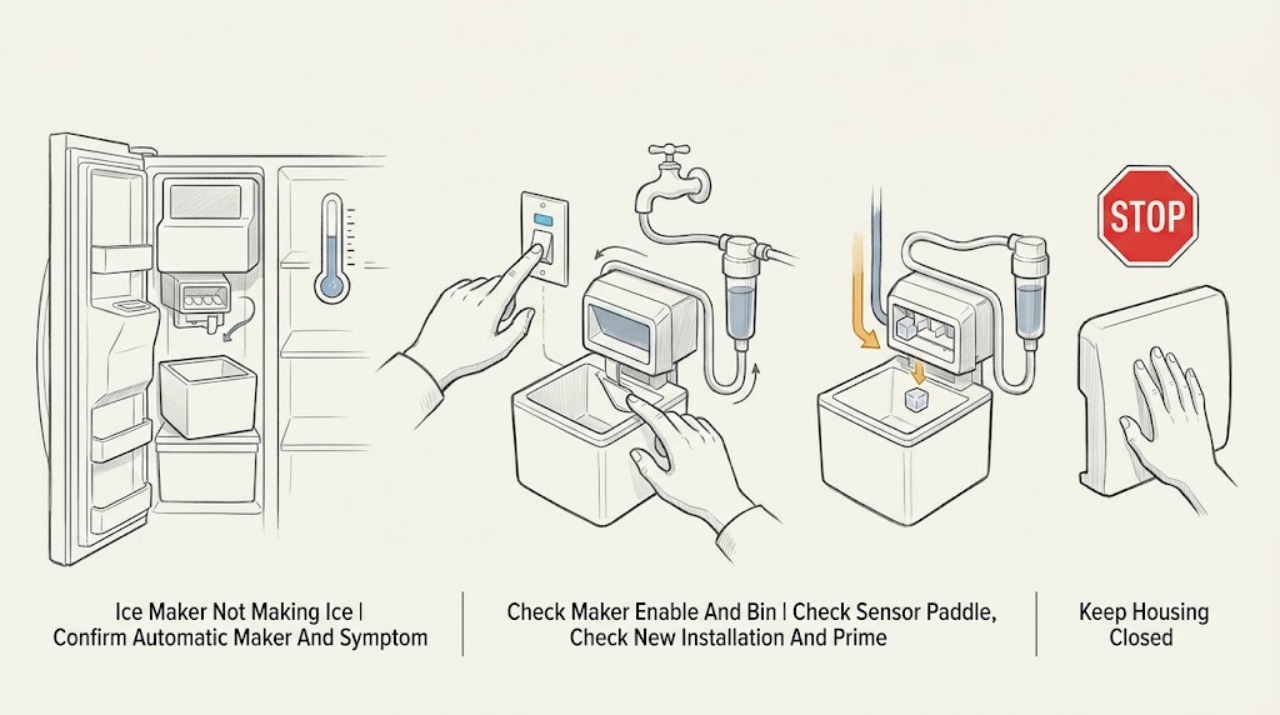
If a Frigidaire refrigerator's automatic ice maker is making no new ice, first confirm that the appliance actually has an automatic ice maker and that the complaint is an empty or unchanged ice bin—not ice that is already made but will not dispense. Check the exact model's ice-maker ON control or signal arm, seat the bin as the manual shows, and make sure the freezer is cold and the refrigerator has had time to stabilize. For a new installation, air in the water lines can cause two or three empty ice-maker cycles; prime the water system using the manufacturer's procedure and allow the unit time to cool. Check only accessible water connections for an open supply and a pinched line, and if the model has a water filter, use its manual and the manufacturer's replacement interval when slow or absent water flow points toward a clogged filter. Frigidaire says colder freezer settings can improve ice production and require 24 hours to stabilize. If the maker remains enabled, the freezer is cold, the accessible supply is sound, and no new ice is formed, stop at external checks and arrange qualified service for the internal maker, valve, sensor, wiring, or control; do not bypass the mechanism or perform live electrical tests.
Before you begin
Safety first
- Do not open the ice maker or refrigerator panels, probe live wiring, bypass an interlock, force a harvest cycle, or handle refrigerant. Stop immediately for smoke, burning odor, sparks, damaged wiring, or water near electrical parts.
Work through in order
Diagnostic checks
Use only checks that match the exact appliance or system and its official guide.
-
Check 1
Record the refrigerator model and verify that an automatic ice maker is installed. Look at the bin and describe the symptom as no cubes, a few empty cycles after installation, or an ice-filled bin that will not dispense; do not start by dismantling the maker.
Expected result: The bin is empty or unchanged, the refrigerator is newly installed, or ice is present but cannot exit through a dispenser.
Next step: Continue with the model-specific enablement, temperature, and water-supply checks only for the no-production symptom. Use the exact manual for the installed architecture.
Stop if: Do not force the bin, signal arm, tray, or any interlock, and do not reach into the mechanism while it can move.
Why this matters
Why: An empty or unchanged bin is a production problem. Ice already in the bin with no dispensing is a different outlet/dispensing issue and should not be diagnosed as a maker that cannot make ice. A new installation makes air in the water line a plausible first branch.
-
Check 2
With the doors and bin handled normally, check the exact model manual or display for the ice maker's ON state. If the model uses a signal arm or removable bin, confirm only that the arm is in its documented ON position and the bin is seated as shown; never hold an arm down or bypass a sensor.
Expected result: The maker is visibly OFF, the bin is absent or mis-seated, the model uses a signal arm that is not in its documented ON position, or the control and bin appear correct.
Next step: Correct only an obvious OFF setting or bin seating described by the manual, then allow the normal cycle time. If the control immediately returns OFF or the arm/bin cannot move normally, stop and obtain model-specific support.
Stop if: Do not defeat an interlock, remove covers, manually cycle the ice maker, or place tools or fingers in the tray or ejector mechanism.
Why this matters
Why: An OFF control, missing bin, or model-specific full-bin signal can stop production without an internal failure. A correct external state only establishes that the next checks should address cooling and water—not that the valve or maker motor is good.
-
Check 3
If the refrigerator was recently installed or the water line was disconnected, prime the water supply using the Frigidaire procedure: hold a glass or pitcher at the water dispenser until water appears, continue flushing for several minutes, discard it, and repeat as directed. Keep the maker OFF if the manual requires that when no water supply is connected.
Expected result: Water takes time to appear, air sputters from the dispenser, the first cycles remain empty, or water flows steadily after priming.
Next step: After priming, leave the maker enabled according to the manual and allow the newly installed refrigerator to cool and begin a normal cycle. If water cannot be established, continue to the external supply check and do not repeatedly run an unconnected fill system.
Stop if: Do not disconnect pressurized tubing, loosen fittings, or continue if water leaks toward electrical components.
Why this matters
Why: Air in new plumbing can cause two or three empty ice-maker cycles and can make the first cubes unsuitable. Steady water after priming makes an air-only explanation less likely, while no water flow points toward the supply path rather than the ice-making mold alone.
-
Check 4
Check the freezer display or control and whether the compartment is actually cold. Keep food and packages clear of documented vents, verify the door closes and seals, and make only the small temperature adjustment permitted by the model manual; do not remove an evaporator or fan cover.
Expected result: The freezer is still stabilizing after installation, is warmer than expected, has blocked airflow or a poor door seal, or is cold with normal airflow.
Next step: Correct only an accessible obstruction or door-closure issue and allow the documented stabilization period. If the freezer remains warm, frost-blocked, or unable to cool, stop the ice-maker diagnosis and arrange refrigerator service.
Stop if: Do not chip frost, apply direct heat, move sealed-system tubing, or continue using the appliance if there is a burning odor, smoke, or water near electrical parts.
Why this matters
Why: Frigidaire says a freezer set too warm can reduce ice production and recommends allowing 24 hours after a colder-setting change for stabilization. Warmth from a blocked vent, open door, or cooling fault must be resolved before blaming the ice maker.
-
Check 5
Inspect only the accessible water connection for an open supply and a visibly kinked line. If this model has a water filter, check its seating, age, and the exact manual's replacement instructions; do not assume every Frigidaire refrigerator uses the same filter or housing.
Expected result: The line is pinched, water at the dispenser is slow or absent, the filter is overdue or not seated, or water flow and the accessible line look normal.
Next step: Restore only an obvious external position or filter seating described by the manual. Replace a filter only after confirming the model and fit in the manual, then allow the system to purge and observe a normal ice cycle. Escalate if supply remains restricted or the maker stays empty.
Stop if: Do not cut or reroute tubing, use an unverified filter, bypass a filter head, or keep operating when a leak reaches electrical components.
Why this matters
Why: Frigidaire connects slow or absent water flow and an old or clogged filter with reduced ice production, and notes that pushing the refrigerator too far against the wall can kink the supply line. Normal external flow does not prove that an internal fill valve or maker inlet is operating.
-
Check 6
After the maker is enabled, the freezer is cold and stable, the accessible supply is flowing, and any model-specific filter issue is addressed, observe whether a normal cycle produces new cubes. Record the model, installation age, control state, water-flow result, and freezer symptom for support.
Expected result: New ice begins after the external correction, or the bin remains empty despite normal external conditions; the maker may also show unusual noise, a repeated failure, or a leak.
Next step: Monitor a recovered maker. For persistent no production, arrange qualified Frigidaire or appliance service and provide the exact model and observations; keep the appliance out of service if the fault involves heat, odor, sparks, damaged wiring, or leaking water.
Stop if: Do not live-test terminals, force a harvest cycle, bypass a sensor or interlock, open panels, or order an internal part without model-specific diagnosis.
Why this matters
Why: Recovery after priming, cooling, or a supply correction supports an external cause. Persistent no production with those conditions makes an internal ice-maker mechanism, inlet valve, sensor, wiring, or control problem more likely, but the symptom alone cannot identify a part.
Use your observations
Decision map
Find the observation that best matches what you see, then follow the next safe action.
-
PATH 01Safety boundary
What you see
The refrigerator or water connection is new, the dispenser initially sputters or takes time to flow, and the maker has had only a few empty cycles.
Do this next
Prime and flush the water system using the official procedure, then allow the refrigerator to cool and observe the normal cycle time before escalating.
Why this path and its safety boundary
Why it matters: Air in new plumbing is more likely than a failed internal maker at this stage.
Safety stop: Stop for a leak or water near electrical parts.
-
PATH 02Safety boundary
What you see
The installed maker is OFF, its model-specific signal arm is not in the documented ON position, or its bin is absent or not seated.
Do this next
Use the exact manual to restore the ON state or seat the bin, then wait for a cycle; do not force or bypass the mechanism.
Why this path and its safety boundary
Why it matters: The control or full-bin sensing state can prevent production without proving a mechanical failure.
Safety stop: Stop if the control will not hold, the bin or arm binds, or access requires a cover removal.
-
PATH 03Safety boundary
What you see
The maker is enabled but the freezer is warm, still stabilizing, blocked at a vent, or unable to maintain cooling.
Do this next
Correct only an accessible airflow or door issue, allow the documented 24-hour stabilization after an adjustment, and arrange service if the compartment remains warm.
Why this path and its safety boundary
Why it matters: Insufficient freezing makes an ice-production failure more likely than a dispenser problem; Frigidaire says a warmer freezer setting can reduce production.
Safety stop: Stop for smoke, burning odor, abnormal heat, or water near electrical components.
-
PATH 04Safety boundary
What you see
The line is kinked, the refrigerator is pushed against the wall, water is slow or absent, or a model-equipped filter is overdue, clogged, or not seated.
Do this next
Correct only an accessible line position or model-documented filter condition, purge the system safely, and retest one normal cycle. Do not assume a universal filter fit.
Why this path and its safety boundary
Why it matters: Restricted water delivery is more likely than an empty mold caused by the ejector alone.
Safety stop: Stop if the connection leaks or water approaches electrical parts.
-
PATH 05Safety boundary
What you see
The maker is enabled, the bin is correctly positioned, the freezer is cold and stable, water reaches the accessible system, and no new ice appears.
Do this next
Stop at external checks and arrange qualified model-specific service. If ice exists but the dispenser cannot release it, use a dispensing diagnosis instead of this no-production path.
Why this path and its safety boundary
Why it matters: An internal maker, fill valve, sensor, wiring, or control fault becomes more likely, but a public symptom check cannot select one replacement part.
Safety stop: Do not remove panels, make live measurements, or bypass the mechanism.
Helpful context
Understand the symptom
Confirm that this is a no-production problem
This page is for an automatic ice maker that is not harvesting or filling with new cubes. If the bin contains ice but a dispenser does not release it, that is a dispensing, chute, or auger problem with a different diagnostic path. Also confirm the refrigerator's exact model and whether an ice maker was installed: Frigidaire's support material covers several refrigerator architectures, but controls, bins, signal arms, and filters vary by model.
A new installation can look like a failed ice maker
When a refrigerator has just been connected, air in the new plumbing may make the first two or three ice-making cycles empty. Frigidaire recommends priming the water supply by holding a glass or pitcher at the water dispenser until water appears, continuing to dispense for several minutes to flush the plumbing, then discarding and repeating the water. Follow the exact model instructions and protect against splashing; do not keep an ice maker enabled without a connected water supply if the manual warns that the fill valve may chatter.
Temperature and water flow decide whether the maker can refill
A maker can be enabled yet produce no useful ice if the freezer is still warming after installation, the water supply is restricted, or a model-equipped filter is clogged or overdue. Frigidaire advises checking for a kinked line, considering the filter when water is slow or absent, and allowing 24 hours for a colder freezer setting to stabilize. These checks do not identify an internal valve or motor failure; a persistent no-ice result after external checks needs model-specific service.
Keep the ice-maker boundary external
Switch the refrigerator off or disconnect it only when the exact manual calls for that step, and do not reach into a moving or jammed mechanism. Do not remove panels, bridge a door or bin interlock, energize a valve by hand, probe live terminals, or open the sealed refrigeration system. Stop using the appliance and seek service for damaged wiring, burning odor, smoke, arcing, water reaching electrical parts, or a persistent fault that requires internal access.
Only after diagnosis
Potential parts
- water filter
Consider this only when the exact model has a water filter and the accessible checks show slow or absent flow or a filter that is overdue or clogged.
Confirm the full refrigerator model and the manufacturer's fit information before ordering; filter housings and intervals vary by model. - ice-maker assembly or water inlet valve
These are service-diagnosis categories only when the maker is enabled, the freezer is cold, the external supply is sound, and no ice is produced; the symptom does not identify which component failed.
Do not order or install an internal part without the exact model's parts documentation and qualified diagnosis.
When checks do not resolve it
Need a professional?
Arrange qualified service when the maker stays empty after accessible checks, the freezer cannot maintain cold, water leaks, or diagnosis requires the internal valve, maker mechanism, sensor, wiring, control, or sealed system. Stop using the refrigerator for smoke, burning odor, sparks, damaged insulation, or water reaching electrical components. Ice that is already made but will not dispense belongs to a separate dispensing problem.
Safety scope: Do not open the ice maker or refrigerator panels, probe live wiring, bypass an interlock, force a harvest cycle, or handle refrigerant. Stop immediately for smoke, burning odor, sparks, damaged wiring, or water near electrical parts.
Have this ready
- Exact model number, installation or water-line-change date, maker ON state, whether the bin is empty, freezer temperature or cooling symptom, water-flow result, filter status if equipped, and any leak, noise, odor, or alarm.
Common questions
FAQ
Is an empty ice bin the same as ice that will not dispense?
No. An empty or unchanged bin is a production problem. If the bin contains ice but the dispenser does not release it, do not use this no-production diagnosis; the outlet, chute, or auger path is different.
How long should I wait after installing or adjusting a Frigidaire refrigerator?
New plumbing can cause two or three empty ice-maker cycles, and Frigidaire says to allow the refrigerator to cool for the initial production period. After a freezer-setting change, its ice-production guidance says to allow 24 hours for temperature stabilization.
Can a water filter stop a Frigidaire ice maker from making ice?
It can reduce production on models equipped with a filter when the filter is clogged or overdue, especially when water is slow or absent. Confirm the exact model's filter and replacement instructions rather than assuming all Frigidaire refrigerators use the same filter.
Read the exact guide
Official sources
- What should I do if my ice maker is not making enough ice in my refrigerator?Frigidaire · Refrigerators, French Door Refrigerators, Side by Side Refrigerators, and Top Freezer Refrigerators
- How To Fix Your French Door Refrigerator Ice Maker Not WorkingFrigidaire · Frigidaire refrigerator ice-maker support page; exact controls and procedures remain model-specific
- Refrigerators - What does it mean to “Prime the Water Supply System” and why is it important for my refrigerator?Frigidaire · Refrigerators, French Door Refrigerators, Side by Side Refrigerators, and Top Freezer Refrigerators
Community feedback
Share a repair observation
Share a plain-text repair observation. Accepted observations are published automatically; this page may take a moment to update.