
On this page
Start here
Quick answer
A broken Bosch microwave handle is first a door and safety check, not a reason to order a generic handle. Stop pulling on a loose or detached handle, keep the microwave off while you inspect it, and confirm that the door, hinges, frame, latch, window, and seal are intact. Bosch says not to carry the appliance by its door handle, and its microwave guidance says never to operate the appliance with a damaged door or seal. If the door cannot close and latch normally, the seal or door is damaged, or the handle failure has distorted the door, leave the microwave disconnected and arrange qualified service. If the door assembly is intact, identify the exact E-Nr/model and use Bosch's compatibility check before considering a replacement handle; do not open the casing or attempt an internal door repair.
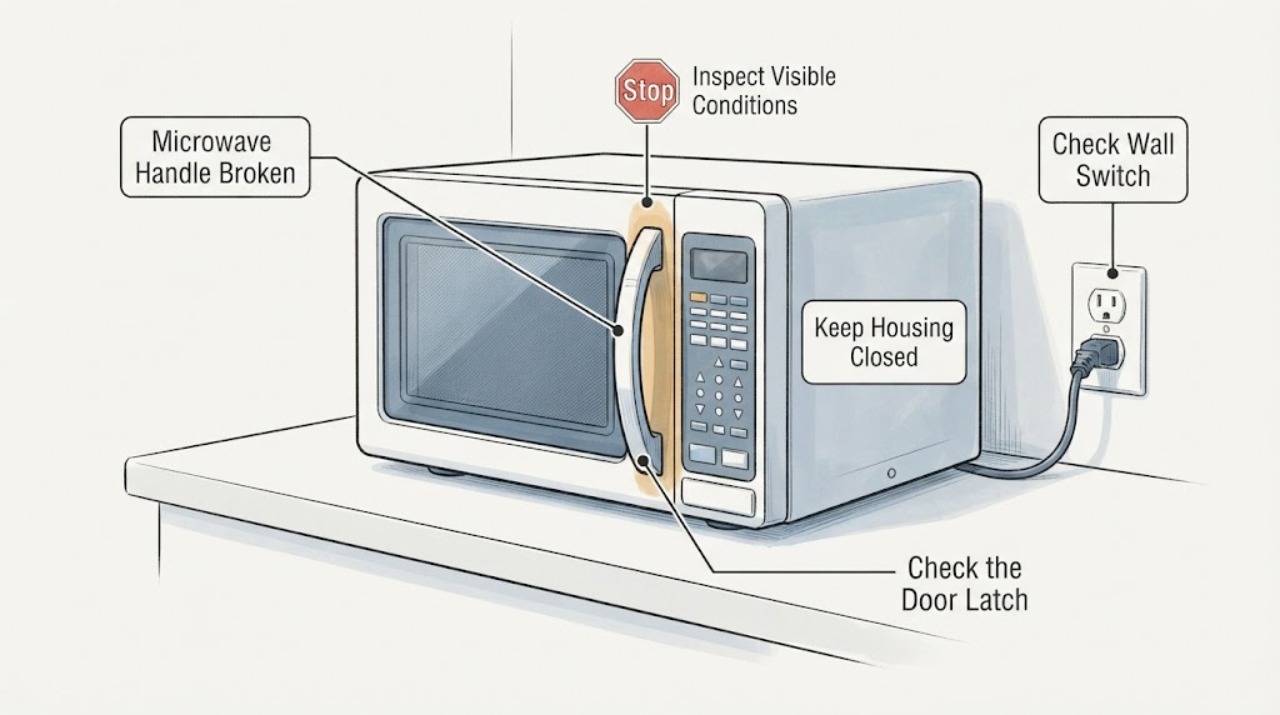
Work through in order
Diagnostic checks
Use only checks that match the exact appliance or system and its official guide.
-
Check 1
Stop using the handle as soon as it feels loose, cracks, separates from the door, or comes off. Switch the microwave off and disconnect it only from a safe, dry position; do not lift, carry, or steady the appliance by the handle.
Expected result: The handle is loose or detached, the plug or receptacle is hot or damaged, or the unit is otherwise stable and cool.
Next step: Keep the microwave off and allow it to cool before inspecting the door. If the electrical area is damaged or unsafe to disconnect, keep clear and arrange qualified electrical or appliance help.
Stop if: Do not tape the handle on for a test, carry the appliance by it, or pull harder to open a jammed door.
Why this matters
Why: A loose handle can worsen door or hinge damage when pulled, and Bosch specifically warns that the handle cannot support the appliance's weight. A hot, wet, arcing, or damaged electrical connection adds a separate electrical hazard.
-
Check 2
With the microwave cold and disconnected, inspect the door from the outside without removing panels. Check whether the door hangs squarely, closes fully, and latches without force; look for a bent frame, cracked window, loose hinge area, or a handle mount pulled away from the door.
Expected result: The door closes and latches normally with no visible distortion, or it rubs, stays ajar, needs force, has a damaged window/frame/hinge area, or the latch does not engage.
Next step: If the door does not close and latch normally or any structural damage is visible, keep the microwave disconnected and arrange Bosch or qualified appliance service. If it is aligned and intact, continue with the seal and model checks without operating the microwave.
Stop if: Do not bend the door, adjust hinges, remove the inner door panel, or bypass the latch switch.
Why this matters
Why: A handle-only failure is different from a door or latch failure. Difficulty closing, visible distortion, or a damaged window means the door assembly may no longer perform its safety function.
-
Check 3
Inspect the visible door seal and sealing surfaces while they are cool. Look for a missing, torn, displaced, contaminated, or compressed seal and for debris that prevents the door from closing; clean only loose accessible residue using the exact Bosch manual's care instructions.
Expected result: The seal is complete and seated with clean sealing surfaces, or the seal is damaged/missing, the door edge is distorted, or something still prevents proper closure.
Next step: Keep the unit out of service for any damaged or missing seal, door distortion, or unresolved closure problem. Arrange model-specific service rather than gluing, stretching, lubricating, or substituting a seal.
Stop if: Do not operate the microwave to see whether a replacement handle or seal holds, and do not remove the seal or door cover unless the exact service procedure authorizes it.
Why this matters
Why: Bosch states that a damaged or missing seal can allow microwave energy to escape and that the appliance must not be operated until repaired. A normal-looking seal does not clear a door that still fails to latch or align.
-
Check 4
Read the complete Bosch E-Nr/model and FD or serial information from the rating plate or the appliance documentation, then check Bosch's official parts listing for a handle matched to that model. Record whether the handle is the only damaged item and whether the mounting area is intact.
Expected result: The exact model is available and Bosch shows a compatible handle path, or the model is missing/ambiguous or the door mounting area is damaged.
Next step: Use only the model-specific Bosch part and the exact approved installation instructions. If compatibility cannot be confirmed or the mounting/door assembly is damaged, send the model information and photos to Bosch service instead of ordering a generic part.
Stop if: Do not open the microwave casing or attempt an internal repair; Bosch describes microwave repair as high-voltage work and directs owners to qualified service.
Why this matters
Why: Bosch's handle listing requires an appliance model number for compatibility, so a visually similar handle is not evidence of fit. A damaged mounting area or safety-relevant door component may require a complete door assessment rather than a handle alone.
Use your observations
Decision map
Find the observation that best matches what you see, then follow the next safe action.
-
PATH 01Next step
What you see
The handle is broken, but the cold door remains square, closes and latches normally, the window and frame are intact, and the seal is complete and seated.
Do this next
Keep use paused until the exact Bosch model and an approved replacement or service procedure are confirmed. Follow only the model-specific instructions; do not install a universal handle.
Why this path and its safety boundary
Why it matters: The visible evidence points to a localized handle or handle-mount problem, while the safety-critical door surfaces appear intact. The broken handle still should not be used as a lifting point or held in place for a microwave test.
-
PATH 02Next step
What you see
The handle failure is accompanied by a door that rubs, will not latch, a bent frame or hinge area, cracked window, loose door panel, or a torn or missing seal.
Do this next
Leave the microwave disconnected and arrange Bosch or qualified appliance service. Do not straighten, shim, glue, or disassemble the door.
Why this path and its safety boundary
Why it matters: The problem has moved beyond a cosmetic handle replacement. Bosch's microwave safety guidance treats a damaged door or seal as a no-use condition because microwave energy may escape.
-
PATH 03Next step
What you see
The model cannot be identified, the handle mounting is pulled out of the door, or the door condition cannot be judged without removing panels.
Do this next
Keep the unit out of service and provide Bosch support with the model/rating-plate information and photos. Do not remove the casing or perform an internal door repair.
Why this path and its safety boundary
Why it matters: The correct handle and the effect of the break cannot be established from appearance alone. The microwave door and internal high-voltage system have model-specific repair boundaries.
Helpful context
Understand the symptom
Why the handle alone does not answer the safety question
A handle can break at its mounting points without proving that the microwave door is unsafe, but the same event can also pull the door out of alignment or damage the latch, hinge area, window, or seal. Treat the handle as a reason to stop normal use and inspect the complete door assembly. Do not make a confirmation run with the handle held in place.
What Bosch's parts listing can and cannot tell you
Bosch lists door handles as model-checked spare parts rather than universal replacements. The part page asks for the appliance model number before compatibility is assessed. That makes the exact model and regional variant essential; the appearance or measured length of a handle is not enough.
Only after diagnosis
Potential parts
- model-specific Bosch microwave door handle or handle-mount assembly
Consider a handle part only when the exact model is confirmed and the door, latch, hinge area, window, frame, and seal are intact. The broken-handle symptom alone does not prove that a handle-only replacement is sufficient.
Confirm the complete E-Nr/model, regional variant, door version, and Bosch fit information before ordering. Do not substitute a visually similar handle or treat a door-inner or latch component as a user-installable part.
When checks do not resolve it
Need a professional?
Contact Bosch or a qualified appliance technician if the door does not close or latch normally, the frame, hinge area, window, latch, or seal is damaged, the handle mounting has pulled away from the door, the model-specific part cannot be confirmed, or the cause of the break is unclear. Keep the microwave disconnected for a damaged door or seal, electrical damage, smoke, arcing, or any condition that requires opening the casing.
Common questions
FAQ
Can I still use a Bosch microwave if only the handle is broken?
Do not assume that the handle is the only affected part. With the appliance cold and disconnected, confirm that the door, latch, hinge area, frame, window, and seal are intact and that the door closes normally. If any of those parts are damaged or the model-specific instructions do not clear operation, keep the microwave off and arrange service.
Can I order a generic Bosch microwave handle by measuring the old one?
No. Bosch's official handle listing asks for the appliance model number to check compatibility. Use the complete E-Nr/model and regional information rather than appearance or length alone.
Can I glue or tape the broken handle back on?
Do not use an adhesive repair as a structural or safety fix and do not run the microwave to test it. A temporary handle can change how force is applied to the door, while the door, latch, hinge, and seal still need to be assessed.
Read the exact guide
Official sources
- Microwave broken? | Microwave Troubleshooting | Bosch Home AppliancesBosch Home Appliances · Opened Bosch's microwave-broken support page; it directs owners to the matching owner's manual and Bosch Customer Support when the microwave is broken.
- TECHNICAL SERVICE BULLETINBSH Home Appliances Corporation · Opened Bosch/BSH technical service bulletin; it describes door-hook/latch symptoms and explicitly limits the repair information to trained, qualified personnel.
- 00644221 Handle | BOSCH USBosch Home Appliances · Opened Bosch official spare-parts page for a door handle; the page asks for the appliance E-Nr/model number before compatibility is checked.
- Use and Care ManualBosch Home Appliances · Opened Bosch microwave use and care manual; the manual identifies the door handle, warns not to carry the appliance by it, and states that a damaged door or seal requires repair before use.
Community feedback
Share a repair observation
Share a plain-text repair observation. Accepted observations are published automatically; this page may take a moment to update.