
On this page
Start here
Quick answer
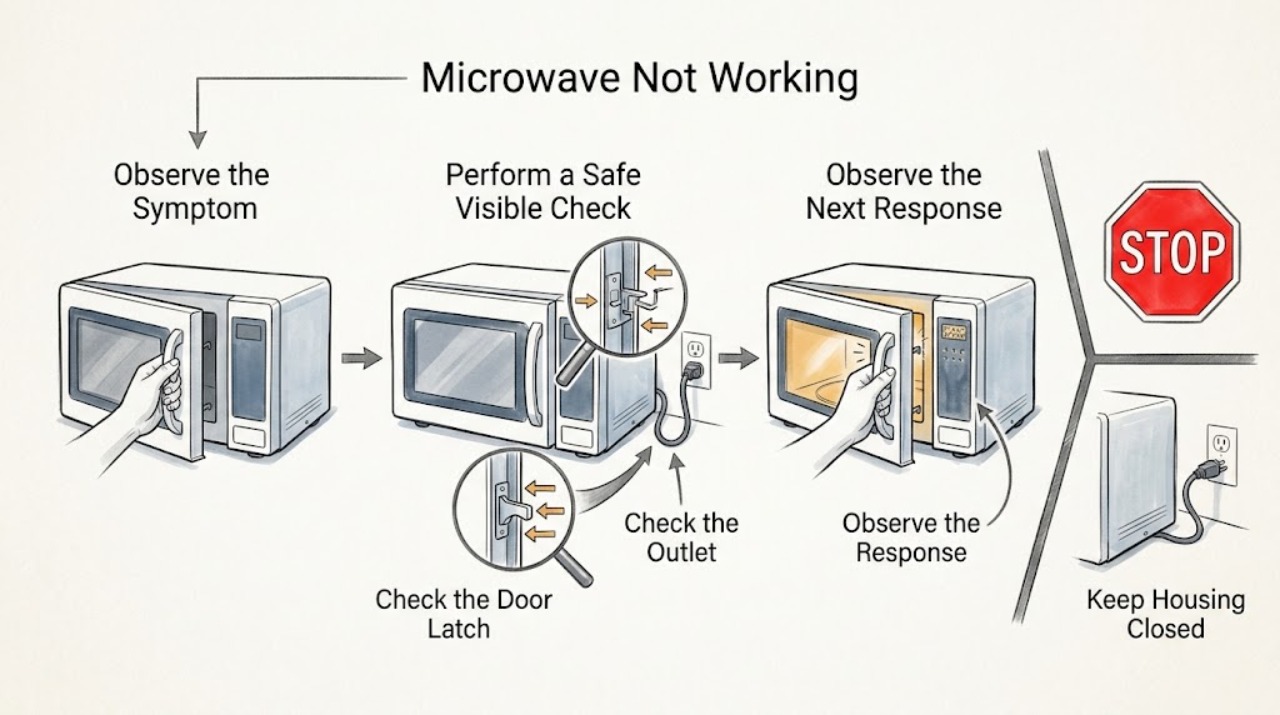
First identify what “not working” means: a dead display, controls that do not respond, a door that will not latch, a cycle that runs without heating, or an error message. Check only the visible, model-appropriate basics in the Bosch owner's manual, and never operate the microwave with the door open or defeat its safety interlocks. If the door, latch, hinge, seal, cord, or plug is damaged, or if there is sparking, smoke, burning odor, or an electrical fault, stop using the appliance and isolate power only from a safe position. Bosch directs owners of a broken microwave to its manual and Customer Support; arrange qualified Bosch service rather than opening the cabinet or testing high-voltage parts.
Before you begin
Safety first
- Do not operate a Bosch microwave with the door open or damaged, defeat or hold its safety interlocks, remove the outer cover, probe live wiring or high-voltage parts, or attempt an internal repair. Do not restart after sparking, smoke, burning odor, a damaged cord/plug, or a repeated breaker trip. Isolate power only from a safe, dry position.
Work through in order
Diagnostic checks
Use only checks that match the exact appliance or system and its official guide.
-
Check 1
Classify the symptom without trying to make the microwave run: note whether the display is completely dark, the display is on but keys do not respond, the door will not close or latch normally, the cycle starts but does not heat, or an error message appears. Record the exact Bosch model from the data plate or manual when it can be read safely.
Expected result: The symptom is clear and model information is available, or the display/controls and model identity are uncertain.
Next step: Use the exact owner's manual for the identified symptom. If the symptom cannot be classified or the appliance shows a hazard sign, leave it out of service and contact Bosch support.
Why this matters
Why: These symptoms use different troubleshooting paths, and a model-specific manual may define different controls or error meanings. An uncertain symptom does not justify borrowing a test from another Bosch model.
-
Check 2
For a dark display, make only a safe visual check of the household breaker or fuse panel and the appliance's visible power connection, provided the area is dry and there is no smoke, heat, damaged cord, or sparking. Do not pull the plug, remove an installation panel, or use another appliance to test the outlet after a fault symptom.
Expected result: The breaker is visibly tripped, the visible cord or plug is damaged, the outlet area shows heat or discoloration, or the supply appears normal but the display remains dark.
Next step: Do not repeatedly reset a breaker after the microwave fault. Keep the appliance isolated and have a qualified electrician assess a damaged or repeatedly tripping supply, with Bosch-authorized service assessing the microwave.
Why this matters
Why: A tripped breaker or damaged connection can involve the household supply; a normal-looking supply does not prove the microwave's internal power path is safe. The absence of a display cannot be diagnosed by opening the cabinet.
-
Check 3
If the display is on but the cycle will not start, inspect the closed-door interface from the outside only: the door should close normally, and the visible door, hinges, latch area, seal, and sealing surfaces should not be bent, loose, split, or obstructed. Do not hold or defeat the interlock and do not force the door.
Expected result: The door is damaged or misaligned, the latch does not engage normally, the seal or sealing surface is damaged/dirty, or the door appears normal but the microwave still will not start.
Next step: Stop using the microwave if any door or latch damage is present. If the visible door is normal but the unit still will not start, contact Bosch-authorized service rather than testing the interlock or removing the front panel.
Why this matters
Why: Bosch treats proper door closure and intact hinges, latches, seals, and sealing surfaces as important safety conditions. A normal-looking door does not prove the interlock circuit works, so the start fault is not a reason to bypass it.
-
Check 4
If the microwave appears to run but food does not heat, stop the cycle and check the exact model manual for the symptom. Do not run the oven empty, extend the cook time as a test, open the cabinet, or probe the magnetron, capacitor, transformer, or other internal parts.
Expected result: The fan/light or turntable operates but heating is absent or inconsistent, or the unit also makes an unusual sound, smells hot, sparks, or trips power.
Next step: Keep the microwave out of service and contact Bosch support or a factory-authorized servicer with the model and symptom. If there is smoke, flame, or active electrical danger, leave the area and contact emergency services.
Why this matters
Why: Visible operation does not prove the heating circuit is safe. Additional sound, odor, sparks, or a power trip increases the urgency and makes a user test inappropriate; internal microwave components require qualified service.
-
Check 5
If there was sparking, smoke, a burning odor, a hot or damaged cord/plug, or a breaker trip, stop using the microwave immediately. If materials inside ignite, keep the door closed and switch off power only when it can be done without entering smoke, heat, or water; never open the door to investigate an active fire.
Expected result: The hazard is active, power has been safely isolated, or the event stopped without visible damage.
Next step: For flame, smoke, or dangerous heat, leave the area and contact emergency services. Otherwise keep the appliance isolated and arrange Bosch-authorized service; do not reset or restart it to see whether the symptom returns.
Why this matters
Why: A stopped spark or odor does not confirm that insulation, wiring, or the heating system is undamaged. Bosch's manual gives a closed-door, power-off response for an oven fire and says damaged appliances must not be operated.
Use your observations
Decision map
Find the observation that best matches what you see, then follow the next safe action.
-
PATH 01Next step
What you see
The display is dark and the breaker, cord, plug, or outlet area shows a trip, heat, discoloration, or damage.
Do this next
Keep the microwave isolated. Use a qualified electrician for the breaker/receptacle or wiring issue and Bosch-authorized service for the microwave; do not keep resetting or open the cabinet.
Why this path and its safety boundary
Why it matters: The first pattern makes a household supply or connection fault more likely, while a normal-looking panel does not rule out an internal microwave power fault.
-
PATH 02Next step
What you see
The display works but the microwave will not start, and the door, hinges, latch, or seal do not close normally.
Do this next
Stop using the microwave and arrange qualified authorized service. Do not force the door, hold an interlock closed, or remove the door or front panel.
Why this path and its safety boundary
Why it matters: The door safety path is not trustworthy. Bosch specifically warns not to operate a damaged oven and not to defeat its safety interlocks.
-
PATH 03Next step
What you see
The display works and the door appears normal, but the cycle will not start or an error message remains.
Do this next
Follow only the exact manual's safe user instruction. If it does not resolve the issue, leave the unit off and contact Bosch support with the model and displayed message.
Why this path and its safety boundary
Why it matters: A model-specific control or interlock condition may be present, but a normal-looking door does not authorize a bypass or internal test.
-
PATH 04Next step
What you see
The microwave runs but does not heat, or it also produces sparks, smoke, burning odor, unusual noise, or a power trip.
Do this next
Keep the microwave out of service and arrange Bosch-authorized service. For flame, smoke, or dangerous heat, leave the area and contact emergency services; do not open the cabinet or restart the appliance.
Why this path and its safety boundary
Why it matters: A no-heat symptom can involve internal heating components even when the fan or display works; any spark, smoke, odor, or electrical trip raises the safety boundary and rules out a user test.
Helpful context
Understand the symptom
“Not working” is not one diagnosis. A dark display points toward the supply or control path, a working display with no start may involve the door-closing system, and a cycle that runs without heating needs a qualified assessment rather than a longer or empty run. Record the symptom and model before making any change, and use the exact Bosch manual because controls and installation differ by model.
Do not bypass a door interlock, hold the door switch closed, remove the outer cover, probe wiring, or perform a live voltage or high-voltage test. Bosch's manual warns against operating a damaged oven, identifies the door, hinges, latches, seals, and sealing surfaces as safety-critical, and says adjustment or repair belongs to qualified authorized service personnel.
When checks do not resolve it
Need a professional?
Contact emergency services for active flame, smoke, or dangerous heat. Arrange Bosch-authorized service for a door/latch/seal fault, no-heat condition, error that persists, dark display after safe supply checks, unusual noise or odor, sparking, or any suspected internal electrical fault. Use a qualified electrician when the breaker, receptacle, cord, or household wiring is implicated.
Safety scope: Do not operate a Bosch microwave with the door open or damaged, defeat or hold its safety interlocks, remove the outer cover, probe live wiring or high-voltage parts, or attempt an internal repair. Do not restart after sparking, smoke, burning odor, a damaged cord/plug, or a repeated breaker trip. Isolate power only from a safe, dry position.
Have this ready
- Provide the exact Bosch model, the visible symptom, any error message, whether the display, fan, light, or turntable operated, the state of the door and seal, when the issue began, and any spark, smoke, odor, heat, sound, or breaker behavior.
Common questions
FAQ
Why is my Bosch microwave not working?
The symptom matters: a dark display, unresponsive controls, a door that does not latch, a no-heat condition, and an error message have different paths. Identify the exact model and use its Bosch manual, but do not open the cabinet or bypass the door interlock.
Can I bypass the door switch on a Bosch microwave?
No. Bosch warns not to operate the oven with the door open or defeat its safety interlocks. A door, latch, hinge, or seal problem requires qualified authorized service.
What should I do if my Bosch microwave runs but does not heat?
Stop using it and do not run an empty or extended test cycle. A display, fan, or turntable that operates does not prove the heating circuit is safe; contact Bosch support or a factory-authorized servicer.
What if my Bosch microwave sparks or smells burnt?
Stop using it immediately. If there is flame, smoke, or dangerous heat, leave the area and contact emergency services; otherwise isolate power only from a safe position and arrange Bosch-authorized service. Do not restart it to see whether the symptom returns.
Read the exact guide
Official sources
- Use and Care ManualBosch · Bosch microwave safety interlocks, damaged-door boundary, fire response, no-empty-operation warning, and qualified-service requirement
- Microwave Troubleshooting: Microwave brokenBosch · Bosch microwave not-working support and service routing
Community feedback
Share a repair observation
Share a plain-text repair observation. Accepted observations are published automatically; this page may take a moment to update.