
On this page
Start here
Quick answer
First separate the symptom on your Candy dishwasher: no display or lights, a lit panel that will not start, no water entering, water left inside, poor washing or no heat, or a displayed code/rapid flashing pattern. For a blank machine, check only the accessible plug, wall outlet, and ON/OFF control; do not open the appliance. If the panel responds but no programme runs, close the door fully, cancel an old cycle if your model documents START/RESET, select a programme, and press the documented start control. A delay-start setting, child lock, or an open door can make a working control panel appear not to start, and these controls vary by model. For a no-water or E2 indication, verify the water tap is open, the inlet hose is not kinked, and the inlet filter is not clogged. For E3 or standing water, inspect the accessible drain hose, internal filter, and sink siphon for blockage without reaching into moving or powered parts. Poor cleaning can follow blocked spray-arm jets, an obstructed spray arm, a dirty filter plate/filter, overloaded racks, or unsuitable/incorrect detergent. Candy manuals identify E8 as a heating-element or filter-plate condition and E18 as a water-level/filter-plate condition, but the code meanings are model-dependent. E4 or visible water requires stopping the cycle and checking for a leak; E21 means close the water tap immediately and disconnect power. If the fault returns after the model-specific external checks, or involves wiring, pump, inlet valve, heater, control board, door safety, AquaStop/WaterBlock, or an internal leak, stop using the dishwasher and contact an authorized Candy service provider.
Before you begin
Safety first
- This article covers only cool, unplugged, water-isolated external checks of the plug, controls, door closure, accessible hoses, filters, siphon, spray arms, loading, and model-approved reset. A qualified provider must handle internal electrical parts, pumps, valves, heaters, sensors, safety hoses, door interlocks, control boards, and leak diagnosis.
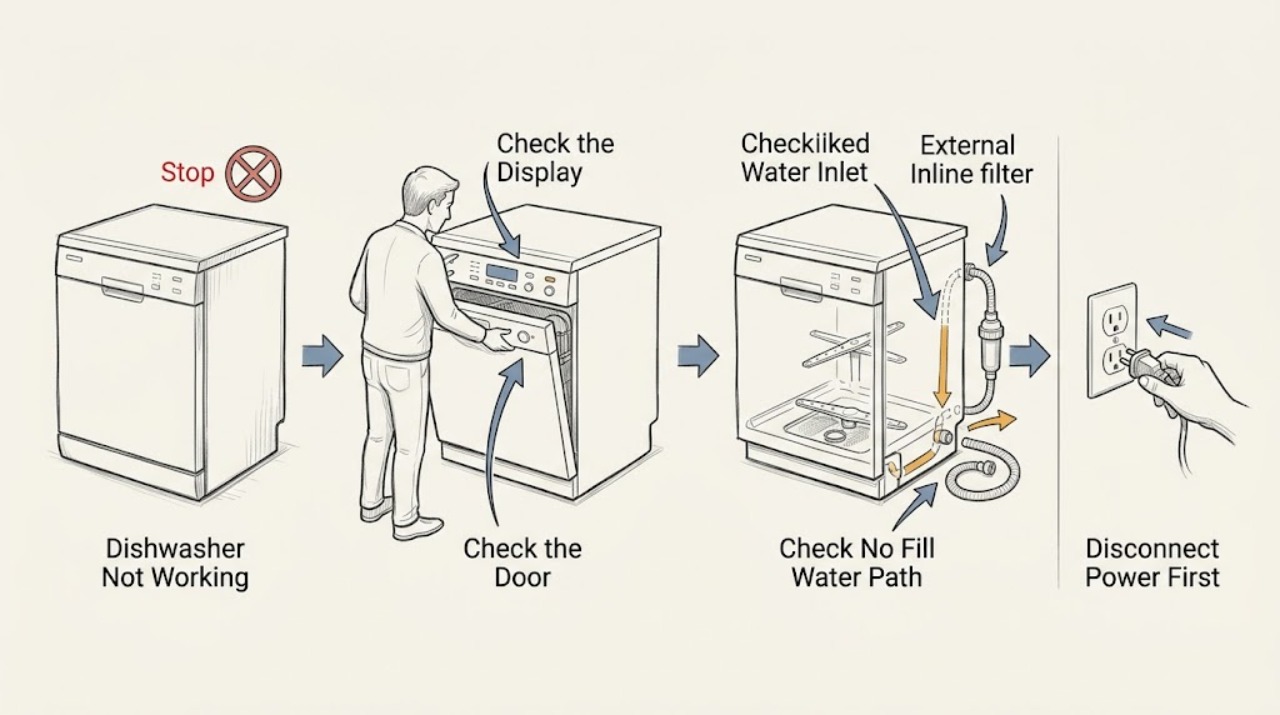
Work through in order
Diagnostic checks
Use only checks that match the exact appliance or system and its official guide.
-
Check 1
Record the complete Candy model number and observe whether the appliance is completely blank, has lights or a display but will not start, starts and stops, leaves water inside, washes poorly, fails to heat, or shows a code or repeating LED flashes.
Expected result: The panel is blank, controls respond but no programme starts, water never enters or remains, spray arms are not heard, dishes are dirty/cold, or an E-code/flash sequence appears.
Next step: Follow the matching external check below and use the exact model manual for button combinations and code meanings. Do not infer a failed part from the broad phrase ‘not working.’
Stop if: Stop before any test if there is smoke, burning odor, sparking, a damaged cord, uncontrolled water, or water near electrical parts.
Why this matters
Why: A blank panel points first to accessible power or an internal power path. A responsive panel shifts the diagnosis to door/programme/start logic, water flow, drain, spray/filtration, heating, leak protection, or a model-specific error state.
-
Check 2
For a blank or no-start symptom, check that the plug is fully in the accessible wall socket, the socket has power, the ON/OFF control is pressed, and the door closes without dishes or trim obstructing it. On a lit panel, cancel a pending cycle only with the model's documented START/RESET procedure, select a programme, and press the documented start control once.
Expected result: The plug or socket was not supplying power, the ON/OFF control was off, the door was open, a delay/old cycle was active, the machine starts after correction, or it remains blank/idle.
Next step: If power and door/start conditions are correct but the dishwasher remains blank or will not start, unplug it and arrange authorized service. If it starts, observe which later symptom appears rather than repeatedly pressing start.
Stop if: Do not remove panels, test live wiring, bridge a door switch, or keep resetting a machine that trips power or leaks.
Why this matters
Why: Candy lists the plug, ON/OFF button, open door, and no electricity as causes of no programme. A delay, child lock, or pending cycle is a model-specific control state; persistent blank or idle behavior after external checks suggests an internal electrical, control, or door-sensing fault.
-
Check 3
If the dishwasher displays NO WATER/E2 or starts without filling, switch it off, close the water tap, unplug it, and inspect the accessible inlet hose for kinks or crushing. Confirm the tap is open when the appliance is ready for a test; clean the inlet-hose filter only as the exact manual permits and without cutting or opening a safety hose.
Expected result: The tap was closed, the inlet hose was bent, the inlet filter was visibly clogged, water enters after correction, or the machine still gives NO WATER/E2.
Next step: Restore only the documented external condition and run one supervised programme. If no water enters or the code returns, close the tap, unplug the dishwasher, and contact authorized service.
Stop if: Do not cut, open, bypass, or electrically test an AquaStop/WaterBlock hose or inlet valve, and do not continue if the hose or safety housing is damaged.
Why this matters
Why: Candy maps NO WATER/E2 to a fill problem and lists the tap, hose, drain-pipe installation, and inlet filter as external checks. Persistent no-fill after those checks makes an inlet valve, flow sensor, AquaStop/WaterBlock, wiring, or control fault more likely; the code alone does not identify one part.
-
Check 4
If water remains in the tub or E3 appears, switch off, unplug, close the tap, and check the accessible drain hose for kinks, crushing, blockage, or an incorrect connection. Clean the dishwasher filter/filter plate and check the sink siphon only after the appliance is isolated and only according to the model manual.
Expected result: The filter, drain hose, or siphon was blocked; the hose was kinked or incorrectly connected; water drains after correction; or E3/standing water persists.
Next step: Restore the documented hose/filter/siphon condition and run one short supervised drain or programme if safe. If water remains or the code returns, leave the appliance off and arrange service; protect the floor from residual water.
Stop if: Do not reach into a powered sump, force a pump impeller, tilt a full dishwasher, or disconnect internal hoses to chase a blockage.
Why this matters
Why: Candy associates E3 with failure to drain and lists the drain pipe, filter, and siphon as checks. A persistent drain fault can involve the pump, wiring, control, or a hidden obstruction, so a clean filter does not justify replacing a pump by guesswork.
-
Check 5
If the programme runs but dishes are dirty, check with the appliance off and cool that the spray arms rotate freely, their visible jets and the filter plate/filter are not clogged, dishes do not block the arms or detergent dispenser, and the detergent is suitable and correctly dosed. If dishes remain cold or E8/E18 appears, record the code and clean only the accessible filter plate as directed; do not expose the heater.
Expected result: A spray arm was obstructed, jets or filters were dirty, loading/detergent was wrong, cleaning improves, dishes remain cold, or E8/E18 returns.
Next step: Correct only the external loading, detergent, spray-arm, or filter condition documented for the model and run one normal cycle. If heat is still absent or E8/E18 recurs, stop use and arrange qualified service for the heater, sensor, pump, or control circuit.
Stop if: Do not run an empty machine with exposed parts, probe the heater, bypass thermal protection, or use tools that can deform spray jets or damage the filter.
Why this matters
Why: Candy lists blocked arms, excessive detergent, loading, and dirty filtering parts as causes of poor wash results. E8 is associated with the heating element or filter plate, while E18 is associated with water level or filter plate; repeated codes can require internal diagnosis.
-
Check 6
For E4, visible water, a rapidly flashing cycle light, E21, or any other code, stop the programme and note the exact display/flash sequence. Close the water tap and disconnect power immediately for E21 or uncontrolled water; for another code, use the model manual's reset procedure once after checking only the accessible tap, hoses, siphon, and filters.
Expected result: There is a visible leak, E21/uncontrolled water, E4, a repeating code after one reset, or the dishwasher completes a cycle after an external correction.
Next step: Keep the tap closed and appliance unplugged for a leak or E21, and arrange authorized service. For another recurring code, provide the exact model, code/flash count, and what happened immediately before it appeared.
Stop if: Do not restart a leaking or uncontrolled-fill machine, mop around live connections, tilt the appliance to make a code disappear, or attempt an internal leak/electrical repair.
Why this matters
Why: Candy identifies E4 as a leak and E21 as uncontrolled water from an open solenoid valve. Other codes and flash counts are model-dependent; recurrence after the manual's one reset makes a persistent fault more likely than a temporary control state.
Use your observations
Decision map
Find the observation that best matches what you see, then follow the next safe action.
-
PATH 01Safety boundary
What you see
The dishwasher has no display/lights, or the panel responds but no programme begins after the plug, ON/OFF control, door, programme, and documented start/reset conditions are correct.
Do this next
Leave the dishwasher unplugged and arrange authorized Candy service, especially if a breaker trips or the cord/plug is damaged.
Why this path and its safety boundary
Why it matters: Accessible power or user-control causes are less likely; an internal supply, control, door-sensing, or lock fault is more likely, but the symptom does not identify a safe replacement part.
Safety stop: Do not open the console, bypass the door lock, or test energized wiring.
-
PATH 02Safety boundary
What you see
The dishwasher has NO WATER/E2, no incoming water, E3, or standing water after one cycle.
Do this next
Check only the documented external water path with power and water isolated; stop and call service when the code persists or a safety hose/hidden connection needs access.
Why this path and its safety boundary
Why it matters: A tap, hose, inlet filter, drain hose, filter, or siphon issue is plausible. If those accessible conditions are correct, a valve, flow sensor, pump, control, or safety-hose fault becomes more likely.
Safety stop: Do not open an AquaStop/WaterBlock housing, work on a powered pump, or tilt a machine containing water.
-
PATH 03Safety boundary
What you see
The cycle runs but spray action or cleaning is poor, dishes stay cold, or E8/E18 returns after the filter plate and loading checks.
Do this next
Use one model-approved cleaning/loading correction and one supervised cycle. If heat or the code does not recover, stop using the dishwasher and arrange qualified diagnosis.
Why this path and its safety boundary
Why it matters: Loading, detergent, spray-arm, filter, water-level, or heating symptoms overlap, but repeated E8/E18 or persistent cold water increases concern for an internal heater, sensor, pump, or control fault.
Safety stop: Do not test or replace the heater, sensor, or control board based only on a generic E8/E18 label.
-
PATH 04Safety boundary
What you see
There is visible water, E4, E21, or water continues entering or draining abnormally.
Do this next
Close the water tap and disconnect power if safe, do not restart, and contact authorized service with the model and code.
Why this path and its safety boundary
Why it matters: A leak, overflow protection response, hose failure, or uncontrolled inlet-valve condition is more likely than a routine programme issue.
Safety stop: Do not mop around live connections, move/tilt the appliance while full, or attempt to bypass an overflow or inlet safety device.
-
PATH 05Safety boundary
What you see
A code other than the documented water, drain, leak, heating, or water-level patterns appears, or a displayless model repeats an unfamiliar LED-flash count.
Do this next
Use the exact model manual for one reset procedure if it permits, then contact Candy technical assistance if the code returns; preserve a photo or written flash count.
Why this path and its safety boundary
Why it matters: Candy uses different display and LED signalling across models, so the code cannot safely be translated into a universal part diagnosis.
Safety stop: Do not keep restarting an unknown error or order a part from an unverified code equivalence.
Helpful context
Understand the symptom
Identify the failure before changing parts
Candy sells freestanding, fully integrated, and tabletop dishwashers with different control panels and programme options. “Not working” can mean that the appliance is electrically dead, has power but is waiting for a door/programme/start input, cannot fill or drain, washes poorly, fails to heat, or has entered a protective error state. Record the model and the exact display text or LED flash pattern before following a procedure; a code such as E2 or E3 must be interpreted against the manual for that model.
Keep electrical, hot-water, and leak checks external
Before cleaning a filter or touching a hose, switch the dishwasher off, unplug it, and close the water supply. Water can be very hot during a cycle. Do not tilt or move a running machine, open electrical covers, cut or open a WaterBlock/AquaStop hose, reach into a powered pump or spray arm, or bypass a door, overflow, or other safety device. Stop immediately for a damaged cord, smoke, burning smell, sparking, uncontrolled water, or water near electrical parts; isolate the appliance only if it is safe and arrange qualified service.
A programme that waits is different from a dead dishwasher
A lit panel does not prove that the wash motor or heater has failed. On Candy models, the door must be closed for a programme to run, and a selected delay can intentionally postpone the start. Some models also have child protection or a START/RESET control that behaves differently from a simple press. Cancel only by the procedure in the exact manual, then select a basic programme and start it once. If the panel still responds but the appliance stops with a code, diagnose the water, drain, leak, or heating symptom rather than repeatedly restarting it.
Cleaning and heating faults need separate evidence
A dishwasher that runs but leaves soil may have blocked spray-arm jets, a dirty filter plate or filter, obstructed loading, or detergent issues. A dishwasher that runs but leaves dishes cold or reports E8 is a different path: the manual links E8 to the heating element or filter plate, so clean only the accessible filter plate as instructed and do not test the heater or control wiring yourself. A clean filter cannot prove that an internal heating part is safe or functional.
Safety boundary
Stop conditions
- Stop immediately for smoke, sparking, burning odor, a damaged cord or plug, uncontrolled water, visible leaking near electrical parts, or repeated breaker trips.
- For E21 or uncontrolled filling, close the water tap and disconnect the dishwasher from power if safe; do not restart it.
- Before cleaning filters or checking hoses, switch off, unplug, and close the water supply; do not reach into a powered pump or moving spray arm.
- Do not open electrical covers, cut or open AquaStop/WaterBlock hoses, bypass door/overflow protection, tilt a full dishwasher, or test internal heater, valve, pump, or control wiring.
When checks do not resolve it
Need a professional?
Safety scope: This article covers only cool, unplugged, water-isolated external checks of the plug, controls, door closure, accessible hoses, filters, siphon, spray arms, loading, and model-approved reset. A qualified provider must handle internal electrical parts, pumps, valves, heaters, sensors, safety hoses, door interlocks, control boards, and leak diagnosis.
Common questions
FAQ
Why is my Candy dishwasher completely dead?
Check only the accessible plug, wall outlet, ON/OFF control, and visible cord, then make sure the door closes. Candy's manual lists an unplugged plug, unpressed ON/OFF button, open door, and no electricity as no-programme causes. If the panel stays blank after those checks, unplug the dishwasher and arrange authorized service rather than opening it.
Why does my Candy dishwasher have power but not start?
A fully closed door, an unselected programme, a pending cycle, delay start, or model-specific child lock can prevent a start. Use the exact manual to cancel/reset, select a programme, and press the documented start control once. If the panel responds but the dishwasher remains idle, service may be needed for the door-sensing or control circuit.
What should I check if a Candy dishwasher is not filling with water?
For NO WATER or E2, verify that the tap is open, the inlet hose is not bent or crushed, and the accessible inlet filter is not clogged, following the model manual. Do not cut or open an AquaStop/WaterBlock hose. If the dishwasher still will not fill or the code returns, close the tap and call authorized service.
Why is water staying inside my Candy dishwasher?
Candy associates E3 with a drain problem. With power and water isolated, check the accessible drain hose for kinks or blockage, clean the filter/filter plate as directed, and check the sink siphon. Persistent standing water can involve the drain pump or control and needs qualified diagnosis; do not reach into a powered sump or tilt the appliance while full.
What do E4, E8, E18, and E21 mean on a Candy dishwasher?
In the opened Candy manual, E4 indicates a water leak, E8 indicates a heating-element or filter-plate condition, E18 indicates a water-level or filter-plate condition, and E21 indicates uncontrolled water supply. These meanings are model-dependent. For E21, close the tap and disconnect power immediately if safe; for other recurring codes, follow the exact model manual once and contact authorized service if they return.
Read the exact guide
Official sources
- Technical assistance for our appliances | CandyCandy · Official Candy UK technical-assistance page; contact and warranty details are region-specific, while the support workflow is relevant to Candy appliances.
- CF 5C7F0W-80 EN (70048142.A) Instruction ManualCandy · Official Candy instruction manual linked from the Candy CF 5C7F0X-80 product page; controls, options, and code behavior are model-specific and do not automatically apply to every Candy dishwasher.
- Dishwashers: Integrated and freestanding | CandyCandy · Official Candy UK dishwasher category page; it describes the range, while operating details remain model-specific.
- CF 5C7F0X-80 | Dishwasher Candy RapidòCandy · Official Candy UK product page for one freestanding Rapidò model; it confirms a product-specific manual link and features but is not evidence that every Candy dishwasher has the same controls or options.
Community feedback
Share a repair observation
Share a plain-text repair observation. Accepted observations are published automatically; this page may take a moment to update.