
On this page
Start here
Quick answer
If a Danby freezer stops freezing and begins cooling again after you unplug and reconnect it, treat the restart as a temporary change in behavior, not proof that the fault is fixed. Protect the food first, then check the temperature setting, door or lid seal, ventilation, frost or airflow obstruction, and whether the freezer was recently moved. Danby says to verify that the unit is plugged in and turned on and that it stood upright before connection; its manuals also list warm settings, an open lid, warm food, blocked airflow, heat, and incorrect voltage as causes of a warm interior. If cooling stops again, the breaker trips, the cord or outlet is hot or damaged, or the freezer cannot hold a safe temperature, keep it out of service and arrange qualified Danby refrigeration service.
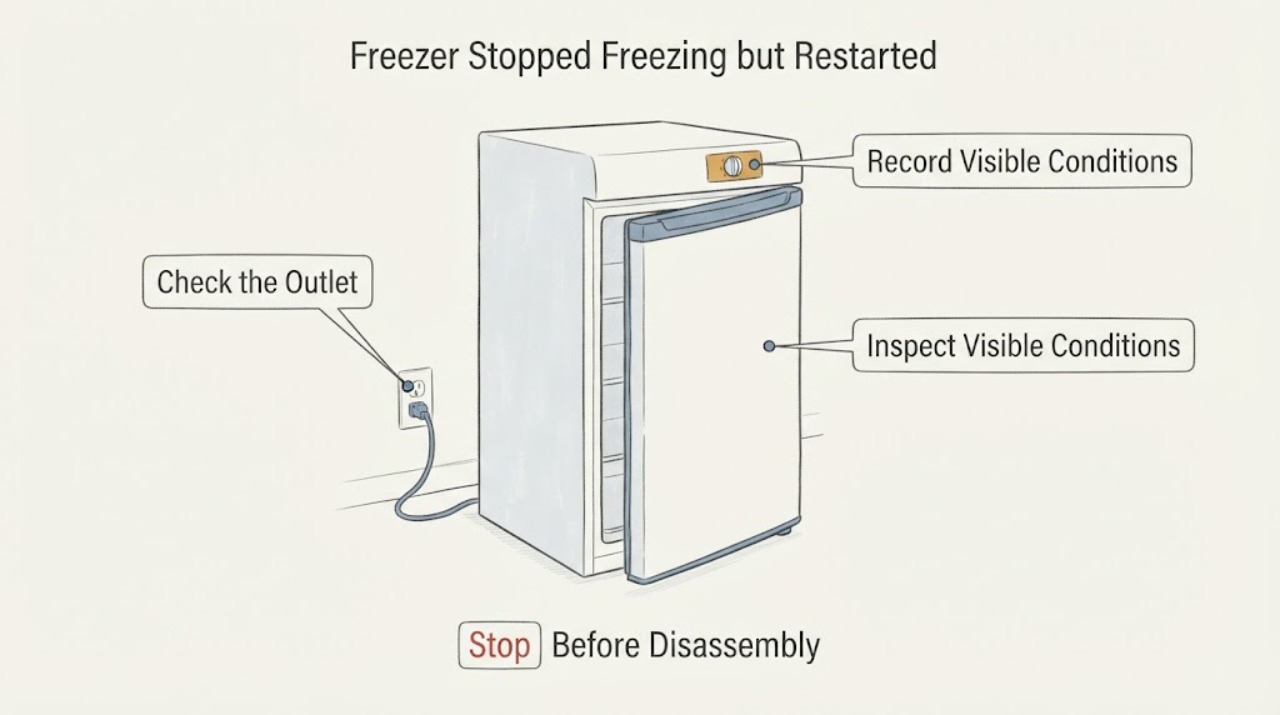
Work through in order
Diagnostic checks
Use only checks that match the exact appliance or system and its official guide.
-
Check 1
Protect the food first and record the timeline: when the freezer stopped freezing, when it was unplugged, how long it was disconnected, when cooling returned, and whether the compressor was silent, clicking, running, or running continuously. Use an independent thermometer if available and note the complete model number from the rating label.
Expected result: The freezer reaches and holds the model's target temperature, remains warmer than the target, stops cooling again, or the food has partially thawed.
Next step: Move food to a known-cold freezer when the temperature is uncertain, and keep the Danby unit under observation only long enough to record the pattern without repeatedly cycling its power. Use the exact model manual for the target and service instructions.
Stop if: Do not taste questionable food to decide whether it is safe, repeatedly restart the freezer to force cooling, or continue using it when the cord, outlet, cabinet, or food condition is unsafe.
Why this matters
Why: A temporary return of cooling does not establish stable operation. A repeated warm period or a temperature that never reaches the target needs service assessment, while partially thawed food creates a separate food-safety decision.
-
Check 2
From a dry, safe position, verify that the plug is fully inserted in the wall outlet, the accessible breaker or fuse is not open, and the freezer is turned on with its temperature control set to a freezing setting rather than OFF or an unusually warm setting. Do not use an extension cord or a damaged outlet or cord.
Expected result: The plug is loose, the outlet or breaker is abnormal, the control is OFF or too warm, or power and the control setting appear normal.
Next step: Correct only a plainly loose plug or control setting when the area is dry and safe. If the breaker trips again, an outlet is hot, or wiring is damaged, stop and arrange qualified electrical help; if power is normal but cooling fails again, arrange Danby service.
Stop if: Do not open electrical covers, test live voltage, bypass a breaker, use an extension cord, or touch a wet, hot, scorched, or damaged connection.
Why this matters
Why: A loose connection, open circuit, or warm control setting can explain a warm cabinet without proving an internal refrigeration failure. Normal power and control settings make the temporary restart pattern more significant, but they do not identify a failed component.
-
Check 3
Without moving a loaded or built-in freezer, look for blocked ventilation openings, close contact with a heat source or direct sun, an overcrowded cabinet, or a door or lid that cannot close and seal. If the freezer was recently transported on its side or back, compare the elapsed upright time with the exact Danby manual before another connection.
Expected result: Airflow is blocked, the cabinet is near heat, the door or lid seal is visibly incomplete, the freezer is overloaded, or it was recently transported and the upright interval is unknown.
Next step: Restore only safe external clearance or door or lid closure without moving the appliance. If transport history is relevant, follow the exact model manual; do not keep reconnecting it until that instruction is satisfied.
Stop if: Do not pull out a heavy or built-in freezer, bend refrigerant tubing, remove rear covers, or continue if the cabinet, cord, or floor is damaged or wet.
Why this matters
Why: Danby identifies airflow obstruction, heat, an incompletely closed door or lid, and transport position as conditions that can prevent normal cooling. A restart after an uncertain transport interval does not clear the cooling system.
-
Check 4
When the freezer is safely accessible and the model permits it, inspect the door or lid gasket, the interior airflow space, and any visible frost that blocks vents or prevents closure. Note whether a large amount of warm food was added or the door or lid was opened frequently. Do not chip ice or disassemble the cooling system.
Expected result: A gasket does not seal, frost blocks airflow or closure, warm food or frequent openings explain the recent warm period, or the interior has no visible obstruction.
Next step: Close the door or lid correctly and restore safe loading space. Follow the exact manual for a permitted defrost procedure; if the gasket is damaged or cooling remains unreliable, arrange qualified service rather than replacing a part from the symptom alone.
Stop if: Do not scrape frost with a sharp tool, puncture the liner or tubing, use an unapproved heat source, or force a damaged door or lid closed.
Why this matters
Why: Danby manuals associate warm food, frequent openings, a poorly closed lid or door, and airflow obstruction with an interior that is not cold enough. A clear cabinet with a good seal makes an intermittent power or refrigeration fault more concerning if the problem recurs.
-
Check 5
After the safe external checks, make one controlled observation using the exact model's normal operating instructions. Record whether the freezer reaches and holds its target temperature, whether the compressor starts without repeated clicking, and whether cooling stops again after the restart. Do not keep unplugging it to repeat the result.
Expected result: Cooling remains stable, cooling returns only briefly and then stops, the compressor clicks or cycles abnormally, or the freezer never reaches the target.
Next step: Keep food elsewhere when temperature is uncertain and arrange qualified Danby refrigeration service for any repeat failure. Give the technician the model, temperature record, power history, transport history, and whether the restart temporarily restored cooling.
Stop if: Stop immediately for smoke, burning odor, sparking, a hot cord or outlet, refrigerant damage, water near electricity, or a cabinet that becomes unusually hot.
Why this matters
Why: Stable cooling after correcting a setting, seal, airflow, or transport condition supports that external cause. A brief recovery, repeated stop, abnormal start sound, or failure to reach target leaves an intermittent control, start, compressor, fan, or sealed-system fault possible without identifying which part failed.
Use your observations
Decision map
Find the observation that best matches what you see, then follow the next safe action.
-
PATH 01Next step
What you see
The freezer was warm because its control was OFF or too warm, the plug was loose, the door or lid was not sealed, or airflow was visibly blocked, and it remains cold after one safe correction.
Do this next
Keep the corrected setting and loading, verify the temperature with the exact model guidance, and monitor without repeatedly unplugging the freezer. Arrange service if the temperature falls again.
Why this path and its safety boundary
Why it matters: A user-accessible power, control, sealing, or airflow condition is more likely than a confirmed internal part failure.
-
PATH 02Next step
What you see
The freezer cools again after unplugging, but it later warms up, clicks without starting, or never reaches and holds the target temperature while power and the external conditions are normal.
Do this next
Keep food in a known-cold freezer and arrange qualified Danby refrigeration service. Provide the timeline and temperature observations instead of ordering a start component or compressor from the reset behavior alone.
Why this path and its safety boundary
Why it matters: The restart has not resolved the fault. An intermittent control, compressor-start, fan, or sealed-system problem is possible, but the symptom cannot identify the component safely.
-
PATH 03Next step
What you see
The freezer was recently transported on its side or back, or the required upright rest before connection is unknown.
Do this next
Disconnect only from a dry, safe position and follow the exact Danby model manual for the required upright interval before a normal connection. Do not use repeated short restarts as a substitute for that instruction.
Why this path and its safety boundary
Why it matters: Danby warns that transport position affects when the freezer should be connected; a premature reconnection can make cooling unreliable.
-
PATH 04Next step
What you see
The breaker trips, the outlet or cord is hot or damaged, there is smoke or burning odor, refrigerant tubing is damaged, or water is near electrical parts.
Do this next
Stop using the freezer and arrange qualified electrical, appliance, or refrigeration help from a safe, dry location. Protect food elsewhere and do not restore power to reproduce the symptom.
Why this path and its safety boundary
Why it matters: Electrical, fire, shock, water, or refrigerant safety takes priority over cooling diagnosis.
-
PATH 05Next step
What you see
The freezer appears to run normally and holds the model's target temperature after the restart, with no power, seal, airflow, transport, or hazard finding.
Do this next
Keep a temperature and event log for the next cooling periods, avoid repeated power cycling, and arrange service if the freezer warms again or the target cannot be maintained.
Why this path and its safety boundary
Why it matters: The immediate symptom is not currently reproducible, but a one-time recovery does not prove that an intermittent fault is gone.
Helpful context
Understand the symptom
A restart is a clue, not a diagnosis
Unplugging can change an intermittent control, compressor-start, or overload condition, but a freezer that cools again may still stop later. The useful question is whether it now reaches and holds the model's target temperature over time. Do not repeatedly unplug and reconnect it as a substitute for diagnosis, and do not assume a compressor, relay, thermostat, or sealed-system part from this symptom alone.
Protect food while you observe
Move food to a known-cold freezer or use an independent thermometer if available. Danby's FAQ gives below 0°F/-18°C as the freezer target for food safety, while the exact model manual remains the authority for controls and temperature display. Record when cooling stopped, when it returned, and whether the freezer was warm, silent, clicking, running continuously, or showing a warning.
Keep the model boundary visible
Danby sells chest, upright, compact, and other freezer designs. A control location, defrost method, fan arrangement, or restart instruction from one model must not be copied to another. Use the complete model number from the rating label when looking up the manual or arranging service.
Only after diagnosis
Potential parts
- model-specific temperature control or thermostat
Consider only after a qualified diagnosis finds that the control is not maintaining the correct cooling request; a temporary restart does not identify it.
Confirm the complete Danby model and the exact part listing before selection. - model-specific compressor-start component
Consider only when a technician confirms an intermittent start or overload fault; clicking or recovery after unplugging is not enough to choose this part.
Do not open the compressor compartment or substitute a generic relay or overload. - model-specific fan, compressor, or sealed-system component
Consider only after service testing confirms an internal cooling-system fault and rules out power, control, seal, airflow, and transport conditions.
Sealed-system work requires qualified refrigeration service and exact model identification.
When checks do not resolve it
Need a professional?
Stop and seek qualified help for repeated loss of cooling, failure to hold the target temperature, repeated breaker trips, smoke, burning odor, a hot or damaged cord or outlet, refrigerant tubing damage, water near electricity, or any repair requiring an electrical cover, compressor compartment, refrigerant circuit, or sealed-system access.
Common questions
FAQ
Why did my Danby freezer start freezing again after I unplugged it?
A restart can temporarily change an intermittent control, compressor-start, or overload condition, but it does not prove the freezer is repaired. Check whether it reaches and holds the model's target temperature, record whether cooling stops again, and arrange service for a repeat failure.
How long should I unplug a Danby freezer before plugging it back in?
The correct interval depends on why it was disconnected and the exact model. Danby says a freezer transported on its side or back must remain upright before connection, and a Danby manual provides a model-specific interval. Follow the exact manual rather than using repeated short restarts as a general fix.
Can I keep using the freezer if it is cold again?
Only if it reaches and holds the target temperature and there are no safety symptoms, and even then a recurring restart pattern should be logged. Danby states that freezer temperature should be maintained below 0°F/-18°C for food safety; move food elsewhere when the temperature is uncertain.
Should I replace the Danby compressor or start relay?
Not from this symptom alone. A temporary recovery after unplugging does not distinguish a control, start, fan, compressor, or sealed-system problem. Have qualified service diagnose the exact model before selecting an internal part.
Read the exact guide
Official sources
- CHEST FREEZERDanby · Opened Danby-hosted owner manual for the DCF051A2WDD chest-freezer model; use the assigned freezer's exact manual for model-specific values and procedures.
- UPRIGHT FREEZERDanby · Opened Danby-hosted owner manual for the DUFM085A2BSLDD upright-freezer model; use only as general Danby guidance where the assigned model differs.
- The freezer is not cooling properly. What should I do?Danby USA · Opened Danby USA official FAQ; exact controls and transport instructions remain model-specific.
- Faqs Category: FreezersDanby USA · Opened Danby USA official freezer FAQ category; individual model manuals control where a design differs.
Community feedback
Share a repair observation
Share a plain-text repair observation. Accepted observations are published automatically; this page may take a moment to update.