
On this page
Start here
Quick answer
For the GE Monogram ZIF36NMILH, first verify that the freezer has power and the temperature control is not OFF. The linked Monogram owner’s manual says to start the control at 5, use 9 as the coldest setting, change it one number at a time, and allow 24 hours after a setting change; its freezer test is a container of ice cream in the center checked after a day. Check that packages are not holding the door open, clean the condenser only by the manual’s power-off procedure, and then reassess. If it remains warm after those checks, or if heavy frost, no cooling, repeated thawing or abnormal operation persists, protect the food and arrange qualified service. Do not infer a thermostat, fan, compressor, defrost part or refrigerant problem from temperature alone, and do not open the sealed system.
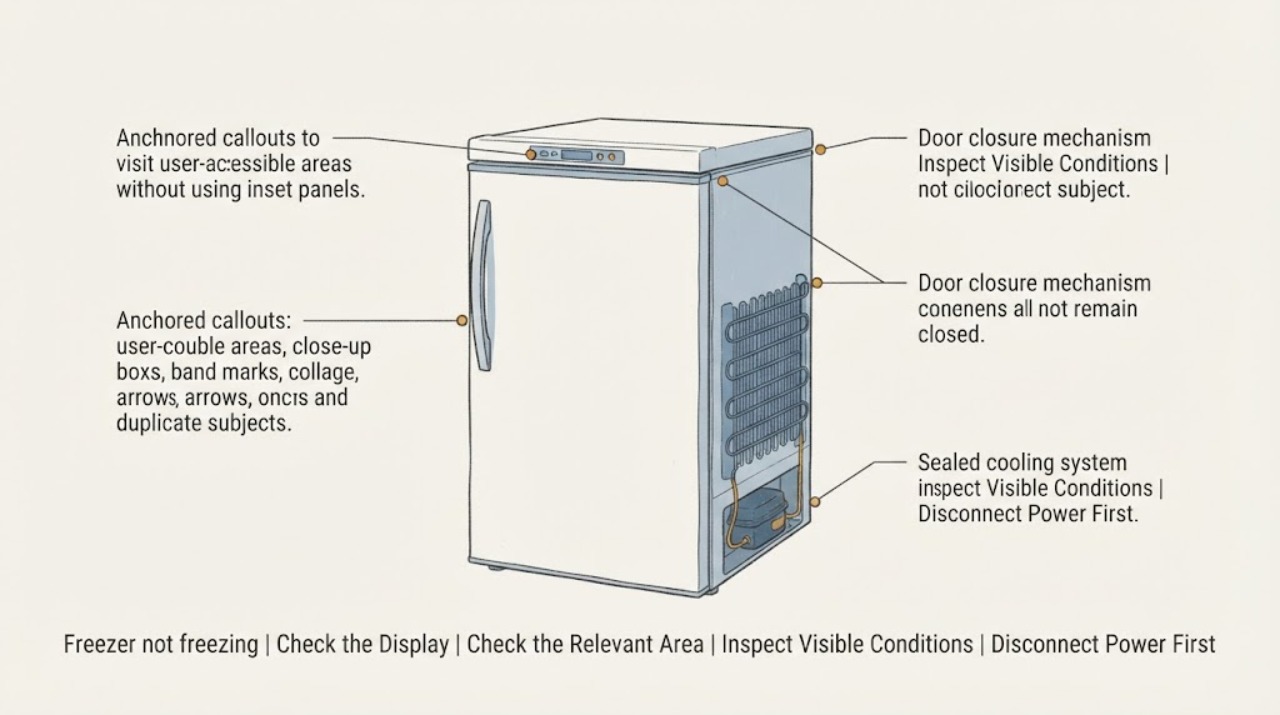
Work through in order
Diagnostic checks
Use only checks that match the exact appliance or system and its official guide.
-
Check 1
Confirm from outside the cabinet that the freezer has power, the interior light responds, and the temperature control is not set to OFF. If a breaker or fuse was interrupted, restore it only if the electrical condition is otherwise safe; do not remove electrical covers.
Expected result: The control was OFF or power was interrupted, or the freezer has power and the control was already enabled.
Next step: If power or the control was corrected, keep the door closed and continue with the manual's 24-hour cooling interval. If the unit has power but does not begin cooling, stop at the service boundary instead of repeatedly resetting it.
Why this matters
Why: The manual lists the OFF control, an unplugged unit, and a blown fuse or tripped breaker as reasons the refrigerator/freezer may not operate. Power being present does not by itself prove the compartment has recovered its temperature.
-
Check 2
Check the numbered temperature control. For a newly started or adjusted freezer, use the manual's starting setting of 5, change only one number at a time toward 9 if colder operation is needed, and place a container of ice cream in the center for the manual's one-day check.
Expected result: The setting was recently changed or the freezer is newly started, or the ice cream is still too soft after a full 24 hours at a stable setting.
Next step: Do not keep turning the control back and forth. If the one-day check remains too warm, proceed to the door and condenser checks and then arrange qualified service if the condition persists.
Why this matters
Why: The manual says 9 is coldest, 1 is warmest, and the freezer needs 24 hours after an adjustment. Soft ice cream after that interval is evidence that the freezer remains too warm, but it does not identify a failed control or other part.
-
Check 3
With the door open only briefly, inspect the door edge, gasket, shelves and packages for a package holding the door open or preventing a complete closure. Look for obvious frost or contamination at the gasket; clean the gasket only as the manual describes and do not pry or chip ice.
Expected result: A package holds the door open, the gasket cannot seat, the door is not level/closing properly, or the closure and accessible interior are clear.
Next step: Remove only the visible obstruction and allow the freezer to stabilize again. If the gasket is damaged, frost returns, or the door still cannot close, arrange service rather than forcing the door or removing interior panels.
Why this matters
Why: The manual lists an open door, a package holding the door open, frequent or long openings and a freezer that is not level as causes associated with warm operation or a door that does not close properly. A clear closure does not rule out an internal cooling fault.
-
Check 4
If the temperature remains too warm, clean the condenser exactly as the Monogram manual directs: switch power off at the breaker or fuse box, wait about 30 minutes for the condenser area to cool, lift the decorative panel up and toward you, brush the fins with a soft brush, vacuum the loosened soil, then restore power and replace the panel.
Expected result: The condenser has visible dust or lint, or it is already reasonably clear after the power-off inspection.
Next step: After restoring power, keep the door closed and allow the manual's full stabilization period. If the freezer still cannot freeze after the control, closure and condenser checks, stop DIY diagnosis and arrange qualified service.
Why this matters
Why: The manual specifically identifies a condenser that needs cleaning as a cause of long running/cycling and provides this user maintenance procedure. It is an external maintenance step, not proof of a compressor, fan, defrost or sealed-system diagnosis.
-
Check 5
Record the model ZIF36NMILH, control setting, time since the last change, observed food/ice-cream result, door and gasket condition, frost pattern, condenser condition, and any abnormal noise or lack of cooling. Keep food handling separate from the appliance diagnosis.
Expected result: The freezer returns to a stable frozen condition after the documented external checks, or it remains warm, repeatedly thaws, develops heavy frost or shows no cooling/abnormal operation.
Next step: For persistent warmth or repeated thawing, stop relying on the freezer for food storage, do not refreeze food that has thawed completely, and arrange qualified service with the model and serial information. Do not open the sealed system or perform live electrical tests.
Why this matters
Why: Recovery after a stable control setting or an external obstruction supports a setup or maintenance cause. Persistent warmth after those checks is outside the user-level causes documented in the manual and cannot be assigned to one internal part from the symptom alone.
Use your observations
Decision map
Find the observation that best matches what you see, then follow the next safe action.
-
PATH 01Next step
What you see
The control was OFF or power was interrupted, and the freezer reaches the expected frozen condition after the control is enabled and a full 24-hour stabilization period.
Do this next
Leave the control at the stable setting, keep the door closed during recovery and monitor the same center-of-freezer test. If the problem returns, record the timing and arrange service.
Why this path and its safety boundary
Why it matters: The first failure was consistent with a control or power state and transient recovery rather than a proven cooling-component failure.
-
PATH 02Next step
What you see
A package holds the door open, the gasket cannot seat, the door is not closing properly or frost prevents the closure from sealing.
Do this next
Remove only the visible obstruction and follow the manual's gasket/cleaning guidance. Arrange service for a damaged gasket, returning frost or a door that will not close; do not force the door or chip ice.
Why this path and its safety boundary
Why it matters: Warm air can enter continuously, so the immediate next decision is an external closure correction rather than a guessed thermostat or compressor.
-
PATH 03Next step
What you see
The door closes, the control has been stable for 24 hours, and the condenser has been cleaned by the manual's power-off procedure, but food remains soft or the freezer remains warm.
Do this next
Keep the freezer closed, protect food and arrange qualified GE/Monogram or appliance service. Do not remove interior panels, pierce tubing, add refrigerant, bypass a control or order a part based only on this symptom.
Why this path and its safety boundary
Why it matters: The documented user checks did not resolve the condition; the symptom does not distinguish the control, fan, defrost system, compressor or sealed refrigeration system.
-
PATH 04Next step
What you see
Food has thawed completely while the freezer is being assessed.
Do this next
Do not taste or refreeze completely thawed food. Keep the appliance out of food service until qualified service confirms stable cooling.
Why this path and its safety boundary
Why it matters: The manual warns not to refreeze frozen food that has thawed completely; food disposition is a safety decision separate from the appliance diagnosis.
Helpful context
Understand the symptom
Use the Monogram control test before naming a part
This exact model is listed by GE's parts site as a GE Monogram 36-inch built-in all freezer, and the linked manual covers built-in single-door freezers. That manual uses a numbered control rather than a numeric temperature display: 5 is the starting setting, 9 is coldest and 1 is warmest. A freezer that was recently started or adjusted needs a full 24 hours before the result is judged. A soft container of ice cream in the center after a day is the manual's practical freezer check; it does not identify an internal component.
Work through the accessible causes first
The manual's problem solver points to an OFF control, loss of power, a door left open or held by a package, frequent openings, and a dirty condenser as causes of warm or long-running operation. Those checks are useful because they change what you do next without requiring an internal diagnosis. A clear door and a clean condenser do not prove that the sealed cooling system is healthy; they only remove the external causes that the manual gives the user to check.
Keep condenser cleaning separate from sealed-system repair
The manual permits condenser cleaning after power is turned off at the breaker or fuse box and the condenser area has cooled for about 30 minutes. It describes lifting off the decorative panel, brushing the fins and vacuuming the loosened soil, then restoring power and replacing the panel. That user procedure does not authorize removing interior covers, testing live circuits, opening refrigerant tubing or replacing a thermostat, fan, compressor or defrost component. Persistent warmth after the documented checks belongs with qualified appliance service.
When checks do not resolve it
Need a professional?
Stop relying on the freezer for food storage and arrange service for persistent warmth after the full stabilization period and external checks, repeated thawing, heavy returning frost, a damaged or non-closing door, no cooling, or any condition requiring internal or sealed-system access.
Common questions
FAQ
What setting should I use on the GE Monogram ZIF36NMILH freezer?
The linked Monogram owner manual says to start at 5; 9 is the coldest setting and 1 is the warmest. Change one number at a time and allow 24 hours before judging the result. Use the manual's center-of-freezer ice-cream test rather than repeatedly changing the control.
How long should I wait after changing the freezer control?
Allow 24 hours. The manual says the refrigerator/freezer needs that long to reach the selected temperature, and it recommends checking a container of ice cream in the center of the freezer after a day.
Can I clean the condenser myself?
The manual includes a user condenser procedure: turn power off at the breaker or fuse box, wait about 30 minutes for the area to cool, remove the decorative panel as directed, brush and vacuum the fins, then restore power and replace the panel. Do not extend that procedure to interior covers or sealed-system work.
Does a warm freezer prove the thermostat or compressor is bad?
No. The manual's external causes include the control state, power, door/package obstruction and condenser cleanliness, and persistent warmth after those checks does not identify one internal part. Give the technician the model, setting, timing and observations instead of ordering a guessed component.
Read the exact guide
Official sources
- Model Search | ZIF36NMILHGE Appliances · Opened the GE Appliances parts/model page. It identifies the exact assigned model as a GE Monogram 36-inch built-in all freezer and links its Product Specifications, Owner's Manual and Installation Instructions.
- Owner's Manual: Built-In 36″ Single Door Refrigerators and 36″ Single Door Freezers (49-60421)GE Appliances / Monogram · Opened the exact PDF linked by the GE Appliances model page and verified the Monogram refrigerator/freezer cover and the freezer-specific sections. Used only its control, 24-hour stabilization, problem-solver, condenser-cleaning, safety and service-boundary instructions; it does not support a definitive internal component diagnosis.
Community feedback
Share a repair observation
Share a plain-text repair observation. Accepted observations are published automatically; this page may take a moment to update.