
On this page
Start here
Quick answer
A GE freezer compressor may run much of the time by design, so a long run is not the same as a short-cycle fault. First record whether the compressor starts and stops every few minutes, or runs for long periods while the food remains at the expected temperature. Check the exact freezer type and temperature setting, measure food temperature between frozen packages rather than relying only on cabinet air, and look for a warm load, frequent door openings, a dirty or damaged gasket, blocked interior vents, restricted condenser airflow, or an extremely warm room. A lightly loaded freezer or a colder setting can also increase run time. If the freezer is not staying cold, the compressor rapidly clicks on and off, a breaker trips, the cord or outlet is hot, frost blocks airflow, or the issue persists after the accessible checks, keep food safe and arrange qualified appliance service. Do not open the sealed refrigeration system, add refrigerant, test live terminals, or replace a compressor based on cycling alone.
Before you begin
Safety first
- This article supports timing the symptom, checking food temperature, reading settings, inspecting the load, door seal, visible vents, clearances, and obvious power hazards from outside. Do not open panels or sealed tubing, reach into fans, perform live electrical work, add refrigerant, or replace a compressor or start device as a user test.
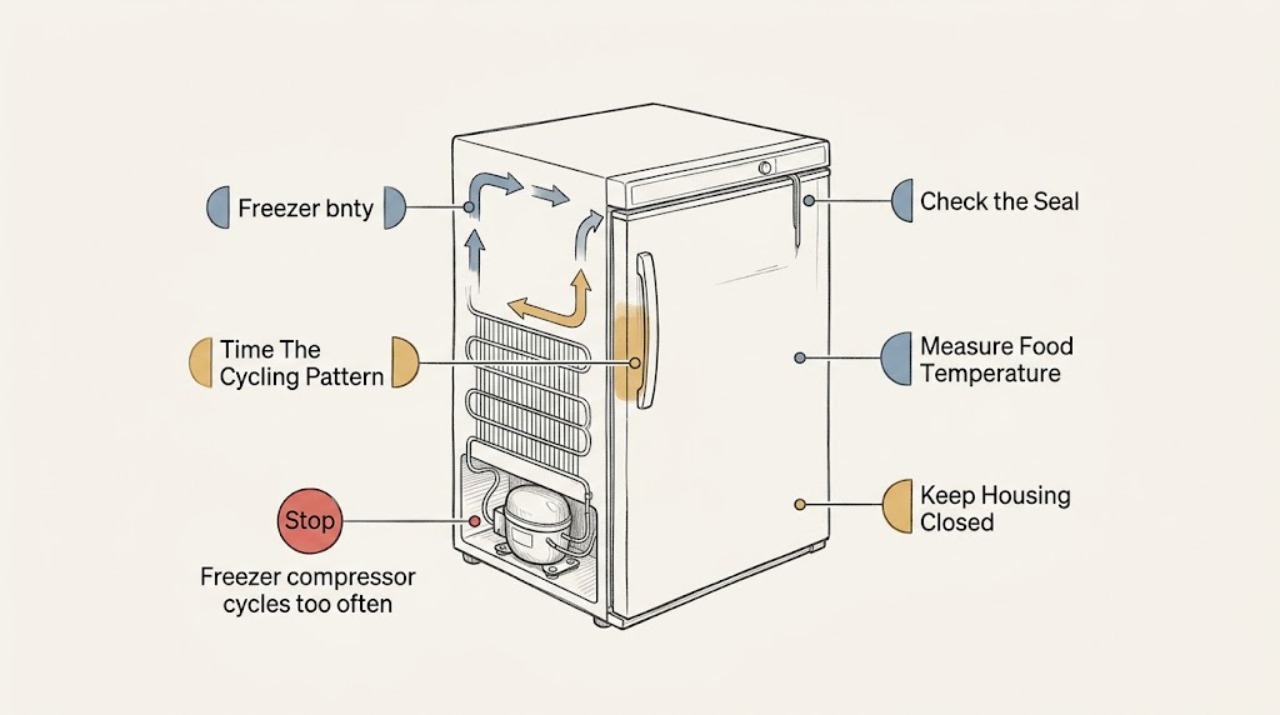
Work through in order
Diagnostic checks
Use only checks that match the exact appliance or system and its official guide.
-
Check 1
With the freezer closed and undisturbed, listen and observe for one normal observation period: note when the compressor starts, how long it runs, how long it stays off, whether the interior fan or condenser fan runs, and whether the pattern changes after a door opening.
Expected result: The compressor runs for long stretches with stable frozen food, or it starts and stops within a few minutes repeatedly; note clicks, a failed restart, fan noise, vibration, or a warming cabinet.
Next step: Continue with temperature and installation checks only when the unit is stable and there is no electrical hazard. If rapid cycling is paired with warming food, repeated clicking, smoke, a hot connection, or a trip, keep the freezer out of service and arrange qualified diagnosis.
Stop if: Do not keep forcing starts, cycle power repeatedly, or touch a hot cord, outlet, compressor area, or exposed wiring.
Why this matters
Why: Long running can be normal for a freezer and may approach continuous operation after a warm load or in high ambient heat. Rapid repeated starts with poor cooling or a failed restart are more consistent with a power, control, fan, overload, or refrigeration fault than normal temperature maintenance.
-
Check 2
Using a suitable appliance thermometer without leaving the door open longer than necessary, measure between frozen packages or in ice cream, then record the freezer type and the actual control setting shown in the GE model instructions.
Expected result: Food remains at the model's expected frozen temperature while the compressor runs often, or food is soft or warming and the measured temperature is outside the expected range; note whether a high-temperature alarm is active.
Next step: If food is warming, protect perishable food and arrange service rather than turning the control colder repeatedly. If temperature is stable, compare the observed run pattern with the exact model's normal-cycle guidance before escalating.
Stop if: Do not leave the door open to watch the compressor, place a thermometer where it blocks airflow, or alter the control beyond the model's documented range as a test.
Why this matters
Why: A cold, stable load with frequent compressor operation can be normal. Warming food or an alarm means the compressor is not merely cycling too often; cooling performance, airflow, door sealing, control, or refrigeration service must be considered.
-
Check 3
Inspect the load and door from outside: note whether a large amount of warm or unfrozen food was recently added, the freezer is nearly empty, the door is opened often, a package holds the door open, or the gasket is dirty, split, loose, or not contacting evenly.
Expected result: A recent warm load, very light load, frequent openings, an obstruction, or a damaged or dirty gasket is present; alternatively, the load is settled, the door closes evenly, and the gasket looks intact.
Next step: Remove only loose door obstructions, clean the accessible gasket as the model instructions allow, and let a settled load recover without repeated door openings. If the gasket is damaged, the door will not close, or the freezer remains warm, arrange service.
Stop if: Do not bend, glue, heat, or replace the gasket by guesswork, and do not keep the door open while the compressor is cycling.
Why this matters
Why: Warm food and lost cold air create a normal demand for longer compressor operation. A poor gasket or door obstruction lets heat and moisture back in, while a sound settled load makes those explanations less likely.
-
Check 4
With the freezer unplugged only if the plug is cool and undamaged, inspect ordinary-access interior air vents, the exterior clearance, and any condenser grille or coil location identified by the GE manual. Remove loose packaging, dust, or items blocking airflow without removing panels or reaching into fans.
Expected result: Food or ice blocks an interior vent, the exterior has inadequate clearance, a visible grille or applicable coil is heavily dusty, or the visible airflow path is clear.
Next step: Restore only the clearances and accessible cleaning steps specified by the model manual. If heavy frost, a blocked internal passage, or persistent cycling remains after the safe external correction, arrange qualified service rather than chipping or disassembling.
Stop if: Do not chip bonded ice, remove covers, reach through a grille, vacuum energized parts, or operate with a fan guard or panel removed.
Why this matters
Why: Blocked freezer vents can disrupt cold-air circulation, and restricted condenser airflow or a dirty applicable coil can increase compressor workload. A clear visible path does not rule out an internal fan, defrost, control, or sealed-system problem.
-
Check 5
Record the room conditions, installation date, control setting, and recent events such as a power interruption, a move, a defrost, or a large grocery load. Compare the setting and any Turbo Freeze or similar feature with the GE manual without selecting a colder setting simply to mask the symptom.
Expected result: The room is unusually hot, the freezer is newly installed or recovering from a move or warm load, a rapid-freeze feature is active, or no environmental event explains the frequent operation.
Next step: Allow recovery according to the model instructions while minimizing door openings and then recheck food temperature. If frequent starts persist after recovery or the freezer cannot reach temperature, arrange qualified service.
Stop if: Do not move a loaded freezer, cover ventilation openings, or leave a temperature-control change in place when it causes food to freeze improperly or the appliance to cycle abnormally.
Why this matters
Why: GE identifies hot rooms, initial cooling, warm food, and control settings as reasons for increased run time; some models also deliberately run more during a rapid-freeze feature. An unexplained pattern after conditions normalize needs more than a setting change.
-
Check 6
From outside the appliance, inspect the power cord and outlet for looseness, discoloration, heat, or damage and note whether a breaker trips when the compressor starts. Identify the freezer's rating-plate information and whether the installation follows the GE manual's circuit requirements; do not measure live power.
Expected result: The connection is cool and intact with no trips, or there is a hot or damaged connection, repeated breaker activity, a click-and-fail start, or a rapid restart pattern while the freezer is warming.
Next step: For any electrical warning or failed start, stop using the freezer and arrange qualified appliance or electrical diagnosis. Otherwise give the technician the timing, measured food temperature, settings, load, gasket, airflow, and power observations if the issue persists.
Stop if: Do not use an extension cord or improvised adapter, reset a breaker repeatedly, open the electrical compartment, or test live terminals.
Why this matters
Why: GE notes that freezers draw extra current at startup and recommends the specified dedicated circuit for upright and chest freezers. Hot connections, repeated trips, or click-and-fail starts are power or appliance fault clues, not a normal run-time variation.
Use your observations
Decision map
Find the observation that best matches what you see, then follow the next safe action.
-
PATH 01Safety boundary
What you see
The compressor runs much of the time, food stays properly frozen, the door seals, there is no unusual heat or noise, and the pattern follows a warm load, frequent opening, or a hot room.
Do this next
Minimize door openings, let the load settle, keep vents and required clearances open, and monitor food temperature using the model's guidance. Request service if cooling worsens or the pattern remains abnormal after conditions normalize.
Why this path and its safety boundary
Why it matters: This is more consistent with normal heat removal than a compressor cycling fault; GE says freezer compressors are designed to run about 80% to 90% of the time and may approach continuous operation under heavy demand.
Safety stop: Do not dismiss a hot connection, repeated trip, warming food, or rapid clicking as normal long operation.
-
PATH 02Safety boundary
What you see
The freezer is lightly loaded, set colder than needed, recently received warm food, has frequent door openings, or has a gasket or door-obstruction finding while food remains cold.
Do this next
Correct the accessible door or loading issue according to the manual and recheck the food temperature after recovery. Escalate if the gasket cannot seal, the freezer cannot reach temperature, or cycling remains rapid after the demand source is gone.
Why this path and its safety boundary
Why it matters: The compressor is responding to additional heat load or cold-air loss, making a demand-related run pattern more likely than a failed compressor.
Safety stop: Do not force the door, deform the gasket, block vents, or keep changing the control to compensate for a damaged seal.
-
PATH 03Safety boundary
What you see
Food is warming or the alarm is active, frost or a blocked vent is visible, the exterior clearance is restricted, or an applicable condenser grille or coil is heavily dirty.
Do this next
Follow only the model's safe external cleaning or defrost instructions and do not chip ice or remove panels. If the temperature does not recover or the restriction returns, arrange qualified appliance service.
Why this path and its safety boundary
Why it matters: Airflow or heat rejection is impaired, so the compressor may run more while the freezer still fails to reach temperature; a defrost or fan fault is also possible when ice returns.
Safety stop: Do not operate with vents blocked, reach into fans, chip bonded ice, or dismantle the freezer to access a hidden coil or defrost system.
-
PATH 04Safety boundary
What you see
The compressor starts and stops every few minutes, food is warming, a click precedes failed starts, or the compressor repeatedly restarts without a stable cooling interval.
Do this next
Keep the freezer out of service, protect the food, and arrange qualified diagnosis. Give the technician the cycle timing, temperature, sound, power, and recent-event record; do not order a compressor or start device on the symptom alone.
Why this path and its safety boundary
Why it matters: The pattern is not explained by the normal 80% to 90% run-time guidance and may involve start/overload protection, a control, fan, compressor, or sealed-system fault.
Safety stop: Do not force repeated starts, cycle power repeatedly, open the compressor compartment, or work on sealed refrigeration tubing.
-
PATH 05Safety boundary
What you see
The cord or outlet is hot or damaged, a breaker trips, there is a burnt smell or visible discoloration, or the freezer's circuit is overloaded or not installed as required.
Do this next
Stop using the freezer and seek qualified electrical or appliance service; use the rating plate and GE installation guidance for the handoff rather than changing the circuit yourself.
Why this path and its safety boundary
Why it matters: An electrical supply or connection problem can cause failed or repeated compressor starts and presents a separate shock or fire risk.
Safety stop: Do not touch hot or damaged connections, reset the breaker repeatedly, use an improvised adapter, or open an energized compartment.
Helpful context
Understand the symptom
Separate normal long running from true short cycling
A freezer needs to remove heat after a door opening or a warm load, and GE says many freezer compressors run roughly 80% to 90% of the time. The more concerning pattern is a start, stop, and restart every few minutes while the freezer is not at temperature, especially when accompanied by a click, hum that stops, a warm cabinet, a trip, or an alarm. Count the pattern and check the food temperature before calling it a compressor failure.
Use food temperature and the freezer's type as the evidence
GE's guidance for upright and chest freezers notes that the control affects compressor run time and is not always a direct temperature scale. It recommends checking temperature between frozen packages or in ice cream because cabinet air changes quickly when the door opens. The model manual controls the correct setting, alarm behavior, clearance, and any condenser-cleaning procedure.
Do not turn a cycling symptom into sealed-system work
A compressor's start device, overload protection, control, fan, condenser, evaporator airflow, and sealed refrigeration system can produce similar symptoms. User checks should stop at temperature, loading, door closure, visible vents, accessible coils or clearances, and obvious power hazards. Refrigerant gauges, opening tubing, electrical measurements, and compressor replacement require qualified service.
Safety boundary
Stop conditions
- Stop using the freezer for a hot, loose, damaged, or discolored cord or outlet, a burnt smell, smoke, sparking, exposed wiring, or a breaker that trips again.
- Protect the food and arrange service when the compressor rapidly starts and stops while food warms, repeatedly clicks without starting, or cannot maintain the model's expected temperature.
- Do not open the sealed refrigeration system, add or release refrigerant, test live terminals, open the compressor compartment, or replace a compressor or start device based on cycling alone.
- Do not chip bonded ice, reach into fans, remove panels, block vents, or run the freezer with a guard or cover removed as a troubleshooting test.
- Do not dismiss repeated short cycling as normal 80% to 90% run time when the food is warming, the cabinet is unusually hot, or the pattern persists after load, door, control, and airflow conditions normalize.
Only after diagnosis
Potential parts
- freezer door gasket
Consider this category only if the exact GE model's gasket is split, loose, or unable to contact evenly after accessible cleaning and door-obstruction checks.
Confirm the exact GE model and manufacturer's fit information; do not compensate for a mismatched gasket by bending, heating, or forcing the door. - freezer temperature control or sensor
Consider this category only after measured food temperature and a qualified diagnosis show that control or sensing behavior is inconsistent with the selected setting and airflow is adequate.
Confirm the exact GE model, sensor/control design, and manufacturer's fit information; do not replace a control based on compressor sound alone. - freezer condenser or evaporator fan
Consider this category only when qualified diagnosis confirms missing airflow, abnormal fan noise, or a fan fault after visible vents and clearances are addressed.
Confirm the exact GE freezer model and fan location before ordering; do not reach into a fan or operate without guards. - freezer start or overload component
Consider this category only after qualified testing confirms repeated click-and-fail starts or overload behavior and the power supply is correct.
Confirm the exact GE model and electrical specifications; start and overload components are not interchangeable by appearance or compressor cycling symptom.
When checks do not resolve it
Need a professional?
Arrange qualified GE appliance service when rapid compressor starts and stops persist, food is warming, the freezer cannot reach its expected temperature, an alarm remains active, frost or airflow problems return, the door or gasket cannot seal, or a compressor, fan, control, start, overload, or sealed-system fault is suspected. Use qualified electrical help for a hot or damaged connection, repeated breaker trip, or circuit concern.
Safety scope: This article supports timing the symptom, checking food temperature, reading settings, inspecting the load, door seal, visible vents, clearances, and obvious power hazards from outside. Do not open panels or sealed tubing, reach into fans, perform live electrical work, add refrigerant, or replace a compressor or start device as a user test.
Common questions
FAQ
Is it normal for a GE freezer compressor to run most of the time?
Often, yes. GE says freezer compressors are designed to run about 80% to 90% of the time, and operation can approach 100% after warm food is loaded or when the room is very hot. Check food temperature and cooling performance rather than judging the compressor by sound alone.
What is the difference between long run time and short cycling?
Long run time means the compressor stays on for extended periods while the freezer removes heat; it can be normal if food stays cold. Short cycling is repeated starting and stopping over brief intervals, especially with clicks, failed starts, warming food, or an alarm, and needs service-oriented diagnosis.
Could an empty GE freezer make the compressor run more?
Yes. GE lists an empty or lightly loaded freezer as a factor that increases run time, and also identifies warm food, frequent door openings, damaged or dirty gaskets, blocked vents, and applicable dirty condenser coils. Correct only accessible loading, door, and airflow issues and recheck food temperature.
What temperature should I use to judge a GE freezer?
Use the exact model instructions, because the control may change compressor run time without representing a direct temperature value. GE recommends measuring between frozen packages or in ice cream rather than relying only on cabinet air, which changes quickly when the door opens.
When does frequent compressor cycling require service?
Arrange service when rapid starts and stops persist, food is warming, a high-temperature alarm remains active, the compressor clicks and fails to start, the cord or outlet is hot, a breaker trips, frost blocks airflow, or accessible load, gasket, control, and vent checks do not explain the pattern. Do not open the sealed system or replace a compressor based on cycling alone.
Read the exact guide
Official sources
- Refrigerator or Freezer - Normal Run TimeGE Appliances · GE household refrigerator and freezer guidance; exact model instructions control the appliance's settings and service procedure.
- Refrigerator and Freezer Troubleshooting and SupportGE Appliances · GE refrigerator and freezer support overview; model-specific documentation and qualified service determine the repair.
- Upright & Chest Freezer - Running AmpsGE Appliances · GE upright and chest freezer electrical guidance; exact rating-plate information and installation instructions control the appliance.
- Upright & Chest Freezer - Run TimeGE Appliances · GE upright and chest freezer guidance; the exact model and ambient installation conditions control interpretation.
- Upright & Chest Freezer - Temperature ControlGE Appliances · GE upright and chest freezer guidance; use the exact model manual for control positions and alarm operation.
Community feedback
Share a repair observation
Share a plain-text repair observation. Accepted observations are published automatically; this page may take a moment to update.