
On this page
Start here
Quick answer
Treat this as a Frigidaire freezer temperature problem until the actual model and temperature are confirmed. Check power and the control setting, keep the door or lid closed, clear blocked vents and excess frost, and verify that the freezer is in a suitable location. Frigidaire says a freezer may need up to 24 hours to stabilize after installation, a power interruption, or a setting change; if it still is not cold after that period, arrange service. The official guidance does not support opening the sealed system, testing live parts, adding refrigerant, or naming a compressor or thermostat from the symptom alone.
Before you begin
Safety first
- Do not use an extension cord, bypass a breaker/GFCI, open the cabinet, perform live electrical tests, puncture tubing, add refrigerant, or order a compressor, relay, thermostat, fan, or control part without exact model-specific service evidence.
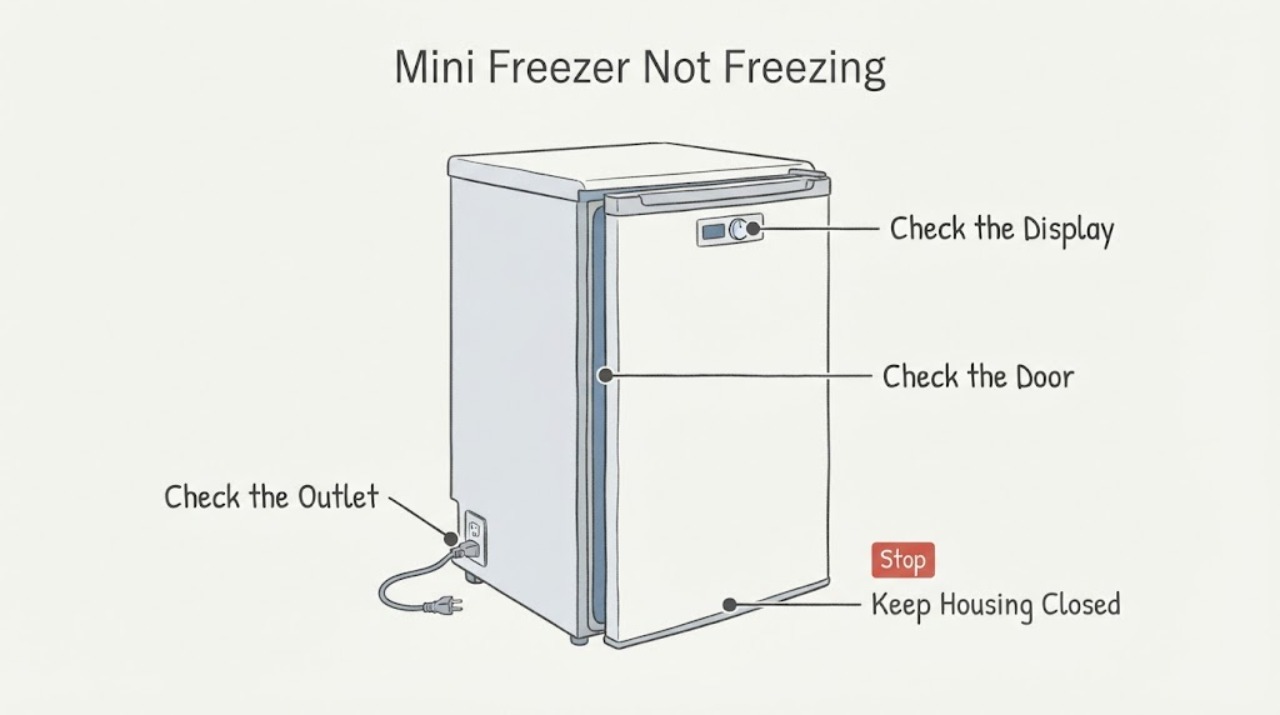
Work through in order
Diagnostic checks
Use only checks that match the exact appliance or system and its official guide.
-
Check 1
Check the plug, wall outlet, breaker or GFCI, and any visible interior or control light without using an extension cord. Confirm that the freezer's control is not set to OFF.
Expected result: The freezer has no lights or sound, the outlet or GFCI is tripped, the cord is loose, or the control is OFF; alternatively it has power and the control is ON.
Next step: Restore only the household power connection you can safely access. If the breaker/GFCI trips again, the cord or outlet is damaged, or the freezer remains dead, stop and arrange qualified electrical or appliance service; do not bypass protection.
Why this matters
Why: A tripped circuit, loose plug, power interruption, or OFF control can stop cooling without proving a freezer component has failed. Frigidaire specifically says not to use an extension cord.
-
Check 2
If the freezer was newly installed, recently unplugged, affected by an outage, or had its setting changed, close the door or lid and allow the unit up to 24 hours to stabilize. Avoid repeated opening during this period.
Expected result: The freezer reaches its expected cold condition after the stabilization period, or it remains warm after running continuously for 24 hours.
Next step: If it remains warm, protect the food and continue with the external checks once; then schedule service if cooling does not return.
Why this matters
Why: Frigidaire says temperature may need 24 hours to stabilize after installation, power interruption, or a setting change. Remaining warm after that period is a service condition, not proof of a particular part failure.
-
Check 3
Verify the temperature control against the exact freezer manual once the model is known. Do not assume a number or dial direction from another Frigidaire family; make only the small, documented adjustment and allow stabilization time.
Expected result: The control was OFF or warmer than intended, or the documented setting was already appropriate and the freezer is still warm.
Next step: Record the model and setting. If the correct documented setting does not restore cooling after stabilization, stop changing controls and request service rather than guessing at a thermostat or board.
Why this matters
Why: A setting can affect temperature, but the task does not provide a model or control style. Frigidaire's generic page gives a suggested freezer temperature for applicable models while directing owners to the manual for model-specific operation.
-
Check 4
Inspect the closed door or lid, gasket contact, visible frost, and interior airflow without removing panels. Make sure food is not blocking vents and that the unit is not overloaded; clean a dirty gasket with the method in the applicable manual.
Expected result: The door or lid does not seal, frost is excessive, vents are blocked, or the cabinet is tightly packed; alternatively the seal, frost and airflow appear normal.
Next step: Correct only the visible loading, closure, or gasket condition supported by the manual and allow the freezer to stabilize. If frost returns heavily, the seal will not close, or it remains warm, arrange service.
Why this matters
Why: Frigidaire says a poor seal can destabilize temperature, excessive frost can reduce airflow or prevent closure, and stored items can block air circulation. These observations do not identify a sealed-system or compressor fault.
-
Check 5
Check the surrounding location and operating sounds from outside the cabinet. Keep the freezer away from a location that falls below 55°F, note whether it hums or fans, and record any unusual silence, repeated clicking, or alarm without opening the sealed system.
Expected result: The location is below the official minimum, the unit is attempting to cool but remains warm after 24 hours, or it is silent/dead despite verified power.
Next step: Correct the location only if it can be done safely and the manual permits it. Otherwise preserve the model/serial information and arrange Frigidaire service; do not test live components or add refrigerant.
Why this matters
Why: Frigidaire identifies unsuitable ambient temperature and persistent warm operation as reasons to escalate. Hum, fan and refrigerant sounds show an attempt to cool but do not diagnose a compressor, fan, relay, or refrigerant fault.
Use your observations
Decision map
Find the observation that best matches what you see, then follow the next safe action.
-
PATH 01Next step
What you see
The freezer has no light or sound, the control is OFF, or the outlet/breaker/GFCI is not supplying power.
Do this next
Restore a safe power connection or correct the documented control position. If protection trips again or the unit remains dead, stop and arrange service without bypassing the circuit protection.
Why this path and its safety boundary
Why it matters: The immediate problem is an external power or control state issue; an internal cooling diagnosis is not yet justified.
-
PATH 02Next step
What you see
The freezer was recently installed, unplugged, or affected by an outage, and it has not yet had 24 hours with the door or lid mostly closed.
Do this next
Keep the door or lid closed and allow the documented stabilization period while protecting food that needs a safe temperature. Escalate if it remains warm afterward.
Why this path and its safety boundary
Why it matters: Frigidaire's stabilization period has not elapsed, so the present temperature does not establish a failure.
-
PATH 03Next step
What you see
The door/lid seal leaks, frost blocks airflow, food blocks vents, or the unit is in an unsuitable cold location.
Do this next
Correct the visible condition according to the exact manual and allow stabilization. If the symptom persists or frost quickly returns, arrange service.
Why this path and its safety boundary
Why it matters: A visible sealing, airflow, loading, frost, or ambient-condition issue can prevent stable freezing, but it does not prove an internal part fault.
-
PATH 04Next step
What you see
Power, setting, stabilization time, seal, frost, airflow and location are acceptable, but the freezer still does not freeze.
Do this next
Keep food in safe cold storage, record the model/serial and observed temperature or sounds, and schedule Frigidaire service. Do not open the sealed system, test energized wiring, bypass controls, or add refrigerant.
Why this path and its safety boundary
Why it matters: The generic external checks are exhausted. The remaining cause could be inside the cabinet or sealed cooling system, but the official sources do not support naming it from this symptom.
Helpful context
Understand the symptom
Confirm what “not freezing” means
Check whether the complaint is a measured warm temperature, soft food, a freezer that is not running at all, or a unit that has just been plugged in. The task does not include a model or a temperature reading, so the steps below stay within Frigidaire's generic freezer guidance and do not assume an upright and chest freezer have the same controls or label location.
Keep the checks external
Power, control position, door or lid closure, gasket condition, visible frost, location, and blocked airflow can be checked without opening the cabinet. A hum, fan sound, or refrigerant gurgle only shows that the unit is attempting to cool; it does not identify which internal component is working or failed.
Protect food and stop before sealed-system work
Keep the door or lid closed while the freezer stabilizes and move food to a safe cold-storage location if it is warming. Do not remove panels, bypass a control, test energized wiring, puncture tubing, or add refrigerant. If the external checks do not restore cooling, use the model number to obtain the correct manual and arrange Frigidaire service.
When checks do not resolve it
Need a professional?
Arrange Frigidaire service if the freezer remains warm after 24 hours of verified operation, if the outlet or protection trips again, if the seal cannot close, frost repeatedly blocks airflow, or the unit has power but does not cool.
Safety scope: Do not use an extension cord, bypass a breaker/GFCI, open the cabinet, perform live electrical tests, puncture tubing, add refrigerant, or order a compressor, relay, thermostat, fan, or control part without exact model-specific service evidence.
Have this ready
- Provide the freezer type, full model and serial label, measured temperature if available, time since power-up, control setting, power symptoms, seal/frost/airflow observations, and any unusual sounds.
Common questions
FAQ
How long should a Frigidaire freezer take to get cold?
Frigidaire says the unit may need 24 hours to stabilize after installation, a power interruption, or a setting change. Keep the door or lid closed as much as practical and protect food if the freezer is warming.
Where do I find the model number on a Frigidaire mini freezer?
The label location depends on the design. Frigidaire says an upright freezer's model label is on the interior side trim, while a chest freezer's label is on the left exterior wall above the access panel. Record the full label before ordering a part or requesting service.
Does a humming sound prove the compressor is good?
No. Frigidaire lists compressor hum, fan noise and refrigerant gurgling as signs that the unit is attempting to cool, but those sounds do not identify a specific working or failed component. If it remains warm after 24 hours, arrange service.
Can I add refrigerant or test the freezer's internal parts?
No. The official guidance supports external checks and service escalation. Do not open the cabinet or sealed system, perform live electrical tests, bypass protection, or add refrigerant based on the symptom alone.
Read the exact guide
Official sources
- Where can I find my model and serial number?Frigidaire Owner Support · Opened the official model-identification article. It explains that freezer label location varies by type: upright labels are on the interior side trim, and chest-freezer labels are on the left exterior wall above the access panel.
- What should I do if my freezer isn't running?Frigidaire Owner Support · Opened the official Frigidaire support article. It applies to freezers and supports checking the OFF control position, household breaker/fuse, plug and power outage; it does not support live electrical testing or an internal diagnosis.
- Freezer - Not Freezing or Not CoolingFrigidaire Owner Support · Opened the official Frigidaire support article. It applies to freezers generally, including an unspecified mini freezer, and supports power, stabilization, ambient temperature, setting, seal, frost, airflow and service-boundary checks. It does not establish an internal part failure.
Community feedback
Share a repair observation
Share a plain-text repair observation. Accepted observations are published automatically; this page may take a moment to update.