
On this page
Start here
Quick answer
A Frigidaire freezer compressor may cycle more often after installation, a power interruption, a large warm load, frequent door openings, or hot room conditions. First verify that the compressor is actually cycling rather than a fan or normal refrigerant sound, and compare the freezer temperature with the exact Use and Care guidance. Check the door or lid seal, frost, blocked interior vents, visible dust or clearance around the cabinet, and whether warm food or a recent power loss explains the recovery period. Do not repeatedly change the control or dismantle the freezer. If the compressor runs almost continuously after the stabilization period, the freezer cannot hold temperature, frost blocks airflow, the door will not seal, the compressor repeatedly clicks off, or electrical, burning, or refrigerant-related signs appear, keep food safe and arrange qualified appliance service.
Before you begin
Safety first
- Owner checks end at keeping the door closed, hazard triage, safe temperature and sound observation, model-approved setting and recovery checks, visible gasket and frost inspection, accessible airflow checks, and safe service documentation. A qualified professional must handle rear-cover access, electrical testing, compressor or start components, fans, defrost system, refrigerant, and sealed-system work.
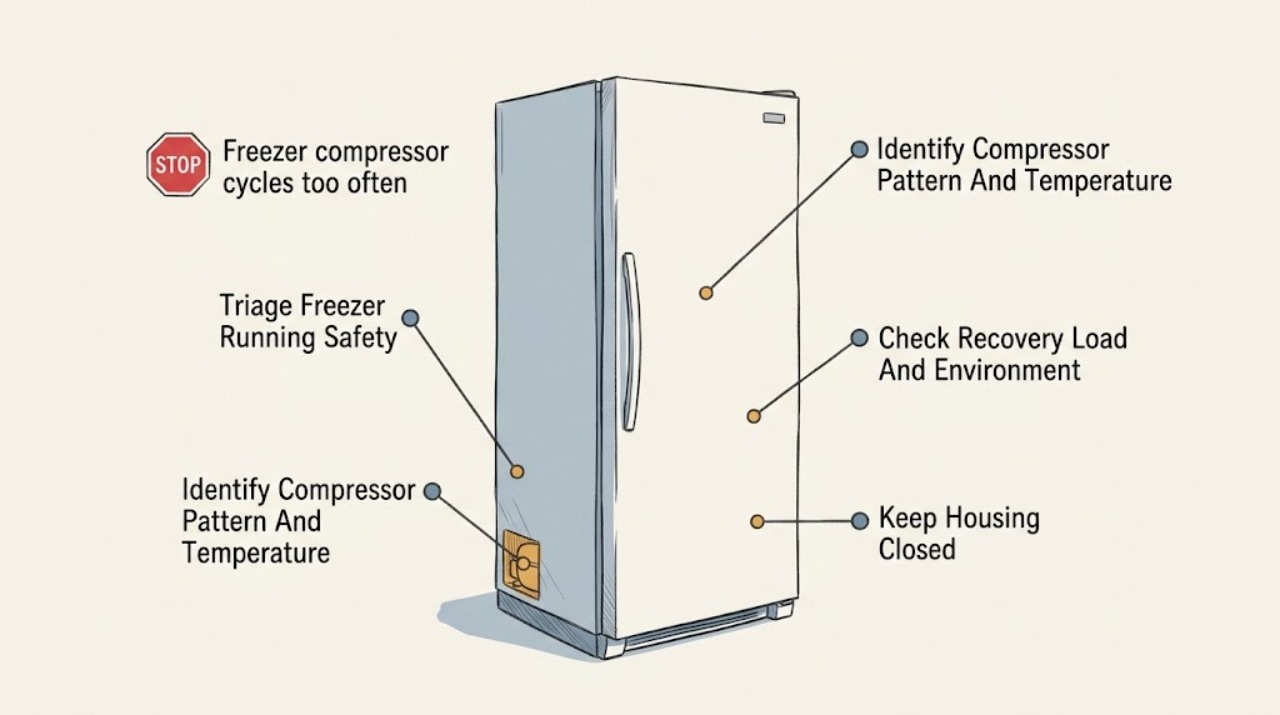
Work through in order
Diagnostic checks
Use only checks that match the exact appliance or system and its official guide.
-
Check 1
Observe the freezer without opening panels or touching the compressor, wiring, or hot surfaces. Note smoke, burning odor, repeated electrical clicking, a hot or damaged cord, water near an outlet, exposed wiring, a tripped breaker, or a refrigerant-like hissing or oily residue. Keep the door closed as much as practical while deciding whether food needs to be moved.
Expected result: The cabinet is stable with no hazard; the compressor is warm but the freezer is cooling; or an electrical, fire, refrigerant, or water hazard is present.
Next step: For smoke, fire, or active electrical danger, leave the area as appropriate and contact emergency help from a safe location. Otherwise disconnect power only if it can be done without touching damage or standing in water, keep the freezer closed, and arrange qualified appliance service.
Stop if: Stop immediately for smoke, flames, burning odor, exposed wiring, a damaged cord or outlet, repeated breaker trips, water at electrical parts, or suspected refrigerant leak.
Why this matters
Why: A normal operating sound or warm compressor does not establish failure. Smoke, burning odor, damaged wiring, repeated electrical trips, or suspected refrigerant release is outside owner troubleshooting and can create fire, shock, or exposure risk.
-
Check 2
With the door closed, record whether the sound is a steady hum, a start-stop click, fan noise, or a brief pop; whether the compressor rests between runs; and whether the freezer is holding the exact manual's recommended temperature. Use an independent appliance thermometer only if it can be placed without leaving the door open repeatedly, and do not alter settings repeatedly while measuring.
Expected result: The freezer reaches and holds target temperature with regular rest periods; the compressor runs almost continuously; it clicks off and restarts; or temperature remains high after the documented stabilization period.
Next step: Follow the exact model manual and allow its stated stabilization period after installation, power recovery, or a setting change. If the pattern remains abnormal or the freezer is not cold enough, keep the door closed and arrange service.
Stop if: Stop any further observation if the compressor repeatedly clicks, the cabinet or cord overheats, temperature rises rapidly, or any odor, smoke, or electrical symptom appears.
Why this matters
Why: Regular cycling with stable temperature can be normal, especially after a short-term load or environment change. Near-continuous running with poor cooling, repeated start attempts, or failure to stabilize points toward an airflow, seal, control, start, or sealed-system problem.
-
Check 3
Review the recent history without repeatedly opening the door: was the freezer newly installed, recently unplugged or without power, loaded with a large amount of warm food, placed in a hot or unconditioned room, or opened frequently? Keep the door fully closed and return the control only to the exact manual's recommended setting; do not place hot food inside or overfill the cabinet.
Expected result: One of these temporary recovery conditions is present; the freezer is in a hot or uninsulated location; or no recovery explanation fits and the running pattern is new.
Next step: Allow the exact model's documented stabilization period with minimal door opening. If it still runs excessively or cannot hold temperature, proceed to the seal, frost, and airflow checks and prepare for service.
Stop if: Stop if food is thawing, the freezer cannot maintain a safe condition, the compressor is repeatedly clicking, or a change requires moving a heavy unit or accessing wiring.
Why this matters
Why: Frigidaire says installation, power recovery, warm loading, frequent openings, and surrounding temperature can make a freezer run longer. A persistent change without one of these conditions is less likely to be ordinary recovery.
-
Check 4
Inspect the closed door or lid from outside for a blocked corner, warped gasket, visible gap, dirt, or frost preventing full closure. Clean a dirty gasket with the method in the exact manual and look for frost around the opening; do not pry ice off, use a sharp tool, apply heat, or remove the gasket unless the manual explicitly allows it.
Expected result: The seal is dirty, cracked, loose, visibly gapped, or blocked; heavy frost is present; or the door and gasket appear clean and fully sealed.
Next step: Correct only a plainly safe obstruction or clean the gasket as directed. If the gasket is damaged, frost is heavy, or the door remains unsealed, keep the freezer closed and arrange service rather than forcing a door or performing a manual defrost outside the manual.
Stop if: Stop for a torn or displaced gasket, heavy ice, a door that will not close, water near electrical parts, or any need to chip ice, remove panels, or apply heat.
Why this matters
Why: Frigidaire says a leaking gasket admits warm air and makes the freezer run more, while frost can prevent a door from closing or decrease airflow. A good visible seal does not rule out a sensor, defrost, compressor, or sealed-system fault.
-
Check 5
With the freezer closed between checks, look for food blocking interior air vents and for dust or objects restricting the accessible exterior ventilation area. Do not move a full or built-in freezer, remove the rear cover, vacuum around live components, or touch the compressor or condenser while powered.
Expected result: Food blocks an interior vent; frost blocks airflow; the exterior has restricted clearance or visible dust; or vents and clearance appear unobstructed.
Next step: Reposition only accessible food to restore the manual's airflow path. Have qualified service handle internal dust, condenser access, heavy frost, or built-in clearance; request appliance service if running remains excessive.
Stop if: Stop for heavy frost, a hot compressor or cabinet, inaccessible dust, a built-in unit that must be moved, or any need to remove the rear cover or touch live parts.
Why this matters
Why: Frigidaire identifies blocked food vents, frost, and restricted airflow as reasons cooling can suffer and the compressor can work longer. External clearance and a clear interior vent do not prove the refrigeration circuit is healthy.
-
Check 6
Record the full Frigidaire model and serial information, freezer type, temperature setting and measured temperature if safely available, compressor sound and rest pattern, installation or power history, load and room conditions, gasket and frost findings, vent or clearance observations, and any alarm, odor, heat, clicking, or breaker event. Do not keep cycling the compressor for a better recording.
Expected result: The freezer stabilizes after the documented recovery period; it runs nearly continuously but holds temperature; it runs continuously and remains warm; or it has a safety or mechanical symptom.
Next step: Keep the freezer closed and arrange qualified Frigidaire appliance service when the pattern persists, temperature is not maintained, or internal access is needed. Move vulnerable food only when necessary and avoid repeatedly opening the freezer.
Stop if: End owner troubleshooting when the problem requires electrical testing, refrigerant or sealed-system work, compressor access, defrost-component access, rear-cover removal, or a forced defrost.
Why this matters
Why: Stable temperature with a temporary recovery explanation is different from persistent overrun with poor cooling or repeated start failure. The latter may require diagnosis of airflow, door sealing, controls, defrost, fan, compressor start, or the sealed system.
Use your observations
Decision map
Find the observation that best matches what you see, then follow the next safe action.
-
PATH 01Next step
What you see
The freezer was newly installed, recently lost power, received warm food, or had frequent door openings; temperature is trending toward the exact manual's target and there is no hazard.
Do this next
Keep the door closed, avoid adding warm food, and allow the exact model's stabilization period. If it does not reach or hold target afterward, request service.
Why this path and its safety boundary
Why it matters: Frigidaire documents longer running during temperature stabilization after these events. This is a recovery pattern, not proof of a compressor defect.
-
PATH 02Next step
What you see
The gasket is dirty, warped, cracked, loose, or gapped; frost interferes with the door or vents; or food blocks interior airflow, and the compressor runs longer while cooling is affected.
Do this next
Correct only an obvious safe obstruction or clean the gasket as the manual directs. Have qualified service handle damaged seals, heavy frost, internal airflow, or persistent overrun.
Why this path and its safety boundary
Why it matters: Warm-air leakage or restricted airflow is more likely. Frigidaire links gasket leaks and frost or blocked vents to longer running and unstable temperature, but the compressor may also be reacting to another fault.
-
PATH 03Next step
What you see
The freezer is in a hot or unconditioned location, the control is set colder than needed, or the surrounding clearance is poor, while the freezer still reaches and holds the model's target.
Do this next
Use the exact manual's recommended setting, improve only safe accessible clearance, and observe after stabilization. If the compressor still runs nearly continuously or temperature falls, arrange service.
Why this path and its safety boundary
Why it matters: Environment, setting, or heat rejection can explain more frequent operation when temperature remains stable. It is less likely to be a failed compressor if the unit cools normally and no hazard appears.
-
PATH 04Next step
What you see
The compressor runs nearly continuously after stabilization, the freezer remains warm or unstable, or the compressor repeatedly clicks off and attempts to restart despite a clear seal, vents, and ordinary load.
Do this next
Keep the door closed, protect food according to food-safety guidance, and arrange qualified Frigidaire appliance service. Do not add refrigerant, replace a start device, bypass a control, or force a defrost without diagnosis.
Why this path and its safety boundary
Why it matters: A control, fan, defrost, compressor-start, sealed-system, or other refrigeration fault is more likely than normal cycling. Sound and running time cannot identify a replaceable part safely.
-
PATH 05Next step
What you see
The freezer has smoke, burning odor, exposed wiring, a hot or damaged cord, repeated breaker trips, water at electrical parts, or signs of a refrigerant leak.
Do this next
Keep the freezer off and disconnect power only if safe to do so without touching damage or standing in water. Leave for fire or other immediate danger and seek emergency help; otherwise arrange qualified appliance or electrical service.
Why this path and its safety boundary
Why it matters: Electrical, fire, water, or sealed-system safety takes priority over compressor-cycle diagnosis.
Helpful context
Understand the symptom
Frequent cycling is not the same as a compressor that never rests
The sound near a freezer may come from the compressor, fan, refrigerant, or normal expansion and contraction. Frigidaire notes that compressors cycle on and off and that some variable-speed refrigerator models can run nearly continuously; freezer behavior still depends on the exact design. Count the observed run and rest pattern only after the door has stayed closed and the unit has had time to stabilize, rather than diagnosing by sound alone.
Warm air is the first safe explanation to rule out
Every door opening introduces warm air. A dirty or poorly fitted gasket, a door that is blocked, warm food, a recent power loss, a hot room, or blocked interior airflow can all lengthen the cooling recovery. Clean and inspect accessible areas, but do not pull panels, scrape ice with a sharp tool, or adjust a sealed refrigeration system.
Temperature and frost decide whether service is needed
A compressor that runs frequently while the freezer reaches and holds its target after a known warm-load or installation recovery is different from one that runs continuously while temperature rises. Heavy frost can reduce airflow or keep a door from sealing. If safe external checks do not restore temperature, protect food and request qualified service rather than forcing a defrost or adding refrigerant.
Safety boundary
Stop conditions
- Stop immediately for smoke, flames, burning odor, exposed wiring, a damaged cord or outlet, repeated breaker trips, water at electrical parts, suspected refrigerant leak, or a rapidly hot compressor or cabinet.
- Do not open the rear cover, test live wiring, add refrigerant, bypass a control or thermal device, force a defrost, chip ice with a sharp tool, apply heat to frost, or replace a compressor or start component from running behavior alone.
- Do not repeatedly open the door, change the setting back and forth, load hot food, or restart after an electrical or overheating event while trying to confirm a cycle pattern.
- Use the exact Frigidaire model manual for the recommended temperature, stabilization period, clearance, gasket care, frost removal, and any diagnostic mode. A generic freezer instruction is not proof of fit or safety.
- Call qualified Frigidaire appliance service when the freezer cannot hold temperature after safe recovery and airflow checks, runs nearly continuously, repeatedly clicks, develops heavy frost, has a failed seal, or requires electrical, compressor, fan, defrost, sealed-system, or rear-cover access.
Only after diagnosis
Potential parts
- Frigidaire freezer door or lid gasket
Consider this only when inspection confirms a torn, warped, loose, or poorly fitting gasket that cannot make a reliable seal after safe cleaning and alignment checks.
Confirm exact model, door or lid design, gasket profile, installation method, and manufacturer fit information; frequent cycling alone does not prove gasket failure. - Frigidaire freezer temperature control or sensor
Consider this only when qualified testing shows that temperature sensing or control is not regulating a correctly sealed, unobstructed freezer.
Verify exact model, sensor or control revision, connectors, ratings, and service procedure; do not replace from run time alone. - Frigidaire freezer evaporator or condenser fan component
Consider this only when qualified diagnosis finds a fan that is stalled, noisy, obstructed, or not moving air after frost, load, and seal conditions are addressed.
Confirm exact model, fan location, voltage, connector, blade, and mounting; do not reach through covers or test live components. - Frigidaire freezer compressor start or sealed-system component
Consider this only after qualified testing confirms repeated start failure, compressor fault, or sealed-system loss following safe checks of temperature, gasket, airflow, and defrost conditions.
Sealed-system and compressor work requires qualified service; confirm exact model, refrigerant, electrical configuration, and manufacturer procedure rather than ordering a component by symptom.
When checks do not resolve it
Need a professional?
Arrange qualified Frigidaire appliance service when the compressor runs nearly continuously after the documented stabilization period, the freezer remains warm or unstable, repeated clicking occurs, frost blocks airflow or the door, the gasket will not seal, or diagnosis requires compressor, fan, defrost, electrical, rear-cover, or sealed-system access. Treat smoke, burning odor, exposed wiring, water at electrical parts, repeated breaker trips, and suspected refrigerant release as urgent safety conditions.
Safety scope: Owner checks end at keeping the door closed, hazard triage, safe temperature and sound observation, model-approved setting and recovery checks, visible gasket and frost inspection, accessible airflow checks, and safe service documentation. A qualified professional must handle rear-cover access, electrical testing, compressor or start components, fans, defrost system, refrigerant, and sealed-system work.
Common questions
FAQ
Why is my Frigidaire freezer compressor cycling so often?
Frequent operation can follow installation, power recovery, warm loading, frequent openings, hot surroundings, a colder setting, a leaking gasket, frost, or blocked airflow. If the freezer holds temperature and rests normally after recovery, it may be expected; persistent overrun with poor cooling needs service.
How often should a Frigidaire freezer compressor turn on and off?
There is no universal timing that fits every Frigidaire model, load, and room. Judge the pattern together with temperature, rest periods, door seal, frost, and recent recovery events. The exact Use and Care manual controls normal behavior.
Is it normal for a new Frigidaire freezer to run a lot?
Yes, Frigidaire says a newly installed freezer may run longer while temperature stabilizes. Keep the door closed, avoid warm loading, and allow the model's documented stabilization period. If it remains warm or runs nearly continuously afterward, request service.
Can a power outage make a Frigidaire freezer run continuously?
A freezer can run longer while recovering from a power interruption. Frigidaire documents an extended stabilization period after power recovery. If temperature does not recover or the compressor repeatedly clicks, keep the door closed and call service.
Can a bad freezer gasket cause frequent compressor cycling?
Yes. A dirty, worn, cracked, or poorly fitted gasket can leak warm air and make the compressor work longer. Inspect for gaps and clean only as the manual directs; a damaged gasket or persistent overrun needs qualified service.
Can frost make my Frigidaire freezer compressor run too often?
Heavy frost can prevent the door from sealing or reduce airflow, which can affect cooling and increase running time. Do not chip ice with a sharp tool or apply heat; use the exact manual or qualified service for defrost and internal access.
Does a hot room make a Frigidaire freezer run longer?
Yes. Frigidaire says hot surroundings or an unconditioned location can make a freezer work harder. Keep safe clearance and use the model's specified environment. If the freezer cannot hold temperature, arrange service rather than assuming room temperature is the only cause.
Why does my Frigidaire freezer compressor click and restart?
Repeated clicking can indicate a start, control, overload, or compressor problem, especially if cooling is poor. Sound alone cannot identify a part. Keep the freezer off if it overheats or clicks repeatedly and arrange qualified diagnosis.
Should I set my Frigidaire freezer colder to stop frequent cycling?
Do not keep changing the setting as a test. Use the exact manual's recommended setting and allow stabilization. A colder setting can make the compressor run more, while a persistent problem may be a seal, airflow, control, or refrigeration fault.
When should I call a technician for a Frigidaire freezer that runs too much?
Call when it runs nearly continuously after stabilization, cannot hold temperature, repeatedly clicks, develops heavy frost, has a door-seal problem, or requires fan, defrost, electrical, compressor, refrigerant, or rear-cover access. Treat smoke, burning odor, exposed wiring, and repeated breaker trips as urgent.
Read the exact guide
Official sources
- Support for FreezersFrigidaire Owner Support · Official Frigidaire freezer support hub; use the exact model and current support article for any repair procedure.
- Refrigerators / Freezer - Frost Build UpFrigidaire Owner Support · Official Frigidaire frost support article; appliance model and manual determine safe defrost and access procedures.
- Freezer - Not Freezing or Not CoolingFrigidaire Owner Support · Official Frigidaire freezer support article; exact model, configuration, and current manual control procedures.
- Refrigerators - Why does my refrigerator run most of the time? Is this normal?Frigidaire Owner Support · Official Frigidaire refrigeration support article; it is primarily refrigerator guidance and is used only for compressor-sound and operating-pattern context, not an exact freezer cycle specification.
- Freezer Runs Too MuchFrigidaire Owner Support · Official Frigidaire freezer support article; exact model settings, stabilization behavior, and installation limits control.
Community feedback
Share a repair observation
Share a plain-text repair observation. Accepted observations are published automatically; this page may take a moment to update.