
On this page
Start here
Quick answer
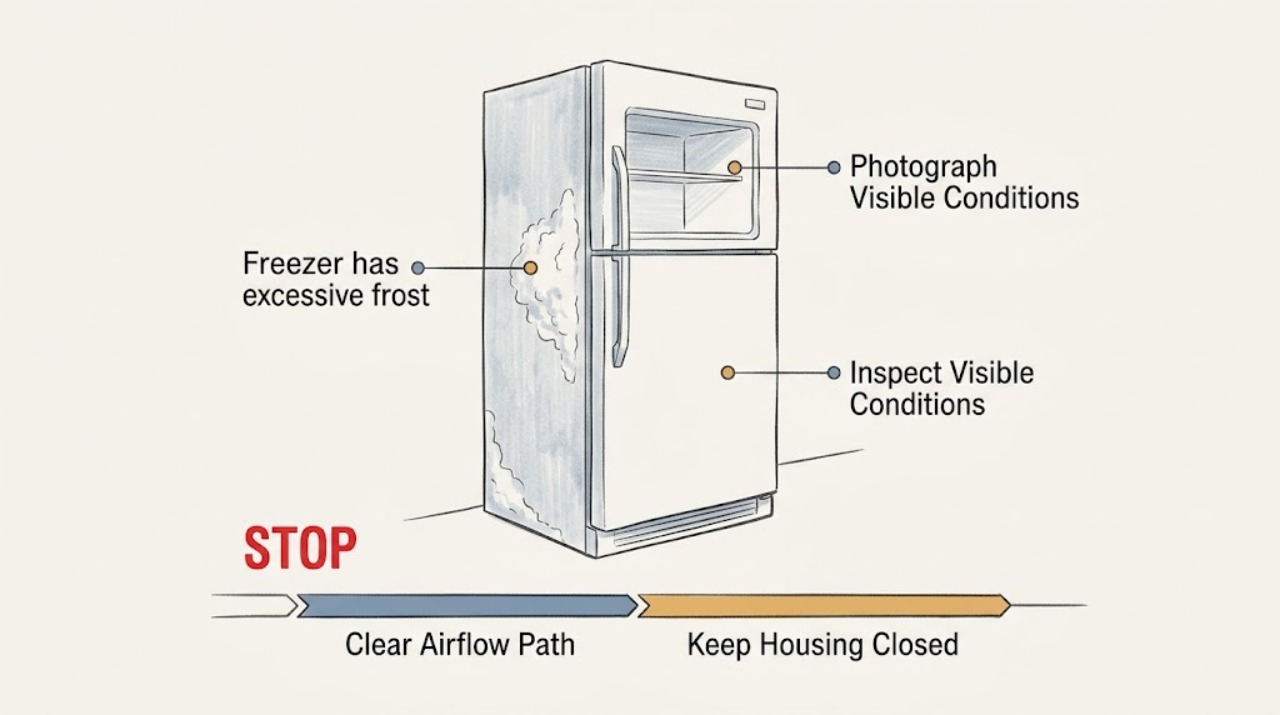
Excessive frost in a Frigidaire freezer usually means warm, moist air is entering, airflow is being blocked, or the freezer is operating at an unsuitable setting; Frigidaire specifically points to a poor door or gasket seal, an ice-chute flap that does not close, very low settings, and blocked vents. First confirm the door or lid closes fully, inspect the gasket and chute if fitted, keep vents and the rear wall clear, and verify that the freezer has power. Frost across the back wall or around an air path can reduce cooling and keep the door from sealing. Do not chip ice with a knife, use an open flame or heat gun, bend an evaporator cover, or remove panels to force a defrost repair. Use only the exact model manual's user-permitted defrost instructions; if frost returns, the freezer remains warm, the seal is damaged, or power is unstable, arrange Frigidaire service. Record the model, frost location, door and vent observations, temperature behavior, and any recent power outage or long-open door event.
Before you begin
Safety first
- Keep the freezer out of service for water near electrical parts, smoke, burning smell, unstable power, unsafe flooding, or persistent warming. Do not use flame or sharp tools, remove evaporator or sealed-system panels, or force a hidden component.
Work through in order
Diagnostic checks
Use only checks that match the exact appliance or system and its official guide.
-
Check 1
From a safe position, photograph the frost pattern and note whether ice is at the door edge, on the back wall, around a vent, on food, at the bottom, or across most of the compartment. Protect food and the floor if melting has started; do not scrape or touch hidden cooling parts.
Expected result: Frost is localized at the door edge, concentrated at a vent or rear wall, widespread, or accompanied by water, a warm cabinet, smoke, burning smell, or water near electrical equipment.
Next step: Keep clear and obtain qualified or emergency help for smoke, burning smell, water near electrics, or unsafe flooding. Otherwise continue with the door and airflow checks without using sharp tools or heat.
Why this matters
Why: A door-edge pattern makes an air leak more likely; a vent or broad rear-wall pattern makes blocked airflow or heavy frost more likely. Water, warming, smoke, burning smell, or electrical contact changes this from a routine frost check to a safety or cooling branch.
-
Check 2
Inspect the door or lid closure and gasket without removing it. Close the unit on a clean, dry seal, look for a gap, torn or warped rubber, a package holding the door open, and—if present—an ice-chute flap that does not close completely.
Expected result: The seal is even and closed, a corner has a gap, the gasket is torn or warped, a package obstructs closure, or the chute flap remains open.
Next step: Remove only an obvious package obstruction and close the door normally. Do not force or reshape a gasket; photograph a damaged seal or chute and arrange service if it does not close correctly.
Why this matters
Why: A gap, obstruction, or open chute allows warm moist air into the below-freezing compartment and can explain recurring frost. A good seal makes that cause less likely but does not rule out blocked airflow or a defrost fault.
-
Check 3
Check the loading pattern and visible vents. Move food away from marked air passages and the rear wall only as the manual allows, leave room for circulation, and note whether frost blocks an air path. Do not pry ice from the liner or evaporator cover.
Expected result: Packages block a vent, food is pressed against the rear wall, vents are open but frost is widespread, or airflow looks clear with localized frost.
Next step: Reposition items only, then monitor the pattern. If frost remains heavy or returns, use the exact model manual and arrange service rather than dismantling the freezer interior.
Why this matters
Why: Frigidaire says blocked product placement and excessive frost can reduce airflow. Clearing an external loading obstruction may help; widespread frost with clear loading points to a defrost or seal problem that an external rearrangement will not fix.
-
Check 4
Verify the temperature setting, control response, indicator or interior lights, and power cord from a dry, safe position. Check the applicable breaker or GFCI only as a normal household check; do not use an extension cord or repeatedly reset a tripping circuit.
Expected result: The setting is unusually low, the freezer has normal power, the display or light is blank, the breaker or GFCI trips again, or cooling is poor despite power.
Next step: Use only the normal control and power checks described for the appliance. Stop for repeated trips or persistent loss of power and obtain appliance or electrical service; do not change wiring or controls.
Why this matters
Why: Frigidaire lists very low settings as a possible frost contributor and lists control, breaker, cord, outage, and power checks for a freezer that is not running. A blank or unstable supply can also interrupt normal cooling and defrost operation.
-
Check 5
Locate the exact model number and consult its Frigidaire manual for any user-permitted defrost procedure. If you perform that documented procedure, record what was done and then observe whether the compartment dries, cools normally, and stays free of renewed frost; never use a knife, open flame, heat gun, or forced panel removal.
Expected result: The manual provides a clear user procedure, the drain or frost is behind a cover, the model manual cannot be found, frost returns, or the freezer remains warm after the procedure.
Next step: Stop when access requires a cover or the symptom returns. Provide the model, photos, procedure, and timing to qualified Frigidaire service; do not continue dismantling the appliance.
Why this matters
Why: A documented, accessible procedure can address a temporary frost event. Hidden access, an unknown method, recurrence, or poor cooling makes a deeper defrost, airflow, fan, sensor, gasket, or cooling fault more likely.
Use your observations
Decision map
Find the observation that best matches what you see, then follow the next safe action.
-
PATH 01Next step
What you see
Frost is concentrated at the door edge, a gasket corner is open or damaged, or an ice-chute flap stays open.
Do this next
Remove only an obvious closure obstruction; have a damaged gasket, door, lid, or chute repaired or replaced through qualified service. Keep the vents clear and do not reshape the seal with heat.
Why this path and its safety boundary
Why it matters: Warm moist air entering through the closure is more likely than an isolated internal defrost failure.
-
PATH 02Next step
What you see
Packages block vents or press against the rear wall, and frost is localized around an airflow path while the door seals normally.
Do this next
Reposition the food as the manual allows and monitor. If frost remains widespread or returns, stop treating it as a loading issue and arrange service.
Why this path and its safety boundary
Why it matters: Loading and airflow are plausible contributors, and a simple external obstruction may be enough to explain the pattern.
-
PATH 03Next step
What you see
Frost covers much of the back wall or compartment, airflow is poor, and the freezer is too warm or the door will not close.
Do this next
Follow only the exact model's user instructions for defrosting. If the procedure is unavailable, requires panel removal, or does not restore cooling, stop and schedule qualified service.
Why this path and its safety boundary
Why it matters: Excessive frost is now affecting cooling or closure; a defrost, seal, airflow, or cooling fault may be present rather than a one-time surface issue.
-
PATH 04Next step
What you see
The freezer has no stable power, the breaker or GFCI trips repeatedly, the display or light remains blank, or water reaches electrical equipment.
Do this next
Use normal power checks once from a dry, safe position, then stop and obtain qualified appliance or electrical service. Do not use an extension cord or repeatedly reset a tripping circuit.
Why this path and its safety boundary
Why it matters: An electrical or power condition can interrupt cooling and defrost operation and is not safely diagnosed by scraping frost.
-
PATH 05Next step
What you see
The seal and loading look normal, frost returns after the documented model procedure, the freezer stays warm, or the frost source cannot be identified safely.
Do this next
Leave the appliance in a safe state, preserve the model and symptom record, and request qualified Frigidaire appliance service. Do not remove evaporator covers or sealed-system parts.
Why this path and its safety boundary
Why it matters: A hidden defrost, fan, sensor, drain, or cooling problem is more likely and may require access or tests outside a user-level inspection.
Helpful context
Understand the symptom
Why frost builds up
Frigidaire explains that frost forms when warm and cold air combine in a below-freezing compartment. A gap at the door or lid, a warped gasket, an ice-chute flap that remains open, very low settings, or blocked air passages can all supply the conditions for excess ice. Frost itself can then interfere with closure and airflow, creating a cycle of worsening frost and uneven cooling.
Read the frost pattern before defrosting
A thin film near the door edge suggests an air-seal issue; frost concentrated around a blocked vent suggests loading or airflow; a broad layer over the back wall can reduce airflow and cooling. These patterns are clues, not a license to remove an evaporator cover. Photograph the pattern and check the simple external causes first.
Use the exact model instructions
Frigidaire model-number locations vary: an upright freezer's number is on the interior side trim, while a chest freezer's is on the left exterior wall above the access panel. Retrieve the matching manual before defrosting. Do not assume that a generic heater, drain, water, or scraping method is suitable for every design.
When frost signals a service problem
If the gasket is damaged, frost returns after the documented procedure, the freezer stays warm, or the unit loses power, the cause may involve a hidden defrost, airflow, sensor, fan, or cooling fault. Frigidaire directs owners to service when its basic frost and cooling checks do not resolve the issue.
Safety boundary
Stop conditions
- Stop immediately for smoke, burning smell, damaged wiring, water near electrical equipment, unsafe flooding, repeated breaker or GFCI trips, or a freezer that is unsafe to approach. Keep clear and obtain qualified or emergency help.
- Do not chip frost with a knife or sharp tool, use an open flame or heat gun, bend an evaporator cover, puncture the liner, or force a hidden drain or panel.
- Disconnect power before any model-approved defrost procedure only when the plug and surrounding area are dry and safe. Do not handle wet electrical equipment or make live electrical measurements.
- Stop when the model manual is unavailable, access requires disassembly, frost returns after the documented procedure, cooling remains poor, or the gasket or door cannot seal. Arrange qualified appliance diagnosis.
Only after diagnosis
Potential parts
- freezer door or lid gasket
Consider this category only if inspection confirms the gasket is torn, warped, or unable to make an even seal and the resulting air leak matches the frost pattern.
Upright and chest freezer seals are model-specific. Confirm the exact model and diagnosis before selecting a gasket. - defrost heater, sensor, or control component
Consider this category only after qualified diagnosis confirms frost returns because the defrost system is not operating, rather than because a door or vent is allowing excess moisture.
Defrost parts, wiring, and controls vary by model and may be behind covers. Do not select or test them as a generic frost repair. - evaporator fan or airflow component
Consider this category only if qualified diagnosis links widespread frost, poor airflow, or persistent warming to a fan or airflow fault.
Fan assemblies and controls are model-specific and may require panel access. Confirm the exact model and service diagnosis. - defrost drain tube or trough component
Consider this category only when recurring bottom ice or water is traced by a qualified technician to a restricted or damaged drain path.
Drain routing and trough designs vary by freezer model. Do not order a generic tube by appearance or dimensions.
When checks do not resolve it
Need a professional?
Arrange Frigidaire or qualified appliance service when frost is widespread or recurring, the door gasket or chute is damaged, the freezer remains warm after the model-approved procedure, the source is behind a cover, or power is unstable. Treat smoke, burning smell, water near electrical equipment, repeated breaker trips, and unsafe flooding as urgent safety conditions.
Safety scope: Keep the freezer out of service for water near electrical parts, smoke, burning smell, unstable power, unsafe flooding, or persistent warming. Do not use flame or sharp tools, remove evaporator or sealed-system panels, or force a hidden component.
Common questions
FAQ
What causes excessive frost in a Frigidaire freezer?
Frigidaire identifies warm air entering through a poor door or gasket seal, an ice-chute flap that stays open, a very low setting, and blocked airflow. Check closure, the gasket, the chute if fitted, and visible vents before assuming an internal defrost fault.
Can I scrape heavy frost off a Frigidaire freezer wall?
Do not use a knife or other sharp tool, flame, or heat gun. Follow only the exact model manual's user-permitted defrost instructions. Stop if access requires panel removal or if the freezer has wiring, water, smoke, or warming concerns.
Why does frost return after I defrost the freezer?
A returning frost pattern can mean the door or gasket still leaks air, the ice chute remains open, vents are blocked, or a hidden defrost, fan, sensor, drain, or cooling problem remains. Record how quickly it returns and arrange service for persistent or widespread frost.
Does excessive frost mean my Frigidaire freezer is not cooling?
It can. Frigidaire says excessive frost can decrease airflow or prevent the door from closing correctly, both of which can affect cooling. Check the temperature behavior and vents; if the freezer remains warm after the model-approved procedure, schedule service.
When should I call a Frigidaire freezer technician for frost?
Call when frost is widespread or recurring, the gasket or door cannot seal, the freezer stays warm, the power is unstable, or the likely frost source is behind a cover. Treat smoke, burning smell, water near electrical equipment, repeated breaker trips, and unsafe flooding as urgent.
Read the exact guide
Official sources
- What should I do if my freezer isn't running?Frigidaire · Official Frigidaire owner-support guidance for a freezer that is not running; electrical repairs remain outside a user-level frost inspection.
- Where can I find my model and serial number?Frigidaire · Official Frigidaire owner-support page; model-number locations differ between upright and chest freezers and should be used to retrieve the correct manual.
- Freezer - Not Freezing or Not CoolingFrigidaire · Official Frigidaire owner-support guidance for freezer cooling symptoms; it does not establish a model-independent internal frost repair.
- Refrigerators / Freezer - Frost Build UpFrigidaire · Official Frigidaire owner-support guidance for frost buildup; it does not provide a universal defrost or disassembly procedure for every freezer model.
Community feedback
Share a repair observation
Share a plain-text repair observation. Accepted observations are published automatically; this page may take a moment to update.