
On this page
Start here
Quick answer
Excessive frost does not prove that the defrost heater itself has failed. In an automatic-defrost freezer, the heater melts frost from the evaporator, while a timer or adaptive control starts the cycle and a drain carries away meltwater. Frost can also come from a door that is not sealing, warm moist air, blocked vents, or a manual-defrost model. Check the freezer type, door closure and gasket, visible vents, and the location and return pattern of the frost. Defrost only as the owner's manual directs, never with a hair dryer, heater, knife, or ice pick. If frost returns after a complete safe defrost, cooling is weak, or access to the heater requires removing a panel, stop and arrange qualified appliance service.
Before you begin
Safety first
- The homeowner scope is identification, visible seal and vent checks, and the model-approved defrost procedure only. No panel removal, electrical testing, wiring bypass, or internal part replacement.
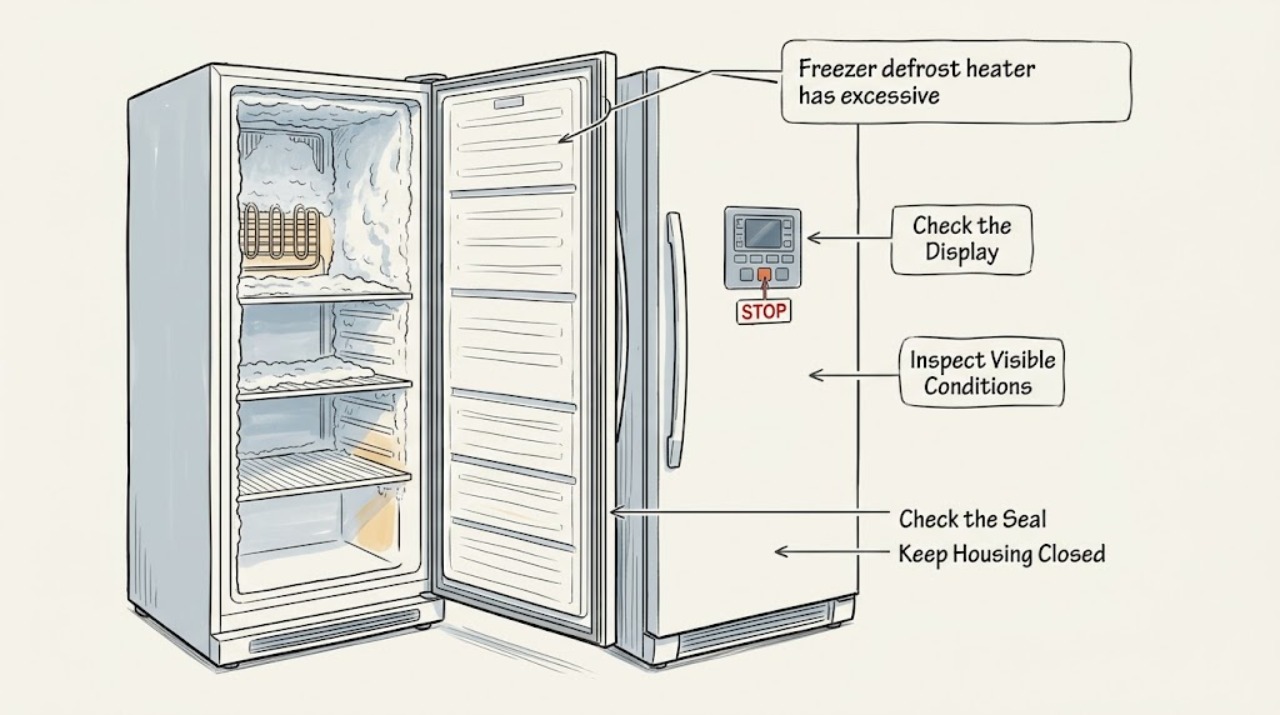
Work through in order
Diagnostic checks
Use only checks that match the exact appliance or system and its official guide.
-
Check 1
Identify whether the freezer is labeled frost-free or automatic-defrost, or manual-defrost, using the controls, product literature, or a label that is visible without moving panels. Note the model information only if it is easy to read.
Expected result: An automatic-defrost freezer has a heater and control cycle; a manual-defrost or some compact model may not have a defrost heater at all.
Next step: Use the model's owner's manual for defrosting instructions. For an automatic-defrost model, continue with the visible checks and treat recurring frost as a service issue rather than a reason to open the evaporator area.
Why this matters
Why: The same frost symptom leads to different next steps by design. Assuming a heater exists on a manual-defrost model can send the diagnosis toward the wrong part.
-
Check 2
Look at where the frost is concentrated without removing any interior cover: on the door liner and shelves, around a rear vent, across a rear wall, or as a thick layer that appears to cover the hidden evaporator area.
Expected result: A local patch near the door or vent differs from an even heavy buildup across the freezer; frost that blocks a vent can also reduce air movement.
Next step: Keep the location in your service notes. Do not pry off a rear panel or chip frost away from an evaporator; move to the closure and vent checks first.
Why this matters
Why: A door-air leak or blocked airflow is more likely when frost follows an opening, seal, or vent. Heavy frost concentrated behind the rear cover is compatible with a defrost-system problem, but the heater cannot be confirmed from the visible pattern.
-
Check 3
Close the freezer door normally and inspect the gasket, frame, and nearby food packages for a visible gap, torn seal, dirt, or an item holding the door open. Clean a dirty gasket with the method allowed by the owner's manual and dry it.
Expected result: The gasket should contact the frame around the closed door. A repeatable gap, damaged seal, or package interference is different from a door that closes evenly.
Next step: Remove only the obstruction or surface debris you can reach safely. If the gasket is torn, the door is misaligned, or the frost returns with a good seal, arrange appliance service.
Why this matters
Why: A seal or closure leak lets warm, moist room air enter and can create excessive frost even if the defrost heater is healthy. A sound closure makes a door leak less likely but does not rule out a defrost fault.
-
Check 4
Check visible air vents and the space around stored food. Keep packages from pressing against vents or the door, and avoid putting warm or uncovered food into the freezer while you observe the symptom.
Expected result: A vent blocked by food or frost, overpacked shelves, or repeated warm-air exposure can be seen without accessing the evaporator.
Next step: Restore the clearances specified in the manual and minimize door-open time. Do not use a stronger setting or force food around a frosted vent; if frost already blocks the passage, follow the safe defrost branch.
Why this matters
Why: Blocked circulation and added moisture can increase frost and reduce cooling independently of the defrost heater. If the vents are clear and the freezer is not routinely exposed to warm air, an internal defrost-system cause becomes more plausible.
-
Check 5
If the manual permits a user defrost, protect the food and perform only that documented procedure. Disconnect power only as the manual directs, allow the frost to melt, collect water safely, and dry the interior before restoring the appliance.
Expected result: After all visible frost has melted, note whether the freezer cools normally and whether frost begins returning in the same location. Do not speed melting with a hair dryer, heater, sharp tool, or force.
Next step: If the manual does not authorize this procedure, or if frost returns after the documented defrost, stop repeating defrost cycles and schedule qualified appliance service.
Why this matters
Why: A temporary return to normal after a complete defrost can mean frost was blocking airflow, but it does not prove the underlying cause is fixed. Frost that returns, especially behind an evaporator cover, points toward a seal, drain, control, sensor, or heater-system diagnosis.
-
Check 6
Record the freezer temperature symptom, food condition, frost location, door-seal result, and how quickly frost returned after a safe defrost. Check for unusual dripping or water collecting where the manual identifies the drain path, without removing covers.
Expected result: Weak cooling, repeated frost, a blocked or overflowing drain area, or an automatic-defrost freezer with no lasting improvement is a different pattern from one-time frost after a door was left open.
Next step: Give the observations and model information to a qualified appliance technician. Do not remove the evaporator cover, test the heater, bypass a thermal device, or replace an internal part without model-specific diagnosis.
Why this matters
Why: Persistent frost can involve the heater, defrost sensor or thermostat, timer or control, drain, fan airflow, or a seal. These parts have different tests and replacement decisions, so the symptom record is more useful than ordering a heater by appearance.
Use your observations
Decision map
Find the observation that best matches what you see, then follow the next safe action.
-
PATH 01Next step
What you see
The freezer is manual-defrost or compact, and the manual does not describe an automatic heater cycle.
Do this next
Follow the owner's manual for a complete manual defrost and check door closure and food loading afterward. Do not search for or install an automatic-defrost heater.
-
PATH 02Next step
What you see
Frost is concentrated by a door edge or vent, and the door has a gap, damaged gasket, blocked vent, or package interference.
Do this next
Correct only the visible obstruction or cleanable seal issue, then watch whether frost stops returning. Replace a damaged seal or arrange service when the door cannot seal evenly.
-
PATH 03Next step
What you see
An automatic-defrost freezer has a thick, widespread buildup or frost returns after a documented complete defrost while the gasket and vents are clear.
Do this next
Schedule qualified appliance diagnosis. Leave internal covers, heater wiring, and controls untouched rather than replacing a heater based only on frost.
-
PATH 04Next step
What you see
The freezer improves briefly after defrosting but frost quickly blocks airflow again or cooling becomes weak.
Do this next
Avoid repeated forced defrosts and arrange service, especially if food is warming or the frost is behind a panel.
-
PATH 05Next step
What you see
Water collects unexpectedly, the drain area overflows, the appliance trips power, or there is a burning odor or exposed wiring.
Do this next
Stop using the appliance, keep clear of electrical parts and standing water, and contact a qualified appliance technician or appropriate emergency service for an immediate hazard. Do not open panels or bypass a safety device.
Helpful context
Understand the symptom
Why the heater is only one possibility
Frost normally forms on the evaporator during cooling and is periodically melted during an automatic-defrost cycle. The heater is switched by the appliance's defrost controls and the water should drain away. If the heater, its sensor, the control that starts the cycle, or the drain is not working, frost can accumulate; however, a door leak or blocked vent can create a similar result without a heater fault. The frost pattern and whether it returns after a complete defrost are more useful than naming a part from appearance alone.
Use a model-specific defrost boundary
A frost-free upright freezer is different from a manual-defrost or compact model. Follow the owner's manual for any manual defrost and power-disconnection steps. Keep the work limited to food removal, visible cleaning, door and vent checks, and safe observation. Do not remove an evaporator cover, pull heater wiring, test continuity, or work around energized appliance parts.
Only after diagnosis
Potential parts
- defrost heater
Consider this part only if a qualified diagnosis confirms the heater is open, damaged, or otherwise not heating during the model's defrost cycle.
Heater shape, connectors, voltage, and mounting vary by model. Confirm the complete appliance model and the technician's diagnosis before ordering. - defrost temperature sensor or thermostat
Consider this category only when the heater and defrost control are evaluated and the sensor or thermostat is identified as preventing the cycle from completing.
The correct device and mounting location are model-specific; do not substitute a generic thermal part or bypass it. - freezer door gasket
Consider this only if the gasket is visibly torn, deformed, or unable to seal evenly after food and debris are cleared.
Confirm the appliance model and the gasket's fit and installation requirements before ordering.
When checks do not resolve it
Need a professional?
Arrange qualified appliance service when excessive frost returns after a complete model-approved defrost, cooling is weak, the frost is behind an evaporator cover, the door cannot seal, or water is not draining as expected. Stop immediately for a burning odor, smoke, exposed wiring, repeated power trips, or water near electrical parts. Testing a defrost heater, thermal device, sensor, timer, control, or wiring requires model-specific electrical and access procedures; do not open panels or bypass a safety device.
Safety scope: The homeowner scope is identification, visible seal and vent checks, and the model-approved defrost procedure only. No panel removal, electrical testing, wiring bypass, or internal part replacement.
Common questions
FAQ
Does excessive frost always mean the freezer defrost heater is bad?
No. A door seal leak, warm moist air, blocked vents, a drain problem, a sensor or control issue, or a manual-defrost design can produce frost. A heater fault is only one diagnosis in an automatic-defrost system.
Can I test or replace the freezer defrost heater myself?
Do not remove the evaporator cover or test heater wiring as a routine homeowner check. Access and electrical testing are model-specific; have a qualified appliance technician confirm the heater and the rest of the defrost system before ordering a part.
How can I safely clear heavy freezer frost?
Use the owner's manual's defrost procedure for that model, protect the food, and keep water controlled. Do not use a hair dryer, heater, knife, ice pick, or force, and stop if power or water could contact electrical parts.
Why does frost come back after I defrost the freezer?
A complete defrost can temporarily restore airflow without fixing the cause. If the gasket and vents are sound but frost returns, an automatic-defrost heater, sensor, control, timer, drain, or airflow issue needs professional diagnosis.
Read the exact guide
Official sources
- Frost forms in the Samsung freezer, refrigerator, or ice bucketSamsung · freezer frost, door closure, vents, gasket inspection, and safe defrost cautions
- Refrigerator - Automatic Defrost SystemGE Appliances · automatic freezer defrost cycle and recurring heavy-frost service guidance
- How to Avoid Frost Build UpWhirlpool · freezer frost causes, door sealing, food loading, and airflow
- Refrigerator and Freezer - Types of Defrost SystemsGE Appliances · freezer automatic-defrost systems and defrost heater operation
Community feedback
Share a repair observation
Share a plain-text repair observation. Accepted observations are published automatically; this page may take a moment to update.