
On this page
Start here
Quick answer
Excessive freezer frost with gaps at the door or lid seal usually means warm, humid room air is entering and freezing on cold surfaces. First confirm the gap around the entire gasket, then check for packages, shelves, baskets, ice, or an unlevel cabinet preventing full closure. Clean the gasket with warm soapy water, restore the correct fit, and follow the owner's manual for a safe defrost if frost is already blocking the seal or vents. Do not chip ice, use an open flame or improvised heat, or remove internal covers. If the gasket remains torn or uneven, frost returns after the seal and airflow are corrected, the fan is not running, or the freezer cannot maintain temperature, arrange qualified appliance service.
Before you begin
Safety first
- This article covers visible seal and closure checks, gasket cleaning, package and vent organization, model-directed placement review, a paper seal test, and only the owner's manual's permitted defrost procedure. A technician must handle internal fan, defrost, control, electrical, refrigeration, and inaccessible gasket or hinge work.
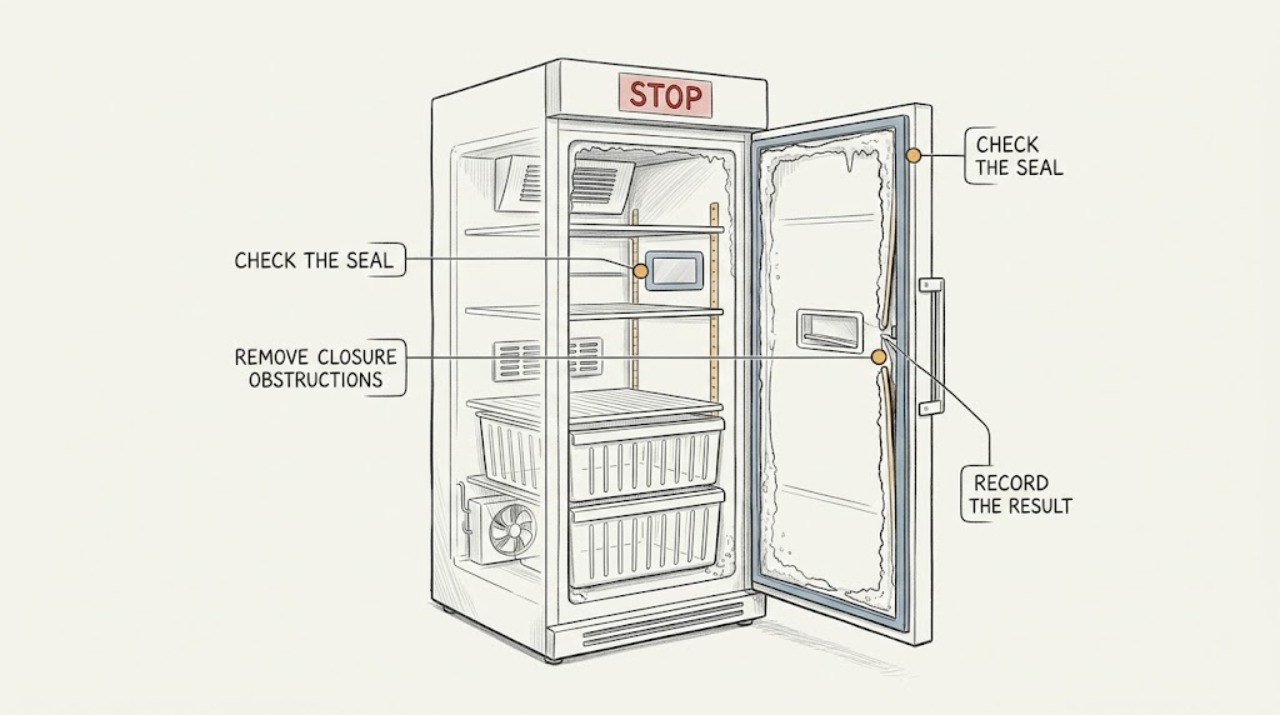
Work through in order
Diagnostic checks
Use only checks that match the exact appliance or system and its official guide.
-
Check 1
With the freezer closed, inspect the gasket and cabinet contact around the entire door or lid. Place a sheet of paper between the gasket and frame at several positions, close the door, and pull gently. Do not force the door or pry the gasket.
Expected result: The paper has consistent resistance, slides out freely at one or more points, the gasket is torn or split, the gasket is pulled out of its retainer, or frost is concentrated along one edge.
Next step: Photograph the gap and continue with the closure and obstruction checks. Clean and reseat only a visibly loose gasket if the owner's manual permits; arrange a model-specific gasket or service if it is torn, deformed, or still fails the test.
Stop if: Stop if the door is warped, hinges are damaged, frost prevents safe closure, or fixing the gap would require removing panels or forcing hardware.
Why this matters
Why: Even resistance makes a major seal gap less likely. Little resistance, a tear, a loose section, or edge frost supports warm-air entry through the seal; a single edge also suggests closure, leveling, hinge, basket, or frost interference may be involved.
-
Check 2
Inspect the door or lid edge, shelves, baskets, and packages for anything holding the freezer open. Remove only an obvious obstruction, ensure baskets or shelves are seated as the manual shows, and check that the freezer sits level enough for the door or lid to close without force.
Expected result: A package, basket, shelf, shipping material, frost ridge, or uneven cabinet prevents full closure; or the door path is clear and closes normally.
Next step: Rearrange packages and reseat removable baskets or shelves, then close the door and repeat the perimeter paper test. Use only the manual's leveling or adjustment method; do not bend hinges or force the door.
Stop if: Do not move a loaded freezer alone, remove fixed panels, force a hinge, or continue if the door cannot close safely.
Why this matters
Why: A closure obstruction can create a seal gap and admit moisture even when the gasket itself is sound. If the path is clear but a gap remains, the gasket, hinge or leveling adjustment, or door alignment needs model-specific attention.
-
Check 3
Turn the freezer off only when needed for safe cleaning, wipe the gasket and mating frame with warm soapy water, and dry them completely. Inspect for crumbs, grease, hardened residue, or a section that will not sit in its groove. Keep the door closed between checks and minimize openings while the frost source is corrected.
Expected result: Residue prevents contact, the gasket seats evenly after cleaning, a section remains out of its groove, or a tear, split, hard deformation, or persistent gap remains.
Next step: Repeat the paper test after cleaning. Monitor one normal stabilization period if the seal is even; if the gap persists, use the exact model information for a gasket or qualified service rather than gluing or stretching the seal.
Stop if: Do not use solvents, glue, sharp tools, a flame, or high heat on the gasket; stop if cleaning would require electrical or internal access.
Why this matters
Why: Residue or a loose section can interrupt the seal and admit humid air. Cleaning may restore contact, but a torn or permanently deformed gasket is not repaired by wiping it and can continue to create frost and longer cooling runs.
-
Check 4
With the door open only briefly, note where frost is accumulating and inspect visible air vents, rear-wall openings, shelves, and food packaging. Keep packages from touching the rear wall or blocking vents, and do not scrape or puncture the liner.
Expected result: Frost is a thin surface layer, frost forms a thick blanket or blocks a vent, packages rest against a wall or vent, frost is concentrated near the leaking edge, or visible airflow paths are clear.
Next step: Remove only the visible food obstruction and follow the owner's manual for any permitted defrost procedure. If frost blocks the door or vents, returns quickly, or the fan is not operating when the manual says it should, arrange service.
Stop if: Do not chip ice, use a knife, open flame, heat gun, or improvised heater, or remove an evaporator or fan cover.
Why this matters
Why: Frequent openings, warm or uncovered food, high humidity, packages against a wall, and blocked vents can add moisture or reduce airflow. Frost concentrated at the gasket supports infiltration; a thick blanket that returns with a good seal can indicate a defrost or fan problem.
-
Check 5
If the manual allows user defrosting and frost is preventing the door seal or airflow, protect the food, disconnect power as the manual directs, and use only that documented defrost method. After the freezer is dry and reassembled, restore power and repeat the seal and vent checks once.
Expected result: Frost clears and the gasket closes evenly, frost remains because a component or area cannot be safely defrosted, or frost returns after the door seals and airflow are corrected.
Next step: Monitor the freezer and minimize humid-air entry only if the seal remains even. Arrange qualified service for returning frost, a non-working fan, a frost-free unit that repeatedly ices, or any procedure not covered by the manual.
Stop if: Do not disassemble internal components, bypass a defrost control, or apply heat directly to the liner, wiring, evaporator, or refrigerant tubing.
Why this matters
Why: A lasting clear seal after a permitted defrost supports accumulated moisture or a closure obstruction as the immediate cause. Frost that returns despite a good seal and clear airflow points toward a defrost, fan, control, or other appliance fault.
-
Check 6
After one stabilization period with the door or lid closed, check the food or appliance thermometer and record whether the compressor is running normally. Note the seal test, frost location, room humidity, control setting, fan sound if safely audible, and any alarm.
Expected result: The freezer reaches and holds its normal frozen temperature with no new heavy frost, the gasket still has gaps, frost returns, food is softening, the fan is silent, or an alarm persists.
Next step: Continue normal use only when the seal is even and the freezer is stable. Otherwise keep the door closed, protect food, and arrange qualified appliance service with the recorded observations; do not order a defrost or fan part from frost location alone.
Stop if: Stop for a damaged cord, smoke, burning odor, water near electrical components, exposed wiring, or an unusually hot compressor or control area.
Why this matters
Why: Stable temperature with no recurring frost supports a corrected air-leak or moisture cause. A persistent gap, returning heavy frost, softening food, silent fan, or alarm means the external checks did not establish a repair and an internal component or cooling diagnosis is needed.
Use your observations
Decision map
Find the observation that best matches what you see, then follow the next safe action.
-
PATH 01Next step
What you see
Paper pulls out with little resistance at a section, the gasket is torn or split, or the door does not touch the frame evenly.
Do this next
Clean and inspect the gasket, remove closure obstructions, and use model-specific instructions for a loose gasket or adjustment. Arrange service or a correctly identified gasket if it remains damaged or uneven.
Why this path and its safety boundary
Why it matters: Warm humid air is likely entering at the seal, making frost and longer cooling operation more likely; the obstruction or alignment still needs to be ruled out.
-
PATH 02Next step
What you see
A package, basket, shelf, shipping piece, frost ridge, or uneven placement holds the door or lid open.
Do this next
Remove the visible obstruction, reseat removable parts, and follow the manual's leveling guidance. Repeat the full perimeter seal check and monitor for new frost.
Why this path and its safety boundary
Why it matters: The gasket may be serviceable; the gap is being created by closure geometry rather than a failed seal alone.
-
PATH 03Next step
What you see
Frost follows frequent openings, humid conditions, warm or uncovered food, packages against a wall, or blocked vents, while the gasket closes evenly.
Do this next
Minimize openings, organize food, clear visible vents, and use the manual's permitted defrost method if needed. Arrange service if heavy frost does not clear or returns.
Why this path and its safety boundary
Why it matters: Moisture entry or restricted airflow is more likely than a torn gasket; a large frost load can later prevent the door from sealing.
-
PATH 04Next step
What you see
The gasket has even resistance, closure is unobstructed, vents are clear, but a frost-free freezer repeatedly develops heavy frost or the fan is not operating.
Do this next
Do not remove the evaporator or fan cover. Arrange qualified appliance service and provide the frost location, return interval, temperature, and fan or alarm observations.
Why this path and its safety boundary
Why it matters: A defrost system, fan, control, or airflow fault is more likely than an external door gap.
-
PATH 05Next step
What you see
Food is softening, the freezer cannot hold temperature, an alarm persists, or frost and a seal gap recur after one safe correction.
Do this next
Keep the door closed, protect food according to local food-safety guidance, and arrange prompt service. Do not keep scraping frost or repeatedly changing the control.
Why this path and its safety boundary
Why it matters: The issue is no longer cosmetic frost alone; continued warm-air entry or an internal cooling fault can compromise food and appliance operation.
Helpful context
Understand the symptom
A seal gap is both a frost cause and a closure problem
Frost forms when warm, moist room air enters the freezer and freezes on cold surfaces. A gasket that does not touch the cabinet evenly can let that air in; the resulting frost can then make the gap larger or keep the door from closing. A little frost during humid weather or frequent openings is different from a thick blanket that blocks vents or closure. Treat the visible gap as a finding to verify, not proof that the gasket is the only failed part.
Check the whole door path before ordering a gasket
Packages, shelves, baskets, shipping material, an unseated gasket, an unlevel cabinet, and frost at the frame can all create an apparent seal gap. The paper test should be repeated around the full perimeter, not just at the most frosted corner. A gasket that seals evenly after the obstruction is removed does not need replacement solely because frost was present.
Recurring frost after a good seal needs service diagnosis
If the door seals evenly and vents are clear but heavy frost returns, a defrost system, fan, control, or another cooling issue may be involved. Frost on a frost-free appliance should not simply be scraped away repeatedly. Use only the defrost method in the owner's manual and keep sharp tools, flames, and improvised heaters away from the liner and refrigeration components.
Safety boundary
Stop conditions
- Do not chip or puncture frost, use an open flame, heat gun, hair dryer, or improvised heater, or scrape the liner.
- Do not remove evaporator, fan, electrical, or refrigeration covers, bypass a defrost control, or work on refrigerant tubing.
- Do not force the door, bend hinges, stretch or glue a gasket, or move a loaded freezer alone.
- Stop and arrange prompt service if the gasket remains damaged, frost returns after one safe correction, the fan is not operating, food is softening, or an alarm persists.
- Disconnect power only by the normal plug or breaker when safe and when the owner's manual directs it for an approved cleaning or defrost step; stop for smoke, burning odor, a damaged cord, exposed wiring, or water near electrical components.
Only after diagnosis
Potential parts
- Freezer door or lid gasket
Consider this category only when the full-perimeter paper test and inspection confirm a torn, split, deformed, or persistently non-sealing gasket after closure obstructions are corrected.
Confirm the freezer model, door or lid design, gasket profile, and manufacturer's fit information before ordering. - Door hinge, basket, or leveling hardware
Consider this category only when the gasket is intact but a hinge, basket, shelf, or leveling condition prevents even door contact and the model manual identifies an adjustment or part.
Confirm the exact model and adjustment procedure; do not bend hinges or move a loaded appliance alone. - Evaporator fan motor
Consider this category only when a qualified technician confirms that a model-equipped fan is not running and airflow blockage is not the cause.
Confirm the exact model, fan assembly, connector, and service procedure; do not reach into a moving fan or remove its cover. - Defrost heater, sensor, or control
Consider this category only when heavy frost returns with a good door seal and a technician confirms a defrost-system fault.
Confirm the freezer model, defrost design, sensor or heater identity, and service requirements before ordering. - Freezer temperature control or sensor
Consider this category only when measured temperature and recurring frost support a control or sensor diagnosis after seal, airflow, and permitted defrost checks.
Confirm the exact model, control revision, sensor type, and manufacturer's service information before ordering.
When checks do not resolve it
Need a professional?
Arrange qualified appliance service when a door or lid gasket remains torn, deformed, or gapped after cleaning and obstruction checks; when heavy frost returns despite an even seal and clear vents; when the fan is not operating; or when defrost, control, temperature, or cooling diagnosis is needed. Seek prompt help if food is softening, the freezer cannot hold temperature, an alarm persists, or there is smoke, burning odor, exposed wiring, a damaged cord, or water near electrical components.
Safety scope: This article covers visible seal and closure checks, gasket cleaning, package and vent organization, model-directed placement review, a paper seal test, and only the owner's manual's permitted defrost procedure. A technician must handle internal fan, defrost, control, electrical, refrigeration, and inaccessible gasket or hinge work.
Common questions
FAQ
Why does a freezer with a door seal gap build excessive frost?
A gap lets warm, humid room air enter. That moisture freezes on cold surfaces and can accumulate until it blocks airflow or keeps the door from closing. First rule out packages, baskets, shelves, frost ridges, and leveling problems before deciding the gasket itself needs replacement.
How can I test a freezer door gasket for gaps?
Place a sheet of paper between the gasket and frame at several points, close the door, and pull gently. You should feel resistance around the perimeter. If paper pulls out easily at a section, inspect for debris, misalignment, a package obstruction, an unseated gasket, or damage; do not force or bend the door.
Can a package or basket cause a freezer door seal gap?
Yes. A package, shelf, basket, shipping material, or frost ridge can hold the door open or shift the gasket contact. Remove only obvious obstructions, reseat removable parts as the manual shows, and repeat the perimeter seal test.
Should I scrape or heat away excessive freezer frost?
No. Do not chip ice, puncture the liner, use a flame, heat gun, hair dryer, or improvised heater. If the owner's manual permits user defrosting, follow only that documented procedure. Internal or recurring frost needs qualified service.
Why does frost return after I clean the gasket?
Cleaning may remove residue, but it cannot repair a torn or permanently deformed gasket. If the gasket closes evenly and frost still returns, check visible vents and food placement, then arrange service for a possible fan, defrost, control, or cooling fault.
Can excessive frost make a freezer run longer?
Yes. Frost can reduce airflow and a poor door seal lets warm air in, so the freezer works harder to maintain temperature. Clear only visible obstructions and use the manual's permitted defrost method; persistent frost is not solved by repeatedly scraping it.
When should I call a freezer technician for frost and a door gap?
Call when the gasket remains torn or gapped after cleaning and obstruction checks, heavy frost returns with an even seal, the fan is not operating, food is softening, temperature cannot be maintained, or an alarm persists. Do not remove internal covers or diagnose a defrost or sealed cooling system yourself.
Read the exact guide
Official sources
- Refrigerator & Freezer - Ice on Freezer WallGE Appliances · Official GE refrigerator and freezer support guidance; model manual controls defrost and cleaning procedures.
- Freezer Runs Too MuchFrigidaire · Official Frigidaire freezer support guidance for extended running; model manual controls exact setting and recovery procedure.
- Door is Not Sealing - Forming Frost - Upright FreezerWhirlpool Corporation · Official Whirlpool upright-freezer support guidance; apply model-specific closure and installation instructions to other freezer types.
- How to Avoid Frost Build UpWhirlpool Corporation · Official Whirlpool general freezer frost guidance; model manual controls defrost and cleaning details.
Community feedback
Share a repair observation
Share a plain-text repair observation. Accepted observations are published automatically; this page may take a moment to update.