
On this page
Start here
Quick answer
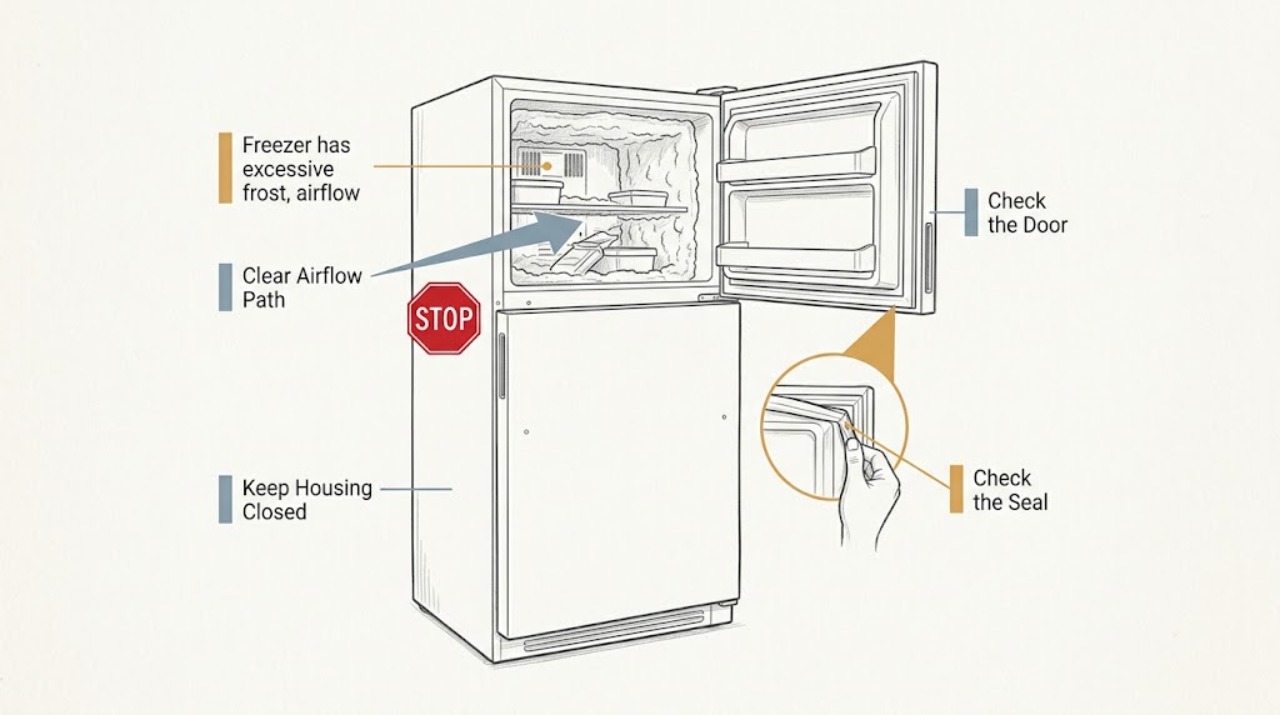
Excessive frost can cover freezer vents or the evaporator area and reduce airflow, but the frost is usually a result of moisture entering or a defrost problem rather than a stand-alone part diagnosis. First check that packages are not blocking vents, the door closes completely, and the gasket is clean and intact. If the frost is heavy, move food to safe cold storage and follow the appliance manual's defrost procedure; do not chip ice with a sharp tool or use a hair dryer. After the frost is cleared, leave space around vents and avoid putting warm or uncovered food inside. If frost returns quickly, the door will not seal, the fan makes abnormal noise, temperatures remain uneven, or the freezer cannot be safely defrosted, arrange qualified appliance service.
Before you begin
Safety first
- The homeowner scope is limited to moving packages, checking closure and the gasket, cleaning the seal, clearing accessible vents, safe manual defrost according to the owner manual, and observing the result. Do not chip ice, use a hair dryer or flame, remove an evaporator cover, test live parts, handle refrigerant, or replace defrost or fan components without qualified diagnosis.
Work through in order
Diagnostic checks
Use only checks that match the exact appliance or system and its official guide.
-
Check 1
Map the frost and airflow pattern without removing an interior panel. Note whether frost is on the door perimeter, rear wall, vents, drawers, or a concentrated evaporator area, and whether airflow is weak in one compartment or throughout the freezer.
Expected result: Frost is concentrated near a door gap or front edge; vents are covered; the rear wall or evaporator area is heavily iced; or the entire compartment has reduced airflow and uneven temperature.
Next step: Photograph the pattern and continue with the door, storage, and safe defrost checks. Do not remove an evaporator cover to inspect hidden components.
Stop if: Stop for damaged liner or wiring, exposed refrigerant tubing, water near electrical parts, food-safety concerns, or any need to pry ice from a panel.
Why this matters
Why: Front-edge frost favors humid air entering through a door or gasket. Frost over vents can directly reduce circulation. A heavy rear or evaporator blanket makes airflow and defrost problems more likely, while whole-compartment symptoms need more than a single blocked package check.
-
Check 2
Check that the freezer door or drawer closes completely: remove packages that interfere with closure, inspect the gasket around its full perimeter, and clean food residue with warm soapy water before drying it. Check for a visible tear, split, gap, or gasket pulled away from its channel without forcing it.
Expected result: A package blocks closure; the gasket is dirty but intact; the gasket is torn, split, or pulled away; or the door appears fully sealed with no obstruction.
Next step: Remove only the obstruction or clean and reseat a gasket that is merely pulled from its channel when the manual permits. If the seal is damaged, the door is misaligned, or frost persists with a good seal, arrange service or follow the model manual.
Stop if: Stop for a warped door, broken hinge or rail, torn gasket that will not seat, trapped wiring, or any need to disassemble the door.
Why this matters
Why: A closure obstruction or dirty gasket can admit warm humid air and create frost. A damaged gasket can require replacement. A confirmed seal shifts attention toward storage, airflow, or defrost operation rather than continuing to adjust the door.
-
Check 3
Rearrange food only from safe, accessible areas: move packages away from the rear wall and internal vents, avoid overpacking, and do not place warm or uncovered food inside. Keep doors open only as long as needed and confirm drawers and shelves do not hold the door open.
Expected result: A package was against a vent or rear wall, the freezer was overpacked, warm or uncovered food had been added, or storage was already clear and organized.
Next step: Leave clear space around vents and observe after a safe frost removal or defrost. Do not scrape frost to make a narrow air path or continue operating with the fan obstructed.
Stop if: Stop if food is thawing, an interior panel is iced solid, the fan is scraping, or the needed rearrangement would damage shelves, drawers, or the door seal.
Why this matters
Why: Blocked vents and excess warm moisture can reduce airflow and create more frost. If storage is corrected but the vents remain iced, frost must be cleared safely; if the arrangement was already good, storage is less likely to be the sole cause.
-
Check 4
If frost is light, wipe it with a damp cloth and dry the compartment. If it is heavy or blocks vents, protect the food and follow the exact owner manual for a manual defrost. Do not use a hair dryer, open flame, sharp knife, screwdriver, or force against the liner or an iced cover.
Expected result: Light frost clears without damage; heavy frost requires a full defrost; frost cannot be removed using the manual's normal procedure; or ice returns immediately after the compartment is clear.
Next step: After a complete safe defrost, restore the intended temperature and storage layout and monitor airflow and frost recurrence. Arrange qualified appliance service if the frost returns quickly or hidden access is required.
Stop if: Stop for a damaged liner, water contacting electrical parts, abnormal odor, exposed wiring, a fan that is scraping or stalled, or any need to heat or pry concealed ice.
Why this matters
Why: A safe complete defrost can restore airflow when frost itself is the obstruction. An inability to defrost safely, immediate recurrence, or ice behind a cover suggests an underlying door, defrost, fan, sensor, or control issue rather than routine surface frost.
-
Check 5
After the freezer is clear and closed, observe one normal cooling period without repeatedly opening the door. Record whether airflow returns, temperatures become even, the compressor or fan sounds normal, and frost begins again at the same location or across the compartment.
Expected result: Airflow and temperature recover and frost stays limited; airflow remains weak; frost returns rapidly; the fan makes scraping or abnormal noise; or the compressor runs continually while cooling remains poor.
Next step: Keep the door closed as much as practical, protect food if temperatures rise, and arrange qualified appliance service for persistent or recurring symptoms. Provide the frost map, defrost date, door-seal result, and sound pattern.
Stop if: Stop using the appliance if food is not staying safely frozen, the motor or fan is overheating or scraping, smoke or burning odor appears, or water reaches electrical components.
Why this matters
Why: Improvement after correcting a gap or blocked vent supports an air-entry or storage cause. Persistent weak airflow, rapid repeat frost, abnormal fan noise, or continuous operation suggests a defrost, fan, control, gasket, or sealed-system issue needing diagnosis.
Use your observations
Decision map
Find the observation that best matches what you see, then follow the next safe action.
-
PATH 01Safety boundary
What you see
Frost is concentrated at the door edge, the door was blocked by a package, or the gasket is dirty or pulled from its channel.
Do this next
Remove the obstruction, clean and dry the gasket, reseat it only as the manual permits, and confirm the door closes evenly before monitoring frost recurrence.
Why this path and its safety boundary
Safety stop: Do not force a misaligned door, bend a torn gasket, or disassemble hinges or rails as a first response.
-
PATH 02Safety boundary
What you see
Food packages rest against vents or the rear wall, the freezer is overpacked, or warm or uncovered food was recently stored.
Do this next
Rearrange food to leave the vents and rear wall clear, limit door-open time, and allow the freezer to stabilize after safe frost removal.
Why this path and its safety boundary
Safety stop: Do not chip frost away to create a vent opening or operate with the internal fan blocked.
-
PATH 03Safety boundary
What you see
A heavy frost blanket covers vents or the evaporator area and airflow is reduced, but there is no immediate electrical, water, or mechanical hazard.
Do this next
Protect the food and perform only the manual's safe defrost procedure; use a damp cloth or approved plastic scraper for light accessible frost and avoid heat or sharp tools.
Why this path and its safety boundary
Safety stop: Stop if ice is behind a cover, the liner will not release it safely, the fan scrapes, or the manual does not describe a user defrost procedure.
-
PATH 04Safety boundary
What you see
Frost returns quickly after a complete safe defrost and a confirmed door seal and clear storage path.
Do this next
Arrange qualified appliance service to evaluate the defrost system, fan, sensor, control, or other model-specific cause; provide the recurrence timing and frost location.
Why this path and its safety boundary
Safety stop: Do not repeatedly defrost as the only remedy, remove the evaporator cover, or replace a heater, sensor, timer, or control from the symptom alone.
-
PATH 05Safety boundary
What you see
The freezer remains warm or airflow remains weak, the fan makes scraping or abnormal noise, or the compressor runs continually after frost is cleared.
Do this next
Protect food and arrange appliance service for fan, airflow, defrost, temperature-control, or sealed-system diagnosis; keep the appliance accessible for the technician.
Why this path and its safety boundary
Safety stop: Stop operation for smoke, burning odor, overheating, exposed wiring, or food no longer staying safely frozen.
-
PATH 06Safety boundary
What you see
Water from defrosting reaches electrical components, the liner or evaporator tubing is damaged, or safe frost removal is not possible.
Do this next
Disconnect power only if it can be done without contacting water or damaged wiring, protect food, and obtain qualified appliance service.
Why this path and its safety boundary
Safety stop: Do not use a hair dryer, heat gun, open flame, knife, screwdriver, or other tool to force the ice away.
Helpful context
Understand the symptom
Reduced airflow is a symptom, not proof of one failed part
A frost-covered vent can make airflow feel weak even when the fan is operating. Frost forms when warm, moist air enters and freezes, and it can then block the same vents needed to circulate cold air. The useful sequence is to check the door seal and storage layout, clear frost safely, and see whether the problem returns before assuming the defrost heater, timer, sensor, or fan needs replacement.
Check the door and storage path first
A package can prevent a drawer or door from closing, and a dirty, pulled-away, split, or torn gasket can let humid room air in. Keep items away from the internal vents and rear wall, leave room for air to circulate, and let hot items cool before storing them. A flashlight or paper check can reveal a door gap, but do not force a misaligned door or bend the gasket into place.
Defrost without damaging the freezer
Light frost can be wiped away with a damp cloth and dried. Heavy frost may require a manual defrost using the exact owner instructions, with food protected in another cold location. Samsung cautions against using a hair dryer, and a sharp scraper can damage the liner or concealed refrigerant tubing. Do not remove an evaporator cover or use heat unless the manual explicitly provides a safe procedure for that model.
A recurring frost blanket needs diagnosis
If frost quickly covers the vents or evaporator area again after a complete safe defrost and a confirmed door seal, a defrost timer, heater, sensor, fan, control, or sealed-system issue may be involved. Those parts are model-specific and often require access behind a panel. Do not keep defrosting indefinitely while food temperature is rising or the fan is scraping ice; arrange appliance service and provide the frost location and recurrence timing.
Only after diagnosis
Potential parts
- freezer door gasket
Consider a gasket only when the door fails a full-perimeter closure check and the seal is torn, split, permanently deformed, or cannot be reseated according to the manual.
Match the exact appliance model, door or drawer orientation, gasket profile, and installation method; a visible frost pattern alone does not establish gasket failure. - defrost heater, sensor, timer, or control component
Consider these categories only after a qualified technician confirms rapid frost recurrence with a sound door seal and clear airflow path.
Defrost components are model-specific and involve electrical access behind panels; do not select or replace one based only on reduced airflow. - evaporator fan or fan motor
Consider this category only when professional testing or a clear model procedure confirms that the fan is stalled, noisy, or not moving air after frost is safely cleared.
Match the exact model, fan blade, motor, connector, voltage, and ice-clearance design; do not reach through an iced cover or operate a scraping fan.
When checks do not resolve it
Need a professional?
Escalate for rapid frost recurrence, a damaged or misaligned gasket, persistent weak airflow, abnormal fan noise, continuous compressor operation, unsafe or inaccessible defrosting, or any suspected defrost-system, control, sealed-system, or electrical fault.
Safety scope: The homeowner scope is limited to moving packages, checking closure and the gasket, cleaning the seal, clearing accessible vents, safe manual defrost according to the owner manual, and observing the result. Do not chip ice, use a hair dryer or flame, remove an evaporator cover, test live parts, handle refrigerant, or replace defrost or fan components without qualified diagnosis.
Have this ready
- Provide the appliance model, freezer type, frost location and thickness pattern, door-seal and storage observations, whether vents are blocked, date and method of the last safe defrost, temperature behavior, fan or compressor sounds, and whether the refrigerator compartment is also affected.
Common questions
FAQ
Why does excessive frost reduce freezer airflow?
Frost can cover internal vents or the evaporator area, physically narrowing the air path and causing uneven temperatures. Clear storage obstructions and follow the manual's safe defrost process; if frost returns quickly, the underlying door or defrost system needs diagnosis.
Can a bad freezer door gasket cause heavy frost?
Yes. A dirty, torn, split, or poorly seated gasket can let warm humid air in. Check the full perimeter and remove packages that prevent closure. Replace a damaged gasket only with the exact model part or arrange service.
How should I remove heavy freezer frost?
Protect the food and follow the exact owner manual for a manual defrost. Do not use a hair dryer, open flame, knife, screwdriver, or force against the liner or an iced evaporator cover. A qualified technician should handle inaccessible or recurring ice.
Why does frost return after I defrost the freezer?
A door gap, damaged gasket, frequent humid-air entry, blocked vents, or an underlying defrost, fan, sensor, or control problem may remain. Confirm the seal and storage path, then arrange service if frost rapidly covers the vents again.
When should I call appliance repair for freezer frost and reduced airflow?
Call when safe defrosting is not possible, frost returns rapidly, the door or gasket will not seal, the fan scrapes or stops, the compressor runs continually, temperatures remain unsafe, or the next step would require removing an interior panel or testing electrical parts.
Read the exact guide
Official sources
- 7 Freezer Problems & How to Help Fix ThemWhirlpool · Whirlpool general freezer troubleshooting guidance; model manuals control access and exact repair steps.
- Whirlpool Chest Freezer Use and Care GuideWhirlpool · Whirlpool chest-freezer manual used for general safe-maintenance patterns; the owner's manual for the installed model controls.
- How to Avoid Frost Build UpWhirlpool · Whirlpool consumer guidance used for general freezer frost patterns; exact appliance features and service procedures vary by model.
- Frost forms in the Samsung freezer, refrigerator, or ice bucketSamsung · Samsung consumer guidance used for general freezer frost and airflow patterns; the installed appliance manual controls exact defrost and service procedures.
Community feedback
Share a repair observation
Share a plain-text repair observation. Accepted observations are published automatically; this page may take a moment to update.