
On this page
Start here
Quick answer
Excessive frost does not prove the defrost thermostat is bad. Frost can come from warm moist air entering through a door or gasket, blocked vents, a warm food load, or a fan or airflow problem; in a frost-free freezer, frost that returns after a proper defrost can also indicate a defrost thermostat, heater, timer, control, drain, or fan fault. First photograph where the frost is, check that the door closes and its gasket seals, and clear obvious food or vent obstructions without removing panels. If heavy frost blocks airflow, follow the freezer's owner manual for a safe manual-defrost procedure; never chip ice with a sharp tool or use a hair dryer or other heat source. After the freezer is fully back in service, note whether frost returns and where. Do not remove the evaporator cover, test a thermostat with live power, cut wires, or substitute a part by appearance. Arrange qualified appliance service when frost returns in a frost-free unit, the evaporator fan is blocked or silent, the temperature rises, water collects, the gasket or cabinet is damaged, or diagnosis requires accessing the defrost circuit.
Before you begin
Safety first
- Do not remove an evaporator cover, cut wires, test terminals or continuity, work on energized circuits, chip ice with sharp or metal tools, use a hair dryer, heat gun, flame, or other heat source, or replace a thermostat by appearance. Stop for smoke, burning odor, exposed wiring, repeated electrical trips, water near electrical parts, damaged liner, or unsafe food temperature.
Work through in order
Diagnostic checks
Use only checks that match the exact appliance or system and its official guide.
-
Check 1
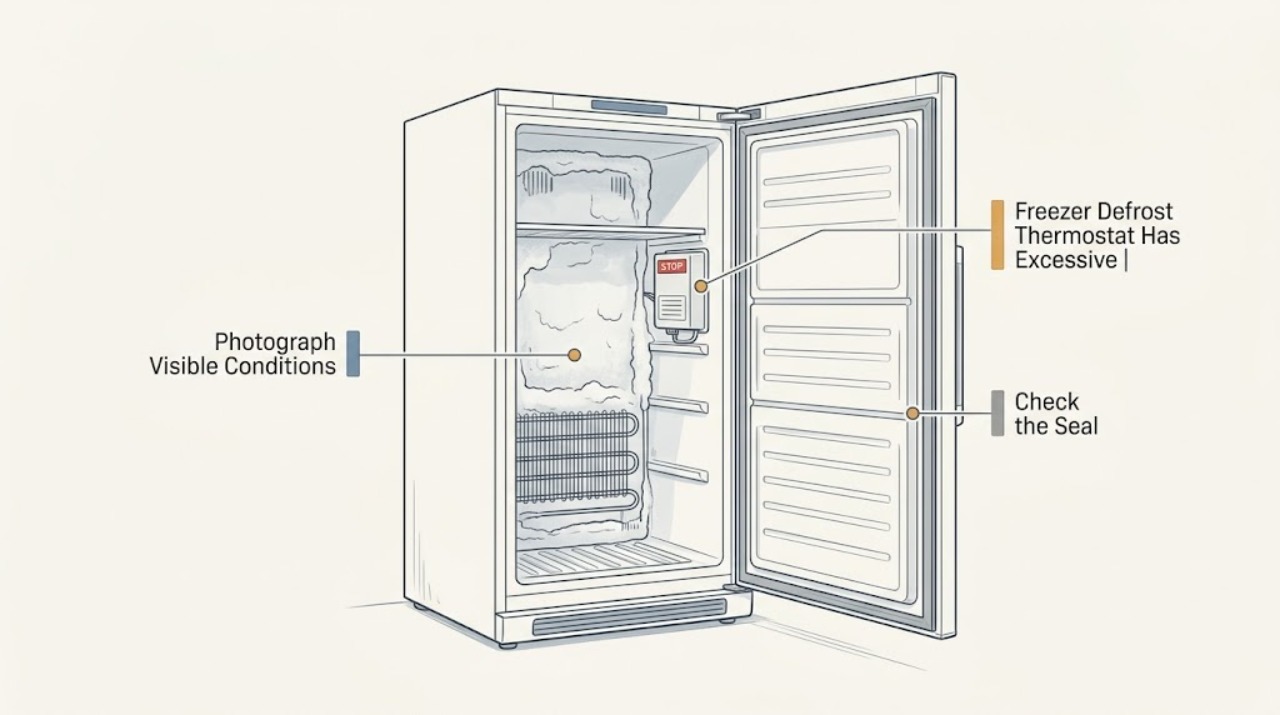
Photograph and map the frost before disturbing it. Note whether it is concentrated around the door opening and gasket, on the rear wall or evaporator-cover area, around vents, on packages, or across most of the compartment; also record the freezer temperature symptom and whether the door has been hard to close.
Expected result: Frost is localized at the door edge; a rear panel or vent is blanketed; only packages have crystals; or frost covers a broad area and the freezer is warming.
Next step: Keep the photos and use the matching door, airflow, or defrost branch. Do not remove the rear panel to see the evaporator; arrange service if the freezer is warming, food is softening, or the pattern is broad and recurring.
Stop if: Stop if ice is holding the door open, the liner or gasket is torn, water is near electrical parts, or access would require removing an interior panel.
Why this matters
Why: Door-edge frost makes warm-air entry more likely, package crystals can follow moisture from food or door openings, and a broad rear-panel blanket can obstruct airflow or reflect a defrost-system problem. Frost plus rising temperature or blocked vents is more urgent than a small edge film.
-
Check 2
Check the door and gasket from the outside of the closed compartment. Confirm that packages, shelves, drawers, or ice are not preventing closure; inspect the rubber seal for dirt, splits, warping, or a section pulled out of its channel; and note whether the door sits squarely against the cabinet without forcing it.
Expected result: The door is held open by a package or frost; the gasket is dirty but intact; the gasket is torn, warped, or separated; or the door closes evenly with no visible gap.
Next step: Remove only the ordinary obstruction and clean or reseat an intact gasket according to the owner guidance. Do not stretch, glue, heat, or replace a gasket by guesswork; request service for a damaged seal, misalignment, cabinet distortion, or frost that returns with a good closure.
Why this matters
Why: A closure obstruction or damaged seal can admit humid room air and produce recurring frost without a failed thermostat. A clean, intact seal with a firm closure makes a hidden defrost or airflow issue more likely if the frost is on the rear wall or returns after defrost.
-
Check 3
Check the freezer's air path without opening the evaporator cover. Look for food pressed against the rear wall or covering vents, a fan opening buried in frost, or an overloaded compartment that prevents circulation; note whether the fan can be heard during a normal cooling period without holding a door switch or reaching into the opening.
Expected result: Vents are blocked by food or frost; the freezer is tightly packed; the fan is silent or repeatedly hitting ice; or the vents and fan sound normal.
Next step: Move food only enough to restore the clearance specified by the owner manual, without chipping ice or removing covers. If the fan remains silent, strikes ice, or the frost returns after the air path is clear, arrange appliance service.
Stop if: Stop if checking the fan would require a finger, tool, door-switch manipulation, panel removal, or contact with ice-covered wiring.
Why this matters
Why: Blocked vents and a fan obstructed by ice can reduce circulation and allow frost to build. A silent fan can require service. Normal visible airflow does not rule out a heater, thermostat, timer, or control fault behind the cover.
-
Check 4
Determine whether this freezer is frost-free or manual-defrost from its owner manual, model documentation, or clearly labeled controls. For heavy frost, use only the documented defrost method for that model and protect food and flooring; do not use a hair dryer, heat gun, open flame, sharp tool, metal scraper, or improvised hot-water treatment.
Expected result: The documentation identifies automatic defrost; it identifies manual defrost; no reliable manual is available; or the frost is too hard or extensive for the documented user procedure.
Next step: Follow the owner manual and record the condition after the freezer returns to normal operation. If there is no safe, model-specific procedure or the frost is extensive, keep the unit closed as practical and arrange service rather than dismantling it.
Stop if: Stop the defrost attempt for damaged liner, leaking water near electrical parts, smoke, burning odor, a cracked shelf or gasket, or any need for an unapproved heat source.
Why this matters
Why: An automatic-defrost freezer should normally remove evaporator frost on its own, so recurring heavy frost after safe door and airflow corrections raises a defrost-system or fan question. A manual-defrost freezer can naturally accumulate frost and should be handled by its manual. Missing documentation or extreme buildup makes improvised defrosting unsafe.
-
Check 5
After a documented, complete defrost and restored door and vent clearance, observe the same areas over the next comparable use period. Record whether frost returns first at the door edge, at one rear area, around a vent, or broadly across the evaporator-cover area, and whether the freezer maintains normal food firmness.
Expected result: Frost does not return; it returns at the door edge; it returns as a broad rear blanket or around vents; or the freezer warms even while frost is present.
Next step: Use the pattern and photos when requesting service. Do not repeatedly perform full defrosts as the only fix, because clearing ice can hide the original defrost or airflow fault and water can damage the appliance or floor.
Why this matters
Why: No return supports an air-entry or temporary load explanation. A quick door-edge return keeps the gasket or closure path high on the list. A recurring rear blanket or vent blockage in a frost-free unit makes automatic-defrost, evaporator-fan, or drain trouble more likely; warming with heavy frost can mean airflow is being choked.
-
Check 6
Prepare the service handoff without testing the defrost thermostat yourself. Record the freezer model and serial information from its normal label, the frost pattern, door and vent findings, any fan noise, water on the freezer floor, temperature changes, and whether the condition returns after the manual's defrost procedure.
Expected result: The pattern and model information are available; the thermostat or heater is suspected only because frost returns; or the unit also has water, abnormal noise, food warming, or visible damage.
Next step: Give the technician the photos and timeline and request model-specific defrost-circuit diagnosis. Do not remove the evaporator cover, disconnect wires, measure terminals, or order a thermostat solely from a generic appearance or search result.
Stop if: Stop using the freezer and arrange prompt service for smoke, burning odor, exposed wiring, repeated electrical trips, severe water leakage, or a damaged liner.
Why this matters
Why: A returning pattern alone cannot identify the thermostat: the heater, timer or electronic control, fan, drain, seal, and airflow can produce similar symptoms. Water, warming, or damage changes the priority and may require prompt service or food-safety decisions.
Use your observations
Decision map
Find the observation that best matches what you see, then follow the next safe action.
-
PATH 01Next step
What you see
Frost is concentrated around the door edge, the door was held open or obstructed, the gasket is dirty or visibly damaged, or warm moist air was recently introduced.
Do this next
Restore unobstructed closure and clean an intact gasket according to the manual, then monitor the photographed area. Request service for a torn gasket, misaligned door, cabinet distortion, or frost that returns despite a sound seal.
Why this path and its safety boundary
Why it matters: Air entry is more likely than a failed defrost thermostat. Moisture freezes where the warm air meets the cold compartment and can spread if closure remains poor.
-
PATH 02Next step
What you see
Food or ice blocks rear vents, frost surrounds a fan opening, airflow is weak, or the fan is silent or striking ice.
Do this next
Restore only the documented food clearance and keep hands and tools out of the fan or cover. Arrange service when the fan remains abnormal or the blockage returns.
Why this path and its safety boundary
Why it matters: Circulation trouble is likely contributing to the frost and temperature symptom. The fan or an ice-obstructed evaporator area may need service; the defrost thermostat is not proven by this pattern.
-
PATH 03Next step
What you see
A frost-free freezer has a broad rear or evaporator-cover blanket that returns after a complete documented defrost, while the door seal and food clearance are sound.
Do this next
Arrange a qualified appliance diagnosis of the model-specific defrost system. Do not test continuity, remove the cover, cut wires, or replace a thermostat without the exact model procedure and safe power isolation.
Why this path and its safety boundary
Why it matters: An automatic-defrost circuit problem becomes more likely. The defrost thermostat is one possible component, but the heater, timer or electronic control, wiring, fan, and drainage also need consideration.
-
PATH 04Next step
What you see
The freezer is manual-defrost, or frost followed frequent door opening, uncovered warm food, or a short-term heavy load and does not return after the documented defrost and closure correction.
Do this next
Use the owner manual's maintenance interval and loading guidance, keep the door fully closed, and monitor the same area. Escalate if the frost returns unusually fast, the temperature rises, or the pattern becomes localized and unexplained.
Why this path and its safety boundary
Why it matters: Normal moisture entry or the freezer's operating design is more likely than a defrost-thermostat failure. A manual-defrost model is expected to need periodic defrosting under its instructions.
-
PATH 05Next step
What you see
Ice has melted into the freezer floor, water is reaching electrical areas, the liner or gasket is damaged, food is warming, or there is smoke, burning odor, or repeated power interruption.
Do this next
Stop and arrange qualified appliance service; keep people away from damaged or energized areas and protect the floor only from a safe position. Do not energize, probe, heat, or dismantle the appliance to find the thermostat fault.
Why this path and its safety boundary
Why it matters: The issue has moved beyond routine frost maintenance. A drain, frozen coil, electrical fault, structural damage, or food-safety concern may be involved.
Helpful context
Understand the symptom
Excess frost is a symptom, not a thermostat verdict
In a frost-free freezer, a defrost cycle periodically melts frost that forms on the hidden evaporator. The thermostat is one part of that circuit, alongside a heater and a timer or electronic control. A door that admits humid air can create so much frost that it looks like a defrost failure, and a blocked vent or evaporator fan can make the frost and temperature problem worse. The frost location and what happens after a safe defrost are more useful than guessing from appearance.
Read the pattern before clearing it
A thin film around the door opening points toward air entry. A dense blanket on a rear panel or hidden coil that returns after a complete defrost is more concerning for airflow or automatic-defrost trouble. Frost on packages can follow warm food or frequent door openings and may not indicate a failed component. Photograph the pattern, door edges, vents, and any ice on the floor before cleaning so a technician can see what changed.
Keep defrost and electrical work within the manual or service boundary
Only use a manual-defrost procedure when the owner manual identifies the freezer as a manual-defrost model or provides that procedure for the condition. Keep food safe and protect the floor from meltwater, but do not improvise heat, scrape with metal or sharp tools, remove an evaporator cover, cut wires, or test a thermostat or heater at the terminals. In a frost-free freezer, repeated frost after a safe defrost is a service diagnosis.
Only after diagnosis
Potential parts
- defrost thermostat or defrost terminator
Consider this part only after a qualified technician confirms that the model's defrost thermostat is not opening or closing as specified and that door, airflow, heater, timer or control, and wiring causes have been evaluated.
Match the exact freezer model, thermostat configuration, temperature behavior, connector, mounting method, and manufacturer procedure. A generic-looking thermostat is not evidence of compatibility. - defrost heater
Consider this category only if model-specific service testing identifies an open, damaged, or otherwise failed heater after the frost pattern indicates an automatic-defrost problem.
Confirm exact model, heater shape, electrical specification, mounting, insulation, and required power isolation with a qualified technician. Do not use a heater as a trial replacement for a suspected thermostat. - defrost timer or electronic control
Consider this category only when a technician confirms that the freezer's timer or electronic control is failing to schedule or control defrost and other causes have been ruled out.
Confirm the model's control architecture, connector layout, programming or configuration requirements, and manufacturer fit information before ordering. - freezer door gasket
Consider this part only when the gasket is torn, warped, detached, or unable to seal after ordinary cleaning and closure checks; a broad rear frost pattern does not by itself justify a gasket.
Match the exact model, door orientation, dimensions, attachment method, and corner profile. Do not heat or glue a gasket as an improvised fit.
When checks do not resolve it
Need a professional?
Stop and arrange qualified appliance service for frost that returns in a frost-free freezer after a documented safe defrost, a broad rear-wall or evaporator-cover ice blanket, a fan that is silent or striking ice, a torn gasket or damaged liner, water near electrical parts, food warming, smoke, burning odor, repeated electrical trips, or any need to remove a panel or test the defrost thermostat, heater, timer, control, or wiring. Do not chip ice, use a hair dryer or other heat source, cut wires, or substitute a thermostat by appearance.
Safety scope: Do not remove an evaporator cover, cut wires, test terminals or continuity, work on energized circuits, chip ice with sharp or metal tools, use a hair dryer, heat gun, flame, or other heat source, or replace a thermostat by appearance. Stop for smoke, burning odor, exposed wiring, repeated electrical trips, water near electrical parts, damaged liner, or unsafe food temperature.
Common questions
FAQ
Does excessive freezer frost mean the defrost thermostat is bad?
No. Frost can result from a door or gasket that admits humid air, blocked vents, warm food, frequent openings, or an airflow problem. In a frost-free freezer, frost that returns as a broad rear blanket after the door and airflow causes are corrected makes an automatic-defrost fault more likely, but the thermostat is only one possible part.
How does a freezer defrost thermostat work?
In the service-manual example, the defrost thermostat is in series with the heater. It allows the defrost circuit when cold and opens when a preset temperature is reached, then resets after the cycle and cooling conditions. Exact circuits and temperatures vary by model, so this is a technician-level diagnosis rather than a universal homeowner test.
Can I use a hair dryer to remove freezer frost?
No. Samsung specifically warns that a hair dryer or other heat source can damage the refrigerator. Follow the exact owner-manual defrost procedure for the model, and never use sharp or pointed tools that could damage the refrigeration system. Heavy or unexplained frost is a reason to request service.
Why does frost keep forming on the back wall after I defrost the freezer?
If the door closes and seals, food is clear of vents, and the broad frost pattern returns in a frost-free freezer, an automatic-defrost, fan, drain, or airflow problem becomes more likely. A door-edge return points more toward warm-air entry. Photograph the return pattern and arrange model-specific appliance service instead of repeatedly clearing it as the only fix.
Should I replace the defrost thermostat first?
Not from frost appearance alone. A qualified technician should identify whether the problem is the thermostat, heater, timer or electronic control, wiring, evaporator fan, drain, door seal, or airflow. Provide the model information and before-and-after frost photos, and do not remove panels or test the defrost circuit yourself.
Read the exact guide
Official sources
- Service Manual - 16025629Maytag Services · Manufacturer service documentation used only to explain the defrost thermostat's role and the professional electrical-access boundary; the exact circuit is not generalized to every freezer
- Refrigerator - Automatic Defrost SystemGE Appliances · Manufacturer explanation of how frost-free refrigerators melt evaporator frost and when heavy buildup or abnormal defrosting needs a technician
- Refrigerator - Manual DefrostingGE Appliances · Manufacturer guidance distinguishing manual-defrost operation from frost-free service and warning against sharp tools that can damage the refrigeration system
- Refrigerator & Freezer - Ice on Freezer WallGE Appliances · Manufacturer troubleshooting guidance for ice or frost on a frost-free freezer wall and related airflow or door-seal symptoms
- Frost forms in the Samsung freezer, refrigerator, or ice bucketSamsung · Manufacturer support guidance for distinguishing warm-air entry and blocked airflow from heavy frost requiring service
Community feedback
Share a repair observation
Share a plain-text repair observation. Accepted observations are published automatically; this page may take a moment to update.