
On this page
Start here
Quick answer
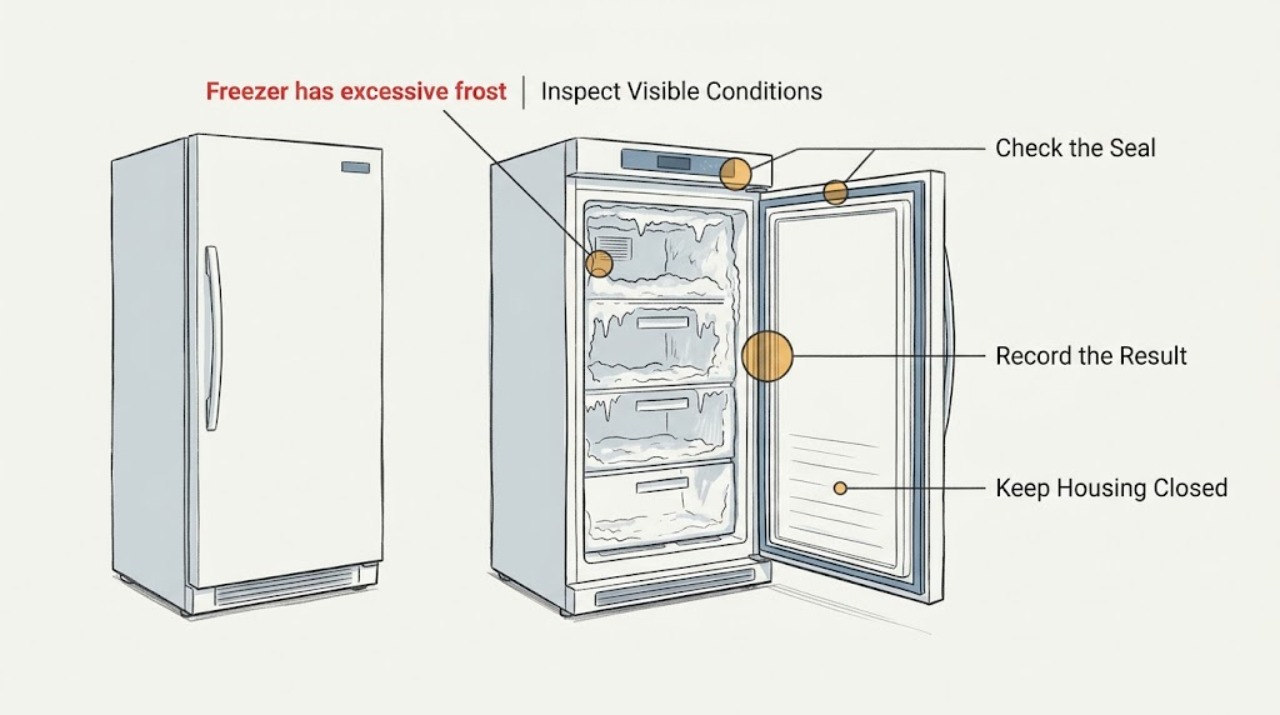
Some frost can be normal, but heavy or repeatedly returning frost usually means warm, moist air is entering, a door is not sealing, airflow is blocked, or a frost-free system needs service. Start with user-visible checks: where the frost is concentrated, whether the door closes and its gasket looks intact, whether food blocks vents or the door, and whether temperature or food condition is changing. Do not remove interior panels, test a defrost heater or thermostat, probe ice, use a sharp tool or direct heat, or open electrical covers. If food is thawing, frost returns after the basic door and loading observations, or a fan/defrost fault is suspected, arrange appliance service and protect food according to food-safety guidance.
Work through in order
Diagnostic checks
Use only checks that match the exact appliance or system and its official guide.
-
Check 1
Look at the frost from inside the freezer without touching or scraping it, and record where it is concentrated.
Expected result: Note whether frost is mainly at the door edge, around a gasket, on packages, near the rear wall or vents, or spread across much of the compartment.
Next step: Photograph the pattern, keep the door closed, and compare it with the door-seal, loading, and temperature observations below.
Stop if: Stop if ice blocks the door, a shelf, or an air path so severely that forcing movement could damage the appliance; arrange service.
Why this matters
Why: Frost near an opening or package can be consistent with warm humid air entering, while a wall or vent pattern that persists needs a service assessment; the location alone cannot diagnose the defrost system.
-
Check 2
Close the freezer door normally and inspect the visible gasket and cabinet contact line without pulling, stretching, or removing the gasket.
Expected result: Look for a package or shelf holding the door open, a visible gap, torn or split gasket, compression, misalignment, or frost concentrated along one sealing edge.
Next step: Remove only an obvious loose food obstruction if it can be done without force, then leave the door closed and request service if the gasket or alignment appears damaged.
Stop if: Stop if the door will not close, the gasket is torn, the cabinet or hinge is damaged, or closing requires force; do not adjust or disassemble the door.
Why this matters
Why: An obstruction or compromised seal can let warm moist room air enter and create frost; a seemingly normal seal does not rule out an internal airflow or defrost problem.
-
Check 3
Observe the visible food arrangement and air-vent area without removing panels or pushing items against a frost-covered wall.
Expected result: Record whether packages touch the rear wall, block a visible vent, prevent a drawer or door from closing, or leave little space for the normal air path.
Next step: Move only a loose package that is clearly blocking normal door closure or a visible vent, without breaking ice or forcing frozen items, and monitor the pattern through normal use.
Stop if: Stop if items are frozen into place, the vent is behind an ice sheet or panel, or access would require force or a tool; arrange service.
Why this matters
Why: Blocked vents or a package holding the door open can increase moisture and frost or reduce air movement; correcting a simple loose-package obstruction is different from testing an internal fan.
-
Check 4
Read the user-accessible temperature setting or display and review recent food condition without changing settings repeatedly or opening the freezer for long periods.
Expected result: Note whether the setting changed accidentally, food is hard-frozen or softening, an alarm is active, and frost is accompanied by a warmer-than-usual compartment.
Next step: Record the display and food condition, keep the door closed, and arrange appliance service if performance is declining or the frost persists after basic visible checks.
Stop if: Stop relying on the freezer for temperature-sensitive food if food is thawing or temperature is uncertain; follow food-safety guidance and request service.
Why this matters
Why: Food softening, a temperature change, or a recurring alarm raises the priority for service and food-safety decisions; frost alone does not prove a cooling or defrost component failure.
-
Check 5
From outside the freezer, listen during normal operation and observe any user-visible fan, alarm, or control indication without removing covers or attempting a defrost test.
Expected result: Note whether the appliance is silent when it normally runs, has an unusual repeated click or alarm, or shows a visible fault indicator alongside the frost.
Next step: Record the sound or indicator and its timing, then provide it with the frost photographs and model information to appliance service.
Stop if: Stop for burning odor, smoke, sparking, damaged cord, water near electrical parts, or a hot abnormal enclosure; disconnecting or inspection should be handled safely by qualified service.
Why this matters
Why: An abnormal operating indication together with heavy frost can require a technician to assess fan, defrost, sensor, or control functions; the user should not test those parts directly.
Use your observations
Decision map
Find the observation that best matches what you see, then follow the next safe action.
-
PATH 01Safety boundary
What you see
The door is blocked or visibly fails to seal, and frost is concentrated around the opening.
Do this next
Remove only a loose obstruction if safe and leave the door closed; arrange service for a damaged gasket, hinge, alignment, or persistent gap.
Why this path and its safety boundary
Safety stop: Do not force the door, pull the gasket, or disassemble the hinge or door.
-
PATH 02Safety boundary
What you see
Packages block a visible vent or touch the rear wall, with no sign of damage or forced access.
Do this next
Reposition only loose packages enough to restore normal space and closure, then monitor whether frost stops returning during ordinary use.
Why this path and its safety boundary
Safety stop: Stop if items are frozen in place or the obstruction is behind ice or a panel.
-
PATH 03Safety boundary
What you see
The door and loading look normal, but frost continues, covers a wall/vent, or returns after basic observations.
Do this next
Request appliance service for model-specific assessment of airflow, defrost, fan, sensor, or control functions.
Why this path and its safety boundary
Safety stop: Do not test, bypass, remove, or replace an internal defrost part yourself.
-
PATH 04Safety boundary
What you see
Food is softening, a temperature alarm is active, or the compartment is warmer than expected.
Do this next
Limit door opening, protect food according to food-safety guidance, and arrange service promptly.
Why this path and its safety boundary
Safety stop: Stop treating the appliance as a reliable freezer until temperature and operation are confirmed.
-
PATH 05Safety boundary
What you see
There is a burning odor, smoke, sparking, damaged cord, water near electrical parts, or unusual heat.
Do this next
Keep clear and contact emergency services or qualified appliance/electrical service according to severity.
Why this path and its safety boundary
Safety stop: Do not touch the appliance, open covers, apply heat, or attempt a reset.
Helpful context
Understand the symptom
What the frost pattern can tell you
Frost forms when moisture reaches a cold surface. A pattern around the door edge or packages can suggest warm humid air entering, while frost across an interior wall or recurring ice that affects airflow needs a model-specific assessment. The pattern narrows the next question; it does not identify a defrost part by itself.
Keep the freezer intact
Use only ordinary door, control, and visible storage observations. Do not chip or melt ice with a knife, hair dryer, heater, or other improvised method, and do not remove a liner, fan cover, evaporator cover, heater, thermostat, or wiring. Keep the door closed as much as practical while arranging service.
Only after diagnosis
Potential parts
- freezer door gasket
Consider this category only if the visible door-seal inspection or a technician confirms a torn, split, compressed, or incompatible gasket is allowing warm air into the freezer.
Confirm the appliance model and gasket profile from the manufacturer's fit information before ordering; frost location alone is not proof of fit. - freezer defrost heater
Consider this category only after a qualified technician identifies a defrost-system fault; excessive frost does not justify internal electrical testing or a heater purchase by itself.
Confirm the exact model, defrost-system design, and professional diagnosis before ordering or installing. - freezer defrost thermostat
Consider this category only if service diagnosis identifies the thermostat or sensor path as the cause of recurring frost and reduced defrost performance.
Confirm the model-specific sensor/thermostat specification and approved fit; do not test or replace it with the freezer energized.
When checks do not resolve it
Need a professional?
Request appliance service when frost continues after visible door, loading, and control observations, frost blocks airflow, food is softening, or an internal fan/defrost fault is suspected.
Have this ready
- Provide frost location and photos, door/gasket observations, visible vent and loading conditions, temperature display and food condition, alarm or sound timing, and the appliance model.
Common questions
FAQ
Is some frost in a freezer normal?
Some frost can be normal depending on the design and conditions, but heavy or repeatedly returning frost deserves checks of door closure, gasket, loading, airflow, and temperature, followed by service if it persists.
Can I chip away heavy freezer ice with a knife?
No. Sharp tools or direct heat can damage the liner, tubing, or electrical components. Keep the freezer intact and follow only the model's documented care guidance or arrange service.
What if the frost keeps returning after the door looks sealed?
A normal-looking door does not rule out airflow, fan, defrost, sensor, or control problems. Do not test internal parts; provide photos and observations to an appliance technician.
When should I stop relying on the freezer for food storage?
Stop relying on it when food is softening, a temperature alarm is active, or temperature is uncertain. Keep the door closed, follow food-safety guidance, and arrange service.
Read the exact guide
Official sources
- Frosting in the Freezer Section - Top Freezer RefrigeratorWhirlpool · General user-level frost pattern and loading checks; model-specific details remain subject to the owner's manual
- Refrigerator & Freezer - Ice on Freezer WallGE Appliances · Visible frost, door, package, vent, and user-level observations
- Freezer problemsBosch Home Appliances · General distinction between ordinary frost and excessive frost requiring diagnosis
Community feedback
Share a repair observation
Share a plain-text repair observation. Accepted observations are published automatically; this page may take a moment to update.