
On this page
Start here
Quick answer
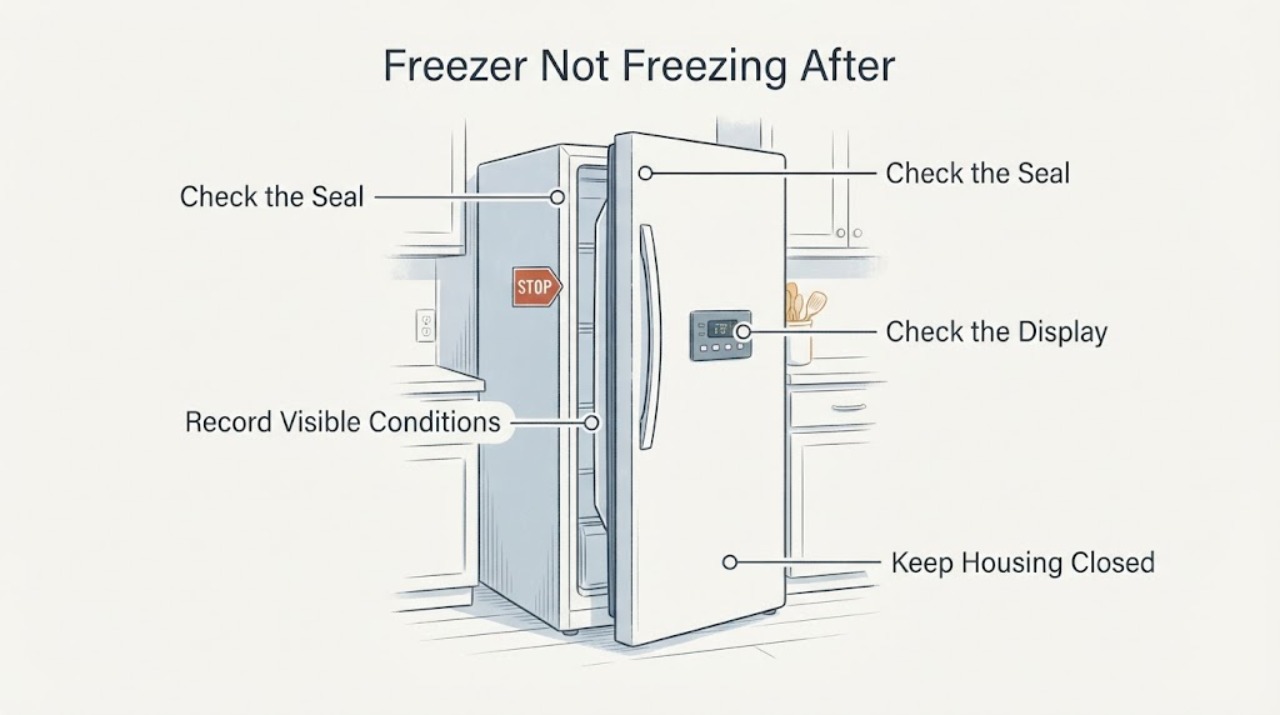
A Liebherr 525i freezer can be warm after its door was left open because Liebherr lists a door left open too long as a cause of a freezer being too warm. Close the door fully, clear anything blocking the seal, verify the freezer setting and warning display, and avoid repeated opening while it recovers. Liebherr recommends -18°C for normal freezer performance; if the setting was changed, allow time for the temperature to settle, and use SuperFrost only if that function is available on the exact appliance. Do not assume a compressor or refrigerant fault from warmth immediately after the door event. If the temperature remains too warm, the door will not seal, alarms persist, or food safety is uncertain, preserve the serial/service number and submit a Liebherr product-fault request rather than opening the sealed system.
Work through in order
Diagnostic checks
Use only checks that match the exact appliance or system and its official guide.
-
Check 1
Close the freezer door completely and inspect the visible gasket and door opening for a drawer, package, ice, or other obstruction; wipe only the accessible seal with clean water if it is dirty, without removing the gasket.
Expected result: The door closes evenly with the seal contacting all around, or it springs back, leaves a gap, or has a split/obstruction.
Next step: Reposition only the visible obstruction and close the door. If the seal is damaged, the door is misaligned, or it will not stay closed, keep the freezer closed as far as possible and request model-specific service rather than forcing or replacing the seal without the exact part information.
Why this matters
Why: Liebherr identifies an improperly closed door and a door seal that is not intact as conditions that can make an appliance too warm; continued heat entry prevents a meaningful recovery assessment.
-
Check 2
Read the freezer temperature setting, actual-temperature display, door/temperature alarm, and any warning symbol with the door closed; record the readings and the time since the door was shut.
Expected result: The set point is warmer than the normal freezer target, the display shows a rising-temperature warning, or the actual temperature remains above the target after the door is closed.
Next step: Restore only the documented temperature setting using the exact operating instructions and avoid repeated door opening. If the display cannot be read, shows dashes, or remains warm, move food to a known-safe freezer/cooler and continue to the service boundary.
Why this matters
Why: Liebherr recommends -18°C for optimal freezer performance and says the display may show the current reading after a set-point change. A warning or warm reading confirms a temperature problem but does not identify compressor, fan, sensor, or refrigerant failure.
-
Check 3
If the exact appliance offers SuperFrost, activate it through the appliance display or Liebherr app as documented, then leave the door closed and monitor the temperature; do not activate a feature that is absent or use an unverified key sequence.
Expected result: The temperature trends toward the set point and the warning clears, or the freezer remains warm despite a confirmed setting and closed door.
Next step: Allow the appliance to complete its documented recovery without repeatedly opening it. If it remains too warm or the alarm continues, keep food in safe cold storage and submit a Liebherr product-fault request with the readings and full serial details.
Why this matters
Why: Liebherr says SuperFrost rapidly boosts freezing performance and returns to normal automatically after at most 65 hours. Improvement after a long-open-door event is consistent with recovery, but failure to improve does not identify a specific internal part.
-
Check 4
Check only the exterior conditions: keep the front ventilation path clear, confirm the freezer is not beside a radiator or other heat source, and verify the room is within the climate range on the serial/product information; do not remove rear covers or touch refrigerant tubing.
Expected result: Ventilation is blocked, a heat source is nearby, or the ambient conditions are outside the stated climate range; alternatively the exterior conditions are normal.
Next step: Correct only a clearly visible obstruction or heat-source issue, then keep the door closed and observe. If the temperature remains too warm with normal exterior conditions, stop self-diagnosis and arrange qualified Liebherr service.
Why this matters
Why: Liebherr says inadequate ventilation, a nearby heat source, and ambient temperature outside the climate class can contribute to a freezer being too warm. Normal exterior conditions leave the cause unresolved rather than proving a sealed-system fault.
-
Check 5
Protect food while the freezer is warm: transfer perishable frozen food to a known-safe freezer or insulated cooler, note the highest displayed temperature and how long it was elevated, and photograph any alarm or warning display.
Expected result: Food remains hard frozen and the temperature returns toward the target, or food softens/thaws, the display stays warm, or the temperature has been elevated for an extended period.
Next step: Do not refreeze questionable food solely because the appliance later cools. Keep the appliance closed and submit the exact model/service number, temperature history, door-open event, seal observations, and alarm state to Liebherr or qualified service; do not open the sealed system.
Why this matters
Why: Liebherr states that -9°C and above is a critical value beyond which frozen food should no longer be consumed, and treats unresolved “not freezing” as a product-fault service category. Food safety cannot be decided from compressor sound alone.
Use your observations
Decision map
Find the observation that best matches what you see, then follow the next safe action.
-
PATH 01Next step
What you see
The door now closes fully, the seal is intact, the display trends back toward the set point, and no warning persists.
Do this next
Keep the door closed, avoid repeated checks, and continue monitoring the actual temperature. Escalate if it stops improving or the alarm returns.
Why this path and its safety boundary
Why it matters: The pattern is compatible with temporary heat gain after the door was left open, although the sources do not provide a fixed recovery time for this exact event.
-
PATH 02Next step
What you see
The door remains ajar, a drawer or package blocks the seal, or the gasket is split/misaligned.
Do this next
Remove only the visible obstruction and close the door without force. Request service for a damaged seal or alignment problem.
Why this path and its safety boundary
Why it matters: Continued warm air entry can prevent recovery, and Liebherr identifies door closure/seal problems as temperature contributors.
-
PATH 03Next step
What you see
The setting is correct, the door seals, exterior ventilation is clear, but the actual temperature remains too warm or the alarm persists.
Do this next
Move food to safe cold storage, keep the freezer closed, and submit the full serial/service information for qualified diagnosis. Do not remove covers or work on the refrigeration circuit.
Why this path and its safety boundary
Why it matters: The open-door event no longer explains the unresolved temperature fault by itself; Liebherr directs unresolved not-freezing issues to product-fault support.
-
PATH 04Next step
What you see
Food has thawed or the display has reached -9°C or warmer for an extended period.
Do this next
Do not rely on later refreezing to make questionable food safe. Follow local food-safety guidance, keep the appliance closed, and arrange Liebherr service for the not-freezing fault.
Why this path and its safety boundary
Why it matters: Liebherr identifies -9°C and above as a critical food-safety threshold.
Helpful context
Understand the symptom
Confirm the 525i identity before judging recovery
“525i” is a family shorthand rather than the complete service identifier. Liebherr’s official product page identifies FNd 525i prime as a freestanding NoFrost freezer with a temperature display, door alarm, and SuperFrost; record the full model and nine-digit service number from the serial plate before service. If the plate identifies a different 525i combination or regional suffix, follow that appliance’s operating instructions for display and SuperFrost controls.
A long-open door can explain temporary warmth
Liebherr lists a door opened too often or for too long among the causes of a freezer being too warm. That makes a temperature rise immediately after the reported door event compatible with heat gain, but it does not prove that the freezer has recovered or that an internal part has failed. Judge the result from the display or a suitable thermometer while keeping the door closed as much as practical.
When checks do not resolve it
Need a professional?
Arrange qualified Liebherr service if the freezer remains too warm after the door is sealed and the documented setting/recovery checks, the temperature alarm persists, the door or gasket will not close correctly, food has thawed, or any internal refrigeration, electrical, fan, sensor, or sealed-system work would be required.
Common questions
FAQ
How long should a Liebherr 525i take to become cold again after the door was left open?
The opened Liebherr support material does not give one fixed recovery time for this exact door event. Keep the door closed, verify the setting and display, and allow the appliance to recover without repeated opening. If the temperature remains too warm or the alarm persists, use Product Issue/Fault service.
Should I turn on SuperFrost?
Only if SuperFrost is present on the exact 525i appliance and the operating instructions support using it. Liebherr says the function rapidly boosts freezing performance and turns off automatically after at most 65 hours; it is not a substitute for service when the freezer remains warm.
Could the open door have caused the freezer to stop freezing?
Liebherr lists a door opened too often or for too long as a cause of a freezer being too warm, so it can explain a temperature rise. It does not by itself prove that the compressor, fan, sensor, or refrigerant circuit has failed.
What should I do with food that softened?
Record the highest temperature and duration, move food to a known-safe freezer or insulated cooler, and do not rely on later refreezing to make questionable food safe. Liebherr identifies -9°C and above as a critical value for frozen food and directs unresolved not-freezing faults to service.
Read the exact guide
Official sources
- Online Contact Us – Liebherr APACLiebherr · Official Liebherr consumer support guidance used for general freezer checks and safety/service boundaries. It does not diagnose an internal component on 525i from door-open warmth alone.
- FNd 525i prime NoFrost Freestanding freezer with NoFrost and EasyTwist-Ice - LiebherrLiebherr · Official product page matching the assigned 525i freezer shorthand as FNd 525i. The serial plate and full service number remain authoritative if the appliance uses another 525i suffix or regional variant.
Community feedback
Share a repair observation
Share a plain-text repair observation. Accepted observations are published automatically; this page may take a moment to update.