
On this page
Start here
Quick answer
Protect perishable food first and confirm the symptom with an appliance thermometer rather than judging by the motor sound or a single item. Hotpoint says a freezer must reach about -18 °C to be safe, but controls, fast-freeze functions, defrost schedules, and temperature displays vary by model. Check that the door closes and seals, food is not blocking airflow, the exterior has ventilation, and any fast-freeze or thermostat setting matches the manual. If ice is thick, defrost only as the model manual allows; Hotpoint says frost-free models normally do not need manual defrosting. Do not chip ice, heat the cabinet, remove panels, add refrigerant, or repeatedly restart a freezer with smoke, burning odor, a damaged cord, or a suspected leak. Arrange Hotpoint service if the temperature stays above the model target, the freezer cannot hold temperature after accessible checks, the door seal is damaged, frost rapidly returns, or the cooling system needs an internal diagnosis.
Before you begin
Safety first
- Do not chip ice, heat the cabinet, remove panels, perform live electrical tests, open a sealed refrigerant circuit, add refrigerant, or repeatedly restart a freezer showing smoke, burning odor, sparking, or damaged wiring. Use qualified service for internal diagnosis.
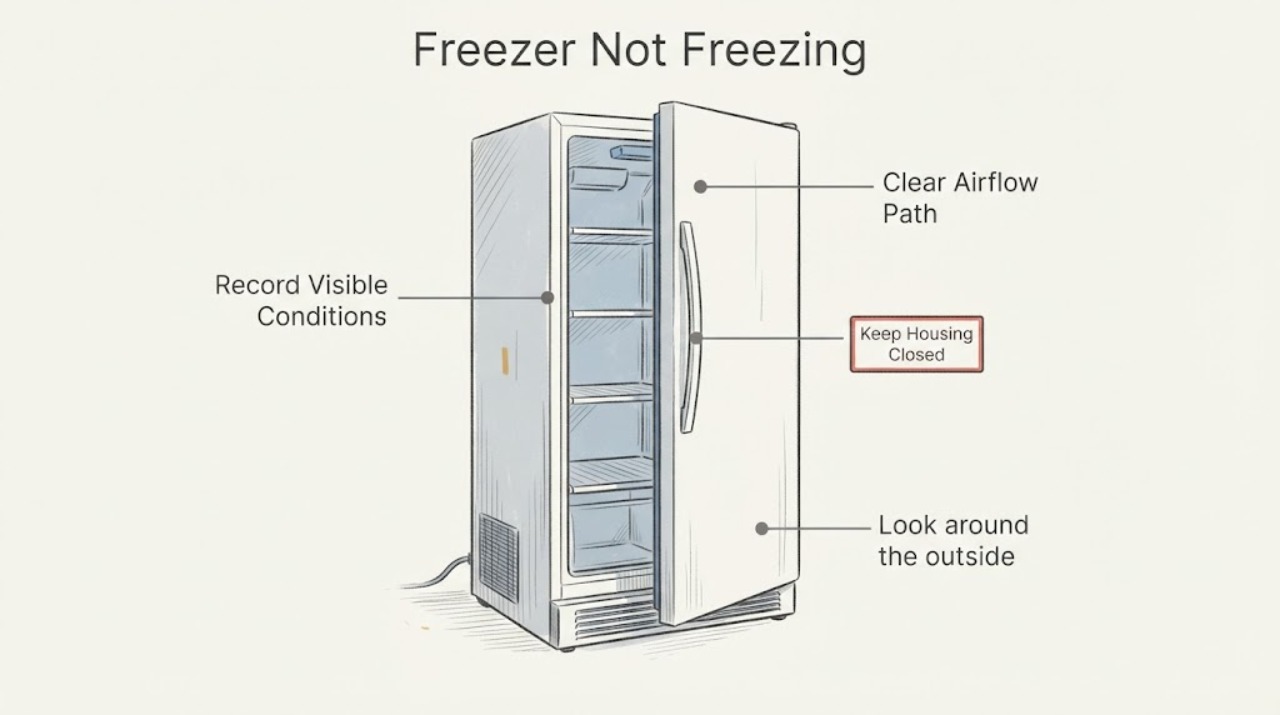
Work through in order
Diagnostic checks
Use only checks that match the exact appliance or system and its official guide.
-
Check 1
Move thawing or temperature-sensitive food to a known-safe cold location, then place an appliance thermometer in the freezer if one is available. Keep the door closed except for a brief inspection and record the reading, display state, and how long the condition has been present.
Expected result: The measured temperature is near the model target, or it remains warmer than the target and food is softening or thawing.
Next step: If food is warming or the temperature remains above the matched manual's safe target, protect the food and continue only with safe external checks; arrange service if it does not recover. Do not rely on repeated resets or the sound of the motor.
Why this matters
Why: A thermometer separates a true cooling problem from a normal compressor cycle or a misleading surface impression. Hotpoint says a freezer must reach about -18 °C to be safe, but exact settings and recovery behavior are model-dependent.
-
Check 2
Inspect the gasket and door closure from the outside. Remove only packages, drawers, or ice at the opening that visibly prevent closure, and check that food is not packed against the rear wall or airflow openings. Do not pry the gasket or remove an interior panel.
Expected result: The door was ajar or obstructed, the gasket has a gap or damage, or the door closes evenly with the gasket contacting the cabinet.
Next step: Correct only a visible obstruction and allow the freezer to stabilize with minimal door opening. If the gasket is damaged or the door cannot close, keep the door shut as much as possible and arrange model-specific service.
Why this matters
Why: Hotpoint says small frost on basket fronts can follow a door left ajar and moisture entering the appliance. A sound closure makes that cause less likely but does not identify an internal refrigeration fault.
-
Check 3
Look around the outside of the cabinet for a heat source, blocked ventilation space, or a position that prevents the appliance from shedding heat. Check only the clearances and placement rules in the exact manual; do not pull a built-in or connected unit out by force.
Expected result: The cabinet is tightly enclosed or near a heat source, or the external position and ventilation appear normal.
Next step: Correct only a safe, visible placement issue allowed by the manual, then monitor the measured temperature. If the temperature remains high or the appliance needs internal access, stop and arrange service.
Why this matters
Why: Hotpoint identifies position and exterior air circulation as factors that can make a freezer run longer while it reaches operating conditions. Normal placement does not rule out a cooling-system fault.
-
Check 4
Look through the normal user-accessible area for thick ice covering shelves, basket fronts, vents, or the rear wall. Identify whether the freezer is frost-free or a manual-defrost type from the exact manual before choosing any defrost procedure.
Expected result: There is only light frost, or thick ice is obstructing the compartment; the appliance is frost-free or its defrost type is not yet confirmed.
Next step: For a confirmed manual-defrost model, follow its unplugged defrost instructions. For a frost-free model, or when the type is unknown, do not chip or heat the ice or remove covers; use the exact manual or service route.
Why this matters
Why: Hotpoint says model type controls the defrost interval: frost-free appliances normally do not need manual defrosting, while other types may need defrosting at a stated ice thickness. Ice by itself does not prove a failed heater or sensor.
-
Check 5
Record the full model number or 12NC, temperature reading, display or light state, door/gasket result, frost pattern, placement, recent power interruption, and whether the compressor or fan sounds abnormal. Compare controls with the matching Hotpoint manual; do not order a part from the symptom alone.
Expected result: The freezer remains warm after the external checks, frost returns rapidly, the door will not seal, or there is burning odor, smoke, sparking, a damaged cord, or suspected refrigerant leakage.
Next step: Keep the freezer out of service for a hazard, avoid opening panels or adding refrigerant, protect food, and arrange qualified Hotpoint service with the recorded model and observations.
Why this matters
Why: The remaining possibilities require model-specific testing or sealed-system/electrical service. Hotpoint's public guidance does not support a universal compressor, fan, thermostat, heater, or refrigerant diagnosis for a model-free report.
Use your observations
Decision map
Find the observation that best matches what you see, then follow the next safe action.
-
PATH 01Next step
What you see
If the thermometer is near the exact manual's target and food remains solidly frozen
Do this next
Keep the door sealed, keep vents and loading paths clear, and monitor the temperature without changing internal parts.
Why this path and its safety boundary
Why it matters: The reported impression may reflect a normal cycle or recovery period rather than a confirmed no-freezing fault.
-
PATH 02Next step
What you see
If the door was left ajar, a package blocks closure, or the gasket has a visible gap
Do this next
Correct only the visible obstruction, keep the freezer closed, and arrange gasket/door service if it will not seal evenly.
Why this path and its safety boundary
Why it matters: Humid air can enter and frost can accumulate; Hotpoint identifies this pattern on freezer guidance.
-
PATH 03Next step
What you see
If thick ice covers the compartment and the exact model is confirmed as a manual-defrost type
Do this next
Unplug and defrost only by the matched Hotpoint manual; never chip, heat, or remove internal panels.
Why this path and its safety boundary
Why it matters: The ice can restrict usable space or airflow, but it does not by itself identify an internal failed part.
-
PATH 04Next step
What you see
If the appliance is frost-free, the model type is unknown, or thick frost rapidly returns after an approved defrost
Do this next
Keep food safe, do not open the cabinet or add refrigerant, and arrange qualified Hotpoint service with the exact model.
Why this path and its safety boundary
Why it matters: A generic defrost instruction is not safe or sufficient, and a recurring condition needs model-specific evaluation.
-
PATH 05Next step
What you see
If there is smoke, burning odor, sparking, a hot/damaged cord, a suspected leak, or the freezer cannot hold a safe temperature
Do this next
Stop using the freezer, isolate power only from a safe accessible point, keep people away from active smoke or flame, protect food, and obtain qualified service or emergency help as appropriate.
Why this path and its safety boundary
Why it matters: The situation has an electrical, fire, refrigerant, or food-safety priority and is not suitable for repeated user tests.
Helpful context
Understand the symptom
Confirm a temperature problem before diagnosing a part
A freezer that sounds quiet, runs for a long time, or has a soft frost film is not automatically failed. Use an appliance thermometer if available and record the temperature after the freezer has had time to stabilize with the door closed. Hotpoint says the freezer must reach about -18 °C to be safe; a model-specific display or setting can differ. Move food that is thawing to a safe cold location while you investigate.
Start with the door, load, and outside ventilation
Check the door gasket and closure from the outside. A package, drawer, or ice buildup at the front can hold the door ajar and admit humid air. Keep food and containers from blocking the intended airflow path, and check that the cabinet is not pressed against a heat source or left without the ventilation its manual requires. These checks can explain warming or frost, but they do not prove that a fan, compressor, thermostat, or sealed system has failed.
Treat frost according to the exact freezer type
Hotpoint says defrost intervals depend on the model. Its general guidance includes defrosting when ice reaches roughly 3–5 mm for applicable non-frost-free types, while frost-free appliances normally do not need manual defrosting. Do not scrape with a sharp tool, pour hot water into the cabinet, or remove an evaporator cover. Use the matched manual or service route when thick ice blocks drawers or vents.
Use controls only as the manual describes
A fast-freeze button or thermostat may be useful after a large warm load, but the controls are model-dependent. Hotpoint says fast freeze may be applicable to some appliances and recommends consulting the user instructions. Do not leave a holiday mode selected with food in a freezer compartment, and do not treat a control change as proof that the cooling system is healthy.
When checks do not resolve it
Need a professional?
Arrange Hotpoint service when the measured freezer temperature remains above the matched model target, food is thawing, the door gasket will not seal, frost rapidly returns, an internal panel or sealed-system diagnosis is needed, or there is smoke, burning odor, sparking, a damaged cord, or a suspected refrigerant leak. Keep the appliance out of service for a safety hazard.
Safety scope: Do not chip ice, heat the cabinet, remove panels, perform live electrical tests, open a sealed refrigerant circuit, add refrigerant, or repeatedly restart a freezer showing smoke, burning odor, sparking, or damaged wiring. Use qualified service for internal diagnosis.
Have this ready
- Provide the full model number or 12NC, measured temperature and duration, display/light state, door and gasket result, frost location and thickness, placement/ventilation, fast-freeze or holiday setting, recent power interruption, and any odor/noise/leak observation.
Common questions
FAQ
What temperature should a Hotpoint freezer reach?
Hotpoint's public guidance says a freezer must achieve about -18 °C to be safe and notes that some appliances are preset between -18 and -26 °C. Use the exact manual for the model's control and measurement instructions, and protect food if the temperature remains above its target.
Should I manually defrost a Hotpoint frost-free freezer that is not freezing?
Do not assume so. Hotpoint says frost-free appliances do not need manual defrosting, while defrost timing depends on model for other freezer types. Confirm the model and follow its manual; do not chip ice or remove internal covers.
Can a freezer running continuously still be working normally?
Possibly. Hotpoint says freezers can run longer while achieving lower operating temperatures and identifies placement and exterior ventilation as factors. Use a thermometer and the model manual rather than diagnosing a compressor from running time alone; persistent warm temperatures require service.
Read the exact guide
Official sources
- Get Hotpoint Appliance ManualsHotpoint UK Appliances Limited · The opened official manual portal states that the first five model digits or 12NC locate the correct product manual and documents. It supports the model-scope boundary, not an unseen repair procedure.
- Hotpoint Fridge Freezer Troubleshooting & FAQHotpoint UK Appliances Limited · The opened official Hotpoint fridge-freezer page is used for guidance that explicitly concerns the freezer compartment of combination units; it is not used to claim every standalone freezer has the same controls or layout.
- How to Videos - Freezer Repair ServiceHotpoint UK Appliances Limited · The opened official freezer support page identifies freezer troubleshooting, manuals, error-code and maintenance resources, including model-number lookup and defrost topics. It is used only as a navigation/support boundary, not as evidence for an unseen video procedure.
- Hotpoint Freezer Troubleshooting & RepairHotpoint UK Appliances Limited · The opened official Hotpoint freezer page covers model-free user-level checks and directs users to the manual or service for unresolved issues. It does not establish a universal internal component diagnosis.
Community feedback
Share a repair observation
Share a plain-text repair observation. Accepted observations are published automatically; this page may take a moment to update.