
On this page
Start here
Quick answer
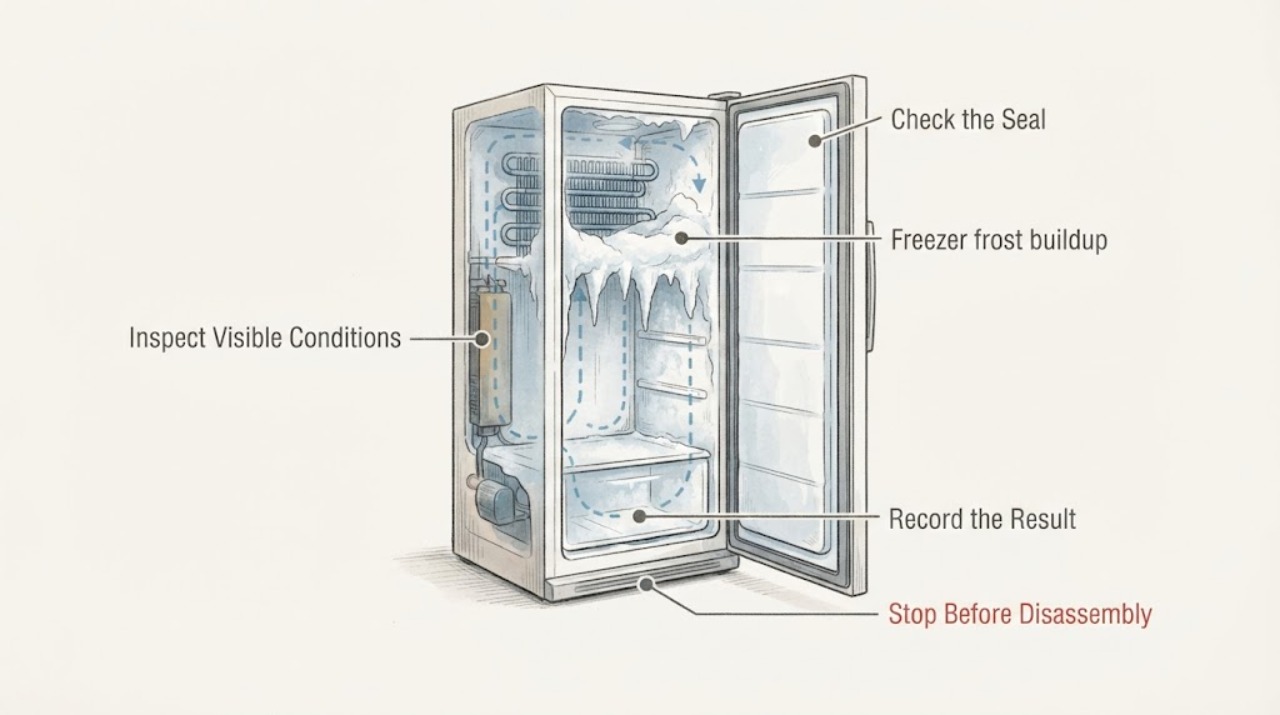
Frost in a Hotpoint freezer usually points to moist room air entering through a door that is not sealing or closing, blocked airflow, or a defrost condition that depends on the model. First identify whether the cabinet is frost-free, then check the closure and airflow without disturbing the sealed refrigeration tubing. A manual-defrost model can be defrosted according to its model manual when ice is about 3–5 mm thick; a frost-free model with recurring frost needs service if the closure and airflow checks do not resolve it.
Work through in order
Diagnostic checks
Use only checks that match the exact appliance or system and its official guide.
-
Check 1
Record the freezer type and map where the frost is forming: check whether the model is described as frost-free, then look at the door or basket fronts, rear wall, shelves, and any single heavily iced area.
Expected result: A frost-free model has frost returning on one wall or near a vent, while a manual-defrost model may develop a generally even layer. Frost concentrated at the door or basket fronts often accompanies a door left ajar or a poor seal.
Next step: Use the model type to choose the defrost path in the fourth check, and inspect closure before removing any ice.
Why this matters
Why: A localized pattern points toward air entry or blocked circulation; a general layer on a manual-defrost model may simply have reached its scheduled defrost condition.
-
Check 2
Close the door fully and inspect the visible gasket all the way around for a gap, folded section, food residue, or a package, drawer, or basket that prevents the door from seating.
Expected result: The door should meet the cabinet evenly without rocking back open; a visible gap or an item touching the gasket confirms an air-entry problem.
Next step: Reposition only accessible food or drawers that block closure, wipe the visible gasket and cabinet contact area, then observe the frost and temperature over the next normal cooling cycle. If the door still will not seal, stop and request service for the closure or gasket.
Why this matters
Why: Warm, moist room air entering through the gap can freeze on the cold interior and produce frost that returns quickly.
-
Check 3
Check the installation space and interior loading without pulling a loaded appliance forward: look for blocked external ventilation, a nearby heat source, or packages pressed against the rear wall or internal air outlets.
Expected result: Clear vents and a gap around the cabinet match the installation guidance; food touching the rear wall or covering an outlet indicates restricted circulation or a local cold spot.
Next step: Restore the clearances specified for the model and leave air paths open. If the cabinet is next to a strong heat source or frost returns despite clear airflow, arrange a technician assessment.
Why this matters
Why: Poor ventilation can reduce cooling performance, while blocked internal circulation can make one area ice over even when other areas are warmer.
-
Check 4
Choose the defrost response from the model information: for a manual-defrost Hotpoint freezer, compare the ice thickness with the manufacturer's general 3–5 mm guide; for a frost-free model, check whether the manual says routine manual defrosting is unnecessary.
Expected result: Manual-defrost ice at or beyond that guide supports a model-specific defrost cycle. A frost-free model should normally prevent ice buildup, so recurring frost after the door and airflow checks is an unresolved fault rather than a routine scraping job.
Next step: Follow the Hotpoint model manual for a manual-defrost cycle only when applicable. If a frost-free freezer keeps icing, or ice is bonded around a vent, liner, or rear area, stop and request service.
Why this matters
Why: The same visible symptom has different next steps by model type; the exact manual controls the procedure and timing.
-
Check 5
Inspect the accessible inner base and moisture outlet area for standing water or droplets, and check whether containers or food are touching the rear wall; clear only an accessible outlet in the manner permitted by the model manual and dry the visible water.
Expected result: Water at the inner base, droplets, or a blocked gutter outlet supports a drainage or moisture path issue; a dry base with frost only at the door points back to closure and air entry.
Next step: Keep food and containers clear of the rear wall and monitor whether moisture stops. If the outlet is inaccessible, repeatedly blocks, or water reaches controls or wiring, stop and arrange service.
Why this matters
Why: Hotpoint identifies a blocked gutter outlet and items touching the rear wall as common causes of moisture in the cabinet.
-
Check 6
After the door and airflow corrections, check the cabinet temperature with an appliance thermometer and watch the warning indicator while keeping the door closed as much as possible.
Expected result: The manual's normal target is -18°C or colder. A warning light can occur while the freezer is recovering after start-up or a large load, but a persistently warm cabinet or repeated alarm is not a frost-only issue.
Next step: Allow recovery after a load and recheck. If the freezer does not return to its target, frost rapidly returns, food is softening, or the warning persists, keep the door closed and arrange service; follow local food-safety guidance for any food that has warmed.
Why this matters
Why: Frost can coexist with poor cooling, and a cold surface alone does not prove that stored food is being held safely.
Use your observations
Decision map
Find the observation that best matches what you see, then follow the next safe action.
-
PATH 01Safety boundary
What you see
The door does not close evenly, or the gasket has a visible gap.
Do this next
Correct the accessible obstruction and clean the contact area; if the seal or hinge still cannot close the door, stop and request service.
Why this path and its safety boundary
Safety stop: Continue with the airflow and model-type checks.
-
PATH 02Safety boundary
What you see
The model is manual-defrost and the ice has reached the manufacturer's general 3–5 mm guide.
Do this next
Use the exact model manual's defrost procedure and timing, then monitor whether frost returns after the freezer is back at its normal target.
Why this path and its safety boundary
Safety stop: Do not treat routine manual defrosting as the answer; on a frost-free model, recurring frost after closure and airflow checks needs service assessment.
-
PATH 03Safety boundary
What you see
Ventilation is blocked, the cabinet is close to a heat source, or food covers an internal air path.
Do this next
Restore the model's clearances and keep air outlets unobstructed, then allow a normal cooling cycle before judging the result.
Why this path and its safety boundary
Safety stop: Move to the moisture and temperature checks rather than changing settings repeatedly.
-
PATH 04Safety boundary
What you see
The cabinet remains warmer than its normal target, frost returns quickly, or water reaches a control or electrical area.
Do this next
Keep the door closed, stop home troubleshooting, and arrange appliance service; protect or discard food according to applicable food-safety guidance.
Why this path and its safety boundary
Safety stop: Continue monitoring the corrected door, airflow, and moisture conditions through the next normal cycle.
Helpful context
Understand the symptom
A light rim of ice after a door has been opened in humid air is different from a blanket of frost that returns across the rear wall. The pattern, model type, and speed of recurrence tell you whether to correct the door and loading habits, follow a manual defrost procedure, or arrange a technician visit. Keep the freezer closed as much as practical while it is warming and protect food if the cabinet is no longer staying cold.
Before cleaning or maintenance, isolate the appliance from power as directed by the model information. Keep ventilation openings clear and do not disturb the pipes at the rear. If a liner, pipe, cable, or control area is damaged or wet, stop and arrange service rather than trying to remove the ice around it.
Only after diagnosis
Potential parts
- freezer door gasket
Consider this only if the door remains unevenly sealed after accessible obstructions and gasket-contact cleaning have been addressed, and the model-specific fit is confirmed.
Confirm the complete Hotpoint model identifier and the manufacturer's fit information before ordering any part. - automatic defrost component
Consider this only after a frost-free freezer has recurring frost despite a sound door seal and clear airflow, and a technician has identified the failed component.
Do not infer compatibility from the brand alone; the model identifier and technician diagnosis control the part choice.
When checks do not resolve it
Need a professional?
Arrange service when the door or gasket will not seal, a frost-free model repeatedly ices, frost is bonded around a vent or rear area, the cabinet will not hold its normal temperature, water reaches controls, or any liner or rear tubing appears damaged. Stop immediately if you smell burning, see smoke, or see refrigerant damage, and move to a safe area before seeking help.
Common questions
FAQ
Is some frost normal in a Hotpoint freezer?
A small amount can form after humid air enters, but a frost-free model should not develop recurring heavy buildup. A thick or rapidly returning layer needs the door, airflow, and model-specific defrost path checked.
Should I manually defrost a Hotpoint frost-free freezer?
Routine manual defrosting is normally unnecessary for a frost-free model. Check the door seal and airflow first; if frost keeps returning or is concentrated around a vent or rear area, arrange service.
What temperature should a Hotpoint freezer reach?
The Hotpoint manual used for this guidance identifies -18°C or colder as the normal internal target. Allow recovery after a large load and use a thermometer rather than judging temperature from frost alone.
When should I stop troubleshooting frost buildup?
Stop when the door cannot seal, frost is bonded around a vent or rear tubing, water reaches controls, the cabinet stays warm, or any damage or burning smell appears. Keep the door closed and arrange qualified service.
Read the exact guide
Official sources
- FREEZER - MODELHotpoint · Hotpoint freezer operating, installation, safety, temperature, and troubleshooting guidance
- Hotpoint Freezer Repair TroubleshootingHotpoint · Hotpoint freezer troubleshooting, frost patterns, moisture, and defrost guidance
Community feedback
Share a repair observation
Share a plain-text repair observation. Accepted observations are published automatically; this page may take a moment to update.